
sei
UNITED STATES
SECURITIES AND EXCHANGE COMMISSION
Washington, DC 20549
FORM
REGISTRATION STATEMENT PURSUANT TO SECTION 12(b) OR (g) OF THE SECURITIES EXCHANGE ACT OF 1934 |
OR
ANNUAL REPORT PURSUANT TO SECTION 13 OR 15(d) OF THE SECURITIES EXCHANGE ACT OF 1934 |
For the fiscal year ended
OR
TRANSITION REPORT PURSUANT TO SECTION 13 OR 15(d) OF THE SECURITIES EXCHANGE ACT OF 1934 |
SHELL COMPANY REPORT PURSUANT TO SECTION 13 OR 15(d) OF THE SECURITIES EXCHANGE ACT OF 1934 |
Date of event requiring this shell company report —————
For the transition period from ————— to —————
Commission File No.
(Exact name of Registrant as specified in its charter)
N/A
(Translation of Registrant’s name into English)
Federal Republic of
(Jurisdiction of incorporation or organization)
+49 (0)89 5589 428 0
(Address of principal executive offices)
c/o Mynaric AG
(Name, Telephone, E-mail and/or Facsimile number and Address of Company Contact Person)
Securities registered or to be registered pursuant to Section 12(b) of the Act:
Title of each class: |
|
Trading Symbol(s) |
|
Name of each exchange on which registered: |
|
|
|||
|
– |
|
Securities registered or to be registered pursuant to Section 12(g) of the Act:
None
Securities for which there is a reporting obligation pursuant to Section 15(d) of the Act:
None
Indicate the number of outstanding shares of each of the issuer’s classes of capital or common stock as of the close of the period covered by the annual report:
Indicate by check mark if the registrant is a well-known seasoned issuer, as defined in Rule 405 of the Securities Act. Yes ☐
If this report is an annual or transition report, indicate by check mark if the registrant is not required to file reports pursuant to Section 13 or 15(d) of the Exchange Act of 1934. Yes ☐
Indicate by check mark whether the registrant (1) has filed all reports required to be filed by Section 13 or 15(d) of the Exchange Act during the preceding 12 months (or for such shorter period that the registrant was required to file such reports), and (2) has been subject to such filing requirements for the past 90 days.
Indicate by check mark whether the registrant has submitted electronically every Interactive Data File required to be submitted pursuant to Rule 405 of Regulation S-T (§232.405 of this chapter) during the preceding 12 months (or for such shorter period that the registrant was required to submit such files).
Indicate by check mark whether the registrant is a large accelerated filer, an accelerated filer, a non-accelerated filer, or an emerging growth company.
Large accelerated filer ☐ |
Accelerated filer ☐ |
Emerging growth company |
If an emerging growth company that prepares its financial statements in accordance with U.S. GAAP, indicate by check mark if the registrant has elected not to use the extended transition period for complying with any new or revised financial accounting standards provided pursuant to Section 13(a) of the Exchange Act.
† The term “new or revised financial accounting standard” refers to any update issued by the Financial Accounting Standards Board to its Accounting Standards Codification after April 5, 2012.
Indicate by check mark whether the registrant has filed a report on and attestation to its management’s assessment of the effectiveness of its internal control over financial reporting under Section 404(b) of the Sarbanes-Oxley Act (15 U.S.C. 7262(b)) by the registered public accounting firm that prepared or issued its audit report.
If securities are registered pursuant to Section 12(b) of the Act, indicate by check mark whether the financial statements of the registrant included in the filing reflect the correction of an error to previously issued financial statements.
Indicate by check mark whether any of those error corrections are restatements that required a recovery analysis of incentive-based compensation received by any of the registrant’s executive officers during the relevant recovery period pursuant to §240.10D-1(b).
Indicate by check mark which basis of accounting the registrant has used to prepare the financial statements included in this filing.
U.S. GAAP ☐ |
Other ☐ |
|
|
by the International Accounting Standards Board ☒ |
|
If “Other” has been checked in response to the previous question, indicate by check mark which financial statement item the registrant has elected to follow. Item 17 ☐ Item 18 ☐
If this is an annual report, indicate by check mark whether the registrant is a shell company (as defined in Rule 12b-2 of the Exchange Act). Yes ☐ No
TABLE OF CONTENTS
|
i |
|||
|
i |
|||
|
i |
|||
|
i |
|||
|
ii |
|||
|
iii |
|||
|
vi |
|||
|
1 |
|||
|
ITEM 1. IDENTITY OF DIRECTORS, SENIOR MANAGEMENT AND ADVISERS |
|
1 |
|
|
|
|
1 |
|
|
|
1 |
||
|
|
1 |
||
|
|
|
1 |
|
|
|
|
1 |
|
|
|
|
1 |
|
|
|
|
1 |
|
|
|
27 |
||
|
|
|
27 |
|
|
|
|
28 |
|
|
|
|
52 |
|
|
|
|
52 |
|
|
|
52 |
||
|
|
53 |
||
|
|
|
58 |
|
|
|
|
65 |
|
|
|
|
69 |
|
|
|
|
69 |
|
|
|
|
69 |
|
|
|
70 |
||
|
|
|
70 |
|
|
|
|
77 |
|
|
|
|
85 |
|
|
|
|
87 |
|
|
|
|
88 |
|
|
|
88 |
||
|
|
|
88 |
|
|
|
|
89 |
|
i
|
|
|
89 |
|
|
|
89 |
||
|
|
|
89 |
|
|
|
|
89 |
|
|
|
89 |
||
|
|
|
89 |
|
|
|
|
90 |
|
|
|
|
90 |
|
|
|
|
90 |
|
|
|
|
90 |
|
|
|
|
90 |
|
|
|
90 |
||
|
|
|
90 |
|
|
|
|
90 |
|
|
|
|
90 |
|
|
|
|
90 |
|
|
|
|
91 |
|
|
|
|
100 |
|
|
|
|
100 |
|
|
|
|
100 |
|
|
|
|
101 |
|
|
ITEM 11. QUANTITATIVE AND QUALITATIVE DISCLOSURES ABOUT MARKET RISK |
|
101 |
|
|
ITEM 12. DESCRIPTION OF SECURITIES OTHER THAN EQUITY SECURITIES |
|
101 |
|
|
|
|
101 |
|
|
|
|
101 |
|
|
|
|
101 |
|
|
|
|
102 |
|
|
104 |
|||
|
|
104 |
||
|
ITEM 14. MATERIAL MODIFICATIONS TO THE RIGHTS OF SECURITY HOLDERS AND USE OF PROCEEDS |
|
104 |
|
|
|
104 |
||
|
|
106 |
||
|
|
106 |
||
|
|
106 |
||
|
ITEM 16D. EXEMPTIONS FROM THE LISTING STANDARDS FOR AUDIT COMMITTEES |
|
106 |
|
|
ITEM 16E. PURCHASES OF EQUITY SECURITIES BY THE ISSUER AND AFFILIATED PURCHASERS |
|
107 |
|
|
|
107 |
||
|
|
107 |
||
ii
|
|
108 |
|
|
ITEM 16I. DISCLOSURE REGARDING FOREIGN JURISDICTIONS THAT PREVENT INSPECTIONS |
|
108 |
|
|
108 |
|
|
|
108 |
|
|
110 |
||
|
|
110 |
|
|
|
110 |
|
|
|
110 |
|
|
112 |
||
iii
INTRODUCTION
We conduct our business through Mynaric AG, a German stock corporation (Aktiengesellschaft). Unless otherwise indicated or the context otherwise requires or where otherwise indicated, the terms “Mynaric,” the “Company,” “we,” “our,” “ours,” “ourselves,” “us” or similar terms refer to Mynaric AG together with its subsidiaries.
PRESENTATION OF FINANCIAL AND OTHER INFORMATION
We report under International Financial Reporting Standards (“IFRS”) as issued by the International Accounting Standards Board (“IASB”), which differ in certain significant aspects from U.S. generally accepted accounting principles (“U.S. GAAP”). Accordingly, our results of operations and financial condition as reflected by our IFRS financial statements that are included in this Annual Report on Form 20-F (“Annual Report”) may differ substantially from the results of operations and financial condition that would be reflected by financial statements prepared in accordance with U.S. GAAP. We have not prepared a reconciliation of our financial information to U.S. GAAP or a summary of significant accounting differences between IFRS and U.S. GAAP, nor have we otherwise reviewed the impact the application of U.S. GAAP would have on our financial reporting.
Our consolidated financial statements are reported in euros, which are denoted “euros,” “EUR” or “€” throughout this Annual Report and refer to the currency introduced at the start of the third stage of European economic and monetary union pursuant to the treaty establishing the European Community, as amended. Also, throughout this Annual Report, the terms “dollar,” “USD” or “$” refer to U.S. dollars. For the convenience of the reader, we have translated some financial information into U.S. dollars. Unless otherwise indicated, these translations were made based on the Euro/U.S. dollar exchange rate published by the European Central Bank on December 29, 2023, which was €1.00 to $1.105.
Financial information in thousands or millions, and percentage figures have been rounded. Rounded total and sub-total figures in tables in this Annual Report may differ marginally from unrounded figures indicated elsewhere in this Annual Report or in the financial statements. Moreover, rounded individual figures and percentages may not produce the exact arithmetic totals and sub-totals indicated elsewhere in this Annual Report.
MARKET AND INDUSTRY DATA
We obtained the industry, market and competitive position data in this Annual Report from our own internal estimates, surveys, and research as well as from publicly available information, industry and general publications and research, surveys and studies conducted by third parties, including, but not limited to, Airbus, ARK Investment Management LLC, article on “Optical Wireless Communication” by Harald Haas, Jaafar Elmirghani, Ian White, Aviation Week Network, BryceTech, German Aerospace Center, EDR Online, FCAS Forum, MarketsandMarkets, Meta, Morgan Stanley (Space Economy), Orbiting Now, Space Capital, Space Development Agency, Space Explored, SpaceNews, Stockholm International Peace Research Institute (SIPRI), The National Interest, The Royal United Services Institute (RUSI), and Via Satellite.
Industry publications, research, surveys, studies and forecasts generally state that the information they contain has been obtained from sources believed to be reliable, but that the accuracy and completeness of such information is not guaranteed. Forecasts and other forward-looking information obtained from these sources are subject to the same qualifications and uncertainties as the other forward-looking statements in this Annual Report. These forecasts and forward-looking information are subject to uncertainty and risk due to a variety of factors, including those described under “Item. 3 Key Information—D. Risk Factors.” These and other factors could cause results to differ materially from those expressed in our forecasts or estimates or those of independent third parties. While we believe our internal estimates, surveys, and research are reliable, they have not been verified by any independent source.
TRADEMARKS, SERVICE MARKS AND TRADE NAMES
We have proprietary rights to trademarks used in this Annual Report that are important to our business, many of which are registered under applicable intellectual property laws. Solely for convenience, the trademarks, service marks, logos and trade names referred to in this Annual Report are without the ® and ™ symbols, but such references are not intended to indicate, in any way, that we will not assert, to the fullest extent under applicable law, our rights or the rights of the applicable licensors to these trademarks, service marks and trade names.
This Annual Report contains additional trademarks, service marks and trade names of others, which are the property of their respective owners. All trademarks, service marks and trade names appearing in this Annual Report are, to our knowledge, the property of their respective owners. We do not intend our use or display of other companies’ trademarks, service marks, copyrights or trade names to imply a relationship with, or endorsement or sponsorship of us by, any other companies.
i
FREQUENTLY USED TERMS
In this Annual Report:
“CJADC2” refers to Combined Joint All Domain Command and Control architecture.
“Coarse pointing assembly” refers to a two axis gimballed mirror for independent steering of optical communication terminals. It is a device that is mounted on a terminal telescope and allows the terminal to operate without constraining the satellite attitude. It is used in inter-satellite links in high- and low-earth orbits.
“DARPA” refers to the U.S. Defense Advanced Research Projects Agency.
“DLR” refers to the German Aerospace Center (Deutsches Zentrum für Luft- und Raumfahrt e.V.).
“DoD” refers to the U.S. Department of Defense.
“Free space optic communication” is the wireless transmission of data via a modulated optical beam directed through free space, without fiber optics or other optical systems guiding the light.
“Inter-plane” refers to the communication between satellites in different orbital planes occurring through inter-plane inter-satellite lines.
“Intra-plane” refers to the communication between satellites in the same orbital plane occurring through intra-plane inter-satellite lines.
“LEO” refers to low Earth orbit, which is an orbit around Earth with an altitude above Earth’s surface from 160 kilometers to 2,000 kilometers.
“MEO” refers to medium Earth orbit, which is an orbit around Earth with a distance of 2,000 kilometers to 35,786 kilometers.
“Mesh Network” means a type of wireless network topology, where each network node participates in the distribution of data across the network by relaying data to other nodes that are in range. A mesh network has no centralized access points but uses wireless nodes to create a virtual wireless backbone. Mesh network nodes typically establish network links with neighboring nodes, enabling user traffic to be sent through the network by hopping between nodes on many different paths. At least some nodes must be connected to a core network for backhaul.
“OISLs” refers to optical-intersatellite links, which are wireless communication links using optical signals to interconnect satellites.
“PWSA” refers to the SDA’s Proliferated Warfighter Space Architecture.
“Quantum key distribution” refers to a technique that enables secure communications between devices using a cryptographic protocol that is partly based on quantum mechanics.
“RF” refers to radio frequency, which is a measurement representing the oscillation rate of electromagnetic radiation spectrum, or electromagnetic radio waves, from frequencies ranging from 300 gigahertz (GHz) to as low as 9 kilohertz (kHz).
“SDA” refers to the U.S. Space Development Agency.
“UAVs” refers to unmanned aerial vehicles.
ii
CAUTIONARY STATEMENT REGARDING FORWARD-LOOKING STATEMENTS
This Annual Report contains forward-looking statements that relate to our current expectations and views of future events. These statements relate to events that involve known and unknown risks, uncertainties and other factors, including those listed under “Item 3 Key Information—D. Risk Factors,” which may cause our actual results, performance or achievements to be materially different from any future results, performance or achievements expressed or implied by the forward-looking statements.
In some cases, these forward-looking statements can be identified by words or phrases such as “believe,” “may,” “will,” “expect,” “estimate,” “could,” “should,” “anticipate,” “aim,” “intend,” “plan,” “believe,” “potential,” “continue,” “is/are likely to” or other similar or comparable expressions. These forward-looking statements include all matters that are not historical facts. These forward-looking statements are based on estimates and assumptions by our management that, although we believe to be reasonable, are inherently uncertain and subject to a number of risks and uncertainties. These statements constitute forward-looking statements within the meaning of Section 27A of the Securities Act of 1933 (as amended, the “Securities Act”), and Section 21E of the Securities Exchange Act of 1934, as amended ("Exchange Act"). Readers are cautioned not to place undue reliance on these forward-looking statements, which speak only as of their dates. Forward-looking statements contained in this Annual Report include, but are not limited to, statements about:
These forward-looking statements are subject to known and unknown risks, uncertainties and assumptions, many of which are beyond our control. In addition, these forward-looking statements reflect our current views with respect to future events and are not a guarantee of future performance. We caution you that forward-looking statements are not guarantees of future performance and that our actual results of operations, financial condition and liquidity, and the development of the industries in which we operate may differ materially from those made in or suggested by the forward-looking statements contained in this Annual Report. In addition, even if our results of operations, financial condition and liquidity, and the development of the industries in which we operate, are consistent with the forward-looking statements contained in this Annual Report, those results or developments may not be indicative of results or developments in subsequent periods. Actual outcomes may differ materially from the information contained in the forward-looking statements as a result of a number of factors, including, without limitation, the risk factors set forth in “Item 3. Key Information—D. Risk Factors,” the following:
iii
iv
The forward-looking statements made in this Annual Report relate only to events or information as of the date on which the statements are made in this Annual Report. Except as required by law, we undertake no obligation to update or revise publicly any forward-looking statements, whether as a result of new information, future events or otherwise, after the date on which the statements are made or to reflect the occurrence of unanticipated events. You should read this Annual Report, including the uncertainties and factors discussed under “Item 3. Key Information—D. Risk Factors” and the documents that we have filed with the SEC as exhibits to the registration statement, of which this Annual Report is a part, completely and with the understanding that our actual future results or performance may be materially different from what we expect. All forward-looking statements made in this Annual Report are qualified by these cautionary statements.
Comparison of results between current and prior periods are not intended to express any future trends, or indications of future performance, unless expressed as such, and should only be viewed as historical data.
v
RISK FACTOR SUMMARY
The following is a summary of the principal risks that could significantly and negatively affect our business, prospects, financial conditions, or operating results. For a more complete discussion of the material risks facing our business, see “Item 3. Key Information—D. Risk Factors”:
vi
vii
PART I.
ITEM 1. IDENTITY OF DIRECTORS, SENIOR MANAGEMENT AND ADVISERS
A. Directors and Senior Management
Not applicable.
ITEM 2. OFFER STATISTICS AND EXPECTED TIMETABLE
Not applicable.
ITEM 3. KEY INFORMATION
A. [Reserved]
B. Capitalization and Indebtedness
Not applicable.
C. Reasons for the Offer and Use of Proceeds
Not applicable.
D. Risk Factors
The following risks may have material adverse effects on our business, financial condition and results of operations. Additional risks and uncertainties of which we are not presently aware or that we currently deem immaterial could also materially affect our business operations and financial condition.
General Risks Related to Our Business Activities and Our Markets
We are a development-stage company with a history of significant losses and expected continuing losses for the foreseeable future, which lead to continued reliance on external financing and raise substantial doubt about our ability to continue as a going concern. We may never be able to execute our business strategy, generate revenue or reach profitability.
We are a development-stage company and are subject to all of the risks inherent in the establishment of a new business enterprise. We have a limited operating history and only a preliminary and unproven business plan upon which investors may evaluate our prospects. Although we have developed, produced and tested prototypes of our products and are currently finalizing our products for serial production, we cannot assure you that our products will perform as expected under daily operating conditions or that we will be able to detect and fix any potential weaknesses in our technology or products prior to commencing serial production. Even if our products become commercially viable, we may not generate sufficient revenue necessary to support our business.
We have a history of net losses and negative net cash used in operating activities since our inception and we expect losses and negative net cash used in operating activities to continue for the foreseeable future. For the years 2023, 2022 and 2021, we incurred consolidated net losses of €93.5 million, €73.8 million and €45.5 million, respectively. As of December 31, 2023, 2022 and 2021, we had an accumulated deficit of €260.1 million, €166.5 million and €92.8 million, respectively. For the years ended December 31, 2023, 2022 and 2021, we had negative net cash used in operating activities of €29.0 million, €50.2 million and €39.4 million, respectively. We expect that we will incur additional significant expenses as we continue to develop our products, expand and refine our technology and conduct research on new technologies. We will also incur significant expenses related to adding infrastructure and personnel to support our growth and preparations for the commercialization of our products, increasing our sales and marketing activities with the goal of building our brand. We will not be able to cover our expenses with revenues at least until such time at which we begin material deliveries of our products and significantly increase the scale of our operations and, therefore, intend to use the proceeds from recent debt and equity financings to cover our ongoing and future expenses. Furthermore, the auditor’s reports covering our consolidated financial statements as of and for the financial years ended December 31, 2023, December 31, 2022 and December 31, 2021 each includes a sub-section entitled “Material Uncertainty Related to Going Concern Assumption,” which indicates that a material uncertainty exists that may cast significant doubt on the group’s ability to continue as a going concern and which represents a going concern risk within the meaning of Section 322 para. 2 sentence 3 of the German Commercial Code. Thus, we need to be successful in obtaining additional financing in a timely manner to fund our operational and financial obligations.
1
Based on our liquidity position as of May 17, 2024 and our management’s forecast of sources and uses of cash and cash equivalents, we believe that we have sufficient liquidity to finance our operations over at least the next twelve months from the date of this Annual Report. However, there can be no assurance that revenue and cash-in from customer contracts will be generated in the amount as expected or at the time needed. A shortfall of revenues and of the corresponding cash-in from customer contracts compared to the budget could require additional external financing to meet our current operational planning. In such a situation, if we should be unable to obtain such additional financing or take other timely actions in response to such circumstances, for example significantly curtailing our current operational budget in 2024, we may be unable to continue as a going concern. As a result, these events and conditions indicate that a material uncertainty exists that may cast significant doubt on our ability to continue as a going concern and, therefore, we may be unable to realize our assets and discharge our liabilities in the normal course of business.
Our business strategy is focused on growth and our decisions regarding capital expenditures and investments are made on this basis. Our projects and strategic decisions may fail to meet expectations and the anticipated return on investment from these projects may not be achieved. Our ability to generate revenue from our operations and, ultimately, achieve profitability will depend on, among other things, whether we can complete the development and commercialization of our technology, whether we can manufacture our products on a commercial scale in amounts and at costs consistent with our expectations, and whether we can achieve market acceptance of our products, services and business model. We may never operate on a profitable basis. Even if we reach profitability, we may not be able to sustain it. If we are unable to reach or sustain profitability, we may need to reduce the scale of our operations, which may impact the growth of our business, or we may not be able to continue as a going concern and investors may lose some or even all of their investment.
Our success and future growth are dependent upon our potential customers’ investments in the development of a market for wireless laser communication, in particular for aerospace-based communication networks.
We develop and manufacture laser communication products for aerospace-based communication networks. Laser communication is designed to serve as a backbone technology, a key connectivity component of telecommunication networks featuring very high data transmission rates, creating data highways by connecting individual platforms such as airplanes and satellites. Our success and future growth, therefore, depend significantly on the development of a market for laser communication, in particular for aerospace-based communication networks.
Aerospace-based communication networks may comprise various platforms, including satellites, drones and airplanes, and may be located in outer space, the troposphere (i.e., at the height of commercial aviation), or in the stratosphere (i.e., at a height of 20 to 30 kilometers above ground). Aerospace-based communication networks consisting of a large volume of satellite or aircraft platforms are referred to as constellations. Each individual node within the network, i.e., each aircraft or satellite, typically contains multiple laser communication units ranging from two to four units. Our ability to successfully develop and commercialize our laser communication products (e.g., flight terminals) depends on potential customers’ willingness to invest, on a global scale, in the development of such constellations. If such constellations are not developed on a global scale, there would be limited applications available for our ground and flight terminals, such as the connection of individual airplanes, drones or satellites with the ground.
Constellations in general, and the market for laser communication systems specifically, are still in early stages of deployment and development. To our knowledge, there are only two commercial constellations currently operational, one of which partly utilizes an internally built laser communication solution for linking its satellites. Other commercial constellations utilizing laser communication are planned but not yet deployed operationally. The future implementation of constellations by potential customers remains subject to significant technological, operational and financing risks. For example, many of the constellations currently being planned by potential customers that envisage worldwide internet and network coverage have not yet issued orders for laser communication equipment. To our knowledge, establishing such extensive coverage through multiple laser communication units has had only limited testing and usage in practice and could entail substantial technical difficulties. At the same time, the development of commercial constellations with such coverage requires investment of potentially billions of dollars, including the costs associated with satellite development and launch capacity, and accordingly depends on the ability to obtain related financing.
If laser communication remains a niche market, demand for our products would be significantly lower than we currently anticipate, as a result of which we may not be able to sell our technology or products. Our approach of developing standardized and modularized products for large-scale deployment could prove unsuccessful if certain customers demand widely varying product specifications and units in significantly lower quantities. This would require project-specific production (as typically being carried out by traditional key suppliers to the air and space (defense) industries) instead of serial production, meaning that our anticipated economies of scale could fail to materialize. If the wireless laser communication market does not develop as we anticipate, we may not be able to implement our business strategy and/or generate any revenues as a result of which we may need to curtail our operations or seek additional financing earlier than anticipated.
2
Our prospects and operations may be adversely affected by changes in government spending and general economic conditions, which may negatively affect demand for laser communication solutions.
Current demand for laser communication is predominantly driven by government needs, with the United States government spearheading the adoption of laser communication technology. U.S. allies and other governments are also evaluating new technologies as part of their national objectives to modernize their space capabilities. Accordingly, governments around the world have invested significantly in research and development as well as deployment of laser communication and other technologies. In fact, defense-related spending in the U.S. and Europe increased following geopolitical tensions. For example, the DoD's budget for 2024, the DoD’s proposed budget for the fiscal year 2024 includes $30.1 billion for the U.S. Space Force and the SDA, an increase of $3.8 billion compared to 2023. However, spending authorizations for defense-related and other programs by the U.S. and other governments have fluctuated in the past, and future levels of expenditures and authorizations for these programs may not remain at current levels and could possibly decrease, including due to shifts to programs in areas where we do not provide services. To the extent the U.S. government and its agencies or other governments reduce spending on such services, as a result of the need to reduce overall spending during periods of fiscal restraint, to reduce budget deficits or otherwise, demand for our services could decrease which could adversely affect our anticipated revenue and business prospects.
While government funding is currently driving laser communication demand, we expect additional demand for commercial applications to drive growth in the overall market in the near to medium-term. However, commercial market demand may be negatively affected in the short to medium-term by prevailing economic conditions, with high inflation, rising interest rates and fears of recession creating a challenging fundraising environment for constellation operators relative to demand from government-funded programs. The global economy has in the past, and will in the future, experience recessionary periods and periods of economic instability. During such periods, our commercial and, to a lesser extent, our governmental customers may choose not to pursue high-risk, capital-intensive infrastructure projects such as satellite constellations or other systems including laser communication capabilities. To the extent any of the risks to the commercial market for laser communication materializes, demand for our products may be lower than we currently anticipate, which could have a negative impact on our revenue and overall financial condition.
The potential customer base for the use of our products is limited.
Given the technological challenges and the high capital expenditures required for the development and deployment of our products, our potential customer base is limited. There are a small number of potential customers deploying our laser communication equipment. Successful customer acquisition and retention of capable significant initial customers is therefore critical to generate follow-on business such as the implementation and maintenance of complementary products. As a result, our ability to sell laser communication products at scale is dependent on our ability to successfully acquire and retain significant initial customers by winning their business at an early stage like our strategic agreement with Northrop Grumman International Trading, Inc. (“NG”), our agreements with Loft Federal and our strategic cooperation framework with an affiliate of L3Harris. Due to our limited potential customer base, we anticipate that sales to initial customers will be, individually, material to our future revenues, results of operations and cash flows. Accordingly, any change in the relationship with any existing customer, the strength of any customer’s business or their demand for our products could materially adversely affect our results of operations and net cash used in operating activities. Similarly, any failure to acquire and maintain relationships with other key customers, as well as the loss of any potential customer, would have a highly adverse impact on the sale of our products and, as a result, on our results of operations.
Our business is affected by the implementation of industry standards guaranteeing interoperability between laser communication products of different vendors, which could be unsuccessful.
We believe that the establishment of a large-scale market for laser communication depends on the successful development and implementation of industry standards guaranteeing interoperability between laser communication products of different vendors. As of today, the optical communications terminal standard issued by the SDA is the leading industrial standard adapted by multiple companies involved in U.S. government programs. So far, we and others have successfully conducted demonstrations of the implementation of the SDA standard in various test scenarios. We cannot assure you that efforts to ensure cross-vendor interoperability will ultimately be successful for all relevant products and applications.
Furthermore, commercial constellations of sufficient size and scale may decide to create and implement their own standard to optimize their network. As a consequence, multiple competing industry standards may emerge in parallel, which could cause a fragmentation of the market, potentially hindering sustained growth of the laser communication market. The U.S. Defense Advanced Research Projects Agency’s (“DARPA”) Space Based Adaptive Communications Node (“Space-BACN”) program aims to establish a flexible optical communications terminal that can adapt to multiple future industry standards. In December 2021, August 2022 and January 2024, we were selected to contribute to phase 0, phase 1 and phase 2, respectively, of the program. We cannot, however, assure you that efforts to ensure a terminal agnostic to a large variety of industry standards will ultimately be successful.
If a potential customer decides to purchase laser communication products from one of our competitors, our products can currently only be sold to that customer and integrated into its existing laser communication system with significant operational and technical outlays or only
3
if the competitor’s product is compliant with interoperability standards. Hence, any failure to implement cross-vendor interoperability or respective industry standards for laser communication vendors could have an adverse effect on the usability of and the demand for our products and ultimately on our revenue potential and business strategy.
We may be unable to manage our future growth effectively, which could make it difficult to execute our business strategy.
If our operations continue to grow as planned, we will need to expand our sales and marketing, research and development, customer and commercial strategy, products and services, supply, manufacturing and accounting and administrative functions. We will also need to continue to leverage our manufacturing and operational systems and processes, and we cannot assure you that we will be able to scale the business and the manufacture of products as currently planned or within the envisaged timeframe. The continued expansion of our business may also require additional manufacturing and operational facilities, as well as space for administrative support, and we cannot assure you that we will be able to find suitable locations for the manufacture of our products.
Our continued growth could increase the strain on our resources, and we could experience operating difficulties, including difficulties in hiring and training employees, finding manufacturing capacity to produce our products, and delays in production. We may have to invest significant additional resources and focus our attention on adapting our internal organization, function and processes which may cause distraction from our operations and negatively affect our business.
Risks Related to Competition
Positive market developments in the area of wireless laser communication could lead to increasingly intense competition and endanger our market position.
While we believe that there are currently only a few enterprises offering viable products to utilize laser communication technology for aerospace-based communication networks, we are subject to significant and intensifying competition within the satellite industry and from other providers of communication capacity, including large multinational enterprises. Public announcements of successful test missions and future functionality availability such as the ones from SpaceX and Capella Space have drawn significant public attention to the laser communication market. To compete successfully and to be able to establish and maintain a competitive position in current and future technologies, we will need to demonstrate the advantages of our technology over both new and well-established alternative solutions for communication networks. If our technology is not, or our future products or services are not, competitive, our business and sales potential would be harmed.
Many of our current and potential competitors are larger than us and have substantially greater resources than we have and expect to have in the future. They may also be able to devote greater resources to the development of their current and future technologies and the promotion of their offerings, and they may be able to offer lower prices in order to establish or gain market share. In addition, certain companies that are potential customers (such as SpaceX or Amazon) may develop or advance their in-house laser communication capabilities and as a result compete with us or not require laser communication equipment from third parties, such as us. Competitors may also establish cooperative or strategic relationships among themselves or with third parties that may further enhance their resources and offerings or may lobby potential governmental customers against us. Furthermore, it is possible that German or foreign companies or governments, some with greater experience in the aerospace industry or greater financial resources than us, may seek to provide products or services that compete directly or indirectly with ours. Any such foreign competitor could, for example, benefit from subsidies from, or other protective measures implemented by, its home country.
In the aerospace sector, our competitors include TESAT Spacecom (an Airbus subsidiary), SA Photonics (a subsidiary of CACI International Inc), Thales Alenia Space, Ball Aerospace, General Atomics Electromagnetic Systems, Honeywell International, Skyloom Global Corp., and Space Micro, as well as a handful of other entities that possess the necessary technical know-how and resources to compete with us. Furthermore, large information technology enterprises such as Cisco, Huawei, CommScope, Infinera and Corning already have experience in wired laser communication for ground-based fiber networks and may potentially enter the market. In addition, aviation enterprises such as Boeing and large military equipment suppliers may enter the market. For example, QinetiQ and Hensoldt are both actively promoting laser communication capabilities. These companies may employ aggressive strategies like subsidy-enabled dumping and lobbying of customers, partners, investors and the media in an attempt to force us out of the market (e.g., by delaying the deployment of our products in certain geographical areas). As the market expands, we expect the entry of additional competitors who may have longer operating histories, more extensive international operations, greater name recognition and/or substantially greater technical, marketing and financial resources.
4
Our business is also subject to competition from ground-based forms of communication technology. A number of companies are increasing their ability to transmit signals on existing terrestrial infrastructures, such as fiber optic cable and terrestrial wireless transmitters, often with funding and other incentives provided by governments. The ability of terrestrial companies to significantly increase the capacity, capability and/or the reach of their conventional or other competing networks or significantly lower prices for such networks could result in a decrease in the demand for laser-enabled aerospace-based communication networks and consequently for laser communication products, thereby having a material adverse impact on our earnings and business prospects. In addition, new technologies could render laser communication-based services less competitive by satisfying connectivity demand in other ways.
If competition in the market for wireless laser communication intensifies, the resulting increase in supply could lead to lower sales or could cause prices to fall, thus narrowing our margins, which in turn would materially adversely impact our future revenues or results of operations.
Industry consolidation may give our competitors advantages over us, which could result in a loss of customers and/or a reduction of our revenue.
Some of our customers, suppliers or competitors have made or may make acquisitions or enter into partnerships or other strategic relationships in order to offer more comprehensive services or achieve greater economies of scale. For example, in October 2023, Eutelsat acquired OneWeb; in May 2023, Viasat acquired Immarsat and Advent International acquired U.S.-based earth observation operator Maxar Technologies; and in December 2021, CACI International Inc. acquired our competitor SA Photonics. The effects of these recent consolidations on us and our industry in general are still to be determined, but they may create unforeseeable dynamics giving advantages to our competitors. In addition, new entrants not currently considered competitors may enter our market through acquisitions, partnerships or strategic relationships. Potential entrants may have competitive advantages over us, such as greater name recognition, longer operating histories, more varied services and larger marketing budgets as well as greater financial, technical and other resources. Industry consolidation may result in practices that make it more difficult for us to compete effectively, including on the basis of price, sales and marketing programs, technology or services functionality. Continuing industry consolidation may give our competitors advantages over us which may result in decreased demand for our products or increased pressure to lower the prices for our products, each of which would negatively impact our revenue and consequently harm our results of operations and business prospects.
Risks Related to Our Products
We use innovative technologies and solutions in our products, which may not be fully functional, and the initial deployment of our products by customers could prove unsuccessful.
The functionality, usability and availability of our technology and products in daily use and at scale is, as of today, unproven. We cannot assure you that our technology or products will perform as expected under daily operating conditions or that we will be able to detect and fix weaknesses or flaws in our technology or products prior to commencing serial production. For example, we have designed and built the metal telescope that we use in our CONDOR terminal ourselves and this design has never been built at scale. Any of the technologies we intend to use or solutions we expect to offer may not be available or fully functional at the time of the first delivery of our products or at all, and this could have an adverse effect on our ability to grow our business. In addition, we may be required to develop new or to adapt our existing technologies and products in light of changing customer requirements. The development of new or adaptation of existing technologies and products may significantly impact our costs or our ability to retain or improve our competitive position.
If our customers are unsuccessful in the initial deployment of our products, this could be considered as indicative of future performance of our products and could significantly harm our reputation in the market. Potential difficulties in connection with meeting obligations under contracts with initial customers, such as delivery delays, technical performance or quality, could lead to a loss of the affected customer and other existing or potential customers. In such cases, it is unlikely that we would succeed in compensating for the related losses in revenues through new customers in the short to medium-term. As a result, any failure in the initial deployment of our products by initial customers would have a materially adverse impact on our anticipated revenue and future prospects.
We depend on third-party suppliers to provide us with components for our products, and any interruptions in supplies provided by these third-party suppliers or any general disruptions to global supply chains may subject us to external procurement risks that negatively affect our business.
We depend on third-party suppliers to provide individual components such as optical components, special electronics and structural components for our products and we expect to continue to do so for future products. While some key components are manufactured to our specifications, many components are “off-the-shelf” and available commercially.
5
We typically do not maintain long-term supply contracts, but instead rely on informal arrangements and off-the-shelf purchases based on purchase orders. We do not carry a significant inventory of necessary components and our suppliers could discontinue the manufacture or supply of these components at any time. Establishing additional or replacement suppliers for any of these components, if required, or any supply interruption from our suppliers, could limit our ability to manufacture our products, result in production delays and increased costs and adversely affect our ability to deliver products to our customers on a timely basis, which could result in our failure to perform under customer contracts. If we are not able to identify alternate sources of supply for the components, we may need to modify our product to use substitute components, which could cause delays in shipments, increase design and manufacturing costs and increase prices for our products. Any such modified product might not be as effective as the predecessor product or might not gain market acceptance. This could lead to customer dissatisfaction, reputational harm and loss of customer orders.
In addition, some of our current suppliers are specialty suppliers providing components that are only available from a handful of suppliers worldwide (or in some cases a sole supplier), which means that off-the-shelf components may not be viable substitutes. It is therefore not always possible to adhere to our “second source strategy” (pursuant to which we always seek to have at least two qualified suppliers for every component). If these specialty suppliers become unable to deliver the required components, procuring these components from another supplier may only be possible at significant additional cost, if at all. As a result, there is a risk that we cannot obtain the components needed for manufacturing our products on a timely basis or at an economically viable cost, and, thus, become unable to deliver our products, resulting in reputational harm and loss of existing and future business. In addition, it is possible that certain components are ultimately not qualified for use, or may not function as intended. The particularly long development cycles in our business and lengthy qualification of individual components render quick replacement of individual suppliers difficult. Insourcing of certain components may require lengthy preparations, license negotiations or significant capital expenditures, or may not be possible at all.
Furthermore, any disruptions to our supply chain, significant increase in component costs, or shortages of critical components could adversely affect our business and result in increased costs or missed deliveries to our customers. Such a disruption could occur as a result of any number of events, including, but not limited to, war, global pandemics and economic sanctions against third parties, including those arising from the ongoing war between Russia and Ukraine, the escalation of hostilities in the Middle East, the implementation of tariffs, export controls or other actions by or against foreign nations (including China) and general market shortages due to surge in demand for any particular part or component. Any such disruption or shortage may be further driven by increases in prices or impact of inflation, labor stoppages, transportation delays or failures affecting the supply chain and shipment of materials and finished goods, the unavailability of raw materials, geopolitical developments, terrorism and disruptions in utilities, trade embargos and other services. For example, certain countries have imposed or may impose in the future export restrictions with respect to certain electronic components, which may include components that we use in our manufacturing process.
Supply chain constraints may emerge and delay our production or the development of upcoming CONDOR and HAWK product versions. A persisting high inflation environment could put pressure on our unit costs in the future and increased upfront payments to our suppliers and earlier phasing of those payments may put pressure on our non-recurring costs in future periods. In addition, any future updates or modifications to the anticipated design of our products may increase the number of parts and components we would be required to source and increase the complexity of our supply chain management. Failure to effectively manage the supply of parts and components could materially and adversely affect our production capacities and thus delay the shipment of our products as well as adversely affect market acceptance for our products.
Defects or performance problems in our products could result in a loss of customers, reputational damage, lawsuits and decreased revenue, and we may face warranty, indemnity and product liability claims arising from defective products.
To date, we have only delivered pre-serial and individual prototype versions of our products. Although we have implemented stringent quality controls, our products may contain undetected errors or defects, especially when first introduced, or may otherwise fail to meet our customers’ quality requirements. These errors, defects, product failures or poor performance can arise due to design flaws, defects in raw materials or components or manufacturing difficulties, which can affect both the quality and the performance of the product.
Any actual or perceived errors, defects or poor performance in our products could result in the replacement or rejection of our products, damage to our reputation, lost revenue, diversion of our engineering personnel from our product development efforts or increases in customer service and support costs. Furthermore, our customers may suffer consequential damages significantly exceeding the value of the products we sell to them if our products are defective or fail to meet their quality requirements. Defective components may give rise to warranty, indemnity or product liability claims against us that could significantly exceed any revenue or profit we receive from such products. Moreover, our insurance coverage may be inadequate to cover our liabilities related to such claims and we may not be able to maintain adequate insurance in the future at rates we consider reasonable and commercially justifiable, and insurance may not continue to be available on the same terms as our current arrangements. The occurrence of a significant uninsured claim, or a claim in excess of the insurance coverage limits maintained by us, could have a severe negative impact on our financial condition.
6
If one of our products causes bodily injury or property damage, including as a result of product malfunctions, defects or improper installation, then we could be exposed to product liability claims. We could incur significant costs and liabilities if we are sued and if damages are awarded against us. Further, any product liability claim we face could be expensive to defend and could divert management’s attention.
Risks Related to the Sale of Our Products
Our sales cycle can be long and sophisticated as well as requiring considerable time and expense.
The timing of our sales is difficult to predict because of the length of our sales cycle, particularly with respect to sales of our products in the government market.
The typical sales cycle for our products in the government market includes a pre-sale process to define a potential customer’s needs and budget. Certain customers may choose, or be required, to conduct a request for information (“RfI”) or request for proposal (“RfP”) process, requiring us to openly bid for the project. In our response to these RfIs and RfPs, we offer potential customers specific commercial solutions covering detailed technical and commercial explanations as well as details on production capacities and ramp-up strategies. Proposals are evaluated based on various criteria, including technical requirements, reliability, associated risk and successful track-record of the manufacturer, and price. If we are selected, we enter into negotiations and, if successful, ultimately receive a purchase order from the customer. Many purchase orders allow for or require phased delivery of products over several months or years, with payments being made following order placement, achievement of other milestones and product delivery. The sales cycle for our products from initial contact with a potential customer in the government market varies widely, ranging from a few months to well over a year. The sales process for our products for commercial applications depends on the individual customer and the size and structure of a project. Our sales team often engages in detailed discussions with potential customers to define the customer’s needs and budget. Following these discussions, we sometimes either sign a memorandum of understanding (“MoU”) or a term sheet or directly negotiate long-form agreements but even then there is no guarantee that we will enter into final agreements. Accordingly, relationships and anticipated opportunities, in some of which we may invest considerable time and resources, might not come to fruition. From time to time, in particular with respect to large, established customers, we may also be required to participate in commercial RfI or RfP processes. As with sales in the government market, the entire commercial sales process may take from a few months to over a year.
There are many other factors specific to clients that contribute to the timing of their purchases, including budgetary constraints, funding authorization, changes in technical requirements and changes in their personnel. In addition, the significance and timing of our product enhancements, and the introduction of new products by our competitors, may also affect our customer’s purchases. As a result, even final purchase orders or definitive agreements relating to the development and delivery of laser communication products may be subject to change or cancelation. For all of these reasons, it is difficult to predict whether a sale will be completed or changed, the particular period in which a sale will be completed or the period in which revenue from a sale will be recognized. It is possible that in the future we may experience even longer sales cycles, more complex customer needs, higher upfront sales costs, and less predictability in completing some of our sales. Moreover, we may in the future enter into agreements under which we will not receive any payments or recognize any revenue until we complete a lengthy implementation cycle.
We have entered into and may in the future enter into strategic partnership agreements with key customers, which may include exclusivity arrangements and provisions that allow either party to terminate the relationship under certain specified circumstances. For example, on October 31, 2021, we entered into a strategic agreement (the “Strategic Agreement”) with NG pursuant to which we agreed to serve as a strategic supplier to NG and to exclusively develop and sell to NG customized laser communication solutions for use in or relating to space where the ultimate customer is a U.S. government customer. Under the Strategic Agreement, we may also collaborate on the development of laser communications for aerospace-based and defense applications outside the space sector. In return, NG has agreed to provide us with an annual minimum awards opportunity to sell and provide to NG customized products or off-the-shelf products and/or related services. Although NG was selected by the U.S. government to provide 42 satellites for the Tranche 1 Transport Layer program, making us the sole supplier of optical communication terminals, there is no guarantee that NG will present us with further opportunities in the anticipated annual amount. Even if they do, there is no guarantee that NG will be awarded the contracts. Furthermore, during the term of the Strategic Agreement, we will not be able to develop and sell customized products to any third party in the space sector where the ultimate customer is a U.S. government customer. Our failure to comply with this exclusivity obligation under the Strategic Agreement could result in NG terminating the Strategic Agreement. In July 2022, we agreed with L3Harris on a strategic cooperation framework pursuant to which we will serve as preferred provider of laser communication solutions to L3Harris and L3Harris, in return, was granted certain collaboration privileges. In connection therewith, L3Harris invested €11.2 million by means of a capital increase from authorized capital in exchange for 409,294 new ordinary shares of the Company. While we intend to build on our existing collaboration with L3Harris in the airborne domain and widen the scope to cover all domains including space, air, maritime and ground, there is no guarantee that we will receive any purchase orders from L3Harris.
If our sales cycle lengthens or our substantial upfront sales and implementation investments do not result in sufficient sales to justify our investments, our revenue could be lower than expected and it could have a material adverse effect on our financial condition.
7
Orders included in our optical communications terminal backlog may not result in actual revenue and are an uncertain indicator of our future earnings.
Our optical communications terminal backlog grew significantly over the past few years, from six terminal deliverables in backlog as of December 31, 2020 to 10 units in backlog as of December 31, 2021 (not taking into account the terminal deliverables under our contract with SpaceLink; see further information below), to 256 units in backlog as of December 31, 2022 and to 796 units in backlog as of December 31, 2023. Optical communications terminal backlog represents the quantity of all open optical communications terminal deliverables in the context of signed customer programs at the end of a reporting period. Optical communications terminals are defined as the individual devices responsible for pointing the laser beam and capable of establishing a singular optical link. The optical communications terminal backlog includes (i) optical communications terminal deliverables related to customer purchase orders; and (ii) optical communications terminal deliverables in the context of other signed agreements. Backlog is calculated as the order backlog at the beginning of a reporting period plus the order intake within the reporting period minus terminal deliveries recognized as revenue within the reporting period and as adjusted for canceled, changed and adjusted orders. If there are multiple options for deliveries under a particular purchase order or binding agreement, backlog only takes into account the most likely contract option based on management assessment and customer discussions.
Our optical communications terminal backlog is comprised of executed purchase orders from leading customers in the defense industries, customers with which we have had long-standing relationships and governmental agencies. We believe that the disclosure of backlog aids in the analysis of the demand for our products, as well as our ability to meet that demand. However, because revenue will not be recognized until we have fulfilled our obligations to a customer, there may be a significant amount of time between executing a contract with a customer and delivery of the product to the customer and revenue recognition. Any changes in government spending, the 2022 slowdown in economic activity, the ongoing supply chain disruptions (in particular, the global chip shortage) and/or any decreases and/or instability in commodity prices, generally increase the risk of backlog orders being delayed, suspended or canceled. Any such delays, suspensions or cancelations, or any scope changes could materially reduce or eliminate profits that we would otherwise realize from orders in optical communications terminal backlog. For example, in September / October 2022, Electro Optic Systems Holdings Ltd., the parent company of SpaceLink, announced that it will end its investment in U.S.-based satellite optical data-relay constellation startup SpaceLink due to the lack of an investment partner, thereby preparing SpaceLink for liquidation. SpaceLink, a former customer, is a commercial constellation builder seeking to develop a medium Earth orbit-based constellation that deploys optical-intersatellite links (“OISLs”) to relay data for space systems in low Earth orbit. While SpaceLink made several milestone payments throughout 2021 and 2022, it defaulted on its obligations in October 2022 as a result of which we decided to terminate our contract with SpaceLink with immediate effect in November 2022. Given the termination of the contract, we decided to no longer show any terminal deliverables under our SpaceLink contract in our backlog for the relevant periods.
Finally, poor contract performance could also result in cancelations and reduce or eliminate profits realized from orders in backlog. Such developments could have a material adverse effect on our business and our profits. In addition, our customers may order products from multiple sources to ensure timely delivery and may cancel or defer orders subject to penalties. Should any cancelations or deferrals occur, our optical communications terminal backlog and anticipated revenue would be reduced unless we were able to replace the canceled order. As a result, optical communications terminal backlog is not necessarily indicative of our revenues to be recognized in a specified future period and we cannot assure you that we will recognize revenue with respect to each order included in our backlog.
We have limited experience with order processing and are subject to internal order processing risks that could materially impact our ability to process orders.
We develop, manufacture and assemble our laser communication products in-house. As part of our order processing management, we must implement adequate internal logistical and technical production processes to minimize project-based risks. Once a customer orders our products, we are required to deliver such products to the customer on a mutually agreed date. Since we have only limited experience with order processing, serial production and delivery logistics, there is a risk that unexpected or spontaneous demand for our products could lead to delays in our internal logistical and technical production processes as well as delays in delivery. This is especially true in the space domain, in which potential customers may demand a steep production increase of laser communication equipment for the rapid deployment of constellations in order to minimize the time during which the constellation is only partially deployed and therefore of limited use. Unanticipated developments with respect to component assembly, or inability to handle customer orders due to a lack of appropriate processes, structures or other factors, could materially impact our ability to process orders. This could lead to customer dissatisfaction, reputational harm and loss of customer orders. Issues related to order processing could also render the sourcing of future orders more difficult, thereby having an adverse effect on our business and our reputation as a reliable partner.
Risks Related to Our Financial Position
We may not be able to obtain sufficient financing for our operations and ongoing growth of our business.
The implementation of our business strategy requires significant capital outlays. The nature of our business also requires us to make capital expenditure decisions in anticipation of customer demand. To date, we have primarily raised capital and funded our operations with
8
proceeds from the sale of our ordinary shares as well as debt financing. On April 25, 2023, Mynaric USA Inc. (“Mynaric USA”), as the borrower, the Company and all its other subsidiaries, as guarantors, two funds affiliated with a U.S.-based global investment management firm, as lenders (the “Lenders”), and Alter Domus (US) LLC, as administrative agent, entered into a five-year, secured term loan credit agreement in an aggregate principal amount of $75 million (the “Original Credit Agreement 2023”). We have fully drawn on all commitments under the Original Credit Agreement 2023. In March 2024, we amended the Original Credit Agreement 2023 (the “First Amendment” and the Original Credit Agreement 2023 as so amended, the “Credit Agreement 2023”) to add a delayed draw term loan facility in an aggregate amount of $20 million, of which $10 million remain undrawn as of the date hereof. In addition to the loan, two affiliates of the Lenders agreed to subscribe for and acquire an aggregate of 565,224 new ordinary shares of the Company. The placement price for the new shares was €22.019 per ordinary share, resulting in aggregate proceeds raised of €12.8 million.
We anticipate that our future cash requirements will continue to be significant and that we will need to obtain additional financing to implement our business plan. The availability and cost of external financing depend on a number of factors, including our financial performance, general market conditions and, in the case of any debt financing, potentially our credit rating. This financing may not be available on acceptable terms, or at all, and our failure to raise capital when needed could harm our business.
Our ability to raise equity financing depends on our ability to convince investors to fund our operations and future growth, especially considering that we have not generated meaningful revenues to date and our market valuation is mostly based on our potential future financial performance rather than past or current financial performance. Our ability to raise financing will depend on the growth of the laser communication market, as well as our success in securing market share and implementing our business model. It is also dependent on our ability to position ourselves favorably to investors from different regions, with different investment focus and investment limitations. This is particularly relevant as our involvement in the government defense sector may make us unattractive to investors with certain environmental, social and corporate governance (ESG) requirements. Furthermore, our ability to raise equity financing depends on the general interest of investors in the aerospace sector and the sentiment of the financial markets at large, both of which are beyond our control.
Our ability to raise further debt financing, should we need or choose to do so, will largely depend on past financial results. Given that we and the industry in which we operate are still at a very early maturity stage and due to our intensive development activities over the last few years, we have consistently incurred significant losses, which have a negative impact on our creditworthiness to banks and lenders. We may fail to obtain debt financing due to a perceived low creditworthiness, a lack of credit ratings, a lack of positive cash flow, our management’s inability to negotiate with existing or potential lenders, as well as external factors such as general market interest rates, banks’ and other lenders’ credit policies or changes in the legal environment. Furthermore, any debt financing, if available, may involve restrictive covenants that could reduce our operational flexibility or profitability.
In addition, long-term disruptions to the capital or credit markets as a result of uncertainty or recession, changing or increased regulation or failures of significant financial institutions could adversely affect our access to capital. If adequate funds are not available on a timely basis, we may be required to curtail the development of our technology or products, or materially delay, curtail, reduce or terminate our research and development and commercialization activities. We could be forced to sell or dispose of our rights or assets. Any inability to raise adequate funds on commercially reasonable terms could have a material adverse effect on our business, financial condition, results of operation and prospects, including the possibility that a lack of funds could cause our business to fail and liquidate with little or no return to investors.
The covenants under our Credit Agreement 2023 impose operating and financial restrictions on us that could significantly impact our ability to operate our business.
The terms of the Credit Agreement 2023 impose, and future financial obligations may impose, operating and financial restrictions on us. These restrictions may prohibit or otherwise limit our ability to fund our operations or capital needs or to undertake certain other business activities or transactions without the consent of the Lenders, which in turn may adversely affect our financial condition. The Credit Agreement 2023 requires us to maintain a specified consolidated leverage ratio and a minimum amount of liquidity, which may require us to take action to reduce our debt, reserve cash amounts or to otherwise act in a manner contrary to our business objectives. The Credit Agreement 2023 also restricts our ability to, among other things, incur additional debt and guarantee indebtedness; pay dividends on or make distributions in respect of, or repurchase or redeem, our capital stock, or make other restricted payments; make loans or certain investments; sell certain assets; create liens on certain assets; consolidate, merge, sell, or otherwise dispose of all or substantially all of our assets; enter into certain transactions with our affiliates; alter the businesses we conduct; and enter into agreements restricting our subsidiaries’ ability to pay dividends. We could incur substantial indebtedness in the future, and the agreements governing any such indebtedness may provide further restrictions on our business.
As a result of these covenants, we are limited in the manner in which we may conduct our business, and we may be unable to engage in attractive business activities or finance future operations or capital needs. These restrictive covenants may limit our ability to engage in activities that may be in our long-term best interest.
9
Our failure to comply with the covenants or other terms of the Credit Agreement 2023, including as a result of events beyond our control, could result in a default under the Credit Agreement 2023 that would materially and adversely affect the ongoing viability of our business.
A failure to comply with the covenants or other terms of the Credit Agreement 2023 could result in an event of default which, if not cured or waived, could result in the acceleration of a substantial amount of our indebtedness and entitle the Lenders to exercise remedies against their collateral.
Our obligations under the Credit Agreement 2023 are secured by a security interest in substantially all of the assets of the borrower and each of the guarantors, which include the Company and each of its existing subsidiaries. Future subsidiaries of the Company are also required to become guarantors of the loans and to grant a security interest in their assets as security for the loans. Accordingly, an acceleration of the debt would result in the Lenders being entitled to claim the full amount owed from all of the entities in the Mynaric Group, and the exercise of remedies by the Lenders against their collateral could result in foreclosure of substantially all the assets of the Mynaric Group, which would have a material adverse effect on the ongoing viability of our business and could result in insolvency proceedings. In the event of an insolvency, given that the Lenders under the Credit Agreement 2023 hold a senior secured position, the obligations owing to them would need to be paid before any funds could be made available to unsecured creditors or equity holders.
Accordingly, if we default on our indebtedness, this could have a material adverse effect on our business, financial condition and results of operation.
The Credit Agreement 2023 requires the payment of an exit fee under certain circumstances.
The Credit Agreement 2023 requires Mynaric USA, as borrower, to pay an exit fee to the Lenders at the time the loans are repaid in full, prepaid in full or accelerated. Such exit fee is calculated as 180% of “invested capital” less the cumulative amount of principal repayments and cash interest payments on the loans received on or prior to the exit date, with “invested capital” defined to mean $74,250,000 plus the aggregate principal amount of term loans advanced under the delayed draw term loan facility (less the 2% original issue discount on such additional term loans) plus the aggregate amount by which the principal amount of the loans is increased as a result of the payment of interest in kind. The exit fee percentage will increase to 185% if the exit fee is triggered on or after the third, but prior to the fourth, anniversary of the drawdown date, and will increase to 200% if the exit fee is triggered on or after the fourth anniversary of the drawdown date. In addition, certain events occurring prior to the full repayment of the facility may trigger mandatory prepayments which also require the payment of an exit fee. Such mandatory prepayments may be triggered upon dispositions of the Company’s assets or upon equity issuances of the Company, subject to specified conditions and in excess of specified amounts.
In the event of an acceleration or mandatory prepayment, we may not have or be able to obtain sufficient funds to refinance our indebtedness or to make any accelerated payments or mandatory prepayment. Even if we were able to obtain new financing, we would not be able to guarantee that the new financing would be on commercially reasonable terms. If the payment of an exit fee is triggered under the Credit Agreement 2023 earlier than we currently anticipate, or if events occur that trigger the payment of a higher exit fee than we currently anticipate will be the case at the end of the loan’s term, we may not have or be able to obtain sufficient funds in order to satisfy such payment obligations, which may have a material adverse effect on our financial condition and results of operation.
A change of control could result in us facing substantial repayment obligations under the Credit Agreement 2023.
Certain events relating to a change of control of the Company and our subsidiaries would constitute an event of default under the Credit Agreement 2023. As a result, upon a change of control event, we may be required to immediately repay the outstanding principal, any accrued interest on and any other amounts owed by us under the Credit Agreement 2023. The source of funds for these repayments would be our available cash or cash generated from other sources and there can be no assurance that we would have, or be able to obtain, sufficient funds to repay such indebtedness and other payment obligations in full. If we were unable to obtain sufficient funds to repay such indebtedness and other payment obligations, this would have a material adverse effect on our financial condition and results of operation.
We may not be able to obtain or agree on acceptable terms and conditions for all or a significant portion of the government grants, loans and other incentives for which we may apply, which may negatively affect our ability to reach funding goals.
We may apply for German and foreign federal and state grants, loans and tax incentives under various government programs designed to stimulate the economy of the relevant jurisdiction or to support the development of aerospace-based related technologies. We anticipate that there may be new opportunities for us to apply for grants, loans and other incentives from the German federal or state government(s), the European Union or other governments or quasi-governmental organizations. Our ability to obtain funds or incentives from these sources is subject to the availability of funds under applicable programs and approval of our applications to participate in such programs. The application process for these funds and other incentives will likely be highly competitive. We cannot assure you that we will be successful in obtaining any of these grants, loans and other incentives. If we are not successful in obtaining any of these additional incentives and unable to find alternative
10
sources of funding to meet our planned capital needs, our financial condition could be materially adversely affected and we may need to shift capital originally planned to be used in other parts of our business, which may harm the overall development of our business and the implementation of our growth strategy.
We are exposed to foreign currency exchange risk and our financial position and results of operations may be negatively affected by the fluctuation of different currencies.
We conduct business transactions predominantly in foreign currencies. Accordingly, exchange rate movements can have an adverse effect on our financial position and results of operations. Exposure to foreign currency exchange risk arises, for example, from purchases and sales transacted by one of our operating units in currencies other than the unit’s functional currency. We operate primarily in Europe and the U.S. with approximately 90% of our outstanding cash-in from customer contracts denominated in U.S. dollars. Most of our sales are thus transacted in foreign currency (U.S. dollars). U.S. dollar cash inflows are partially used to finance the Company’s U.S. subsidiary. As of December 31, 2023, we had U.S. dollar receivables and cash at banks of $20.0 million. Any changes in foreign currency exchange rates may severely impact our net cash used in operating activities and our result of operations.
Other Risks Related to Our Operations
We are highly dependent on our senior management team and other highly qualified personnel, and if we are not successful in attracting or retaining highly qualified personnel, we may not be able to successfully implement our business strategy.
Our success depends, in significant part, on the continued services of our senior management team and on our ability to attract, motivate, develop and retain a sufficient number of other highly qualified engineering, design, manufacturing and quality assurance, finance, marketing, sales and support personnel. Certain members of our senior management team have extensive experience in the aerospace industry, and we believe that their depth of experience is instrumental to our continued success. The loss of any one or more members of our management team, for any reason, including resignation or retirement, could adversely affect our competitiveness and the implementation of our growth strategy.
Competition for qualified employees is intense, and our ability to hire, attract and retain such employees depends, among other things, on our ability to provide competitive compensation. In addition, there is only a small pool of potential replacement employees with adequate competencies and knowledge. Any inability to hire, attract, train and develop qualified employees may result in high employee turnover and may force us to pay significantly higher wages, which may harm our profitability. In addition, we may have to hire a significant additional number of employees in order to be able to finalize the development of our products and start serial production according to our currently envisaged timeline. Any deficiency in our ability to hire additional employees may harm the roll-out of our serial production.
Our business and operations would suffer in the event of computer system failures, cyber-attacks or deficiencies in our cyber-security.
Our ability to execute our business strategy depends, in part, on the continued and uninterrupted performance of our IT systems, which support our operations. Despite the implementation of security measures, our internal computer systems, and those of third parties on which we rely, are vulnerable to damage from, among other things, computer viruses, malware, natural disasters, terrorism, war, telecommunication and electrical failures, cyber-attacks or cyber-intrusions over the internet, attachments to emails, persons inside our organization, or persons with access to systems inside our organization or similar disruptive problems. The risk of a security breach or disruption, particularly through cyber-attacks or cyber intrusion, including by computer hackers, foreign governments and cyber terrorists, has generally increased as the number, intensity and sophistication of attempted attacks and intrusions from around the world have increased. If such an event were to occur and cause interruptions in our operations, it could result in a material disruption of our product development programs. Furthermore, foreign governments may target us given our involvement in government programs, including because we may be in possession of national security information and involved in the development of advanced technology systems. If we are unable to protect sensitive information, governmental authorities could question the adequacy of our security measures.
Our disaster recovery planning cannot account for all eventualities. Our business and operations could be adversely affected if, as a result of a significant cyber event or otherwise, our operations are disrupted or shut down, confidential or proprietary information of ours, our employees, our customers or other third parties such as suppliers is stolen, lost or disclosed, we lose customers, we incur costs or are required to pay fines in connection with confidential or export-controlled information that is disclosed, we must dedicate significant resources to system repairs or increase cyber security protection or we otherwise incur significant litigation or other costs as a result of any such event. Furthermore, negative publicity arising from these types of events could damage our reputation. A serious disruption to our systems could significantly limit our ability to manage and operate our business efficiently, which in turn could have a material adverse effect on our business, results of operations and financial condition. In addition, our products can be exposed to cyber-security risks, such as the risk of being breached or failure to detect, prevent or combat attacks, which could result in losses to our customers and claims against us. A cybersecurity breach could also damage our reputation by adversely affecting our customers’ perception of the security of their information.
11
We are a supplier for government programs, which subjects us to risks including early termination, audits, investigations, sanctions and penalties.
Within the value chain for the government aerospace-based communication industry, we are a sub-system supplier for system primes such as aircraft and satellite manufacturers. We have entered into contracts as a sub-system supplier with counterparties that are prime contractors for the U.S. government who have development contracts directly with the U.S. government and may also do so with non-U.S. governments in the future. As a result, we are and may in the future be subject to statutes and regulations applicable to companies doing business with the relevant government. Government contracts may contain provisions that give the government substantial rights and remedies, many of which are not typically found in commercial contracts with private sector counterparts and which are unfavorable to the contractors. For example, most U.S. government agencies include provisions that allow the government to unilaterally terminate or modify contracts for convenience, and in that event, the counterparty to the contract may generally recover only its incurred or committed costs and settlement expenses and profit on work completed prior to the termination.
In addition, government contracts may contain additional requirements that may increase our costs of doing business, reduce our profits, and expose us to liability for failure to comply with these terms and conditions. These requirements include, for example:
If we fail to comply with government contracting laws, regulations and contract requirements, our government contracts may be subject to termination, and we may become subject to financial and/or other liability under our contracts or criminal law.
Our operations, or those of our suppliers and other business partners, could be adversely affected as a result of disasters or unpredictable events.
Our operations, or those of our suppliers and other business partners, could be disrupted by natural disasters such as earthquakes, fires or explosions, pandemics and epidemics, power outages, terrorist attacks, cyberattacks, war or other critical events. Some of our existing or future production sites, or those of our suppliers and other business partners, may be in regions that could be affected by natural disasters such as flooding or earthquakes. Disruptions may also result from possible regulatory or legislative changes in the relevant jurisdictions of our, our suppliers’ or our business partners’ operations. For example, due to efforts of several governments to limit the spread of COVID-19 or implementation of post-COVID-19 protection measures, global supply chains experienced severe disruptions, which have impacted, and continue to impact, semiconductor supply chains.
Furthermore, the United States and global markets are experiencing volatility and disruption following the escalation of geopolitical tensions such as the invasion of Ukraine by Russia in February 2022. In response to this invasion, the North Atlantic Treaty Organization (NATO) deployed additional military forces to Eastern Europe, and the United States, the United Kingdom, the European Union and other countries have announced and implemented sanctions and restrictive actions against Russia and related individuals and entities. The invasion of Ukraine by Russia and the resulting measures that have been taken, and could be taken in the future, have created global security concerns that could have a lasting impact on regional and global economies. Although the length and impact of the ongoing military conflict in Ukraine is highly unpredictable, the conflict could lead to market disruptions, including significant volatility in commodity prices, credit and capital markets, and could further drive supply chain interruptions. Additionally, Russian military actions and the resulting sanctions could adversely affect the global economy and financial markets and lead to instability and lack of liquidity in capital markets, which, in the end, may make it more difficult for us to obtain equity or debt financing and negatively impact demand for our products.
Moreover, in October 2023, hostilities between Israel and the Hamas as well as other terrorist organizations escalated with the sudden massive attack on Israel and its civil population in October 2023. Israel is one of our focus markets. It is currently uncertain how the escalation of the hostilities in Israel and the Middle East may affect our ability to successfully market and distribute our products in that region. In addition, the hostilities may have a broader negative impact on financial markets and the geopolitical and financial scenario, globally and for individual countries and regions.
12
Adverse developments affecting the financial services industry, such as actual events or concerns involving liquidity, defaults, or non-performance by financial institutions or transactional counterparties, could adversely affect our current and projected business operations and our financial condition and results of operations.
Events involving limited liquidity, defaults, non-performance or other adverse developments that affect financial institutions, transactional counterparties or other companies in the financial services industry or the financial services industry generally, or concerns or rumors about any events of these kinds or other similar risks, have in the past and may in the future lead to market-wide liquidity problems. For example, on March 10, 2023, Silicon Valley Bank (“SVB”), was closed by the California Department of Financial Protection and Innovation, which appointed the Federal Deposit Insurance Corporation (“FDIC”) as receiver. Similarly, on March 12, 2023, Signature Bank and Silvergate Capital Corp., and on May 1, 2023, First Republic Bank (now part of JPMorgan Chase), were each swept into receivership. Since that time, there have been reports of instability at other U.S. banks. As of December 31, 2023, we held $13.3 million of our cash in non-interest bearing bank accounts at First Republic Bank. Although we are not a borrower or party to any such instruments with SVB, Signature or any other financial institution currently in receivership, if any of our lenders or counterparties to any financial instruments (such as letters of credit) were to be placed into receivership, we may be unable to access such funds. In addition, if any of our customers, suppliers or other parties with whom we conduct business are unable to access funds pursuant to such instruments or lending arrangements with such a financial institution, such parties’ ability to pay their obligations to us or to enter into new commercial arrangements requiring additional payments to us could be adversely affected.
Although the U.S. Department of Treasury, FDIC and Federal Reserve Board have announced a program to provide up to $25 billion of loans to financial institutions secured by certain government securities held by financial institutions to mitigate the risk of potential losses on the sale of government securities with interest rates below current market interest rates, widespread demand for customer withdrawals or other liquidity needs of financial institutions for immediate liquidity may exceed the capacity of such program. Additionally, there is no guarantee that the U.S. Department of Treasury, FDIC and Federal Reserve Board will provide access to uninsured funds in the future in the event of the closure of other banks or financial institutions, or that they would do so in a timely fashion.
Although we assess our banking relationships as we believe necessary or appropriate, our access to cash in amounts adequate to finance or capitalize our current and projected future business operations could be significantly impaired by factors that affect the financial institutions with which we have banking relationships. These factors could include, among others, events such as liquidity constraints or failures, the ability to perform obligations under various types of financial, credit or liquidity agreements or arrangements, disruptions or instability in the financial services industry or financial markets, or concerns or negative expectations about the prospects for companies in the financial services industry. These factors could also relate to the financial markets or the financial services industry generally. The results of events or concerns that involve one or more of these factors could include a variety of material and adverse impacts on our current and projected business operations and our financial condition and results of operations. These could include, but may not be limited to, delayed access to deposits or other financial assets or the uninsured loss of deposits or other financial assets; or termination of cash management arrangements and/or delays in accessing or actual loss of funds subject to cash management arrangements.
In addition, widespread investor concerns regarding the U.S. or international financial systems could result in less favorable commercial financing terms, including higher interest rates or costs and tighter financial and operating covenants, or systemic limitations on access to credit and liquidity sources, thereby making it more difficult for us to acquire financing on acceptable terms or at all. Any decline in available funding or access to our cash and liquidity resources could, among other risks, adversely impact our ability to meet our operating expenses, financial obligations or fulfill our other obligations, result in breaches of our financial and/or contractual obligations or result in violations of federal or state wage and hour laws. Any of these impacts, or any other impacts resulting from the factors described above or other related or similar factors not described above, could have material adverse impacts on our liquidity and our current and/or projected business operations and financial condition and results of operations.
Finally, a critical supplier or business partner could be adversely affected by any of the liquidity or other risks that are described above and may file for bankruptcy or open insolvency proceedings, which could in turn negatively affect our operations (for example, if we need to seek an alternative supplier or business partner, possibly having to adapt our products to new components, which could result in additional costs and delays in the deliveries of our products to our customers).
If any of these risk materializes, this would have a material adverse effect on our financial condition and results of operations.
Regulatory Risks
We are subject to regulatory risks, in particular related to evolving sanctions laws as well as governmental export controls, in a number of jurisdictions that could limit our customer base and result in higher compliance costs.
We are subject to regulatory risks, in particular related to complex and evolving export control and economic sanctions laws in certain of the markets in which we operate, including the United States and the European Union. Export control laws impose controls, export license
13
requirements and restrictions on the export of certain products and technology. Any changes to our products or changes in export regulations may limit our ability to export our products and provide our services (such as product maintenance or installation services) in certain countries, or may require export authorizations, including by license, license exception or other appropriate government authorizations.
Export control and economic sanctions laws may include prohibitions on the sale or supply of certain products to embargoed or sanctioned countries and regions, governments, persons and entities. For example, while spaceborne laser communication terminals initially did not qualify as a dual use item under applicable German or European Union regulations, in July 2020, the German government issued a so-called single intervention (Einzeleingriff) banning the shipment of spaceborne laser communication terminals to customers in China, which included the shipment of our laser communication products to a Chinese customer. As a result of this decision, we decided to withdraw from the Chinese market. Subsequently, the German legislature amended the national export list (Ausfuhrliste) and specifically categorized spaceborne laser communication terminals as a dual-use item, requiring prior governmental approval before exportation. However, due to the further enhancement of our products, our CONDOR laser terminal now also qualifies as a dual-use item under the European Union’s Council Regulation (EC) No 428/2009 of 5 May 2009, as most recently amended by Commission Delegated Regulation (EU) 2021/1528 of 8 June 2021, which established a community regime for the control of exports and the transfer, brokering and transit of Dual-Use Items (the “Dual-Use Regulation”), which supersedes the national dual-use regulations of the European Union member states. Although the export of our CONDOR laser communication terminals is covered by the European Union’s general export authorization (EU-Allgemeingenehmigung), we nevertheless will be required to obtain an (individual) export authorization if we export dual-use products to countries that are not covered by the European Union’s general export authorization. In a number of other jurisdictions relevant to our operations, laser communication has not yet been specifically categorized as dual-use goods. If laser communication products were categorized as dual-use goods in other jurisdictions, our ability to sell products to certain markets could be adversely affected or we may be required to obtain export licenses. If we fail to obtain such licenses, our business and operations could be adversely affected.
In addition, various countries regulate the importation of certain products, through import permitting and licensing requirements, and have enacted laws that could limit our ability to distribute our products. Since laser communication is a new technology, import regulations that govern the operation of terminals may be issued and change over time. As of today, we are required to obtain approval for imports to the United States (in the form of what is known as an accession number) under certain performance standards issued by the U.S. Food and Drug Administration, which we have obtained. In addition, while we are currently not subject to the regulation and license requirements of the U.S. Federal Aviation Administration (FAA) or the European Aviation Safety Agency (EASA), we may become subject to such regulations and license requirements in the future. Violations of applicable export control laws and related regulations could result in criminal or administrative penalties, including fines, denial of export privileges, and debarment, which could have a material adverse impact on our business, including our ability to enter into contracts or subcontracts with U.S. or other government customers.
Currently, our largest potential customer base is located in the United States and Canada. We believe that further potential markets may develop in a number of European countries, as well as certain Asian (except China) and Middle Eastern countries. Our products could, therefore, become subject to international trade restrictions in these markets. For example, with respect to the United States, there is a risk that our products may become restricted under arms control provisions, such as the International Traffic in Arms Regulations (“ITAR”). We have implemented policies, plans and procedures to comply with arms control regulations and our products are currently not restricted under arms control provisions in the U.S., such as the ITAR. However, we cannot assure you that in the future all required components for our products can be obtained under these policies. If our products become subject to the ITAR, we may experience lower customer demand for our products. To the extent that certain required parts can only be obtained in compliance with arms control regulations our products could also become subject to arms control regulations, which could have a significant negative effect on the marketability of our products. This would limit our potential customer base to a very limited number of potential customers who are able to import and purchase arms products in accordance with applicable regulations, which could have a material adverse effect on our commercialization plans.
If we do not maintain required security clearances from, and comply with our security agreements with, the U.S. government, we may not be able to enter into future contracts with the U.S. government requiring such clearance.
To participate in certain U.S. government programs, we expect to seek and obtain security clearances from the DoD, including by establishing a U.S. entity cleared for access to classified information. For example, certain contracts with the U.S. government may require us to be issued facility security clearances under the National Industrial Security Program. The National Industrial Security Program requires that a corporation maintaining a facility security clearance be effectively insulated from foreign ownership, control or influence (“FOCI”). In anticipation of potential future U.S. government contracts, in April 2022, we established a new U.S. subsidiary, Mynaric Government Solutions, Inc. for purposes of insulating this entity from FOCI. However, we have decided to postpone the process of obtaining a FOCI special security agreement with the U.S. Government for the foreseeable future. Failure to obtain and maintain a required FOCI mitigation agreement with the DoD in the long term and to comply with such agreement and applicable U.S. government industrial security regulations could result in invalidation or termination of the facility security clearances, which in turn would mean that we would not be able to enter into future contracts with the U.S. government requiring facility security clearances.
14
If we or our employees are unable to obtain or retain any necessary security clearances, we may not be able to win new business, bid on new contracts or effectively rebid on expiring contracts. As a result, our business could be materially adversely affected. Further, if we violate the terms of any special security agreement or if we are found to have materially violated U.S. law, we may be suspended or barred from participating in any government contracts, whether classified or unclassified, and we could be subject to civil or criminal penalties.
Our business is and could become subject to a wide variety of extensive and evolving government laws and regulations. Failure to comply with such laws and regulations could have a material adverse effect on our business.
We are subject to a wide variety of laws and regulations relating to various aspects of our business, including with respect to our technology and products, employment and labor, health care, tax, privacy and data security, health and safety, and environmental issues. Laws and regulations at the German and foreign, federal, state and local levels frequently change, especially in relation to new and emerging industries, and we cannot always reasonably predict the impact of, or the ultimate cost of compliance with, current or future regulatory or administrative changes. For example, the implementation of satellite internet via radio frequency generally requires a license, which will only allot a fraction of the available spectrum and requires a costly and time-consuming application process. Laser communication is currently not regulated by the International Telecommunication Union and can therefore be used without restrictions. However, we cannot assure you that comparable regulatory provisions applicable to laser communication will not be introduced. If laser communication becomes subject to extensive regulations, this could have a material adverse effect on our business and prospects.
Changes in law or the imposition of new or additional regulations that apply to our business could negatively impact our performance in various ways, including by limiting our ability to collaborate with partners or customers or by increasing our costs and the time necessary to obtain required authorization. We monitor new developments and devote a significant amount of management’s time and external resources to compliance with these laws and regulations. We cannot assure you, however, that we are and will remain in compliance with all such requirements and, even when we believe we are in compliance, a regulatory agency may determine that we are not. Failure by us, our employees, affiliates, partners or others with whom we work to comply with applicable laws and regulations could result in administrative, civil, commercial or criminal liabilities, including suspension or debarment from government contracts or suspension of our export/import privileges.
Positive market developments in the area of wireless laser communication could lead to increasingly intense political interest and influence impacting our business.
The reliable provision and expansion of critical infrastructure such as communication networks is at the core of national interests. Constellations (i.e., communication networks consisting of a large volume of satellite or aircraft platforms) could, if successful, become a cornerstone of the communication landscape of the future and we believe that laser communication technology will play a key role in these constellations. A positive development in the constellations and laser communication market could, therefore, lead to increasing political interest and influence impacting our business including, but not limited to, influence from the United States, which we consider our most important market.
Changes in laws, regulations, political leadership and environment, and/or security risks may dramatically affect our ability to conduct business in international markets, including sales to customers and purchases from suppliers. In particular, our operations may be impacted by German, U.S. or other national policies and priorities, political decisions and geopolitical relationships, any of which may be influenced by changes in the threat environment, political leadership, geopolitical uncertainties, world events, bilateral and multi-lateral relationships and economic and political factors. This is particularly relevant in light of the decision by the German government in July 2020 to ban the shipment of spaceborne laser communication terminals to customers in China, which included the shipment of our laser communication products to a Chinese customer, as a result of which we decided to exit the Chinese market. Due to the German government’s export ban, we not only lost an attractive customer order, but also a potential major market for our products. We have only limited options for containing these risks and the occurrence and impact of any of these factors is difficult to predict, but one or more of them could have a material adverse effect on our financial position, results of operations and/or cash flows.
In addition, due to the significant increase in both government and commercial space activities in recent years, in particular the number of constellations that are expected to be deployed, industry experts are increasingly concerned that there is a potential for LEO to become overcrowded and polluted with both active satellites and space debris such that future space endeavors could be more difficult, if not impossible. Outer space remains largely unregulated and there is little to no consensus on standards for space situational awareness, space traffic management, space debris mitigation or space sustainability. A new treaty-like mechanism will be difficult to achieve given the lack of political will and the inability to develop consensus among major governmental space powers. Equally challenging are definitional issues and the dual-use nature of outer space, which makes it difficult to frame appropriate rules. Without coherent international actions to address the risk of debris, it falls on private space companies to adopt responsible satellite design and operational practices to ensure a sustainable space environment. If the risk of increasing satellite collisions materializes, there could be a statutory limit on the number of constellations that can actually be deployed, which would in turn significantly increase competition.
15
Regulations related to conflict minerals, such as the Dodd-Frank Wall Street Reform and Consumer Protection Act, and other supply chain regulations, such as the German Supply Chain Act, may cause us to incur additional expenses and could limit the supply and increase the costs of certain metals and other materials used in the manufacturing of our products.
We may be required under the Dodd-Frank Wall Street Reform and Consumer Protection Act of 2010 (Dodd-Frank Act) to determine, disclose and report whether our products contain “conflict minerals” (tin, tungsten, tantalum and gold). Regulation (EU) 2017/821 of the European Parliament and of the Council of 17 May 2017, setting forth supply chain due diligence obligations for European Union importers of tin, tantalum and tungsten, their ores, and gold originating from conflict-affected and high-risk areas, contains similar obligations (European Union Conflict Minerals Regulation).
Even though our production is not dependent on such minerals and we do not import such minerals directly, the electronic components we use in our products may contain such minerals and, as a consequence, we may be required to comply with these requirements and procedures. The implementation of these requirements could adversely affect the sourcing, availability and pricing of the materials used in the manufacture of components used in our products. In addition, we may incur additional costs to comply with the disclosure requirements, including costs related to conducting diligence procedures to determine the sources of conflict minerals that may be used in or necessary to the production of our products and, if applicable, potential changes to products, processes, or sources of supply as a consequence of such verification activities. We may also face reputational challenges if we determine that certain of our products contain minerals that are not determined to be conflict-free.
In addition, legislative or regulatory bodies, or self-regulatory organizations in jurisdictions in which we operate may expand the scope of applicable laws or regulations, or enact new laws or regulations in areas that are relevant to our business. For example, in June 2021, the German legislature passed the Supply Chain Act (Lieferkettensorgfaltspflichtengesetz), which imposes significant obligations on companies that source their products and services through supply chains from developing and emerging countries and sell them in Germany to comply with human rights and environmental standards, and exposes them to potentially serious liability in the event of violations. As a result, companies have to carefully document their whole value chains, review their suppliers and prove that they are making efforts to comply with applicable standards. While the Supply Chain Act currently does not apply to us because we have less than 1,000 employees in Germany, we may become subject to the Supply Chain Act (e.g., either if we exceed the minimum number of employees in the future, or if a legislative change were to lower the threshold or introduce parameters which we fulfilled, so that we would then fall within the scope of the act) or other laws and regulations governing supply chains in the future, which may impose a significant financial and organizational burden on our business.
Any (perceived) non-compliance with existing laws and regulations as well as new or expanded rules could result in damage to our reputation and a loss of revenues as well as liability, fines, charges and other sanctions, remedial measures or consequences.
Legal and Tax Risks
We may be unable to adequately protect our intellectual property and proprietary rights and prevent others from making unauthorized use of our products and technology.
Our success and competitiveness depends, in significant part, on our ability to protect our intellectual property rights, including our laser communication technology and certain other practices, tools, technologies and technical expertise we utilize in designing, developing, implementing and maintaining applications and processes used in our products. To date, we have relied exclusively on trade secrets and other intellectual property laws, non-disclosure agreements with our employees, consultants, vendors, customers and other relevant persons and other measures to protect our intellectual property, and intend to continue to rely on these and other means.
For strategic reasons, we do not protect our intellectual property by filing patent applications related to our technology, inventions and improvements. Even if we filed patent applications and patents were granted, we cannot assure you we would be fully protected against third parties as those patents may not be sufficiently broad in their coverage, may not be economically significant, or may not provide us with any competitive advantage. Competitors may be able to design around any patents and develop products that provide outcomes comparable or superior to ours. Furthermore, the filing of a patent would entail the disclosure of our know-how, and breaches of patent rights related to a wrongful use of this know-how would be difficult to enforce in the international landscape. We believe that our intellectual property strategy differs significantly from the strategies of others involved in the laser communication market, many of whom have extensive patent portfolios and rely heavily on intellectual property registrations to enforce their intellectual property rights. As a result of this discrepancy in strategy, we may be at a competitive disadvantage with respect to the strength of our intellectual property protection. Unlike others involved in the laser communication market, who generally have patents providing exclusive control over their innovations, we have no recourse against any entity that independently creates the same technology as ours or legitimately reverse-engineers our technology.
16
We generally enter into non-disclosure agreements with our employees, consultants and other parties with whom we have strategic relationships and business alliances. We have also entered into license agreements with various collaboration partners. We cannot, however, assure you that these agreements will be effective in controlling access to and distribution of our technology and proprietary information. Since we do not protect our intellectual property by filing patent applications, we rely on our personnel to protect our trade secrets, know-how and other proprietary information to a greater degree than we would if we had patent protection for our intellectual property. In jurisdictions in which our research and development is not protected by similar agreements, there is no protection against the manufacture and marketing of identical or comparable research and development by third parties, who are generally free to use, independently develop, and sell our developments and technologies without paying license or royalty fees. Furthermore, our former employees may perform work for our competitors and use our know-how in performing this work. As we scale our business to support serial production of our laser communication products for new customers by hiring personnel and entering into contracts with third parties, the risks associated with breaches of non-disclosure agreements, confidentiality agreements and other agreements pertaining to our technology and proprietary information will increase.
We may come to believe that third parties are infringing on, or otherwise violating, our intellectual property or other proprietary rights. To prevent infringement or unauthorized use, we may need to file infringement and/or misappropriation suits, which are expensive and time-consuming, could result in meritorious counterclaims against us and would distract management’s attention. In addition, in an infringement or misappropriation proceeding, a court may decide that one or more of our intellectual property rights is invalid, unenforceable, or both, in which case third parties may be able to use our technology without paying license fees or royalties. If we are unable to protect our intellectual property and proprietary rights, we may be unable to prevent competitors from using our own inventions and intellectual property to compete against us, and our competitive position may be harmed.
We may be involved in legal proceedings based on the alleged violation of intellectual property rights, such as patent or trademark infringement claims, which may be time-consuming and incur substantial costs.
Our industry is characterized by competing intellectual property. We may, therefore, be subject to legal actions for violating intellectual property rights of others, including claims that competitors, collaborators or former employees have an interest in our trade secrets or other intellectual property, and as a result could be subject to significant litigation or licensing costs or face obstacles to selling our products.
As the number of competitors in the market for laser communication grows, the possibility of infringement claims against us increases. Established market players may invest significant resources and capital to protect their intellectual property and scan the market for potential violations, and in many cases our competitors have well-developed patent and intellectual property rights strategies in place. There is generally a heightened risk that inquiries or legal proceedings based on the alleged violation of intellectual property rights are initiated by competitors that develop and test technologies similar to ours, particularly because our competitors may easily determine that we lack the ability to make counter-assertions because of our intellectual property strategy. Some of our competitors may be able to sustain the costs of complex intellectual property litigation more effectively than we can, particularly if they have substantially greater resources. Defending against such litigation is costly and time consuming due to the complexity of our technology and the uncertainty of intellectual property litigation, and would distract our management from our business. Without the protection afforded by patents, the costs we incur defending against such litigation may be greater than the costs incurred by our competitors who have received patent protection for their technologies. Furthermore, we may be required to incur greater costs than our competitors who have received patent protection for their technologies, as we lack the ability to offer cross-licensing arrangements for patents of our own. In addition, any uncertainties resulting from the initiation and continuation of any litigation could have a material adverse effect on our ability to raise the funds necessary to continue our operations.
In the event that we become subject to a patent infringement or other intellectual property lawsuit and if the relevant patents or other intellectual property were upheld as valid and enforceable and we were found to infringe or violate those rights or the terms of a license to which we are a party, we could be prevented from selling any infringing products of ours unless we could obtain a license or were able to redesign the product to avoid infringement. If we are unable to obtain a license or successfully redesign, we might be prevented from selling our technology or products. If we are able to redesign, we may need to invest substantial resources in the redesign process. If there is an allegation or determination that we have infringed the intellectual property rights of a competitor or other person, we may be required to pay damages, a settlement or ongoing royalties, or we may be required to enter into cross-licenses with our competitors or we may be required to cease using certain technologies or abruptly change the focus of our development efforts so as to avoid infringing the rights of third parties. In any of these circumstances, we may be unable to sell our products at competitive prices or at all and our financial condition, results of operations, prospects and reputation could be harmed.
Furthermore, a licensor, collaborator, employee, consultant, adviser or other third party may dispute our or our licensor’s ownership of certain intellectual property rights. We seek to address these concerns in our contractual agreements; however, we may not have contractual arrangements with the party in question or these provisions may not be effective. If these provisions prove to be ineffective or if we or our licensors fail in defending any such claims, we may have to pay monetary damages and may lose valuable intellectual property rights, such as ownership of, or right to use, intellectual property, which could adversely impact our business, financial condition and results of operations.
17
In addition, we may be required to indemnify our customers against claims relating to the infringement of intellectual property rights of third parties related to our products. Third parties may assert infringement claims against our customers. These claims may require us to initiate or defend protracted and costly litigation on behalf of our customers, regardless of the merits of these claims. If any of these claims succeed, we may be forced to pay damages on behalf of our customers, or may be required to obtain licenses for the products or services they use. If we cannot obtain all necessary licenses on commercially reasonable terms, our customers may be forced to stop using our products.
Due to the substantial amount of discovery required in connection with intellectual property litigation, there is a risk that some of our confidential information could be compromised by disclosure during discovery. There could also be public announcements of the results of hearings, motions or other interim proceedings or developments, which could have a material adverse effect on the price of the American Depositary Shares (“ADSs”). If securities analysts or investors perceive these results to be negative, it could have a material adverse effect on the price of the ADSs.
We have been and may become involved in litigation and administrative and regulatory proceedings, which require significant attention from our management and could result in significant expense to us and disruptions to our business.
We have been and may become involved in lawsuits and administrative and regulatory proceedings relating to our business, such as commercial contract claims, labor disputes with our employees, proceedings initiated by public authorities or other examinations and investigations. For example, in 2020 the German Federal Financial Supervisory Authority (Bundesanstalt für Finanzdienstleistungsaufsicht, “BaFin”) initiated an investigation against us on the grounds of the alleged omission of an ad hoc disclosure under the ad hoc disclosure obligation of Article 17 para. 1 of the European Market Abuse Regulation (“MAR”). On January 14, 2020, we had announced, by means of a press release published on our website, that we had entered into a new multi-million Euro contract with a space customer. BaFin argued that the conclusion of this contract would have fallen under the ad hoc disclosure obligation of Article 17 para. 1 MAR, and that the publication on our website did not satisfy this obligation. On March 20, 2023, BaFin imposed an administrative fine amounting to €150,000 in this matter. The administrative fine order is final and binding. In 2021, we received two additional notifications from BaFin relating to the alleged delay of an ad hoc disclosure under the ad hoc disclosure obligation of Article 17 para. 1 MAR both of which were dropped. See “Item 4. Information on the Company—B. Business Overview—Legal Proceedings.”
In connection with our withdrawal from the Chinese market due to the single intervention (Einzeleingriff) by the German government banning the shipment of spaceborne laser communication terminals to customers in China, we terminated all business relationships with customers in China. By letter dated July 2023, a former Chinese customer asserted a repayment claim in the amount of €495,000 plus default interest and ancillary costs in connection with our termination of their contract. We responded in a letter dated August 2023 that we do not see a basis for this claim under the contract with the former customer. However, on December 22, 2023, our former Chinese customer filed a claim in arbitration court. We cannot rule out that the arbitration court may come to a different conclusion.
Furthermore, we were subject to a German wage tax audit (Lohnsteuerprüfung) for the period from January 2017 to August 2021, in particular with respect to the compensation of a former member of the Company’s management board. Although the ultimate outcome of this audit did not have a material adverse effect on our financial position, cash flows or overall trends in results of operations, some of these proceedings, as well as any future proceedings, may result in significant monetary damages or cause reputational harm.
Due to the inherent uncertainties of litigation and regulatory proceedings, we cannot accurately predict the ultimate outcome of any proceeding. An unfavorable outcome could materially adversely affect our business, financial condition and results of operations or limit our ability to engage in certain of our business activities. In addition, regardless of the outcome of any litigation, administrative or regulatory proceeding, such proceedings may be expensive, time-consuming, disruptive to normal business operations and require significant attention from our management.
We may be subject to claims that our employees, consultants or advisers have wrongfully used or disclosed alleged trade secrets of their former employers.
Some of our employees, consultants and advisers, including our senior management, were previously employed at other companies that are engaged in the development or production of laser communication technology or products. Some of these employees, consultants and advisers, including members of our senior management, may have executed proprietary rights, nondisclosure and/or non-competition agreements in connection with their previous employment. We try to ensure that these individuals do not use the proprietary information or know-how of others in their work for us. However, we may be subject to claims that we or these employees have used or disclosed intellectual property, including trade secrets or other proprietary information, of any such former employer. We are not aware of any such disclosures, or threatened or pending claims related to these matters, but in the future, litigation may be necessary to defend against such claims. Even if we are successful in defending against such claims, litigation could result in substantial costs and be a distraction to our management. If we fail in defending any such claims, we may lose valuable intellectual property rights or personnel, in addition to possibly paying monetary damages or being enjoined from conducting our business as contemplated.
18
We may become exposed to unforeseen tax consequences as a result of operating across borders and in multiple jurisdictions.
The more markets in which we operate, the greater our exposure to unforeseen tax consequences. Any expansion internationally would increase the tax risks we face associated with international operations, including expanded compliance with potentially conflicting and changing laws of taxing jurisdictions where we do business such as Germany and the United States, the complexity and adverse consequences of such tax laws, and potentially adverse tax consequences due to changes in such tax laws. Any changes in applicable tax laws and tax rates in the jurisdictions we are operating in, in particular Germany and the United States, would have a material adverse effect on our results of operations and harm our profitability.
Compliance Risks
We have identified material weaknesses in our internal control over financial reporting. If we are unable to successfully remediate these material weaknesses and to maintain an effective system of internal control over financial reporting, we may not be able to accurately report our financial results or prevent fraud.
Effective internal controls over financial reporting are necessary for us to provide reliable financial reports and, together with adequate disclosure controls and procedures, are designed to prevent fraud. Any failure to implement required new or improved controls, or difficulties encountered in their implementation, could cause us to fail to meet our reporting obligations. In connection with our listing on The Nasdaq Stock Market LLC (“Nasdaq”), we are subject to Section 404 of the Sarbanes-Oxley Act, which requires the management of U.S. public companies to develop and implement internal control over financial reporting and to evaluate their effectiveness.
Our management assessed the effectiveness of our internal control over financial reporting based on the criteria established in the SEC guidance on conducting such assessments as of December 31, 2023. Our management conducted the assessment based on certain criteria established in the Internal Control Integrated Framework issued by the Committee of Sponsoring Organizations (COSO) of the Treadway Commission in 2013. Based on such evaluation, our chief executive officer and chief financial officer concluded that as of December 31, 2023, our internal controls over financial reporting were not effective. They identified the following material weaknesses with respect to assuring the proper application of accounting and financial reporting with respect to the current SEC disclosure requirements:
During fiscal year 2023, we began making progress to remediate the deficiencies in our internal controls over financial reporting and we implemented additional processes and controls designed to address the underlying causes of the material weaknesses.
The following previously disclosed material weakness in internal control over financial reporting has been partially remediated a lack of design of controls in accounting process which can prevent material misstatements in a timely manner. The remediation was achieved by completing the implementation of the internal control system and establishing flow charts and risk control matrices for all business processes relevant to financial reporting, as well as establishing flow charts and risk control matrices for all IT systems relevant to financial reporting.
However, the following material weaknesses in our internal controls existed as of December 31, 2023: (i) a lack of sufficient resources with an appropriate level of technical accounting and SEC reporting experience and clearly defined roles within the finance and accounting functions, (ii) insufficient risk assessment procedures necessary to ensure the completeness of processes and identification of required internal controls over financial reporting, (iii) a lack of design and operating effectiveness of controls in accounting process which can prevent material misstatements in a timely manner, (iv) a lack of design and operating effectiveness of general information technology controls (GITC) for information systems that are relevant to the preparation of the consolidated financial statements and (v) a failure to implement sufficient monitoring controls ensuring that corrective action is taken when implemented controls do not operate as designed.
While we have developed a remediation plan to address our material weaknesses, this remediation plan or any additional plan we implement may be insufficient to address our material weaknesses and additional material weaknesses may be discovered in the future. As part of this plan, we engaged and continue to engage in the following remediation efforts:
19
While we are working to remediate the weaknesses as quickly and efficiently as possible, we cannot at this time provide an estimate of the timeframe for implementing our plan to remediate these material weaknesses. These remediation measures may be time consuming and costly, and might place significant demands on our financial and operational resources. As we continue with the remediation of our material weaknesses, we may determine that additional or other measures may be necessary to address and remediate the material weaknesses, depending on the circumstances and our needs. We will not be able to fully remediate these material weaknesses until these steps have been completed and have been operating effectively.
While we are required to disclose material changes in, and are now required to conduct an annual assessment of, our internal control over financial reporting, our independent registered public accounting firm has not been, and will not be, required to attest to the effectiveness of our internal control over financial reporting for as long as we are an “emerging growth company” under the Jumpstart Our Business Startups Act (JOBS Act). We could be an “emerging growth company” until December 31, 2026 (the last day of our financial year following the fifth anniversary of our initial public offering in November 2021). The rules governing the standards that must be met for management to assess our internal control over financial reporting are complex and require significant documentation, testing and possible remediation. Our management may not be able to effectively and timely implement controls and procedures that adequately respond to the increased regulatory compliance and reporting requirements that are applicable to us as a U.S. public company and an assessment of the effectiveness of our internal control over financial reporting by an independent registered public accounting firm in accordance with the provisions of Section 404 could detect additional significant deficiencies or material weaknesses that our management’s assessment might not. Undetected material weaknesses in our internal controls could lead to financial statement restatements, require us to incur the expense of remediation and investors may lose confidence in the accuracy and completeness of our financial reports which could cause the market price of our ordinary shares to decline and also restrict our future access to the capital markets. We could be also subject to sanctions or investigations by Nasdaq, the SEC or other regulatory authorities.
Our risk management and internal control procedures may not prevent or detect violations of law.
Our business may or will be subject to various laws and regulations relating to, among other things, bribery and corruption, money laundering, antitrust and data protection, as well as export control regulations, trade and economic sanctions and embargoes on certain countries, persons, groups and/or entities, projects and/or activities. Our existing risk management and compliance processes and controls may not be sufficient to effectively prevent or detect inadequate practices, fraud and violations of law or group-wide policies by our subsidiaries, intermediaries, sales agents, employees, directors and officers. As a result, we may be exposed to legal sanctions, penalties and loss of orders as well as material harm to our reputation.
We have procedures in place designed to ensure compliance with sanctions and other trade controls and we monitor our product developments closely regarding any further regulatory implications. However, we cannot assure you that our sanctions compliance procedures and trade controls policies will effectively prevent us from violating such laws and regulations. Unanticipated developments such as Germany’s decision to categorize our spaceborne laser communication terminals as dual-use goods (i.e., products that may have both civil and military applications) may require us to obtain new governmental approvals or licenses, which we have not anticipated, for the export of our products to countries which are not covered by the European Union’s general export authorization. In addition, we cannot assure you that our compliance processes will be efficiently implemented in the future or that our subsidiaries, intermediaries, sales agents, employees, directors and officers will effectively follow these processes.
Our failure to maintain adequate internal controls, including in relation to the handling of conflicts of interest, the prevention of bribery, corruption, violations of sanctions and other trade control laws and regulations, and the handling of confidential information and information technology security, as the applicable standards regulating such internal control requirements are modified or amended from time to time, could result in violations of applicable laws, rules or regulations and adversely affect our business, financial condition and results of operations, and in particular our costs.
20
Risks Related to the ADSs
The market price of the ADSs has fluctuated significantly in the past and may continue to do so in the future and any such fluctuations could result in substantial losses for holders of the ADSs.
The market price of the ADSs is affected by the supply and demand for the ADSs, which may be influenced by numerous factors, many of which are beyond our control, including:
As a result, the market price of the ADSs may be subject to substantial fluctuation.
In addition, general market conditions and fluctuation of share prices and trading volumes could lead to pressure on the market price of the ADSs, even if there may not be a reason for this based on our business performance or earnings outlook. The stock market in general and the market for smaller technology companies in particular have experienced extreme volatility that has often been unrelated to the operating performance of particular companies. In addition, prices for companies with a limited operating history may be more volatile compared to share prices for established companies or companies from other industries.
If the market price of the ADSs declines as a result of the realization of any of these risks, investors could lose part or all of their investment in the ADSs.
Additionally, in the past, when the market price of a stock has been volatile, holders of that stock have sometimes instituted securities class action litigation against the company that issued the shares. If any of our shareholders brought a lawsuit against us, we could incur substantial costs defending the lawsuit. Such a lawsuit could also divert the time and attention of our management from our business, which could significantly harm our profitability and reputation.
21
The acquisition of a 20% or more voting interest in us by foreign investors requires governmental approval, which may restrict certain investments in and limit demand for the ADSs.
Pursuant to the cross-sectoral examination in Section 55 et seq. of the German Foreign Trade and Payments Ordinance (Außenwirtschaftsverordnung, “AWV”), the German Federal Ministry for Economic Affairs and Energy (Bundesministerium für Wirtschaft und Energie, “BMWi”) may prohibit or restrict the acquisition of our shares or ADSs by a foreign acquirer (i.e., an investor that is resident or based outside the European Union (Unionsfremder)) if it endangers the public order or the security of Germany. According to an amendment to the AWV, which came into force on May 1, 2021, statutory notification requirements apply, inter alia, to any acquisition by a foreign acquirer of 20% or more of the voting rights of a company that develops or manufactures, among other things, goods intended for use in space or for use in space infrastructure systems as well as goods specifically required for the operation of laser communication networks, including the Company. If grounds for an objection exist, the BMWi may prohibit the direct acquirer of the ADSs from making such an acquisition within two months of the receipt of the approval request in writing or issue instructions in order to ensure the public order or security in Germany. See “Item 4. Information on the Company—B. Business Overview—Regulatory Environment—German Foreign Investment Regime.” As a result, any such requirement to obtain governmental approval or the issuance of an objection by the BMWi may restrict certain investments in the ADSs, limit demand for the ADSs, and have negative impact on the stock exchange price of the ADSs.
Future offerings of debt or equity securities by us could adversely affect the market price of the ADSs, and future issuances of equity securities could lead to a substantial dilution of our shareholders.
We will require additional capital in the future to finance our business operations and growth. We may seek to raise such capital through the issuance of additional equity or debt securities with conversion rights (e.g., convertible bonds and option rights). An issuance of additional equity or debt securities with conversion rights could potentially reduce the market price of the ADSs. We currently cannot predict the amounts and terms of such future offerings.
If offerings of equity or debt securities with conversion rights are made without granting preemptive rights to our existing shareholders, these offerings will dilute the economic and voting rights of our existing shareholders. Preemptive rights may be restricted or excluded by a resolution of our shareholders’ meeting or by another corporate body designated by our shareholders’ meeting. Our management board is authorized until May 13, 2026 to issue shares or grant rights to subscribe for shares up to our authorized share capital from time to time and to limit or exclude preemptive rights in connection therewith. This could cause existing shareholders to experience substantial dilution of their interest in us.
In addition, dilution may arise from the acquisition or investment by us in companies in exchange, fully or in part, for newly issued ADSs or shares, share options or conversion rights granted to our business partners or our customers as well as from the exercise of share options or conversion rights granted to our employees in the context of existing or future share option programs or the issuance of ADSs or shares to employees in the context of existing or future employee participation programs. Any future issuance of ADSs or shares could reduce the market price of the ADSs and dilute the holdings of existing shareholders, which may have a negative effect on any dividend payments.
Future sales by major shareholders, or the perception of future sales, could materially adversely affect the market price of the ADSs.
For various reasons, shareholders may sell all or some of their shares or ADSs, including in order to diversify their investments, subject to certain restrictions described below. Certain of our existing shareholders hold a substantial number of our shares, and may acquire a substantial number of the ADSs in the future. Sales of a substantial number of our shares or ADSs in the public market, or the perception that such sales or issuances might occur, could depress the market price of the ADSs and could impair our ability to raise capital through the sale of additional equity securities.
If securities or industry analysts do not publish research or publish inaccurate or unfavorable research about our business, the market price for the ADSs and trading volume could decline.
The trading market for the ADSs will depend in part on the research and other reports that securities or industry analysts publish about us or our business. If one or more of the analysts who covers us downgrades our shares or ADSs or publishes inaccurate or unfavorable research about our business, the trading price of the ADSs may decline. If one or more of these analysts ceases coverage of our company or fails to publish reports on us regularly, demand for the ADSs could decrease, which might cause the ADS price and trading volume to decline.
We do not expect to pay any dividends in the foreseeable future.
We have not yet paid any dividends to our shareholders and do not currently intend to pay dividends for the foreseeable future. Under German law, dividends may only be distributed from our distributable profit (Bilanzgewinn) or distributable reserves reflected in our unconsolidated financial statements (as opposed to the consolidated financial statements for us and our subsidiaries) prepared in accordance
22
with German generally accepted accounting principles of the German Commercial Code (Handelsgesetzbuch). Such accounting principles differ from IFRS as issued by the IASB in material respects.
Our ability to pay dividends therefore depends upon the availability of sufficient net retained profits. In addition, future financing arrangements may contain covenants that impose restrictions on our ability to pay dividends. Any determination to pay dividends in the future will be at the discretion of our management board and will depend upon our results of operations, financial condition, contractual restrictions, including restrictions imposed by existing or future financing agreements, restrictions imposed by applicable laws and other factors management deems relevant.
Consequently, we do not expect to pay dividends in the foreseeable future, and as a result any return on an investment in the ADSs will be solely dependent upon the appreciation of the trading price of the ADSs, which may not occur. See “Item 8. Financial Information—A. Consolidated Statements and Other Financial Information-Dividends.”
Holders of the ADSs may be subject to limitations on transfer of their ADSs.
The ADSs are transferable on the books of the depositary. However, the depositary may close its transfer books at any time or from time to time when it deems expedient in connection with the performance of its duties. In addition, the depositary may refuse to deliver, transfer or register transfers of ADSs generally when our books or the books of the depositary are closed, or at any time if we or the depositary deems it advisable to do so because of any requirement of law or of any government or governmental body, or under any provision of the deposit agreement, or for any other reason. As a result, you may not be able to trade or otherwise transfer your ADSs in the manner or at the time you choose.
Holders of ADSs are not treated as shareholders of our company and the exercise of voting rights by holders of the ADSs is limited by the terms of the deposit agreement.
Holders of ADSs are not treated as our shareholders, unless they withdraw the shares underlying the ADSs from the depositary. The depositary and the custodian for the depositary are the holders of the ordinary shares underlying the ADSs. Holders of ADSs, therefore, do not have any rights as shareholders of our company, other than the rights that they have pursuant to the deposit agreement.
Holders of the ADSs may exercise their voting rights with respect to the ordinary shares underlying their ADSs only in accordance with the provisions of the deposit agreement. If we ask the depositary to solicit your instructions, then upon receipt of voting instructions from a holder of the ADSs in the manner set forth in the deposit agreement, the depositary for the ADSs will endeavor to vote such holder’s underlying ordinary shares in accordance with those instructions. Under our articles of association, the minimum notice period required for convening a shareholders’ meeting corresponds to the statutory minimum period, which is currently 36 days. When a shareholders’ meeting is convened, a holder of the ADSs may not receive notice of a shareholders’ meeting sufficiently in advance of the meeting to permit such holder to withdraw the ordinary shares underlying its ADSs from the depositary to allow the holder to cast its vote with respect to any specific matter at the meeting. In addition, the depositary and its agents may not be able to send voting instructions to a holder of the ADSs or carry out such holder’s voting instructions in a timely manner. We will make all reasonable efforts to cause the depositary to extend voting rights to a holder of the ADSs in a timely manner, but such holder may not receive the voting materials in time to ensure that such holder can instruct the depositary to vote the shares underlying its ADSs. Furthermore, the depositary and its agents will not be responsible for any failure to carry out any instructions to vote, for the manner in which any vote is cast or for the effect of any such vote. As a result, a holder of the ADSs may not be able to exercise its right to vote and may lack recourse if the ordinary shares are not voted as requested by such holder.
The rights of shareholders in companies subject to German corporate law differ in material respects from the rights of shareholders of U.S. corporations.
We are a stock corporation (Aktiengesellschaft or AG) incorporated under German law. Our corporate affairs are governed by our articles of association and by the laws governing stock corporations incorporated in Germany. You should be aware that the rights of shareholders of a German stock corporation under German law differ in important respects from those of shareholders of a U.S. corporation. These differences include, in particular:
23
For more information, we have provided summaries of relevant German corporate law and of our articles of association in Exhibit 2.3 to this Annual Report.
In addition, the responsibilities of members of our management board and supervisory board may be different from the management or directors of those corporations. In the performance of their duties, our management board and supervisory board are required by German law to consider the interests of our company, its shareholders, its employees and other stakeholders. It is possible that some of these parties will have interests that are different from, or in addition to, your interests as an ADS holder.
Holders of our ADSs may not be able to participate in any future rights offering or elect to receive dividends in shares, which may cause additional dilution to their holdings.
Under German law, the existing shareholders of a stock corporation generally have a preemptive right in proportion to the amount of shares they hold in connection with any issuance of ordinary shares, convertible bonds, bonds with warrants, profit participation rights and participating bonds. However, a shareholders’ meeting may vote, by a majority representing at least three-quarters of the share capital represented at the meeting, to waive or authorize the management of the company to waive (with the approval of the supervisory board), this preemptive right provided that, from the company’s perspective, there exists good and objective cause for such waiver.
The deposit agreement provides that the depositary need not make rights available to you unless the distribution to ADS holders of both the rights and any related securities are either registered under the Securities Act or exempted from registration under the Securities Act. We are under no obligation to file a registration statement with respect to any such rights or securities or to endeavor to cause such a registration statement to be declared effective. Moreover, we may not be able to establish an exemption from registration under the Securities Act. Accordingly, ADS holders may be unable to participate in our future rights offerings and may experience dilution in their holdings. In addition, if the depositary is unable to sell rights that are not exercised or not distributed or if the sale is not lawful or reasonably practicable, it will allow the rights to lapse, in which case you will receive no value for these rights.
Investors may have difficulty enforcing civil liabilities against us, our management board members, our supervisory board members.
Certain members of our supervisory board and management board are non-residents of the United States, and all or a substantial portion of the assets of such persons are located outside the United States. As a result, it may not be possible, or may be very difficult, to serve process on such persons or us in the United States or to enforce judgments obtained in U.S. courts against them or us based on civil liability provisions of the securities laws of the United States. In addition, awards of punitive damages in actions brought in the United States or elsewhere may be unenforceable in Germany. An award for monetary damages under the U.S. securities laws would be considered punitive if it does not seek to compensate the claimant for loss or damage suffered and is intended to punish the defendant. The enforceability of any judgment in Germany will depend on the particular facts of the case as well as the laws and treaties in effect at the time. Litigation in Germany is also subject to rules of procedure that differ from the U.S. rules, including with respect to the taking and admissibility of evidence, the conduct of the proceedings and the allocation of costs. With very narrow exceptions, proceedings in Germany would need to be conducted in the German language, and all documents submitted to the court would, in principle, have to be translated into German. For these reasons, it may be difficult for a U.S. investor to bring an original action based upon the civil liability provisions of the U.S. federal securities laws against us, certain members of our supervisory board and management board in a German court. The United States and Germany do not currently have a treaty providing for recognition and enforcement of judgments (other than arbitration awards) in civil and commercial matters, though recognition and enforcement of foreign judgments in Germany is possible in accordance with applicable German laws.
German and European insolvency laws are substantially different from U.S. insolvency laws and may offer our shareholders less protection than they would have under U.S. insolvency laws.
As a company with its registered office in Germany, we are subject to German insolvency laws in the event any insolvency proceedings are initiated against us including, among other things, Regulation (EU) 2015/848 of the European Parliament and of the Council of May 20, 2015 on insolvency proceedings as of June 2017. Should courts in another European country determine that the insolvency laws of that country
24
apply to us in accordance with and subject to such EU regulations, the courts in that country could have jurisdiction over the insolvency proceedings initiated against us. Insolvency laws in Germany or the relevant other European country, if any, may offer our shareholders less protection than they would have under U.S. insolvency laws and make it more difficult for our shareholders to recover the amount they could expect to recover in a liquidation under U.S. insolvency laws.
We are an emerging growth company, as defined in the Securities Act, and we cannot be certain whether the reduced disclosure requirements applicable to emerging growth companies will make the ADSs less attractive to investors, given that we may rely on these exemptions.
We are an “emerging growth company,” as defined in Section 2(a) of the Securities Act, as modified by the JOBS Act, and therefore we may take advantage of certain exemptions from reporting requirements that are applicable to public companies that are not “emerging growth companies,” including, but not limited to, presenting only limited selected financial data in this Annual Report, not being required to comply with the auditor attestation requirements of Section 404 in this Annual Report or subsequent Annual Reports filed on Form 20-F and not being required to comply with any requirement that may be adopted by the Public Company Accounting Oversight Board regarding mandatory audit firm rotation or a supplement to the auditor’s report providing additional information about the audit and the financial statements. As a result, our shareholders may not have access to certain information that they may deem important. In addition, the JOBS Act provides that an emerging growth company may take advantage of an extended transition period for complying with new or revised accounting standards, which allows an emerging growth company to delay the adoption of certain accounting standards until those standards would otherwise apply to private companies. Such provisions are only applicable under U.S. GAAP. We currently prepare our financial statements in accordance with IFRS as issued by the IASB, which do not have separate provisions for publicly traded and private companies. However, in the event we convert to U.S. GAAP while we are still an “emerging growth company,” we may be able to take advantage of the benefits of this extended transition period. We could be an emerging growth company for up to five years, although circumstances could cause us to lose that status earlier, including if our total annual gross revenue exceeds $1.235 billion, if we issue more than $1.00 billion in non-convertible debt securities during any three-year period, or if we are a large accelerated filer and the market value of the ADSs held by non-affiliates exceeds $700 million as of the end of any second quarter before that time. Investors may find the ADSs less attractive because we have relied on the reporting requirement exemptions described above. If some investors find the ADSs less attractive, there may be a less active trading market for the ADSs and the price of the ADSs may become more volatile.
As a foreign private issuer, we are not subject to U.S. proxy rules and are subject to Exchange Act reporting obligations that, to some extent, are more lenient than those of a U.S. domestic public company.
As of the date of this Annual Report, we report under the Exchange Act, as a non-U.S. company with foreign private issuer status. Because we qualify as a foreign private issuer under the Exchange Act and although we are subject to German laws and regulations with regard to such matters and intend to furnish half year interim reports to the SEC, we are exempt from certain provisions of the Exchange Act that are applicable to U.S. domestic public companies, including (1) the sections of the Exchange Act regulating the solicitation of proxies, consents or authorizations in respect of a security registered under the Exchange Act, (2) the sections of the Exchange Act requiring insiders to file public reports with respect to their share ownership and trading activities and liability for insiders who profit from trades made in a short period of time and (3) the rules under the Exchange Act requiring the filing with the SEC of quarterly reports on Form 10-Q containing unaudited financial and other specified information. In addition, foreign private issuers are required to file their annual report on Form 20-F within four months after the end of each fiscal year, while U.S. domestic issuers that are accelerated filers are required to file their annual report on Form 10-K within 75 days after the end of each fiscal year and U.S. domestic issuers that are large accelerated filers are required to file their annual report on Form 10-K within 60 days after the end of each fiscal year. Foreign private issuers are also exempt from Regulation FD, which is intended to prevent issuers from making selective disclosures of material information. As a result of all of the above, holders of the ADSs may not have the same protections afforded to shareholders of a company that is not a foreign private issuer.
We may lose our foreign private issuer status in the future, which could result in significant additional costs and expenses.
As discussed above, we are a foreign private issuer and, therefore, we are not required to comply with all of the periodic disclosure and current reporting requirements of the Exchange Act. The determination of foreign private issuer status is made annually on the last business day of an issuer’s most recently completed second fiscal quarter, and, accordingly, the next determination will be made with respect to us on June 30, 2024.
In the future, we would cease to be a foreign private issuer at such time as more than 50% of our outstanding voting securities are held by U.S. residents and any of the following three circumstances applies: (i) the majority of our executive officers or directors are U.S. citizens or residents, (ii) more than 50% of our assets are located in the United States or (iii) our business is administered principally in the United States. If we lose our foreign private issuer status, we will be required to file with the SEC periodic reports and registration statements on U.S. domestic issuer forms, which would be required to include financial statements prepared under U.S. GAAP, and which would be more detailed and extensive than the forms available to a foreign private issuer. We will also have to comply with U.S. federal proxy requirements, and our
25
officers, directors and principal shareholders will become subject to the short-swing profit disclosure and recovery provisions of Section 16 of the Exchange Act. In addition, we will lose our ability to rely upon exemptions from certain corporate governance requirements under the listing rules of Nasdaq. As a U.S. listed public company that is not a foreign private issuer, we would incur significant additional legal, accounting and other expenses that we would not incur as a foreign private issuer. These expenses would relate to, among other things, the obligation to present our financial information in accordance with U.S. GAAP in the future. Additionally, a loss of our foreign private issuer status would divert our management’s attention from other business concerns, which could have a material adverse effect on our business, financial condition, results of operations and prospects.
As we are a foreign private issuer and intend to follow certain home country corporate governance practices, holders of the ADSs may not have the same protections afforded to shareholders of companies that are subject to all Nasdaq corporate governance requirements.
As a foreign private issuer, we have the option to follow certain home country corporate governance practices rather than those of Nasdaq, provided that we disclose the requirements we are not following and describe the home country practices we are following. The standards applicable to us are considerably different than the standards applied to domestic U.S. issuers. For instance, we are not required to:
We have relied on and intend to continue to rely on some of these exemptions. As a result, holders of the ADSs may not have the same protections afforded to shareholders of companies that are subject to all Nasdaq corporate governance requirements.
Our ADSs and ordinary shares are listed on two separate stock markets and investors seeking to take advantage of price differences between such markets may create unexpected volatility in the price of the ADSs.
Our ordinary shares are listed and traded on the XETRA trading system of the Frankfurt Stock Exchange and our ADSs are listed and traded on Nasdaq. While our ordinary shares and ADSs are traded on these markets, respectively, price and volume levels for our ordinary shares or ADSs could fluctuate significantly, independent of the price of the ADSs or trading volume on either market. Investors could seek to sell or buy our ordinary shares or ADSs to take advantage of any price differences between the two markets through a practice referred to as arbitrage. Any arbitrage activity could create unexpected volatility in the price of the ADSs and in the volumes of ADSs available for trading. In addition, if we are unable to continue to meet the regulatory requirements for listing on Nasdaq, we may lose our listing on the exchange, which could further impair the liquidity of the ADSs.
The holdings of shareholders may be significantly diluted by future capital increases.
In order to meet our need for capital, we may issue, in the future, shares, including in the form of ADS, or convertible bonds or warrants, for example to finance our business operations. The future issuance of shares, or the exercise of conversion or option rights on our shares, may dilute shareholders’ voting rights or their percentage ownership in us if the new shares are issued without granting subscription rights or similar rights or to the extent such rights are not exercised.
If we were to pay dividends, holders of the ADSs may be unable to claim tax credits with respect to, or tax refunds to reduce German withholding tax applicable to, the payment of such dividends, or such dividends may effectively be taxed twice.
As a German tax resident company, if we were to pay dividends, such dividends will be subject to German withholding tax. Currently, the applicable aggregate German withholding tax rate is 26.375% of the gross dividend (25% income tax plus 5.5% solidarity surcharge thereon). This German tax can be reduced to the applicable rate under the Treaty (as defined in “E. Taxation-German Taxation of ADSs-Taxation of Non-German Resident U.S. Holders”), which is generally 15%, if the applicable taxpayer is eligible for such Treaty rate and files an application containing a specific German tax certificate with the German Federal Central Tax Office (Bundeszentralamt für Steuern). If such a tax certificate cannot be delivered to the ADS holder due to applicable settlement mechanics or lack of information regarding the ADS holder, holders of the ADSs may be unable to benefit from the double tax treaty relief (including “Eligible U.S. Holders” as defined under the Treaty) and may be unable to file for a credit of such withholding tax in its jurisdiction of residence. Further, the payment made to the ADS holder equal to the net dividend may, under the tax law applicable to the ADS holder, qualify as taxable income that is in turn subject to withholding, which could mean that a dividend is effectively taxed twice. There can be no guarantee that the information delivery requirement can be satisfied in all cases, which could result in adverse tax consequences for affected ADS holders. ADS holders should note that the applicable interpretation
26
circular (Besteuerung von American Depositary Receipts (ADR) auf inländische Aktien) issued by the German Federal Ministry of Finance (Bundesministerium der Finanzen), dated May 24, 2013 (reference number IV C 1-S2204/12/10003), as amended by the circular dated December 18, 2018 (reference number IV C 1-S2204/12/10003), (the “ADR Tax Circular”), is not binding on German courts, and there is no certainty as to whether a German tax court will follow the ADR Tax Circular in determining the German tax treatment of the ADSs. In addition, the ADR Tax Circular does not include details on how an ADR program should be designed. If the ADSs were determined not to fall within the scope of application of the ADR Tax Circular, or a German tax court did not follow the ADR Tax Circular, and profit distributions made with respect to the ADSs were not treated as a dividend for German tax purposes, a holder of the ADSs would not be entitled to a refund of any taxes withheld on the dividends under German tax law and profit distributions made with respect to the ADSs may be effectively taxed twice.
The interpretation of the treatment of ADSs by the German tax authorities is subject to change.
The specific treatment of ADSs under German tax law is based on administrative provisions issued by the fiscal authorities, which are not codified law and are subject to change. Tax authorities may modify their interpretation and the current treatment of ADSs may change. According to the circular issued by the German Federal Ministry of Finance (BMF-Schreiben), dated May 21, 2019, (reference number IV C 1 - S 1980-1/16/10010 :001), ADSs are not treated as capital participation (Kapitalbeteiligung) within the meaning of Section 2 para. 8 of the Investment Tax Code (Investmentsteuergesetz). This interpretation by the fiscal authorities may have adverse effects on the taxation of investors. For example, an investment fund may no longer be considered an equity fund or mixed fund within the meaning of Section 2 para. 6 and 7 of the Investment Tax Code if such fund acquires ADSs and, as result, has invested less than 50% or 25% of its assets, respectively, in capital participations.
ADS holders may not be entitled to a jury trial with respect to claims arising under the deposit agreement, which could result in less favorable outcomes to the plaintiffs in an action of that kind.
The deposit agreement governing the ADSs representing our ordinary shares provides that, to the fullest extent permitted by law, ADS holders waive the right to a jury trial of any claim they may have against us or the depositary arising out of or relating to our ordinary shares, the ADSs or the deposit agreement, including any claim under U.S. federal securities laws.
If we or the depositary opposed a jury trial demand based on the waiver, the court would determine whether the waiver was enforceable based on the facts and circumstances of that case in accordance with the applicable state and federal law. To our knowledge, the enforceability of a contractual pre-dispute jury trial waiver in connection with claims arising under the federal securities laws has not been finally adjudicated by the United States Supreme Court. However, we believe that a contractual pre-dispute jury trial waiver provision is generally enforceable, including under the laws of the State of New York, which govern the deposit agreement, by a federal or state court in the City of New York, which has non-exclusive jurisdiction over matters arising under the deposit agreement. In determining whether to enforce a contractual pre-dispute jury trial waiver provision, courts will generally consider whether a party knowingly, intelligently and voluntarily waived the right to a jury trial. We believe that this is the case with respect to the deposit agreement and the ADSs. It is advisable that you consult legal counsel regarding the jury waiver provision before entering into the deposit agreement.
If you or any other ADS holders bring a claim against us or the depositary in connection with matters arising under the deposit agreement or relating to the ADSs, including claims under federal securities laws, you may not be entitled to a jury trial with respect to such claims, which may have the effect of limiting and discouraging lawsuits against us or the depositary. If a lawsuit is brought against us or the depositary under the deposit agreement, it may be heard only by a judge or justice of the applicable trial court, which would be conducted according to different civil procedures and may result in different outcomes than a trial by jury would have had, including results that could be less favorable to the plaintiffs in that action.
Nevertheless, if this jury trial waiver provision is not permitted by applicable law, an action could proceed under the terms of the deposit agreement with a jury trial.
No condition, stipulation or provision of the deposit agreement or the ADSs serves as a waiver by any ADS holder or by us or the depositary of compliance with any substantive provision of the U.S. federal securities laws and the rules and regulations promulgated thereunder.
ITEM 4. INFORMATION ON THE COMPANY
A. Corporate History
We initially conducted our business through ViaLight Communications GmbH, a limited liability company (Gesellschaft mit beschränkter Haftung) under German law, which was incorporated on June 15, 2009. In preparation for our initial public offering on the Frankfurt Stock Exchange, the shareholders of ViaLight Communications GmbH decided to incorporate a new entity in the form of a German
27
stock corporation (Aktiengesellschaft) to serve as a holding company for the Mynaric group (formerly ViaLight Communications group). Accordingly, in August 2017, the initial shareholders of ViaLight Communications GmbH, through a series of transactions, contributed their equity interests in ViaLight Communications GmbH and its subsidiaries to Blitz 17-625 AG, a German stock corporation (Aktiengesellschaft), against the issuance of new ordinary shares in Blitz 17-625 AG. Subsequently, in August 2017, our general shareholders’ meeting resolved to change our legal name from Blitz 17-625 AG to Mynaric AG.
We are registered with the commercial register (Handelsregister) of the local court of Munich under docket number HRB 232763.l Our principal executive offices are located at Bertha-Kipfmüller-Str. 2-8, 81249 Munich, Federal Republic of Germany. Our telephone number is +49 (0)89 5589 428 0. Our website address is www.mynaric.com. The information contained on, or that can be accessed through, our website is not incorporated by reference into this Annual Report, and you should not consider any information contained on, or that can be accessed through, our website as part of this Annual Report or in deciding whether to purchase our ADSs.
On November 12, 2021, our ADSs commenced trading on the Nasdaq Global Select market under the symbol “MYNA.” We received approximately €58.2 million (US$66.04 million based on the spot exchange rate as of December 31, 2021 of US$1.00 = €0.88292) in net proceeds from our initial public offering in the U.S., after deducting underwriting commissions and discounts and the offering expenses payable by us. Our ordinary shares are listed on the Frankfurt Stock Exchange under the symbol “M0Y.”
The SEC maintains an internet site at http://www.sec.gov that contains reports, information statements, and other information regarding issuers that file electronically with the SEC.
B. Business Overview
BUSINESS
Overview
We believe we are a leading developer and manufacturer (in terms of production capacity) of advanced laser communication technology for aerospace-based communication networks in government and commercial markets. Laser communication networks provide connectivity from the sky, allowing for high data rates and secure, long-distance data transmission between moving objects for wireless space- and airborne-based as well as terrestrial applications. Our technology and products are designed to provide the secure wireless backbone for connectivity to link satellites, high-altitude platforms, unmanned aerial vehicles and aircraft with potential future use on ships, mobility platforms and fixed locations on the ground. We aim to industrialize laser communication by focusing on standardization, scale production and cost-efficiency. We believe that we are one of the first companies to develop laser communication technology at commercially attractive price points built at scale for use in both government and commercial markets. By leveraging our deep technical expertise and early mover advantage, we aim to become the go-to supplier for the “internet above the clouds.”
Laser communication offers significant technical and operational advantages for wireless data transmission compared to other wireless communication systems, which mostly use radio frequency (“RF”) technologies to transmit information. RF-based communication is generally characterized by lower bandwidth, significant license requirements and a wide beam divergence, which makes it much more susceptible to detection, interception and, potentially, jamming. Laser communication, on the other hand, benefits from its higher bandwidth capacity, lower latency, improved security, lower power requirements and a license-free spectrum. Laser communication has achieved world record transmission rates of 13.16 terabits per second, as compared to RF’s maximum transmission rate of 36 gigabits per second (according to the Facebook Connectivity Lab). Current demand for laser communication is predominantly driven by government applications in defense, surveillance, intelligence and border control, which seek to leverage the superior capabilities of laser communication. With its significant advantages and wide range of applications, laser communication is highly attractive for the development of next-generation communication networks, in particular for space and airborne applications.
We were founded in 2009 by former scientists of the German Aerospace Center (Deutsches Zentrum für Luft- und Raumfahrt e.V., “DLR”) and have invested in developing and optimizing our laser communication technology, which we are now commercializing. We have developed pre-serial production versions of our CONDOR inter-satellite link terminal and our HAWK airborne terminal, and are currently ramping up serial production to enable customers to deploy our technology at scale. We believe that we are one of a few companies offering a commercially viable laser communication terminal solution combining light weight, robustness, high data rate and high-power efficiency at attractive prices. We aim to industrialize laser communication by focusing on developing standardized and modularized products suitable for a wide array of customers and applications. We have benefited from advancing on the learning curve with the development of the pre-serial product versions of our CONDOR and HAWK terminals, as we continuously seek to decrease the costs of deploying laser communication. By moving from singular prototype production to pre-serial production levels, we have already reduced our material costs per unit for our CONDOR terminals by around 80% compared to previous versions. We are currently ramping up serial production targeting a per year
28
production rate capacity of up to 2,000 units in the medium-term. We expect to continue to incur significant expenses related to the ramp-up of serial production, the further development of our technology and products as well as the expansion of our sales and marketing activities.
Over the past few years, our CONDOR terminals have gained significant traction in the space industry and we have been successful in attracting initial customers, in particular in the government sector. For example, in October 2021, we entered into a Strategic Agreement with Northrop Grumman (NG) under which we agreed to serve as a strategic supplier to NG and to exclusively develop and sell to NG customized laser communication solutions for use in or relating to space where the ultimate customer is a U.S. government customer. In connection with the Strategic Agreement, we entered into a definitive agreement with NG in March 2022 for the delivery of CONDOR terminals for the transport layer Tranche 1 of the SDA’s PWSA satellite constellation. The agreement has an initial value of $36 million and provides for performance-based payment milestones throughout 2022, 2023 and 2024;product shipments are commencing in 2024. In October 2022, we received an additional order from NG for 42 CONDOR terminals as part of the SDA’s Tranche 1 tracking layer program. In January 2023, we entered into a definitive agreement with a new, undisclosed U.S.-based customer for the delivery of CONDOR terminals with an approximate value of $24 million. In May 2023, we entered into a definitive agreement for the sale of CONDOR terminals with Loft Federal, a subsidiary of Loft Orbital. Loft Federal was selected to produce, deploy and operate SDA’s NExT program and will use our terminals to support secure and reliable communication. CONDOR terminal shipments are commencing in 2024. Moreover, after an intensive test campaign, our CONDOR terminals passed optical verification and phase 1 of interoperability tests in September 2023, confirming the product’s compliance with the SDA’s Optical Communications Terminal Standard, relevant for the Tranche 1 transport and tracking layer programs under which we are supplying terminals. The SDA also selected us to contribute to an optical ground terminal demonstration, aimed at demonstrating the successful connection between various space-based optical communications terminals and an optical ground station designed by us. In November 2023, we entered into a definitive agreement with NG for the delivery of CONDOR terminals for the SDA’s Tranche 2 beta-variant transport layer program. The agreement has a value of approximately $25 million and foresees payment milestones beginning in 2023, extending over 2024 to 2025, with product shipments commencing in 2024. Also in November 2023, we entered into a definitive agreement with an existing, undisclosed U.S.-based customer for the delivery of CONDOR terminals with an approximate value of $30 million. The agreement foresees payment milestones in late 2023, extending over 2024 to 2025, with product shipments commencing in 2024. In December 2023, we entered into an additional definitive agreement with NG for the delivery of CONDOR terminals for the SDA’s Tranche 2 alpha-variant transport layer program. The agreement has a value of approximately $33 million and foresees payment milestones beginning in 2024 and continuing in 2025, with product shipments commencing in 2024. In May 2024, we were selected by Rocket Lab USA, Inc. to supply CONDOR terminals to the SDA’s Tranche 2 beta-variant transport layer program. The order has an approximate value of $15 million, with product shipments beginning in 2025 and continuing into 2026. Most recently, we experienced a delay in the production and delivery of CONDOR terminals, which was initially scheduled to start in the fourth quarter of 2023. We currently expect volume production and shipments to commence in 2024.
With respect to our HAWK terminals, in July 2022, we agreed with L3Harris on a strategic cooperation framework pursuant to which we will serve as preferred provider of laser communication solutions to L3Harris, and L3Harris, in return, was granted certain collaboration privileges. With this strategic cooperation framework, we and L3Harris seek to build on our existing collaboration in the airborne domain and widen the scope to cover all domains, including space, air, maritime and ground. Through this partnership, we believe that we are well-positioned to successfully introduce our HAWK terminal to certain customers in the U.S. government market. In November 2022, we delivered a set of multiple HAWK terminals for an initial test campaign to a new commercial U.S.-based energy customer. The terminals are intended to be utilized as part of disaster recovery missions where satellite or terrestrial communications infrastructure has been compromised. In addition, we delivered a small number of HAWK terminals to a U.S.-based government customer in 2022. Although our near-term focus is principally on the finalization of our CONDOR terminals, we see sizeable demand over the medium-to-long term for laser communication capabilities by customers focusing on maritime applications and mobility platforms on the ground for which the HAWK terminal, while primarily developed for airborne applications, may function as a satisfactory demonstration system to evaluate our product’s performance and define upcoming product needs.
We believe that our existing customer relationships will significantly help us win additional business in the context of current and future government and commercial programs. We also believe that the introduction of laser communication technology at commercially attractive price points built at scale has the potential to create a significant market for laser communication for years to come.
29
We are currently in the early phases of serial production and have only recently begun to monetize our technology. Our revenue amounted to €5,390 thousand for the financial year ended December 31, 2023 (compared to €4,422 thousand in 2022). Our operating loss amounted to €79,163 thousand for the financial year ended December 31, 2023 and we reported a net loss of €93,528 thousand for the same period (compared to an operating loss of €73,790 thousand and a net loss of €73,782 thousand in 2022). We manage our business based on our two operating segments, which are also our reportable segments in accordance with IFRS 8. Our two reportable segments include our Space segment, which currently comprises our CONDOR terminals, and our Air segment, which currently comprises our HAWK terminals. Our measure of segment profitability for each reportable segment is operating profit/(loss). We are headquartered in Munich, Germany, with additional offices in Los Angeles and in the Washington D.C. area. As of December 31, 2023, we had 314 full-time equivalent employees (“FTEs”).
Our Market Opportunity
Globally, the need for fast, secure and ubiquitous network connectivity continues to grow – a trend that has been reinforced by the COVID-19 pandemic and geopolitical conflicts such as the ongoing war in Ukraine and the hostilities in the Middle East, including the escalation of the conflict between Israel (one of our focus markets) and the Hamas and other terrorist organizations as from October 2023. Existing data networks, like the internet, are largely based on terrestrial infrastructure such as fiber optic networks, which provide for excellent connectivity in urban, densely populated areas and suburban areas, but cannot be expanded infinitely, resulting in rural and remote areas often lacking reliable or secure terrestrial infrastructure access. Current alternative connectivity solutions, such as RF-based network connectivity provided by satellites in geostationary orbit, are expensive and characterized by relatively low bandwidth and high latency connectivity, as well as limited security from hacking and spoofing. Even where broadband connectivity is available, many existing network technologies are reaching their capacity limits. Over the past decade, internet traffic has grown significantly, and this growth is expected to continue, driven largely by the increase in mobile internet usage and the proliferation of internet-connected devices including the internet of things (“IoT”), which are to be supported by high speed, high bandwidth networks.
The increased market demand for internet connectivity across the globe requires network operators to look beyond existing communication infrastructure, with a particular focus on aerospace-based communication networks. Aerospace-based communication networks will consist of a large number of interconnected network nodes established by various platforms in air and space (such as satellites, high-altitude platforms, unmanned aerial vehicles and aircraft). We believe that laser communication will play a key role in connecting these platforms, as it offers significant advantages over traditional wireless communication technologies, including higher bandwidth capacity, low latency, improved security, lower power requirements and license-free spectrum.
Over the past decade, the laser communication market has started to develop from an experimental phase to a scale-deployment phase, driven predominantly by rapid technological developments in the space industry. While government-backed programs remain a critical driver for further expansion of global space activities, well-funded technology-focused service providers companies have developed formidable commercial, space-based communication capabilities. At the same time, as private sector space capabilities increase, governments have begun to realize the value of the private commercial space industry and have become increasingly supportive and reliant on private companies to catalyze innovation and advance national space objectives. The combination of increased access to capital, economies of scale, and open innovation models has driven rapid growth in the commercial space market in recent years. We believe that the global space industry is at an inflection point today, transitioning from a phase of discovery to a phase of scale deployment and commercialization. We consider these developments in the broader space economy as crucial for the market for our industrialized laser communication equipment to take shape and fully materialize.
Current demand for laser communication is predominantly driven by both government organizations and commercial players seeking to establish LEO satellite-based space communication networks. The U.S. government has been the strongest proponent to date of aerospace-based network capabilities and has made the development of government space architectures using large-scale LEO constellations a priority. As such, the U.S. Department of Defense’s (the “DoD”) proposed budget for the fiscal year 2024 includes $30.1 billion for the U.S. Space Force and the SDA, an increase of $3.8 billion compared to 2023. As fast and secure military communication is a critical requirement for defense communications, governments seek to leverage the superior capabilities of laser communication to enable secure and stealth data exchange, battlefield connectivity, intelligence, surveillance and reconnaissance (“ISR”) data distribution and teamed systems of systems. In the future, such government space architectures are expected to move to multi-orbit “proliferated” constellations (i.e., large constellations of small satellites), particularly those based in LEO, but also including laser-linked satellites in higher orbits.
Over the past years the number of active satellites in orbit increased significantly from around 960 in late 2010 to 3,300 satellites in 2020 to more than 9,300 satellites as of February 2024. The number of communication constellation satellites increased by more than a factor of ten between late 2019 and 2023 driven significantly by the start of satellite deployments as part of commercial mega-constellations. Given these growth dynamics, we expect a continued rapid increase in active satellites in orbit. Going forward, Beyond Earth Institute estimates that by 2030 there could be as many as 100,000 satellites in orbit. We believe the vast majority of these satellites will be part of communication constellations with each satellite in the constellation potentially requiring at least two and often four optical communications terminals.
30
Just as the internet was initially developed as a defense communication network before evolving into a diversified, commercial application network, we believe aerospace-based communication networks will serve not only government but also industry and consumer needs over the medium-term, presenting a significant market opportunity. We believe that we are currently in the early phase of a multi-decade rollout of laser communication capabilities in aerospace-based communication networks, which will lead to more widespread use across commercial applications such as broadband satellite, data relay, Earth observation and in-orbit data processing services. As a result, we believe that the initial deployment of our products in the government market provides a foundation for our presence in the commercial market, and believe that validation from our government customers will help position our products for future large-scale deployment.
Our Value Proposition
Our laser communication technology and products are designed to overcome the current limitations of existing communication systems in air and space. By leveraging our technical expertise and first mover advantage, we believe that we are well-positioned to take advantage of the current market opportunity in government driven end-markets, by building key relationships which will position us for wider deployment as technologies are adopted at scale.
Our value proposition to customers comprises the following:
31
Key Investment Highlights
Significant growth potential for laser communication in government and commercial markets
We believe that the increasing need for fast, secure and ubiquitous network connectivity opens up significant growth potential for laser communication in the near to medium-term. Current demand for laser communication is predominantly driven by government needs, with the U.S. government spearheading the adoption of laser communication technology. U.S. allies and other governments are also evaluating new technologies as part of their national objectives to modernize their space capabilities. As privacy and security of military communication is a critical requirement for defense communications, governments seek to leverage the superior capabilities of laser communication to enable secure and stealth data exchange, battlefield connectivity as well as ISR data distribution. The U.S. government has invested significantly in research and development as well as deployment of laser communication and other technologies. MarketsandMarkets estimates that the military communications market, one of the fastest growing defense segments, is expected to account for approximately $35.4 billion in spending by 2028 up from $24.2 billion in 2023, with total global defense spending reaching more than $2.8 trillion by 2028 from $2.2 trillion in 2022 (based on our assumption of a compound annual growth rate of 2%, based on historical growth rates published by the Stockholm International Peace Research Institute).
While government funding is currently driving laser communication demand, we see increasing activity in the commercial market. In particular, we expect the space segment to grow, as space-enabled broadband connectivity has become central to businesses and individuals and the need to stay connected has spread to locations that cannot readily access existing terrestrial networks. To keep pace with growing demand from underserved regions and an increasing number of applications, network operators will need to look beyond terrestrial infrastructure. The inherent capabilities of laser communication technology can help network operators address these key challenges. According to investment manager ArkInvest, the satellite broadband market could generate $84 billion in annual revenue over the next ten years. We believe that laser communication will enable aerospace-based constellations in the commercial market to serve cellular backhaul (e.g., 4G/5G/6G), automotive, infrastructure, maritime and consumer applications. For example, by establishing laser-enabled optical mesh networks through satellites in LEO or MEO, laser communication may enable such satellites to perform as virtual cell towers connecting various devices, such as ships, aircraft, cars, satellites, trains and even terrestrial cell towers that may be too difficult or costly to connect via existing terrestrial network connections, providing hundreds of kilometers of coverage radius per network node compared to only a few kilometers provided by terrestrial cell towers.
We believe that laser communication will eventually be attractive to a wide range of diversified markets across a number of industries. For example, we believe that laser communication will offer significant advantages for high quantity IoT connectivity involving significant volumes of devices and for private optical mesh networks and backbone connectivity for industries such as aviation. In addition, laser-enabled quantum key distribution (QKD) from space to on premise optical ground terminals may offer widely accessible data security.
Multi-year government programs driving near-term adoption and technology validation
The government sector has historically been a first mover in deploying next generation technologies and has been an early adopter of laser communication in both the space and airborne markets. In the United States, recent government efforts to develop and deploy laser communication are driven by the U.S. government’s vision of a Combined Joint All-Domain Command and Control (“CJADC2”), the ultimate goal of which is to digitally connect all elements of the U.S. military across all five warfighting domains, consisting of air, land, sea, space and cyberspace.
The most prominent government projects currently deploying laser communication are the SDA’s PWSA, a proposed multi-layered network of small satellite constellations primarily in LEO, and DARPA’s Blackjack program, which aims to develop and validate the critical elements for a global high-speed network in LEO providing for highly connected and resilient coverage, both of which are part of the CJADC2:
32
There are numerous additional government programs in the airborne market focusing on the development of connected systems and shared networks based on different communication technologies, including laser communication. These programs include, most notably, the U.S. military’s Advanced Battle Management System (“ABMS”), a military IoT being developed as one of the core elements of the CJADC2, which will enable the joint force to quickly collect, analyze and transmit data at machine speeds. The ABMS is designed to securely connect sensors, data, decision-makers and weapons across multiple domains and to enable ubiquitous connectivity and availability offering powerful capabilities for command and control. Further, SDA’s NExT program, an experimental testbed that will demonstrate warfighter utility of emerging mission partner satellite payloads prior to potential incorporation in future tranches. The program will leverage the low latency data transfer and beyond line-of-sight command and control infrastructure established by the PWSA to field and connect additional space vehicles with different mission payload configurations. As another example, under Project Skyborg, the U.S. Air Force aims to develop a digital artificial intelligence architecture to support a family of low-cost, modular unmanned aerial vehicles (“UAVs”) that can communicate via a network shared with manned aircraft, enabling so-called Manned-Unmanned Teaming (MUM-T). In Europe, Airbus Defense and Space and its French partner Dassault Aviation are currently working on the Future Combat Air System (FCAS), a program aiming to develop a family of air systems connected by an advanced air combat cloud network. In the European summer of 2023, the so-called “Implementation Agreement” for the next FCAS phase (technology maturation) between the three states – Germany, France and Spain – was signed. This cloud network will be designed to deliver common situational awareness by instantaneously capturing, sharing, merging and processing large amounts of data from all connected core air vehicles and unmanned platforms. New programs are regularly introduced as the importance of information supremacy in the defense context and the reliance on data for civil purposes continues to grow.
We believe that these government programs, most of which are driven by the U.S. government, are crucial for the ongoing development and implementation of aerospace-based communication networks in general, and laser communication systems specifically. In addition, in March 2023, we were selected for three technology development projects related to quantum communication, which are part of the second phase of the QuNET initiative funded by Germany’s Federal Ministry of Education and Research. Our technology development will be co-funded with a total amount of up to €5.6 million between 2023 and 2025.
Deeply engaged with customers in the government market through highly attractive contract awards within initial government programs
While laser communication is in the early stages of development, we expect to benefit from our deep technical expertise and first mover advantage in industrializing laser communication technology, paving the way for large-scale deployment. As we are deeply engaged with pioneering customers, we believe that we are well-positioned in the government market with respect to both of our products, our CONDOR inter-satellite link terminal and HAWK airborne terminal.
Our most notable awards are as follows:
33
In 2021, 2022 and 2023, we were awarded additional contracts by different government agencies relating to the design, development, production and testing of initial demonstrators for end-to-end optical communication systems:
34
With respect to our HAWK terminals, in July 2022, we agreed with L3Harris on a strategic cooperation framework pursuant to which we will serve as preferred provider of laser communication solutions to L3Harris and L3Harris, in return, was granted certain collaboration privileges, including our already established interoperability labs and testbeds to emulate the link environment to be expected in space on the ground. With this strategic framework, we and L3Harris seek to build on our existing collaboration in the airborne domain and widen the scope to cover all domains including space, air, maritime and ground. In November 2022, we delivered a set of multiple HAWK terminals for an initial test campaign to a new commercial U.S.-based energy customer. The terminals are intended to be utilized as part of disaster recovery missions where satellite or terrestrial communications infrastructure has been compromised. In addition, we delivered a small number of HAWK terminals to a U.S.-based government customer in 2022. Through this partnership, we believe that we are well-positioned to successfully introduce our HAWK terminal to certain customers in the U.S. government market.
In October 2021, we and H3 HATS GmbH (“H3 HATS”) announced the successful start of a joint demonstration campaign to showcase laser communication capabilities for high-altitude long endurance aircraft using industrialized optical communications terminals. Initial flights of the campaign demonstrated key performance criteria of our HAWK terminal in pre-series production onboard one of H3 HATS’ aircraft. Our partnership with H3 HATS provides for the expansion of HAWK’s suitable mission envelope in upcoming flights and joint customer demonstrations going forward.
We believe that by our early traction with these contract awards within initial government programs in both the space and airborne markets, we will be poised to take advantage of future government initiatives in the U.S. and the other geographies in which we operate.
Strong position in the commercial market, leveraging government track record
While the initial development and implementation of aerospace-based communication networks in general, and laser communication systems specifically, are driven by government programs, in recent years large commercial companies have emerged seeking to build satellite mega-constellations for establishing alternative communication networks. For example, well-funded aerospace companies such as SpaceX, OneWeb, Telesat and Kuiper (Amazon) have committed substantial resources to deploying satellite mega-constellations, which are expected to be connected with each other through OISLs. SpaceX already has hundreds of Starlink satellites equipped with OISLs in orbit and has continued the global rollout of its Starlink satellite internet network throughout 2022 and 2023. OneWeb announced in March 2021 that its second generation of satellites will use OISLs for interconnection. In September 2023, OneWeb was acquired by Eutelsat S.A. with a focus on designing and launching its second-generation constellation. SpaceX and OneWeb combined are responsible for over 70% of small satellites launched to orbit in the years 2021 and 2022 creating significant momentum for satellite constellations. Canadian-based Telesat, an established satellite operator, and Kuiper (Amazon), have also announced that they are working on high-speed, low-latency broadband satellite networks in LEO. While a few of these companies may develop laser communication capabilities in-house, we believe that most will rely on third-party suppliers, such as us, capable of providing laser communication products that are affordable, scalable and interoperable. We regularly engage in discussions with key players in the market, whether or not they seek to rely on third-party merchant market suppliers, aiming to strengthen our network of potential industry partners. We believe that by establishing strong relationships with these market participants, we can develop significant potential for future partnerships or collaborations that will utilize our products or components.
As a result of our government track record, we have also been able to secure initial wins in the commercial market for space-based networks. For example, on January 24, 2023, we announced an order for a small number of CONDOR terminals by Japan-based Warpspace Inc. The terminals will be used by Warpspace Inc. to establish a commercial optical data relay network for Earth observation satellites. Product shipments are scheduled for 2025.
35
In November 2022, we delivered a set of multiple HAWK terminals for an initial test campaign to a new commercial U.S.-based energy customer. The terminals are intended to be utilized as part of disaster recovery missions where satellite or terrestrial communications infrastructure has been compromised.
Beyond communication, commercial constellation operators are targeting several additional applications, including Earth observation and IoT, which may result in a number of smaller companies seeking to provide data relay, secure storage or intelligence services in this market segment. We believe that laser communication is in the early phases of widespread use across commercial applications, and we believe we are well-positioned to serve this market.
Industry leading production capabilities with flexibility to scale
We believe that the ability to manufacture laser communication terminals at scale will be a key differentiator as laser communication proliferates. We have made significant investments in our manufacturing infrastructure and have demonstrated a proven ability to manufacture both our CONDOR and HAWK terminals. Our production facility in Oberpfaffenhofen, Germany, has state-of-the-art capabilities, which we believe provide an advantage versus our competitors. Our production facility is designed to function as a sandbox (i.e., a testing environment) to establish production capabilities and allow us to ramp up our production as dictated by market demand. Going forward, we expect to be able to increase production output targeting a per year production rate capacity of up to 2,000 units in the medium-term.
Learning curve benefits driving continued cost reductions over time
By realizing learning curve benefits as we have scaled from singular prototype production to pre-serial production, we have already reduced our material costs per unit for our CONDOR terminals by around 80% compared to previous versions. We expect to be able to further reduce both material costs and assembly costs in connection with the commencement of serial production. We believe that by focusing on cost-efficient solutions and by improving our superior production capabilities, we will be able to significantly decrease the costs of deploying laser communication for our customers and target markets. Similarly, with our decision to base our HAWK terminals on an increased amount of common components and software from our existing SPACE technology, we expect to create cost synergies in benefitting from similar production processes and a reduction of development and maintenance efforts.
Dedicated management team with relevant industry expertise
We are led by a dedicated senior management team with significant industry experience, including at SA Photonics (acquired by CACI International Inc.), Siemens and, in the case of our co-founder and Chief Technology Officer, at the DLR. In addition, we have assembled a world-class team of engineers and manufacturing experts who comprise our industry leading research and development team. As of December 31, 2023, we had 314.2 FTEs from over 49 nationalities, of which 157 were qualified engineers dedicated to research and development. We believe that the technological expertise and talent of our team allows us to industrialize and commercialize our technology and products, and that this team will provide us with a sustainable competitive advantage over time.
Our Operations
Our laser communication technology and products are designed to provide the secure wireless backbone for connectivity to link satellites, aircraft, UAVs and high-altitude platform stations to the ground. We have introduced two distinct product families for laser-enabled communication in air and space, our CONDOR inter-satellite link flight terminal and our HAWK airborne flight terminal. We have a highly qualified research and development team committed to enhancing our current product portfolio and to developing our pipeline of new and complementary products. We manufacture our own products in our customized facility in southern Germany, which boasts state-of-the-art production capabilities. While we sourced the majority of the components for our products from third-party suppliers in the past, in 2021, we started to in-source important components such as the production of the metal telescope. Although some components are manufactured to our specifications, many of our components are commercial off-the-shelf and are available from multiple sources.
Our Products
We have two principal product families: CONDOR, an optical inter-satellite link flight terminal providing for satellite-to-satellite communications in space, and HAWK, an airborne flight terminal providing for air-to-air and air-to-ground links of airborne vehicles. We have developed and delivered pre-serial production versions of each of these products to initial customers and are currently ramping up initial serial production. In addition to our space-based and airborne products, we developed demonstration prototypes of our ARMADILLO and RHINO ground terminals in 2017 and 2018, respectively, and have recently restarted related product development activities for our ground terminals as use cases and demand are emerging. Our ARMADILLO and RHINO ground terminals are designed to offer high-speed access points for air-to-ground and space-to-ground communication scenarios, respectively.
36
Space Terminals
In our Space segment, we offer our CONDOR terminals which are designed to be attached to satellites in order to establish connections between satellites. Our CONDOR terminals designed for LEO provides the backbone for inter-satellite connectivity in LEO. It is capable of establishing links for inter-plane scenarios independent of satellite motion with coarse pointing assembly as well as intra-plane connections without coarse pointing assembly. Use cases for our CONDOR terminals include, among others, government and military secured communication, backbone connectivity for optical mesh networks for commercial satellite constellations and in-orbit optical relay links for surveillance and Earth observation satellites.
Air Terminals
In our Air segment, we offer our HAWK terminal for air operations, which is designed to be installed on airborne vehicles and shall provide high-speed laser connections between aircraft, balloons, drones and other UAVs. Our HAWK terminal is designed for air-to-air and air-to-ground scenarios by using advanced sensor technology. Potential use cases include, among others, ultra-secure connectivity for intelligence, surveillance, and reconnaissance (ISR) missions of UAVs in defense theaters, the establishment of temporary or regionally limited optical mesh networks to provide broadband connectivity and general high-speed UAV connectivity for government and commercial applications. In 2023, we initiated a redesign process of our HAWK terminal and are developing the next-generation product based on our CONDOR technology. In this respect, we are currently undergoing an evaluation process to determine the needs of our customers.
Ground Terminals
We design and build ground terminals offering high-speed access points for air-to-ground and space-to-ground communication scenarios. We previously sold both our ARMADILLO and RHINO prototypes to initial customers for testing and demonstration purposes. While over the last few years we have not actively promoted or marketed our ARMADILLO and RHINO ground terminals as much as our CONDOR and HAWK products, we have restarted related product development activities for our ground terminals as use cases and demand are emerging with a key focus on initially serving the government market. For example, in August 2023, we were selected by the SDA to contribute to an optical ground terminal demonstration. The research and development programs’ mission, planned for 2025, is to demonstrate the successful connection between various space-based optical communication terminals and an optical ground station designed by us. As the market evolves, we believe that ground terminals will play a vital role in the further development and deployment of aerospace-based communication networks for both the government and commercial markets.
Our Go-To-Market Strategy
We are a sub-system supplier in the aerospace-based communication industry providing products to system primes, such as aircraft and satellite manufacturers, and in certain cases to system operators. We aim to influence both the system primes who build the satellite constellations and the system operators who make the ultimate decisions to deploy laser terminals.
The following graphic illustrates our position as sub-system supplier in the aerospace-based communication industry:

Currently, our largest market is North America, specifically the United States and Canada. We also focus on selling our products into select other countries across Europe, the United Kingdom, Japan, South Korea, Israel, India and Australia. Over time, we believe that additional potential markets may develop across the globe.
Due to the expected average lifetime of LEO and MEO satellites, we expect demand for space products to be subject to cyclical developments with significantly shorter replacement cycles for LEO and MEO satellites relative to GEO satellites. For our products in our Air segment, we are able to offer maintenance services, allowing us to generate recurring revenues from such services over the lifetime of the terminal.
37
Customer Acquisition
We seek to generate sales leads and acquire new customers through our established relationships in the industry, direct sales efforts, trade show attendance, general marketing efforts and public relations. We generally aim to establish relationships with potential customers early in their decision-making processes through our participation in test or demonstration missions, as we believe that this will provide us early insights into customer needs and market developments.
We have a diverse network across the government market, including relationships with a number of system primes who contract with government agencies for the installation and integration of large space- and airborne-based communication systems. We believe that our government and commercial contract wins over the past few years and the successful demonstration of OISL interoperability in accordance with the SDA’s industry standard will help us further deepen our network and enable us to engage in leading government projects aiming to develop and deploy laser communication networks.
We also seek to leverage our established government relationships to drive engagement with potential commercial customers. In the commercial market, we target companies aiming to establish smaller Earth observation and surveillance constellations for our CONDOR terminals. For our HAWK terminals, we focus on UAV and unmanned aircraft system builders who work with customers requiring significant data and increased bandwidth for their applications as well as on other markets for which the current HAWK terminal version serves as a satisfactory demonstration system of our product’s capabilities. As in the government market, we also seek to establish and advance our relationships with system primes, which focus on integrating new technologies and products into vehicles manufactured by third parties, and with system integrators, which focus on equipping existing platforms with novel capabilities.
In addition to our direct sales and marketing activities, we have developed a global network of distributors for our airborne laser-based communication products. For example, for our HAWK terminal, we have distribution relationships in Australia, Israel and Japan and we are actively working to establish additional partnerships in other jurisdictions, such as India and South America.
Sales Cycle
The typical sales cycle for our products in the government market includes a pre-sale process to define a potential customer’s needs and budget. While certain customers may choose, or be required, to conduct an RfI or RfP process, allowing several companies to openly bid for the project, we focus on developing relationships with potential customers early in their decision-making processes, positioning us to avoid RfP processes where possible. In case of government space programs, we typically engage with potential customers in the form of a customer-initiated RfI process, which may take up to six months. During this phase our business development and sales teams provide the potential customer with preliminary information about our products’ suitability in the context of the particular program. This phase is followed by an RfP campaign that includes further refinements of specific program requirements and generally results in an actual firm bid. Such bid is typically composed of, among others, unit volumes, prices, delivery times and payment milestones.
The sales process for our products for commercial applications depends on the individual customer and the size and structure of a project. Our sales team often engages in detailed discussions with potential customers to define the customer’s needs and budget. Following these discussions, we typically either sign an MoU or a term sheet or directly negotiate long-form agreements. From time to time, in particular with respect to large, established customers, we may also be required to participate in RfI or RfP processes. As with sales in the government market, the entire commercial sales process may take from a few months to over a year.
If we are selected, we enter into negotiations and, if successful, typically receive a purchase order from the customer. Many purchase orders allow for or require phased delivery of products over several months or years, with payments being made following delivery or achievement of other milestones. Following acceptance of our bid, we move to the integration phase. During the integration phase our team engages closely with the customer to prepare frictionless integration of our products onto the customer’s platform along a predefined milestone plan. This stage of the engagement may take up to a year. We often ship small quantities of our products to such customer for testing and demonstration campaigns that typically occur during this phase as the insights and documentation created during these milestones are critical for the program’s success. Finally, once integration work is mostly concluded, we move to the product delivery phase that may stretch from as little as a few months to years depending on the scale of the customer program. Through our participation in these processes, we have developed an extensive library of materials and processes for responding effectively and efficiently in a timely manner. The entire sales process can take anywhere from a few months to over a year.
Customer Awards
Government Market
Since 2021, we created a substantial track record in the government market.
38
In 2021, 2022 and 2023, we were awarded additional contracts by different government agencies relating to the design, development, production and testing of initial demonstrators for end-to-end optical communication systems:
39
With respect to our HAWK terminals, in July 2022, we agreed with L3Harris on a strategic cooperation framework pursuant to which we will serve as preferred provider of laser communication solutions to L3Harris. In addition, we delivered a small number of HAWK terminals to a U.S.-based government customer in 2022. Through this partnership, we believe that we are well-positioned to successfully introduce our HAWK terminal to certain customers in the U.S. government market.
In October 2021, we and H3 HATS announced the successful start of a joint demonstration campaign to showcase laser communication capabilities for high-altitude long endurance aircraft using industrialized optical communications terminals. Initial flights of the campaign demonstrated key performance criteria of our HAWK terminal in pre-series production onboard one of H3 HATS’ aircraft. Our partnership with H3 HATS provides for the expansion of HAWK’s suitable mission envelope in upcoming flights and joint customer demonstrations going forward.
Commercial Market
As a result of our government track record and our first mover advantage, we have also been able to secure initial wins in the commercial market:
Strategic Agreement with Northrop Grumman
On October 31, 2021, we entered into the Strategic Agreement with Northrop Grumman (NG) setting forth the terms for a strategic collaboration primarily in the space arena. We and NG signed the Strategic Agreement based upon a shared interest in accelerating the growth, development, adoption and innovation of laser communication solutions primarily for aerospace and defense applications, including air, space, ground, maritime, and undersea with a near-term emphasis on the space arena for the U.S. government’s needs and missions. Under the Strategic Agreement, we serve as a strategic supplier to NG, granting NG assured and preferred access and pricing to our products and services.
As part of the Strategic Agreement, we have agreed with NG to exclusively develop and sell to NG customized laser communication solutions for use in or relating to space where the ultimate customer is a U.S. government customer. The Strategic Agreement does not restrict our ability to develop or sell customized products in any other market segment or to sell our off-the-shelf products to any customer.
Under the Strategic Agreement, NG has agreed to provide us with an annual minimum awards opportunity to sell and provide to NG customized products or off-the-shelf products and/or related services. Over the term of the Strategic Agreement, the cumulative annual awards opportunity will amount to at least $35 million.
The Strategic Agreement has a term of five years. We are entitled to terminate the Strategic Agreement under certain circumstances, including if NG fails to offer us the relevant minimum annual awards opportunity in a given year. NG is entitled to terminate the Strategic Agreement if we fail to perform our obligations under the Strategic Agreement subject to a cure period or if there has occurred any material adverse change to our capabilities or other attributes that would impact our reputation or ability to perform under the Strategic Agreement. We
40
may not assign the Strategic Agreement without NG’s prior consent. In case of a change of control, NG is entitled to terminate the Strategic Agreement.
In connection with the Strategic Agreement, we entered into a definitive agreement with NG in March 2022 for the delivery of CONDOR terminals for Tranche 1 of the SDA’s PWSA satellite constellation. The agreement has an initial value of $36 million and provides for performance-based payment milestones throughout 2022, 2023 and 2024, with product shipments in 2024. Any milestone payments under the SDA Order will count towards the $35 million revenue opportunity under our Strategic Agreement with NG, subject to such milestone payments actually being made. In October 2022, we received another order from NG for 42 CONDOR terminals as part of the SDA’s Tranche 1 tracking layer program. We expect to deliver our CONDOR terminals to NG in 2024, with deployment expected to take place in 2025. In addition, in November 2023, we entered into a definitive agreement with NG for the delivery of CONDOR terminals for the SDA’s Tranche 2 beta-variant transport layer program. The agreement has a value of approximately $25 million and foresees payment milestones beginning in 2023, extending over 2024 to 2025, with product shipments in 2024. In December 2023, we entered into an additional definitive agreement with NG for the delivery of CONDOR terminals for the SDA’s Tranche 2 alpha-variant transport layer program. The agreement has a value of approximately $33 million and foresees payment milestones beginning in 2024 and continuing in 2025, with product shipments in 2024. Our ability to generate additional revenue from the Strategic Agreement will depend on NG being awarded the relevant government contracts.
Strategic Cooperation Framework with L3Harris
On July 5, 2022, we agreed with L3Harris on a strategic cooperation framework. Under the cooperation framework, we agreed to serve as preferred provider of laser communication solutions to L3Harris. In return, we granted L3Harris certain collaboration privileges such as access to select test capabilities, including our already established interoperability labs and testbeds to emulate the link environment to be expected in space on the ground. With this strategic framework, we and L3Harris seek to build on our existing collaboration in the airborne domain and widen the scope to cover all domains including space, air, maritime and ground. In connection with the strategic cooperation framework, L3Harris invested €11.2 million by means of a capital increase from authorized capital in exchange for 409,294 new ordinary shares of the Company.
Our Technology
Laser communication is a highly attractive broadband technology providing for fast, secure and reliable data transmission. Due to the nature of the laser and the small divergence angle of the transmitter, detecting and intercepting laser beams is difficult, making laser communication more secure than existing RF-based wireless systems. In contrast, RF waves are characterized by a much wider beam divergence, and in certain cases even spread spherically, which opens up a broader area for the detection, interception, manipulation, theft and interruption of data. The secure nature of laser communication is key for governments and commercial players seeking to deploy laser communication as part of the next generation of satellite constellations.
While a narrow laser beam is advantageous for thwarting detection, interception and exploitation, it requires higher precision in aligning sending and receiving stations compared to RF technologies. Accordingly, when used in connection with moving objects such as aircraft and satellites, the laser beam needs to be continuously retraced and repositioned between the moving platforms. The alignment mechanism we have developed for our CONDOR and HAWK terminals overcomes this challenge by utilizing two stages of steerable mirrors for the coarse and fine pointing mechanism, respectively. Our laser-based communication system utilizes an accurately steered infrared laser beam at a wavelength of approximately 1550 nanometers to transmit data wirelessly and allows for superior performance parameters compared to competing RF-based communication systems (i.e., systems utilizing radio frequencies in the electromagnetic spectrum bands).
The graphic below illustrates the technological benefits of laser communication compared to existing RF-based communication technologies in terms of distance, data and bandwidth:
41
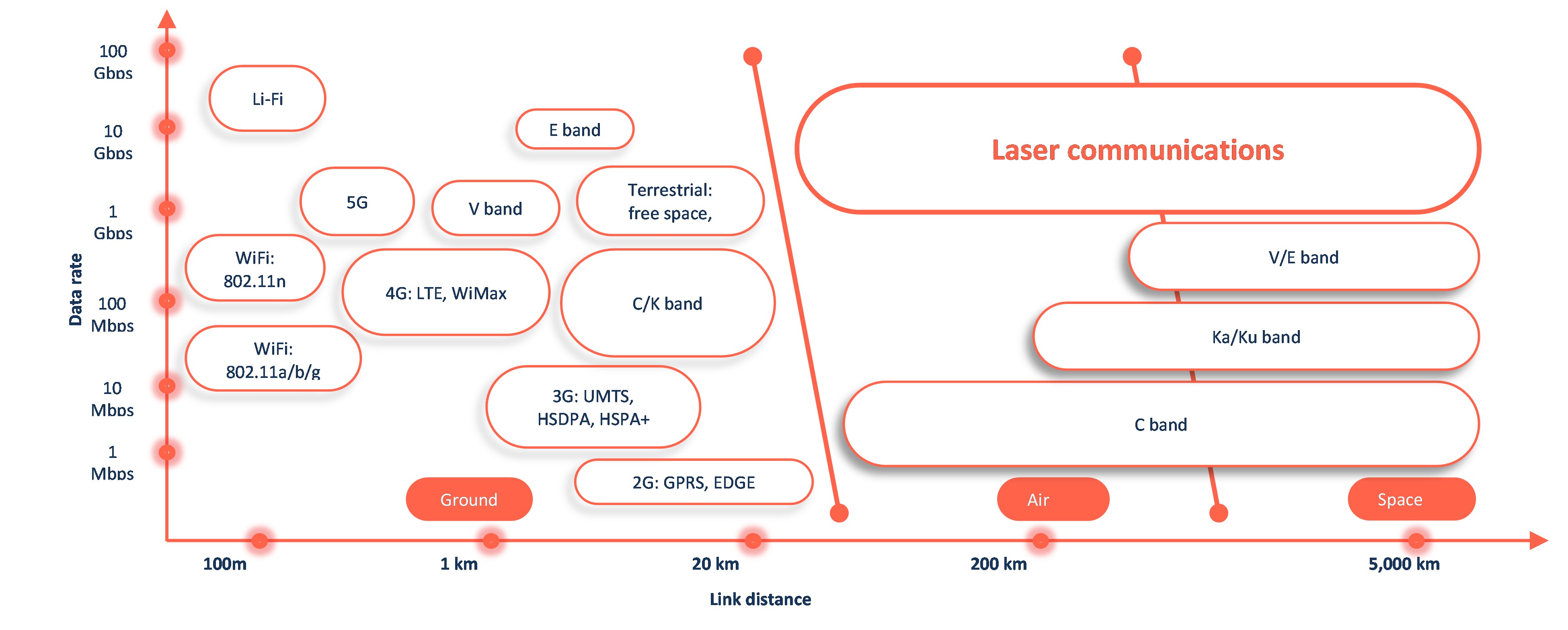
Research & Development and Engineering
Research & development is critical to our business strategy. We believe we have developed strong in-house capabilities in product design, engineering, testing and quality assurance, covering the entire research and development process from conception to completion. We are committed to investing in a robust research and development program to enhance our current product portfolio and to develop our pipeline of new and complementary products.
Our research & development activities were initially based on a license granted to us by the DLR under a cooperation and licensing agreement entered into in 2013. Under this agreement, the DLR granted us a non-exclusive, non-assignable and non-sublicensable limited license for two of DLR’s patents, a software program and know-how related to ground and flight terminals for optics-free communication. In a subsequent amendment, we were granted an exclusive license for certain applications, which include ground-based optical communications, air-based optical communications and ground-air communications. We pay annual license fees under our agreement with the DLR. The agreement will terminate on December 31, 2027. Given the rapid technological developments in our industry and the limited extent of our current reliance on this license, we do not expect that we will need this license for development of our products going forward and accordingly we currently do not intend to seek an extension of this agreement beyond its termination date.
We also collaborate with research institutes for the development and manufacture of certain optical components and products. For example, in cooperation with a German technology research institute, we have developed a metal telescope primarily for use in our CONDOR terminal that allows us to significantly reduce costs compared to alternative components. While we have already insourced most production steps for production of the metal telescope, including diamond-turning and magnetorheological finishing, we seek to expand our capabilities, further allowing us to go from raw material to finished optical telescope entirely in-house. For our HAWK terminals, we have been working on the development of an ultra-sensitive photo diode in cooperation with a French research institute, which is designed to convert fast optical pulses into corresponding electrical signals for optical measurement. Through its superior sensitivity capabilities, our photo diode will allow us to use more standardized versions of other optical components in our products, reducing overall system complexity and cost. We expect to be able to implement this ultra-sensitive photo diode into our HAWK terminals in the near-term. Additionally, by leveraging “commercial off-the-shelf” components developed in the telecommunication industry, we seek to further develop techniques to increase optical bandwidth in a cost-efficient manner, which will allow us to significantly decrease the “cost per bit” over time.
As part of our research and development activities, we have developed significant in-house testing capabilities for our products. For example, we have established a micro-vibration link testbed, which simulates the operational use of our products in air and space (e.g., vibrations during satellite or aircraft operations) while also allowing us to conduct interoperability tests with other vendors. We installed our first micro-vibration link testbed in our research and development facility and have recently completed installation of a second testbed for our interoperability laboratory in Los Angeles. In addition to our micro-vibration testbed, we use a vibration and shock testbed that simulates heavy vibrations and shocks experienced during rocket launch and aircraft landing and turbulences. We also conduct data transmission tests, in which we simulate different (simulated) link distances, acquisition tests (which include far-field simulations of the laser beam) and scenario and full motion testing (which allows us to replicate certain flight conditions in our labs). Additionally, we have installed clean room facilities which include a thermal-vacuum chamber that simulates various temperature and pressure gradients and thermal chambers which are required for temperature shock simulations. We also perform radiation tests, including the exposure of our electronics to harmful radiation to be expected in space, which we do not conduct in-house.
42
On July 13, 2023, for the second time, we were awarded the honor “Best Submitted Idea” in the SME/Scale-up category at the INNOspace Masters Highlight Conference hosted by the German Space Agency of the DLR. The award recognizes pioneers and innovative ideas to advance the next generation of space technology.
Our research and development team consists of in-house staff, including engineers, machinists and researchers as well as quality and manufacturing personnel. Our research and development team conceptualizes technologies and then builds and tests prototypes before refining and/or redesigning as necessary. Our goal is to develop standardized, cost-effective laser communication products and to build tools and testbeds for handover to serial production. As of December 31, 2023, we had 157 FTEs dedicated to research and development.
We have made substantial investments in product and technology development since our inception. Research and development expenditure totaled €21,572 thousand in 2023 compared to €18,986 thousand in 2022 and €20,675 thousand in 2021, of which €0 thousand, €967 thousand and €2,845 thousand, respectively, were capitalized. For more information on the capitalization of development costs under IFRS, see “Item 5. Operating and Financial Review and Prospects—Key Factors Affecting Our Results of Operations.” We conduct the majority of our research and development activities at our facility in Gilching, Germany. We believe that the close interaction between our research and development, marketing and manufacturing groups allows for timely and effective realization of our technology and products.
At the end of the third quarter 2023, based on customer feedback and market requirements as well as strategic reasons, we decided to initiate a re-design process with respect to our HAWK terminal. We continue to believe in the significant potential in the airborne market and have therefore decided to design the next generation of our HAWK terminals based on an adapted version of our core SPACE technology used in our CONDOR terminals. This would allow us to benefit from similar production processes and reduce development and maintenance efforts for both our SPACE and AIR technologies. In the short term, we plan to only produce a limited number of HAWK terminals (based on our AIR technology) in 2024 and 2025. As a result, we recognized an impairment loss on our AIR technology in the amount of €3,308 thousand and wrote it down to a residual amount of €0, as the technology is no longer expected to be used internally and is not reasonably saleable.
Manufacturing and Supply Chain
We have developed highly sophisticated and proprietary manufacturing capabilities in recent years. Initially, we manufactured the prototypes and pre-serial production versions of our CONDOR and HAWK terminals at our site in Gilching, Germany. In 2020, we leased a larger, customized production facility in Oberpfaffenhofen, near Munich. Our facility in Oberpfaffenhofen has approximately 1,600 square meters (approximately 17,200 square feet) of production, assembly, testing, quality assurance and warehouse space and we currently employ around 18.0 FTEs in the production of our laser terminals in this facility. In 2023, in preparation for future growth, we decided to re-locate our facilities to Munich and to sublease a substantial part of our production facility in Gilching, Germany, to third parties. The lease for our new facility in Munich has a term of ten years following handover (which took place in October 2023). Our facility in Munich has approximately 11,000 square meters (approximately 120,000 square feet) of office space, production and development facilities. For more information, see “—Facilities.” We are currently ramping up serial production targeting a per year production rate capacity of up to 2,000 units in the medium term. Going forward, we may be required to install additional production equipment as we further scale our business.
We work with third-party suppliers to provide components used in our products and we expect to continue to do so for future products. Although some components are manufactured to our specifications (such as certain optical or electronic components), most components are available commercially-off-the-shelf. In order to mitigate the risks related to a single-source of supply, we always seek to have at least two qualified suppliers for every component. We forecast our component needs based on current utilization patterns and sales forecasts of future demand. We generally do not maintain long-term contracts with suppliers, but instead rely on informal arrangements and off-the-shelf purchases based on purchase orders. As we expand our business, we may seek to enter into master supply agreements with certain suppliers to ensure continuous supply of critical components for our products.
We believe that our manufacturing capabilities and know-how provide significant barriers to entry, and we have demonstrated an ability to manufacture efficient and effective laser communication products at attractive prices. We believe that customers view our manufacturing capabilities as differentiated in the market.
In November 2023, we announced we experienced a delay in the production and delivery of CONDOR terminals, which was initially scheduled to start in the fourth quarter of 2023. Volume production and shipments of these units was started in the first quarter of 2024 with further ramps of production to occur throughout 2024. The delay in production of our CONDOR terminals resulted in a backlog in our inventories, which also increased significantly as part of the ramp up of our serial production.
Our Competitive Landscape
To our knowledge, currently only a limited number of companies focus on the development of laser communication capabilities in the aerospace industry. As the market evolves, we expect to see additional competitors such as SpaceX or potentially Amazon enter the market or
43
attempt to develop laser communication capabilities in-house. Positive market development notwithstanding we do not expect the number of competitors to grow significantly considering the technological complexity of our underlying technology.
Our main direct competitors include, among others:
We believe that we are differentiated based on our know-how and expertise in ramping up serial production and supply chains, whereas our competitors have historically focused on developing bespoke, non-scalable solutions for individual projects. We believe that customers are seeking more standardized and industrialized solutions that provide the requisite technical capabilities without the additional costs associated with bespoke products and with the capability to ramp up production quickly. We also believe we are the only company offering laser communication terminal products for all altitudes of aerospace applications ranging from the ground, aviation airspace and the stratosphere up to LEO.
Information Technology
We primarily use several commercially-available software programs for our business operations along with our own proprietary software and applications in connection with operating our products. We seek to control costs and improve our ability to deliver our products by maintaining reliable systems.
We engage in a variety of measures designed to address potential cybersecurity risks. Our efforts include firewalls, antivirus software, patches, data encryption, log monitors, routine backups and routine password modifications. Notwithstanding these efforts, our internal information technology systems environment continues to evolve and our business policies and internal security controls may not keep pace as new threats emerge.
Intellectual Property
Protection of our intellectual property is fundamental to the long-term success of our business. We believe that our continued success depends in large part on our proprietary technology, the skills of our employees and the ability of our employees to continue to innovate and incorporate advances into our products. We rely exclusively on a combination of trade secret, copyright and trademark laws, as well as contractual provisions with employees and third parties, to establish and protect our intellectual property rights. While our expertise in laser communication technology is critical to our success, we typically keep our inventions as trade secrets to avoid public disclosure.
We do not own any patents and do not have any patent applications pending. We have non-exclusive licenses from third parties for the use of certain components in our products. For example, we entered into a license agreement with a German technology research institute in September 2020 under which we were granted a limited, non-exclusive license to manufacture certain optical components based on the know-how and the intellectual property of the institute. The license agreement has a term until December 31, 2034. We agreed to pay royalties based on costs of product sales. Upon expiry of the license agreement, we will be permitted to use such know-how and intellectual property freely without any further obligation to pay royalties.
We own six trademarks and 51 internet domain names. We provide our products to customers pursuant to terms and conditions that impose restrictions on use and disclosure of our proprietary and confidential information. We also seek to avoid disclosure of our intellectual
44
property using contractual obligations, by requiring employees, consultants and contractors with access to our proprietary information to execute nondisclosure, non-competition and intellectual property assignment agreements. In addition, we generally control access to our proprietary and confidential information through the use of internal and external controls. See “Item 3. Key Information—D. Risk Factors—Legal and Tax Risks—We may be unable to adequately protect our intellectual property and proprietary rights and prevent others from making unauthorized use of our products and technology.”
Insurance Coverage
We have insurance policies in place that we consider customary for our industry, including general liability insurance, product liability insurance, transportation insurance, and loss of property and earnings insurance. We believe that our insurance policies contain market-standard exclusions and deductibles. We regularly review the adequacy of our insurance coverage and consider the scope of our insurance coverage to be customary in our industry.
Facilities
We currently lease all of our real property and do not own any real property.
Location |
Usage |
Approximate size |
Lease term |
Year lease term expires |
Bertha-Kipfmüller-Str. 2-8 |
Headquarter, office space, production and development facilities |
11,000 square meters / |
10 years(1) |
2033(1) |
Dornierstraße 19 |
Office space |
1,600 square meters/ |
10 years |
2029 |
13100 Yukon Ave Unit A |
Office space, production and development facilities (such as our interoperability laboratory) |
1,800 square meters / |
5.5 years |
2027 |
Arlington Tower, |
Office space |
260 square meters / |
4 years |
2025(2) |
(1) Handover took place in October 2023. For purposes of adapting the facility to our needs, we will pay to the landlord an additional fee of €1.1 million following payment of the first month’s rent. In addition, we have an option to extend our lease for an additional five year term.
(2) We have the option to extend our lease for an additional three years.
Legal Proceedings
From time to time, we may be involved in various claims and government, legal or arbitration proceedings arising out of our operations, including ordinary course litigation with former employees. The following description includes information on material governmental, legal or arbitration proceedings (including any such proceedings which are pending or threatened of which we are aware) during at least the twelve months prior to the date of this Annual Report:
In July 2020, the German Federal Ministry for Economic Affairs and Climate Action (Bundesministerium für Wirtschaft und Klimaschutz, “BMWK”) prohibited the export of laser communication terminals for installation on LEO satellites to customers in China based on Section 6 in conjunction with Section 4 para. 1 of the German Foreign Trade and Payments Act (Außenwirtschaftsgesetz, “AWG”). The ban was issued on the grounds of essential security interests of the Federal Republic of Germany, in order to prevent a disturbance of the peaceful coexistence of nations and to prevent a substantial disturbance to the foreign relations of the Federal Republic of Germany (Section 4 para 1 no. 1, 2 and 3 AWG), as our laser communication terminals would have a potential use in the fields of military reconnaissance and communication. To comply with the ban, in 2020 we terminated all business relationships with customers in China. While we currently do not intend to pursue any business opportunities in China or with Chinese customers, we have challenged the export ban with a lawsuit before the Administrative Court of Berlin with a view to seeking compensation for losses we suffered as a result of the export ban. In a court hearing on October 26, 2022, our action was dismissed. In connection with our withdrawal from the Chinese market due to the export ban to customers in China, we terminated all business relationships with customers in China. By letter dated July 2023, a former Chinese customer asserted a repayment claim in the amount of €495,000 plus default interest and ancillary costs in connection with our termination of their contract. We responded in a letter dated August
45
2023 that we do not see a basis for this claim under the contract with the former customer. However, on December 22, 2023, our former Chinese customer filed a claim in arbitration court.
On February 17, 2020, the German Federal Financial Supervisory Authority (Bundesanstalt für Finanzdienstleistungsaufsicht, “BaFin”) initiated an investigation against us on the grounds of the alleged omission of an ad hoc disclosure under the ad hoc disclosure obligation of Article 17 para. 1 MAR. On January 14, 2020, we had announced, by means of a press release published on our website, that we had entered into a new multi-million Euro contract with a space customer. During the ongoing investigation, BaFin argued that the conclusion of a contract of such dimensions would have fallen under the ad hoc disclosure obligation of Article 17 para. 1 MAR, and that the publication on our website did not satisfy this obligation. On March 16, 2020, as requested, we provided BaFin with additional information about the contract and the negotiations leading up to it as well as our explanation as to why we did not file an ad hoc disclosure in this case. On November 13, 2020, BaFin informed us that notwithstanding the additional information we provided, it still upholds its view of an existing infringement of the ad hoc disclosure obligation. BaFin has now entered the process of investigating the alleged omission of an ad hoc disclosure as an administrative offence (Ordnungswidrigkeit). On October 11, 2022, we received a further letter from BaFin, in which BaFin stated that based on its investigation and prior written responses provided by us, BaFin was of the preliminary view that we had at least objectively violated the ad hoc disclosure obligation of Article 17 para. 1 MAR. We submitted a further written response to the BaFin on November 16, 2022. On March 20, 2023, BaFin imposed an administrative fine amounting to €150,000 on us in this matter. The administrative fine order is final and binding.
On August 17, 2021, we received a notification of a hearing from the BaFin, which initiated an investigation against us on the grounds of the alleged delay of an ad hoc disclosure under the ad hoc disclosure obligation of Article 17 para. 1 MAR relating to the capital increase in connection with an accelerated book building transaction in February 2020. We submitted a written response to the BaFin on September 17, 2021. By letter dated March 1, 2022, the BaFin informed us that it does not follow our argumentation but that it decided to refrain from pursuing the matter further for reasons of expediency.
On November 25, 2021, we received a notification of a hearing from the BaFin, which initiated an investigation against us on the grounds of the alleged delay of an ad hoc disclosure under the ad hoc disclosure obligation of Article 17 para. 1 MAR relating to the announcement of our initial public offering in the U.S., which was published in April 2021. We submitted a written response to the BaFin on January 10, 2022. By letter dated April 20, 2023, BaFin informed us that they will no longer pursue this matter.
In 2020, Airborne Wireless Network (“ABWN”), a former customer, filed a complaint in the Superior Court of the State of California against Mynaric Lasercom GmbH under a contract relating to the delivery of two prototype versions of laser terminals for airborne applications. In its complaint, ABWN alleged breach of contract due to alleged quality issues with respect to the two terminals delivered by us in 2018 and sought damages in an unspecified amount. The terminals were accidentally damaged in the course of delivery and we repaired one terminal and replaced the second terminal with a new one. On April 20, 2021, we participated in settlement negotiations with ABWN, which did not result in any resolution. Court proceedings were scheduled to begin in March 2022. On March 8, 2022, the competent court granted our motion for summary judgment against ABWN. On March 28, 2022, the court ordered that judgment shall be entered in our favor and dismissed ABWN’s claim with prejudice.
Apart from the proceedings described above, we are not and have not been party to any government, legal or arbitration proceedings (including any such proceedings which are pending or threatened of which we are aware) during the past twelve months, which may have, or have had in the recent past, significant effects on our financial position or profitability.
Regulatory Environment
Overview
We are subject to a wide variety of laws and regulations relating to various aspects of our business, including with respect to our technology and products, employment and labor, health care, tax, privacy and data security, health and safety, and environmental issues. Laws and regulations at the non-U.S. and U.S. federal, state and local levels frequently change, especially in relation to new and emerging industries, and we cannot always reasonably predict the impact from, or the ultimate cost of compliance with, current or future regulatory or administrative changes. For example, as of the date of this Annual Report, laser communication is not regulated by the United Nations’ International Telecommunication Union and can, thus, be used without restrictions such as license requirements. There is, however, no guarantee that relevant laws, rules and regulations remain unchanged and will not become more comprehensive and stringent in the future. If we fail to comply with any applicable laws, rules, or regulations, we may be subject to civil liability, administrative orders, fines or even criminal sanctions. See “Item 3. Key Information—D. Risk Factors—Regulatory Risks” and “Item 3. Key Information—D. Risk Factors—Legal and Tax Risks.”
The following provides a brief overview of certain selected areas of laws and regulations applicable to our business operations.
46
Laser Safety Provisions
We develop and test our technology and products in our production facilities, and are currently ramping up serial production of our products in our production facility in Oberpfaffenhofen and Munich, Germany. In developing and manufacturing our products, we must comply with applicable German and European Union laws and regulations on laser safety requirements. For example, Directive 2006/25/EC of the European Parliament and of the Council of 5 April 2006 (as amended) sets forth minimum requirements for the protection of workers from risks to their health and safety arising or likely to arise from exposure to artificial optical radiation (including laser radiation) during their work in the European Union. In Germany, this directive was implemented by the Regulation for Employee Protection Against Artificial Optical Radiation Risks (Verordnung zum Schutz der Beschäftigten vor Gefährdungen durch künstliche optische Strahlung) and the Regulation on Preventive Occupational Medicine (Verordnung zur arbeitsmedizinischen Vorsorge). Among other things, these regulations provide for technical rules related to the assessment of laser radiation risks for employees, measurements and calculations related to laser radiation exposure, and risk protection measures that include the appointment of a laser safety officer (Laserschutzbeauftragter) and the use of laser protective glasses and screens.
In addition, the U.S. Food and Drug Administration (“FDA”) has issued performance standards (see 21 CFR 1040) regulating light-emitting electronic products, including all types of laser products. Laser products are defined as any manufactured product or assemblage of components which constitutes, incorporates, or is intended to incorporate a laser or laser system. A laser or laser system that is intended for use as a component of an electronic product shall itself be considered a laser product (see 21 CFR 1040.10(b)(21)). Prior to introducing a product in the United States, we provide notice to the FDA, in the form of a safety report, which provides identification information and operating characteristics of the product to demonstrate compliance with the respective U.S. safety level. Our CONDOR and HAWK laser terminals are both categorized as laser class IV. If the FDA should find that the report is complete, it would provide us approval in the form of what is known as an accession number. We may not market a product until we have received an accession number. In addition, we submit an annual report to the FDA that includes, among other things, the radiation safety history of all products we sell in the United States. We have provided the FDA with all relevant documentation and obtained the necessary accession numbers for both of our laser terminals.
Regulation of Production Facilities and Storage Sites
Emissions
Specific laws and regulations govern the emission of air pollutants, such as noise, odors, and vibrations. Typically, the operation of industrial facilities is subject to governmental approval and operators of such facilities are required to prevent any form of impermissible emissions. Operators of facilities are required to maintain all installations in compliance with the respective governmental approval in terms of the reduction of certain emissions and the implementation of safety measures. In some cases, continuous improvement or retrofitting of installations to maintain facilities at state-of-the art safety level standards may be required. Compliance with these requirements is monitored by local authorities, and operators may be required to submit emission reports on a regular basis. Noncompliance with maximum emission levels or other requirements imposed by the relevant authority may result in administrative fines, subsequent orders or, in severe cases, the withdrawal of the approval by the relevant authority.
Regulation of Hazardous Incidents
Operators of facilities storing large quantities of hazardous goods, which include, among other things, certain glues, lubricants, varnishes, and nitrogen, are required to comply with safety standards set forth in Directive 2012/18/EU of the European Parliament and of the Council of 4 July 2012 on the control of major-accident hazards involving dangerous substances (the “Seveso III Directive”) and the respective national implementing laws. As the former Council Directive 96/82/EC of 9 December 1996 on the control of major-accident hazards involving dangerous substances, the provisions of the Seveso III Directive are designed to prevent major accidents involving dangerous substances, such as emissions, fires, and larger explosions and to limit detrimental consequences in the event of an accident. The degree of additional safety requirements depends on various categories as well as the amount of hazardous substances stored in the relevant facility.
In Germany, the Seveso III Directive was implemented on December 7, 2016, with the Seveso III Transposition Act (Seveso III Umsetzungsgesetz) which includes, among others, the amendment of certain provisions of the German Federal Immission Control Act (Bundesimmissionsschutzgesetz), the Environmental Impact Assessment Act (Umweltvertäglichkeitsprüfungsgesetz), and the Environmental Legal Remedies Act (Umweltrechtsbehelfgesetz). Additional legislative changes came into force on January 14, 2017 with the amendment of the twelfth ordinance under the German Federal Emissions Control Act (the so-called German Hazardous Incidents Ordinance, Störfall-Verordnung).
47
Production, Possession, and Handling of Waste
During our manufacturing process we generate different kinds of waste, including industrial waste. Applicable waste laws generally require us to reduce and/or avoid waste and to dispose of the different types of waste in a manner consistent with its properties so it does not endanger human health or harm the environment. In the European Union, Directive 2008/98/EC of the European Parliament and of the Council of November 19, 2008 on waste, as amended (Waste Framework Directive), requires European Union member states to take appropriate measures in this regard. In Germany, the Waste Management Act (Kreislaufwirtschaftsgesetz) transports these European Union requirements into national law. Under the Waste Management Act, generators, owners, collectors, and transporters of waste have to demonstrate to the competent authority and to other parties that they have properly disposed of hazardous waste (gefährliche Abfälle) by waste disposal (Entsorgungsnachweis). Besides, the Waste Management Act contains regulations on, among other factors, permissible methods of, and responsibility for, the generation, handling, possession, and discharge as well as recycling methods of waste depending on the danger posed by the waste.
German Act on Environmental Liability
If damage is caused to persons or property by one of our facilities, we may be held strictly liable under the German Environmental Liability Act (Umwelthaftungsgesetz). Liability under the Environmental Liability Act may arise for damages caused by substances or gases that spread through soil, air, or water. Under the statute, there is a presumption that any damage has been caused by a facility if the facility is generally capable of causing such damage. Should any of our facilities be subject to the German Hazardous Incidents Ordinance (Störfall-Verordnung) in the future, we may be required to provide financial security (Deckungsvorsorge) for environmental damages.
German Occupational Health and Safety Requirements
In Germany, general health and safety requirements for employees are laid down by the Working Conditions Act (Arbeitsschutzgesetz), the Occupational Safety Act (Arbeitssicherheitsgesetz) and the Ordinance on Industrial Safety (Betriebssicherheitsverordnung). For the provision and use of working equipment, the Product Safety Act (Produktsicherheitsgesetz) applies, along with the Ordinance on Health and Safety at Work (Arbeitsstättenverordnung). As regards exposure to hazardous substances, the Ordinance on Hazardous Substances (Gefahrstoffverordnung) and the Technical Rules for Hazardous Substances 900 (Technische Regel für Gefahrstoffe 900) set out limits for workplaces. All these requirements are further specified by German trade associations (Berufsgenossenschaften) in their accident prevention regulations (Unfallverhütungsvorschriften), which also address specific health and safety risks of our business.
Compliance with employment safety regulations is subject to regulatory supervision. The law enforcement authorities are provided with wide-ranging enforcement powers including the right to enter a company’s premises, to search for documents, and to examine work and personal health equipment. They are also authorized to impose fines.
Export Control Regime
European Union, German and U.S. export control laws restrict the export of products, services, and technologies designed for non-military purposes, but which are utilized in military applications or can contribute to the proliferation of weapons of mass destruction (“Dual-Use Items”). Some of our products qualify as Dual-Use Items.
European Union and German Dual-Use Export Control Regime
In the European Union, the export of Dual-Use Items from European Union member states is harmonized and mainly governed by European law, in particular by Council Regulation (EC) No 428/2009 of 5 May 2009, as amended, which established a community regime for the control of exports and the transfer, brokering and transit of Dual-Use Items (the “Dual-Use Regulation”). The scope of the Dual-Use Regulation is defined in an annex to the Dual-Use Regulation (“Annex I”), which contains a detailed list of goods divided into different categories. For all listed Dual-Use Items, an export authorization is required (Art. 3 Dual-Use Regulation). Our spaceborne CONDOR laser communication terminal qualifies as a Dual-Use Item under the Dual-Use Regulation. In May 2021, the European Parliament and the Council of the European Union adopted Regulation (EU) 2021/821, as amended, which amends the Dual-Use Regulation and which came into effect on September 9, 2021. The amendment includes an export authorization requirement for the export of certain non-listed surveillance technology should the competent member states’ authorities consider that the items are or may be used in whole or in part in connection with internal repression and human rights and international humanitarian law violations.
The Dual-Use Regulation provides for four types of export authorizations: (i) European Union general export authorizations (EU-Allgemeingenehmigungen; “EUGEAs”), which allow exports of Dual-Use Items to certain destinations under certain conditions (see Annex II of the Regulation), (ii) national general export authorizations, which may be issued by European Union member states if they are consistent with existing EUGEAs and do not refer to items listed in Annex IIg of the Dual-Use Regulation, (iii) individual export authorizations, which
48
can be granted to one exporter and cover exports of one or more Dual-Use Items to one end-user or consignee in a third country, and (iv) maximum amount authorizations, which can be granted to one exporter and may cover multiple items to multiple countries of destination or end users. Under the Dual-Use Regulation, the competent authorities of each member state are responsible for establishing their own administrative procedures for applying and obtaining such export authorizations.
General export authorizations (“GEA”) have the advantage that no authorization application needs to be filed; exports and intra-European Union transfers that satisfy the requirements of a general export authorization are automatically authorized. Exporters or transferors wishing to make use of a general export authorization are, however, required to file a notification and registration with the competent authority of the respective member state, which can also be filed after the exportation. The scope of application of the general export authorization is primarily determined by the authorized group of items and the authorized destinations. For example, exports to Australia, Canada, Japan, New Zealand, Norway, Switzerland (including Liechtenstein), the United Kingdom, and the United States of America are covered by GEA EU001. The other five GEAs cover more specific circumstances such as exports of items according to the Wassenaar Agreement (EU002), exports after repair or replacement (EU003), temporary exports for exhibitions or fairs (EU004), exports of specific telecommunication goods (EU005), and exports of specific chemicals (EU006).
In Germany, the administrative procedure to obtain an export authorization is governed by the AWV, which also defines the German Federal Office for Economic Affairs and Export Control (Bundesamt für Wirtschaft und Ausfuhrkontrolle; “BAFA”) as the competent authority for issuing such authorization. In addition to control lists set out under the Dual-Use Regulation, European Union member states may also set out their own lists of controlled Dual-Use Items. Germany, for instance, has done so by including additional Dual-Use Items on its national export list (Ausfuhrliste) that are not already covered by the Dual-Use Regulation (e.g., spaceborne laser communication terminals under no. 9A904), if they are to be exported to certain countries. Goods listed on Germany’s national export list are subject to the same license requirements as described above. Exports of our CONDOR terminals require a license from BAFA if the exportation is not covered by the European Union’s general exportation authorization.
U.S. Export Regulations
The U.S. Export Administration Regulations (“EAR”) provide for specific rules governing exportations from the U.S., re-exportations from a foreign country to another foreign country, and transfers within a foreign country or to a foreign national if the respective item is located within U.S. territory, originate from the U.S., contains more than de minimis amounts of controlled U.S.-origin items or is the direct product of certain U.S.-origin technology or software. The EAR applies to physical goods as well as technology and software. The Commerce Control List (“CCL”) is an annex to the EAR and contains a list of Dual-Use Items and any controls associated with those items. Since the regulatory intention of the EAR is similar to that of the Dual-Use Regulation, the CCL and Annex I of the Dual-Use Regulation are congruent. Our CONDOR laser terminal and HAWK laser terminal are subject to the EAR and identified on the CCL. Items listed on the CCL may require an export license depending on the item, its reason for control, its end destination (both end user and end country) and end use. In some cases, a license exception may apply. The EAR’s rules regarding license requirements are subject to frequent change. Items that do not currently require a license for exportation, re-exportation or transfer may require such license in the future. Obtaining a license from the U.S. Department of Commerce may be time-consuming and may result in the delay or loss of sales opportunities. We cannot ensure that any such license applications will be granted. Violations of the EAR may result in criminal or civil penalties, the denial of export privileges and/or debarment from participation in U.S. government contracts.
U.S. International Traffic in Arms Regulations (ITAR)
The ITAR is a U.S. regulatory regime to restrict and control the export of defense- and military-related technologies, to safeguard U.S. national security, and further U.S. foreign policy objectives. Defense-related goods and services that are listed on the United States Munitions List (the “USML”) are covered by the regulations. The U.S. Department of State’s Directorate of Defense Trade Controls (“DDTC”) interprets and enforces the ITAR. Nearly every item subject to the ITAR requires a license from DDTC for exportation, re-exportation or transfer, unless an ITAR exemption applies.
Currently, our largest potential customer base is located in the United States. We believe that further potential markets may develop in Asia (except China) and a number of European countries. Therefore, our products could be subject to international trade restrictions in these markets in the future. To the best of our knowledge, none of the components currently used in our products is subject to arms control regulations in the U.S., such as the ITAR; but, this may occur in the future. The related approval process could have a detrimental effect on our potential customers’ demand and could also limit our potential customer base to those entities that are allowed to import and purchase arms products under the relevant regulations.
For practical purposes, ITAR regulations dictate that information and material pertaining to defense- and military-related technologies (items listed on the USML) may not be shared with non-U.S. persons unless authorization from the U.S. Department of State is received or a
49
special exemption is used. U.S. persons may face heavy fines if they, without authorization or the use of an exemption, provide foreign persons with access to ITAR-protected defense goods, services, or technical data.
Trade Sanctions
When selling and/or delivering our products to customers around the globe we must observe economic sanctions and embargoes. Such measures can be based on national legislation (like in Germany or the U.S.), but also on acts of international or supranational organizations like the United Nations and the European Union. They can take the form of comprehensive embargoes (total embargoes), partial embargoes, such as arms, sectoral or financial embargoes, and may be directed at countries, governments, organizations, groups, non-state entities and individuals. Sanctions against individuals or entities usually prohibit placing assets of any kind at the disposal of sanctioned parties or providing them with any economic resources. We are also subject to sourcing regulations such as the requirements under the Dodd-Frank Wall Street Reform and Consumer Protection Act of 2010 (Dodd-Frank Act) and Regulation (EU) 2017/821 of the European Parliament and of the Council of 17 May 2017 as amended by Commission Delegated Regulation (EU) 2020/1588 of 25 June 2020, setting forth supply chain due diligence obligations for European Union importers of tin, tantalum and tungsten, their ores, and gold originating from conflict-affected and high-risk areas (European Union Conflict Minerals Regulation) that require us to carefully monitor our supply chain.
We may be required to comply with embargoes, trade sanctions and sourcing regulations for various reasons, including due to the location of our factories, the seat of our respective entity, the nationality of our responsible employees or the components we use.
U.S. Embargoes and Trade Sanctions
In the U.S., the U.S. Department of the Treasury’s Office of Foreign Assets Control (“OFAC”) is the primary agency responsible for implementing and enforcing embargoes and trade sanctions. Through the implementation of trade sanctions, the U.S. seeks to restrict certain business practices, including cessation of business activities in sanctioned countries or with sanctioned persons or entities, in order to further U.S. national security and foreign policy objectives. The U.S.’s complex sanctions regime also encourages companies to implement compliance programs that address sanctions risks, which may increase compliance costs. Violations of U.S. sanctions may subject us to criminal or civil fines, penalties or other sanctions.
U.S. sanctions may take the form of country- or territory-based sanctions or list-based sanctions. Currently, country-or territory-based sanctions target, inter alia, the Crimea region of Ukraine, the so-called “Donetsk People’s Republic” and “Luhansk People’s Republic,” Russia, Cuba, Iran, North Korea and Syria. OFAC maintains several sanctions lists that identify sanctions targets, and the scope of the sanctions’ restrictions vary depending on the sanctions list. OFAC’s primary sanctions list is the List of Specially Designated Nationals and Blocked Persons, which identifies persons and entities subject to asset blocking restrictions. Certain other OFAC sanctions lists impose non-asset blocking sanctions, such as restrictions on the listed entity’s ability to raise debt or equity in the U.S. in the case of OFAC’s Sectoral Sanctions Identification List that targets certain sectors of the Russian economy.
U.S. sanctions apply primarily to U.S. persons, which include all companies and other legal entities organized under U.S. law and their foreign branches, as well as U.S. citizens and permanent residents. In the case of U.S. sanctions against Cuba and Iran, sanctions also apply to non-U.S. entities owned or controlled by U.S. persons. Our operations in the U.S. and any activities we have with U.S. persons must therefore comply with U.S. sanctions. In addition, we may also be subject to sanctions-related obligations through contracts with suppliers, credit facilities or loan agreements that require compliance with U.S. sanctions or screening against U.S. sanctions lists.
U.S. sanctions may also have an extraterritorial effect and impact the conduct of non-U.S. persons through so-called “secondary sanctions.” Under secondary sanctions, the United States may impose sanctions against non-U.S. persons for engaging in certain transactions or activities, depending on the sanctions program, even absent a U.S. nexus to the activity. For example, as a result of the Countering America’s Adversaries Through Sanctions Act of 2017, non-U.S. persons must comply with certain secondary sanctions against Russia, even if such activities have no connection to the United States. Among other things, non-U.S. persons may face penalties and/or asset-blocking sanctions for knowingly facilitating significant transactions or significant financial transactions for or on behalf of a party subject to the United States sanctions against Russia.
Further, non-U.S. persons and entities that cause a U.S. person to violate U.S. sanctions may violate OFAC’s prohibition on causing another person to violate sanctions, which may result in civil and criminal penalties under applicable U.S. law. Accordingly, transacting with customers in countries such as Cuba may be allowed under European Union law but still violate U.S. sanctions. In case of such conflicts between European Union law and U.S. sanctions, the Council Regulation (EC) No 2271/96 of 22 November 1996 protecting against the effects of the extraterritorial application of legislation adopted by a third country, and actions based thereon or resulting therefrom, as amended, prohibits European Union companies from complying with certain listed U.S. sanctions and shields these entities from the effects of U.S. sanctions in the European Union. Such anti-boycott rules apply, for example, to the 2018 U.S. sanctions targeting Iran. European Union companies are, nonetheless, free to conduct their business as they see fit, i.e., not trade with countries sanctioned by the U.S.
50
European Union Embargoes and Trade Sanctions
European Union trade sanctions have a broad scope, applying (i) within the territory of the member states, (ii) to any person inside or outside the territory of the European Union who is a national of a member state, (iii) to any legal person, entity or body which is incorporated or constituted under the law of a member state whether acting inside or outside the European Union, and (iv) to any legal person, entity, or body in respect of any business done in whole or in part within the European Union.
Our commitments in terms of sanctions and embargoes mainly (but not exclusively) derive from Council Regulation (EC) No 2580/2001 of 27 December 2001, as amended, on specific restrictive measures directed against certain persons and entities with a view to combating terrorism. It aims to prevent and prohibit the financing of terrorist acts by prohibiting that funds, other financial assets, and economic resources are made available, directly or indirectly, to, or for the benefit of, a natural or legal person, group, or entity included in the list of restricted parties, or by prohibiting financial or other related services from being rendered for the benefit of restricted parties.
German Foreign Investment Regime
German foreign trade law may require foreign investors to obtain government approval for the acquisition of our shares if the acquirer directly or indirectly holds 20% or more of our voting rights following the acquisition. Pursuant to the cross-sectoral examination in Section 55 et seq. AWV, the BMWK may prohibit or restrict the acquisition of our shares by a foreign investor that is resident or based outside the European Union (Unionsfremder) if it endangers the public order or the security of Germany.
Additionally, statutory notification requirements apply, inter alia, to direct and indirect acquisitions by a foreign acquirer of 20% or more of the voting rights of a company that develops or manufactures, among other things, goods intended for use in space or for use in space infrastructure systems (Section 55a para. 1 no. 18 third alternative AWV) as well as goods specifically required for the operation of laser communication networks (Section 55a para. 1 no. 22 AWV), including us.
Accordingly, any such acquisition must be notified to the BMWK upon signing of a binding agreement or public takeover offer. However, only the signing of the binding agreement is subject to the notification requirement, not the subsequent acquisition itself (closing). Nonetheless, clearance by the BMWK qualifies as a statutory closing condition for all transactions that are subject to the cross-sectoral investment control proceeding and to the mandatory notification requirement. Furthermore, prior to clearance by the BMWK, the regime prohibits the acquirer, among other things, from exercising any voting rights in the target, and from receiving company related information (provided that such information relates to company divisions or corporate assets that are subject to the investment control proceeding).
Upon receipt of a notification, the BMWK can clear the transaction pursuant to Section 58a para. 1 AWV (in case of mandatory filings) or, alternatively, issue a clearance certificate pursuant to Section 58 para. 1 AWV (in case of voluntary filings). In both cases, clearance is deemed to have been granted within two months from receipt of the notification (phase 1) if the BMWK has not cleared the transaction or initiated formal review proceedings. If the BMWK initiates formal review proceedings (phase 2), it has four months after having received the complete set of information required for the formal review proceedings, to decide pursuant to Section 59 AWV whether to clear the transaction, to prohibit the transaction or either to issue orders to ensure public order and security of the Federal Republic of Germany. The aforementioned statutory review periods of two months (phase 1) respectively four months (phase 2) may be extended or suspended under certain circumstances.
In addition, the BMWK may initiate investigations on its own after becoming aware of the conclusion of a binding agreement, but not later than five years after the conclusion of the respective agreement (Section 55 para. 1 AWV in conjunction with Section 14a para. 3 AWG). If grounds for objections exist, the BMWK may prohibit the direct acquirer from making an acquisition within the meaning of Section 55 AWV within four months of the receipt of the complete application or issue instructions in order to ensure the public order or the security of Germany (Section 59 para. 1 AWV in conjunction with Section 14a para. 1 No. 2 AWG).
In each case, a foreign acquirer of a domestic target company applying for foreign investment control clearance under the cross-sectoral investment control regime is required to disclose its identity. For such purposes, not only the direct acquirer, but also the indirect acquirers (i.e., any entity upstream of a direct acquirer which holds at least 20% of the voting rights in the respective downstream investment vehicle) needs to be disclosed.
Anti-Bribery, Anti-Corruption, Antitrust and Competition
We are subject to various anti-corruption, anti-bribery, anti-money laundering, antitrust and competition laws. Any violation of these laws in any jurisdiction in which we operate may have serious consequences for entities and/or individuals participating in such misconduct. For example, under German criminal law we must comply with the rules against corruption and bribery of public officials (Sections 332, 334 of the German Criminal Code (Strafgesetzbuch)) or private sector employees or business representatives (Section 299 of the German Criminal Code) as well as rules against the taking and giving of bribes meant as an incentive to violating one’s official duties (Sections 331, 333 of the
51
German Criminal Code). These provisions may under certain conditions also apply to circumstances that occur solely or partly on foreign territory. In the United States, the Foreign Corrupt Practices Act of 1977, as amended (“FCPA”) prohibits payments to foreign government officials in order to assist in obtaining or retaining business. The anti-bribery provisions of the FCPA also apply to foreign firms and persons who cause, directly or through agents, an act in furtherance of such a corrupt payment to take place within the territory of the United States.
We are also subject to various antitrust and competition laws. In a broader sense these laws include all legal provisions that concern the protection of a diverse and free competition. National and supranational authorities that monitor compliance with antitrust and competition laws may initiate investigations and proceedings into alleged infringements, such as abuse of a dominant market position, anti-competitive agreements between undertakings or similar agreements with restrictive effects on competition, in particular in terms of Article 101 para. 1 of the Treaty on the Functioning of the European Union and Section 1 of the German Act Against Restraints of Competition (Gesetz gegen Wettbewerbsbeschränkungen), and unless covered by so-called block exemptions or individual exemptions. Violations of antitrust and competition laws can have various consequences including criminal sanctions, administrative fines, disgorgement of profits, exclusion from public tenders, nullity of agreements and civil claims for damages. Antitrust and competition laws in individual jurisdictions may also include rules requiring the approval by antitrust authorities regarding mergers and acquisitions or joint ventures and enable the authorities to impose certain conditions or obligations in these cases.
C. Organizational Structure
Our subsidiaries, each of which is wholly owned by Mynaric AG, are Mynaric Lasercom GmbH (a company organized under the laws of Germany), Mynaric Systems GmbH (a company organized under the laws of Germany), Mynaric USA, Inc. (a company organized under the laws of Delaware) and Mynaric Government Solutions, Inc. (a company organized under the laws of Virginia).
The following chart shows our organizational structure and our direct and indirect subsidiaries as of the date of this Annual Report.
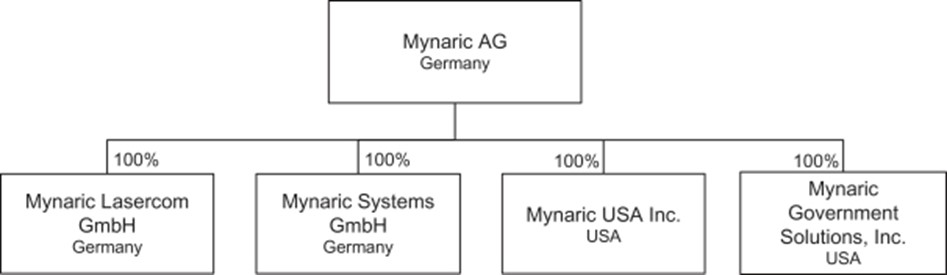
In July 2022, Mynaric AG entered into a joint venture agreement with Isar Aerospace Technologies GmbH, REFLEX aerospace GmbH, and SES Astra Services Europe S.à r.l. and established UNIO Enterprise GmbH, with corporate seat in Munich and a share capital of €29,410. Mynaric AG currently holds 21.25% in UNIO Enterprise GmbH.
D. Property, Plant and Equipment
See “B. Business Overview—Facilities” in this Item 4.
ITEM 4A. UNRESOLVED STAFF COMMENTS
None.
52
ITEM 5. OPERATING AND FINANCIAL REVIEW AND PROSPECTS
The following discussion and analysis should be read in conjunction with the information included under “Item 4. Information on the Company” and “Item 18. Financial Statements”. The following discussion and analysis contains forward-looking statements and involves numerous risks and uncertainties, including, but not limited to, those described in “Item 3. Key Information—D. Risk Factors.” Actual results could differ materially from those contained in any forward-looking statements.
Our consolidated financial statements have been prepared in accordance with IFRS as issued by the International Accounting Standards Board.
Overview
We believe we are a leading developer and manufacturer (in terms of production capacity) of advanced laser communication technology for aerospace-based communication networks in government and commercial markets. Laser communication networks provide connectivity from the sky, allowing for high data rates and secure, long-distance data transmission between moving objects for wireless space- and airborne-based as well as terrestrial applications. Our technology and products are designed to provide the secure wireless backbone for connectivity to link satellites, high-altitude platforms, unmanned aerial vehicles and aircraft with potential future use on ships, mobility platforms and fixed locations on the ground. For more information on our business, see “Item 4. Information on the Company—B. Business Overview.”
Key Factors Affecting Our Results of Operations
We believe that the factors discussed below have significantly affected our results of operations, financial position and cash flow in the historical periods for which financial information is presented in this Annual Report, and that these factors will continue to have a material effect on our results of operations, financial position and cash flow in the future.
Development of the Laser Communication Market
Our ability to successfully develop and commercialize our laser communication products depends on the willingness of potential customers to invest in the development of constellations in the context of aerospace-based communication networks. Over the past decade, the laser communication market has started to take shape, driven by rapid technological developments in the space industry, particularly the advent of smaller, lower-cost satellites. While governments remains a critical driver for further expansion of global space activities, a number of well-funded technology companies have developed formidable commercial space-based communication capabilities. At the same time, as private sector space capabilities increase, governments have begun to realize the value of the private commercial space industry and have become increasingly supportive and reliant on private companies to catalyze innovation and advance national space objectives. The combination of increased access to capital, economies of scale, and open innovation models has driven rapid growth in the commercial space market in recent years.
Current demand for laser communication is predominantly driven by government needs, with the U.S. government spearheading the adoption of laser communication technology. U.S. allies and other governments are also evaluating new technologies as part of their national objectives to modernize their space capabilities. Accordingly, governments around the world in general, and the U.S. government in particular, have invested significantly in research and development as well as deployment of laser communication and other technologies with a view to developing the critical elements for connected systems and shared networks providing for highly connected and resilient coverage from the air and/or sky (e.g., constellations of infrared missile warning and missile tracking satellites, military IoT). For more information on these government programs, see “Item 4. Information on the Company—B. Business Overview—Key Investment Highlights—Multi-year government programs driving near-term adoption and technology validation.” The escalation of geopolitical tensions (such as the invasion of Ukraine by Russia or the hostilities between Israel and the Hamas) has further fueled the need for advanced capabilities to withstand and react to new threat scenarios, driving the recent increase in defense-related spending in the U.S. and Europe.
While government funding is currently the driving force and catalyst for laser communication, we believe that laser communication is in the early phases of widespread use across commercial applications. In recent years, large commercial companies have emerged seeking to build satellite mega-constellations, in particular for establishing alternative communication networks. Beyond communication, commercial constellation operators are targeting several additional applications, including Earth observation and IoT, which may result in a number of smaller companies seeking to provide data relay, secure storage or intelligence services in this market segment. As such, we believe that our business is well-positioned to benefit not only from the successful demonstration and deployment of laser communication technology in the governmental sector, but also from potential future large-scale deployment in the commercial and diversified markets.
53
Regulatory Environment and Government Regulation
We are subject to a wide variety of laws and regulations relating to various aspects of our business, including complex and evolving export control laws as well as economic sanctions laws promulgated by the United States, Germany and the European Union. Export control and economic sanctions laws may include prohibitions on the sale or supply of certain products to embargoed or sanctioned countries and regions, governments, persons and entities. For example, in July 2020, the German government prohibited a shipment of our CONDOR terminals to a customer in China based on the German Foreign Trade and Payments Act (Außenwirtschaftsgesetz). The ban was issued on the grounds of essential security interests, in order to prevent a disturbance of the peaceful coexistence of nations and to prevent a substantial disturbance of Germany’s foreign relations, as the CONDOR terminals would have a potential use in the fields of military reconnaissance and communication. To comply with the ban, in 2020, we terminated all business relationships with customers in China, as a result of which we suffered significant losses in revenue. Following this decision, in 2020, the German government categorized laser communication network products as dual-use goods. See “Item 3. Key Information—D. Risk Factors—Regulatory Risks—We are subject to regulatory risks, in particular related to evolving sanctions laws as well as governmental export controls, in a number of jurisdictions that could limit our customer base and result in higher compliance costs.”
In addition to such export controls laws and regulations, various countries regulate the importation of certain products, through import permitting and licensing requirements. We are also subject to international trade restrictions in certain of our markets, which may impact the sale and delivery of our products going forward.
Commercialization of our Technology and Serial Production
To further drive commercialization of our technology and ramp-up serial production, we must complete the ongoing expansion of our production and development facilities, purchase and integrate related equipment, and achieve several research and development milestones. In 2020, we leased a production facility in Oberpfaffenhofen, Germany, requiring substantial installation of manufacturing equipment; a first expansion phase was completed in 2021. We also made investments in our laboratory and testing equipment, including our micro-vibration link testbed and clean room facilities. We also have incurred, and expect to continue to incur, significant costs in connection with the expansion of our facility in Los Angeles, where we recently installed the industry’s first laser communication interoperability lab. In preparation for future growth, we have decided to further expand our facilities from 2023 onwards. To this end, we signed a lease agreement for a new location in Munich which offers approximately 11,000 square meters (approximately 120,000 square feet) of office space, production and development facilities. Handover of this new facility took place in October 2023.
In addition, we need to further improve our production processes, the manufacturability of our products, our production yield and costs and the stability of our supply chain. These factors, among others, impact our ability to produce our products at increasing quantities and are crucial to achieve our intended production targets, execute on our optical communications terminal backlog and be able to serve additional customers. To this extent, we plan to continue to expand our team with qualified production personnel and invest in our capabilities, technologies and products.
Going forward, we will require additional capital to continue the ramp up of our serial production capabilities, targeting a per year production rate capacity of up to 2,000 units in the medium-term. Until we can generate sufficient cash-flow from customer contracts, we expect to finance our operations through a combination of existing cash, possible additional public equity offerings, debt financings, collaborations, and licensing arrangements. The amount and timing of our future funding requirements will depend on many factors, including the pace and results of our further development efforts.
Customer Demand
We have received significant interest in our technology and products from a wide array of different potential customers, including, among others, government agencies, aerospace companies and private satellite providers. Within the value chain for the government aerospace-based communication industry, we are a sub-system supplier for system primes such as aircraft and satellite manufacturers that are prime contractors for the U.S. government. In the commercial market, we primarily contract with companies aiming to establish smaller Earth observation and surveillance constellations for our CONDOR terminals. In this context, we also enter into strategic partnership agreements with certain key customers for the further development of our products.
Besides some initial orders and customer deliveries in 2022, we received an order from NG relating to Tranche 1 of the SDA’s PWSA satellite constellation. NG’s order has an initial value of $36 million and provides for performance-based payment milestones throughout 2022, 2023 and 2024; product shipments are commencing in 2024. The order follows the Strategic Agreement that we had entered into with NG in October 2021, under which we agreed to serve as a strategic supplier to NG and to exclusively develop and sell customized laser communication solutions for use in or relating to space to NG where the ultimate customer is a U.S. government customer. For more information on the Strategic Agreement and the March 2022 agreement, see “Item 4 Information on the Company—B. Business Overview—Our Operations—Our
54
Go-To-Market Strategy—Strategic Agreement with Northrop Grumman.” In October 2022, we received an additional order from NG for 42 CONDOR terminals as part of the SDA’s Tranche 1 tracking layer program.
In July 2022, we agreed with L3Harris on a strategic cooperation framework pursuant to which we will serve as preferred provider of laser communication solutions to L3Harris and L3Harris, in return, was granted certain collaboration privileges. In connection therewith, L3Harris invested €11.2 million by means of a capital increase from authorized capital in exchange for 409,294 new ordinary shares. With this strategic cooperation framework, we and L3Harris seek to build on our existing collaboration in the airborne domain and widen the scope to cover all domains including space, air, maritime and ground.
In particular in 2023 and early 2024, our products gathered further traction:
In 2023, we were awarded additional contracts by different government agencies relating to the design, development, production and testing of initial demonstrators for end-to-end optical communication systems. For more information on these additional contracts, see “Item 4 Information on the Company—B. Business Overview—Key Investment Highlights—Deeply engaged with customers in the government market through highly attractive contract awards within initial government programs.”
Driven by these initial customer wins, our optical communications terminal backlog and cash-in from customers grew significantly year-over-year. The table below provides an overview of cash-in from customer contracts and optical communications terminal backlog for the periods presented:
|
As of and for the year ended December 31, |
|||||||||||
|
2023 |
|
|
2022 |
|
|
2021 |
|
|
|||
|
(unaudited) |
|||||||||||
Cash-in from customer contracts |
|
49,196 |
|
|
|
18,307 |
|
(1)(2) |
|
3,887 |
|
(2) |
Optical communications terminal |
|
794 |
|
|
|
256 |
|
|
|
40 |
|
(3) |
————————
55
Optical communications terminal backlog represents the quantity of all open optical communications terminal deliverables in the context of signed customer programs at the end of a reporting period. Optical communications terminals are defined as the individual devices responsible for pointing the laser beam and capable of establishing a singular optical link each. The optical communications terminal backlog includes (i) optical communications terminal deliverables related to customer purchase orders; and (ii) optical communications terminal deliverables in the context of other signed agreements. Backlog is calculated as the order backlog at the beginning of a reporting period plus the order intake within the reporting period minus terminal deliveries recognized as revenue within the reporting period and as adjusted for canceled, changed and adjusted orders. If there are multiple options for deliveries under a particular purchase order or binding agreement, backlog only takes into account the most likely contract option based on management assessment and customer discussions. We believe that optical communications terminal backlog will continue to increase in 2024 and have already achieved an increase resulting in an optical communications terminal backlog of 855 terminal deliverables as of March 31, 2024.
In light of the increase in optical communications terminal backlog, cash-in from customer contracts increased from €3.9 million in 2021 to €18.3 million in 2022 to €49.2 million in 2023. Cash-in from customer contracts includes payments from customers under purchase orders and other signed agreements, including payments received based on payment milestones under customer programs. We often accrue meaningful payment milestones during the integration phase that precede customer deliveries. For the three months period ended March 31, 2024, cash-in from customer contracts amounted to €8.9 million. Based on our current optical communications terminal backlog, expected shipments to customers and our sales pipeline, we expect cash-in from customers to increase significantly in 2024.
We remain in active discussions with other potential customers and anticipate a considerable increase in customer demand as the constellation markets continue to develop. While initial customer orders are and will continue to be primarily used for pilot projects, we believe that following the successful initial deployment of our products, many of our customers will continue to use our products for the further rollout of their envisioned missions. The timing of receipt of revenues, if any, from projects with our customers is, however, uncertain and subject to change because many factors affect the scheduling of projects or missions. Adjustments to or cancellations of contracts may also occur.
Most recently, we experienced a delay in the production and delivery of CONDOR terminals, which was initially scheduled to start in the fourth quarter of 2023. We currently expect volume production and shipments of these units to commence in 2024. The delay in production of our CONDOR terminals resulted in a backlog in our inventories, which also increased significantly as part of the ramp up of our serial production.
Research & Development
Research and development activities are central to our business. In 2020, we started pre-serial production of both our CONDOR and HAWK terminals and continued to improve our products with a view to ramping up serial production. We have expanded our testing facilities for product qualification in order to be able to conduct almost all testing in-house except for radiation testing and special EMC measurements. We expect that this approach will significantly accelerate the development cycle, thereby shortening time to market for next product generations.
Under IFRS (as with U.S. GAAP), research costs are expensed. However, unlike U.S. GAAP, IFRS has broad-based guidance that requires companies to capitalize development costs, including internal costs, when certain criteria are met. In particular, under IFRS internally developed intangible assets (e.g., development expenses related to a prototype) are required to be capitalized and amortized if certain criteria are met, rather than expensed as incurred as they would be under U.S. GAAP. This difference requires companies that prepare their financial statements in accordance with IFRS, like us, to distinguish development activities from research activities, and to analyze whether and when the criteria for capitalizing development costs are met.
Under our accounting policies, we generally capitalize costs for the development of a technology until the time that development of such technology is completed. For our development projects “AIR technology” (the technological foundation for our HAWK terminal) and “SPACE technology” (the technological foundation for our CONDOR terminal), we defined such a point in time as the time of final development of a technology, followed by delivery of products based on such final technology to customers. All subsequent expenses incurred to maintain the value of the relevant technology are then expensed. Any expenses relating to the further development and/or adaption of our AIR or SPACE technology (such as the adaption of our SPACE technology for MEO-based constellations) or any new technology will only be capitalized if the requirements for capitalization under IFRS are fulfilled.
With respect to the development of our SPACE and AIR technologies, development costs included costs for the development of certain components for use in our CONDOR and HAWK terminals, respectively. Since we completed the development of the technology for our HAWK terminal in mid-2020, all subsequent expenses incurred in connection with our AIR technology have been recognized as expenses. For our SPACE technology, we reached this milestone in March 2021. Since then, we have only capitalized expenses relating to the adaptation of our SPACE technology for MEO-based constellations. The related capitalized costs of both our AIR and SPACE technologies are being amortized over their expected useful lives of 15 years. The expected useful lives of these technologies are estimated based on the experience of our laser experts and the expected product life, which is in turn determined on the basis of our own technical assessment and market studies.
56
At the end of the third quarter of 2023, based on customer feedback and market requirements as well as strategic reasons, we decided to initiate a re-design process with respect to our HAWK terminal. We continue to believe in the significant potential in the airborne market and have therefore decided to design the next generation of our HAWK terminals based on an adapted version of our SPACE technology used in our CONDOR terminals. This will allow us to benefit from similar production processes and a reduction of development and maintenance efforts for both our SPACE and AIR technologies. In the short term, we plan to produce a limited number of HAWK terminals (based on our AIR technology) in 2024 and 2025. As a result, we recognized an impairment loss on our AIR technology in the amount of €3,308 thousand and wrote it down to a residual amount of €0 as well as an impairment loss on equipment related to our AIR technology of €1,172 thousand.
Research and development expenditure totaled €21,572 thousand in 2023 compared to €18,986 thousand in 2022 and €20,675 thousand in 2021, of which €0 thousand, €967 thousand and €2,845 thousand, respectively, were capitalized. In the year ended December 31, 2023, an impairment in the amount of €3,308 thousand (2022: €1,531, 2021: €0) was recognized for the capitalized development costs regarding our adapted SPACE technology for MEO-based constellations. We expect that our research and development expenses will continue to increase over the next several years as we continue to modify our existing technology for use in related products and to develop other laser communication-related technologies.
In addition, protection of our intellectual property is fundamental to the long-term success of our business. We believe that our continued success depends in large part on our proprietary technology, the skills of our employees and the ability of our employees to continue to innovate and incorporate advances into ourto products. We rely exclusively on a combination of trade secret, copyright and trademark laws and contractual provisions with employees and third parties, to establish and protect our intellectual property rights. While our expertise in laser communication technology is critical to our success, we typically keep our inventions as trade secrets to avoid public disclosure. We do not own any patents and do not have any patent applications pending. We may incur significant losses without the protection afforded by patents. See “Item 3. Key Information—D. Risk Factors-Regulatory, Legal and Tax Risks—We may be unable to adequately protect our intellectual property and proprietary rights and prevent others from making unauthorized use of our products and technology.”
Personnel Costs
Personnel costs, which include salaries, wages and share-based payments as well as social security contributions, account for a significant share of our costs. As we grow our business, we expect these costs to increase. We believe that our success depends, in a significant part, on the continued services of our senior management team and on our ability to attract, motivate, develop and retain a sufficient number of other highly qualified personnel such as engineering, design, manufacturing and quality assurance, finance, marketing, sales and support personnel. We cannot guarantee that our efforts to retain and motivate management and key employees or attract and retain other highly qualified personnel in the future will be successful. Competition for qualified employees is intense, and our ability to hire, attract and retain such employees depends, among other things, on our ability to provide competitive compensation. This may require us to increase compensation for current and new employees over time. See “Item 3. Key Information—D. Risk Factors-Risks Related to Our Business—We are highly dependent on our senior management team and other highly qualified personnel, and if we are not successful in attracting or retaining highly qualified personnel, we may not be able to successfully implement our business strategy.”
Currency Fluctuations
Our reporting currency is the Euro. Some of our current sales are, and we expect that a significant portion of our future sales will be, denominated in U.S. dollars. Fluctuations in foreign currency exchange rates and, in particular, the relative strength or weakness of the U.S. dollar and the Euro can have a significant impact on our performance and results of operations. A weakening of the U.S. dollar against the Euro would have a negative impact on results derived from sales made in U.S. dollars. Conversely, a strengthening of the U.S. dollar against the Euro, could have a positive impact, for example, to the extent that we use U.S. dollar revenue to pay Euro denominated costs. Fluctuations in foreign currency rates could result in either a gain or a loss and could have a significant impact on our performance and results of operations. See “Item 3. Key Information—D. Risk Factors—Risks Related to Our Business—We are exposed to foreign currency exchange risk and our financial position and results of operations may be negatively affected by the fluctuation of different currencies.”
Components of Our Results of Operations
Our consolidated statement of profit or loss and other comprehensive income or loss presents costs using the “nature of expense” method, which results in an (unnetted) gross presentation (i.e., before the deduction of any amounts capitalized) of the costs incurred broken down by type or nature of expenditure including cost of materials, personnel costs, depreciation, amortization and impairment, and other operating costs. All capitalized amounts relate to the development of intangible assets or the construction of property, plant and equipment, and are presented within the line item “Own work capitalized.”
57
The components of our results of operations include the following:
Revenue: We generate revenue from contracts with customers for the delivery of goods or the provision of services. Our goods primarily include our CONDOR and HAWK terminals and the services rendered by us mainly consist of the provision of development and training services for our terminals.
Other operating income: Other operating income comprises income from government grants and miscellaneous operating income.
Cost of materials: Our cost of materials includes costs for raw materials and consumables used, write-downs on raw materials and consumables as well as costs for services purchased.
Personnel costs: Our personnel costs consist of wages and salaries as well as share based payments, social security contributions and other employee benefits. Personnel expenses corresponds to personnel costs excluding own work capitalized.
Depreciation, amortization and impairment: Depreciation, amortization and impairment include amortization and impairment of intangible assets and depreciation of property, plant and equipment and right-of-use-assets.
Other operating costs: Our other operating costs primarily consist of legal and consulting fees, office and IT costs, selling and travel costs, rent and maintenance, other office supplies, costs for preparation and audit of financial statements and accounting expenses, other staff costs as well as administrative offense proceedings. Other operating expenses corresponds to other operating costs excluding own work capitalized.
Change in inventories of finished goods and work in progress: Change in inventories of finished goods and work in progress relates to the ongoing production and write downs of finished and unfinished goods of space and air terminals.
Own work capitalized: Own work capitalized consists primarily of capitalized development costs shown under internally generated intangible assets. In addition, other own work capitalized includes own work for the construction of property, plant and equipment.
A. Operating Results
The following tables present the selected consolidated financial information for our company. The financial data as of and for the years ended December 31, 2023, 2022 and 2021 has been derived from our audited consolidated financial statements and the related notes thereto, which are included elsewhere in this Annual Report and which have been prepared in accordance with IFRS as issued by the IASB.
The financial data presented below is not necessarily indicative of the financial results expected for any future periods. The financial data below does not contain all the information included in our financial statements.
58
Consolidated Statement of Profit or Loss and Other Comprehensive Income
|
For the year ended December 31, |
|
|
|||||||||||||||||||||||||||||||||
|
2023 |
|
|
|
2022 |
|
|
|
2021 |
|
|
|||||||||||||||||||||||||
|
AIR |
|
SPACE |
|
Group |
|
|
|
AIR |
|
|
SPACE |
|
|
Group |
|
|
|
AIR |
|
|
SPACE |
|
|
Group |
|
|
|||||||||
|
(in € thousands) |
|
|
|
(in € thousands) |
|
|
|
(in € thousands) |
|||||||||||||||||||||||||||
Revenue |
|
— |
|
|
5,390 |
|
|
5,390 |
|
|
|
|
1,384 |
|
|
|
3,038 |
|
|
|
4,422 |
|
|
|
|
— |
|
|
|
2,355 |
|
|
|
2,355 |
|
|
Other operating income |
|
1,070 |
|
|
2,554 |
|
|
3,624 |
|
|
|
|
673 |
|
|
|
1,703 |
|
|
|
2,376 |
|
|
|
|
72 |
|
|
|
363 |
|
|
|
435 |
|
|
Cost of materials(1) |
|
(10,121 |
) |
|
(6,650 |
) |
|
(16,771 |
) |
|
|
|
(5,249 |
) |
|
|
(10,185 |
) |
|
|
(15,434 |
) |
|
|
|
(2,846 |
) |
|
|
(7,778 |
) |
|
|
(10,624 |
) |
|
Personnel costs(1) |
|
(1,808 |
) |
|
(34,796 |
) |
|
(36,604 |
) |
|
|
|
(11,486 |
) |
|
|
(25,924 |
) |
|
|
(37,410 |
) |
|
|
|
(6,120 |
) |
|
|
(17,245 |
) |
|
|
(23,365 |
) |
|
Depreciation, amortization and impairments(1) |
|
(4,832 |
) |
|
(6,790 |
) |
|
(11,622 |
) |
|
|
|
(1,948 |
) |
|
|
(6,041 |
) |
|
|
(7,989 |
) |
|
|
|
(1,221 |
) |
|
|
(3,297 |
) |
|
|
(4,518 |
) |
|
Other operating costs(1) |
|
(727 |
) |
|
(13,988 |
) |
|
(23,222 |
) |
(2) |
|
|
(4,831 |
) |
|
|
(11,163 |
) |
|
|
(22,082 |
) |
(3) |
|
|
(1,923 |
) |
|
|
(8,418 |
) |
|
|
(11,830 |
) |
(4) |
Change in inventories of finished goods and |
|
(624 |
) |
|
(152 |
) |
|
(776 |
) |
|
|
|
517 |
|
|
|
243 |
|
|
|
760 |
|
|
|
|
626 |
|
|
|
(58 |
) |
|
|
568 |
|
|
Own work capitalized(1) |
|
370 |
|
|
448 |
|
|
818 |
|
|
|
|
11 |
|
|
|
1,556 |
|
|
|
1,567 |
|
|
|
|
619 |
|
|
|
3,996 |
|
|
|
4,615 |
|
|
Operating income / (loss) |
|
(16,672 |
) |
|
(53,984 |
) |
|
(79,163 |
) |
(2) |
|
|
(20,929 |
) |
|
|
(46,773 |
) |
|
|
(73,790 |
) |
(3) |
|
|
(10,793 |
) |
|
|
(30,082 |
) |
|
|
(42,364 |
) |
(4) |
Financial income |
n/a |
|
n/a |
|
|
911 |
|
|
|
n/a |
|
|
n/a |
|
|
|
— |
|
|
|
n/a |
|
|
n/a |
|
|
|
— |
|
|
||||||
Financial costs |
n/a |
|
n/a |
|
|
(16,035 |
) |
|
|
n/a |
|
|
n/a |
|
|
|
(2,545 |
) |
|
|
n/a |
|
|
n/a |
|
|
|
(2,148 |
) |
|
||||||
Net foreign exchange gain / (loss) |
n/a |
|
n/a |
|
|
562 |
|
|
|
n/a |
|
|
n/a |
|
|
|
2,574 |
|
|
|
n/a |
|
|
n/a |
|
|
|
826 |
|
|
||||||
Financial result |
n/a |
|
n/a |
|
|
(14,562 |
) |
|
|
n/a |
|
|
n/a |
|
|
|
29 |
|
|
|
n/a |
|
|
n/a |
|
|
|
(1,322 |
) |
|
||||||
Share of profit of equity-accounted investees, |
n/a |
|
n/a |
|
|
(355 |
) |
|
|
n/a |
|
|
n/a |
|
|
|
(45 |
) |
|
|
n/a |
|
|
n/a |
|
|
|
— |
|
|
||||||
Income / (loss) before tax |
n/a |
|
n/a |
|
|
(94,080 |
) |
|
|
n/a |
|
|
n/a |
|
|
|
(73,806 |
) |
|
|
n/a |
|
|
n/a |
|
|
|
(43,686 |
) |
|
||||||
Income tax expense |
n/a |
|
n/a |
|
|
552 |
|
|
|
n/a |
|
|
n/a |
|
|
|
24 |
|
|
|
n/a |
|
|
n/a |
|
|
|
(1,791 |
) |
|
||||||
Consolidated net income / (loss) |
n/a |
|
n/a |
|
|
(93,528 |
) |
|
|
n/a |
|
|
n/a |
|
|
|
(73,782 |
) |
|
|
n/a |
|
|
n/a |
|
|
|
(45,477 |
) |
|
||||||
Other comprehensive income / (loss) |
|
|
|
|
|
|
|
|
|
|
|
|
|
|
|
|
|
|
|
|
|
|
|
|
|
|
|
|||||||||
Items which may be subsequently reclassified to |
n/a |
|
n/a |
|
|
1,126 |
|
|
|
n/a |
|
|
n/a |
|
|
|
(411 |
) |
|
|
n/a |
|
|
n/a |
|
|
|
(498 |
) |
|
||||||
Other comprehensive income / (loss) after tax |
n/a |
|
n/a |
|
|
1,126 |
|
|
|
n/a |
|
|
n/a |
|
|
|
(411 |
) |
|
|
n/a |
|
|
n/a |
|
|
|
(498 |
) |
|
||||||
Total comprehensive income/ (loss) for the period |
n/a |
|
n/a |
|
|
(92,402 |
) |
|
|
n/a |
|
|
n/a |
|
|
|
(74,193 |
) |
|
|
n/a |
|
|
n/a |
|
|
|
(45,975 |
) |
|
||||||
|
|
For the year ended December 31, |
|
|||||||||||||||||||||||||||||||||||
|
|
2023 |
|
|
|
2022 |
|
|
|
2021 |
|
|||||||||||||||||||||||||||
|
|
AIR |
|
|
SPACE |
|
|
Group |
|
|
|
AIR |
|
|
SPACE |
|
|
Group |
|
|
|
AIR |
|
|
SPACE |
|
|
Group |
|
|||||||||
|
|
(in € thousands) |
|
|
|
(in € thousands) |
|
|
|
(in € thousands) |
|
|||||||||||||||||||||||||||
Cost of materials |
|
|
(242 |
) |
|
|
(14 |
) |
|
|
(256 |
) |
|
|
|
(3 |
) |
|
|
(686 |
) |
|
|
(689 |
) |
|
|
|
(487 |
) |
|
|
(1,508 |
) |
|
|
(1,995 |
) |
Personnel costs |
|
|
(95 |
) |
|
|
(289 |
) |
|
|
(385 |
) |
|
|
|
(5 |
) |
|
|
(660 |
) |
|
|
(665 |
) |
|
|
|
(95 |
) |
|
|
(1,811 |
) |
|
|
(1,906 |
) |
Depreciation, amortization and impairment |
|
|
(15 |
) |
|
|
(75 |
) |
|
|
(89 |
) |
|
|
|
(1 |
) |
|
|
(111 |
) |
|
|
(112 |
) |
|
|
|
(15 |
) |
|
|
(272 |
) |
|
|
(287 |
) |
Other operating costs |
|
|
(17 |
) |
|
|
(70 |
) |
|
|
(88 |
) |
|
|
|
(1 |
) |
|
|
(100 |
) |
|
|
(101 |
) |
|
|
|
(21 |
) |
|
|
(406 |
) |
|
|
(427 |
) |
Revenue
Comparison of the Years ended December 31, 2022 and December 31, 2023
Revenue increased by 21.9% from €4,422 thousand in 2022 to €5,390 thousand in 2023. This increase was mainly the result of preliminary design review services related to our CONDOR terminal and the delivery of engineering models of our CONDOR terminals to initial customers.
59
On a regional level, revenue was generated exclusively from United States-based customers in the Space Segment.
Comparison of the Years ended December 31, 2021 and December 31, 2022
Revenue increased by 87.8% from €2,355 thousand in 2021 to €4,422 thousand in 2022. This increase is mainly the result of several milestone payments in the amount of €2,589 thousand made by SpaceLink being recognized as revenue since we terminated our agreement with SpaceLink in late 2022 for default. The increase was further driven by the increase in deliveries of our CONDOR and HAWK terminals to initial customers in 2022.
On a regional level, revenue in our Space segment in 2022 consisted exclusively of revenue generated from three customers (including SpaceLink) in the United States. Revenue in our Air segment in 2022 consisted exclusively of revenue generated from two customers in the United States.
Other Operating Income
Comparison of the Years ended December 31, 2022 and December 31, 2023
Other operating income increased by 52.5% from €2,376 thousand in 2022 to €3,624 thousand in 2023, primarily due to income from government grants relating to milestone achievements under the DARPA Space-BACN program and two ESA programs.
Comparison of the Years ended December 31, 2021 and December 31, 2022
Other operating income increased significantly by 446.2% from €435 thousand in 2021 to €2,376 thousand in 2022, primarily due to income from grants generated under the DARPA Space-BACN program and two ESA programs.
Cost of Materials
The following table provides our cost of materials for the periods presented:
|
|
For the year ended December 31, |
|
|||||||||
|
|
2023 |
|
|
2022 |
|
|
2021 |
|
|||
|
|
(in € thousands) |
|
|||||||||
Cost of materials |
|
|
(16,771 |
) |
|
|
(15,434 |
) |
|
|
(10,624 |
) |
Of which own work capitalized |
|
|
256 |
|
|
|
689 |
|
|
|
1,995 |
|
Cost of materials excluding own work capitalized |
|
|
(16,515 |
) |
|
|
(14,745 |
) |
|
|
(8,629 |
) |
Comparison of the Years ended December 31, 2022 and December 31, 2023
Cost of materials increased by 8.7% from €15,434 thousand in 2022 to €16,771 thousand in 2023, primarily due to a substantial increase of raw materials and consumables used in connection with the production of our CONDOR terminals and write-downs for raw materials and consumables. Cost of materials included write-downs for raw materials and consumables used in the amount of €9,569 thousand in 2023 compared to €5,601 thousand in 2022. While write-downs in 2022 mainly related to our CONDOR terminals, write-downs in 2023 mainly related to raw materials and consumables used in our HAWK terminals and the underlying AIR technology.
The portion of own work capitalized included in cost of materials decreased by 62.8% from €689 thousand in 2022 to €256 thousand in 2023, primarily due to the discontinuation of the development in 2022 of the adapted SPACE technology for MEO-based constellations. Cost of materials excluding own work capitalized increased by 58.5% from €14,745 thousand in 2022 to €16,515 thousand in 2023, primarily due to a substantial increase of raw materials and consumables used in connection with the production of our CONDOR terminals and write-downs for raw materials and consumables.
Comparison of the Years ended December 31, 2021 and December 31, 2022
Cost of materials increased by 45.3% from €10,624 thousand in 2021 to €15,434 thousand in 2022, primarily due to a substantial increase of raw materials and consumables used in connection with the production of our CONDOR terminals. The increase was further driven by slightly higher costs for services purchased, which included costs for development services through external research institutes and costs for external processing of certain components used in the production process. Cost of materials in 2022 also included write-downs for raw
60
materials and consumables in the amount of €5,601 thousand (2021: €2,039 thousand) mainly relating to the first and second product versions of our CONDOR terminals.
The portion of own work capitalized included in cost of materials decreased by 65.5% from €1,995 thousand in 2021 to €689 thousand in 2022, primarily due to the completion of the development of our SPACE technology in March 2021. Cost of materials excluding own work capitalized increased by 70.9% from €8,629 thousand in 2021 to €14,745 thousand in 2022, primarily due to a substantial increase of raw materials and consumables used in connection with the production of our CONDOR terminals and higher costs for services purchased.
Personnel Costs
The following table provides our personnel costs for the periods presented:
|
|
For the year ended December 31, |
|
|||||||||
|
|
2023 |
|
|
2022 |
|
|
2021 |
|
|||
|
|
(in € thousands) |
|
|||||||||
Personnel costs |
|
|
(36,604 |
) |
|
|
(37,410 |
) |
|
|
(23,365 |
) |
Of which own work capitalized |
|
|
385 |
|
|
|
665 |
|
|
|
1,906 |
|
Personnel expenses (i.e., personnel costs excluding |
|
|
(36,219 |
) |
|
|
(36,745 |
) |
|
|
(21,459 |
) |
Comparison of the Years ended December 31, 2022 and December 31, 2023
Personnel costs decreased by 2.2% from €37,410 thousand in 2022 to €36,604 thousand in 2023. The overall decrease was mainly due to a decrease in share-based payments, which more than offset the increase in wages and salaries.
Personnel costs also included a one-time severance compensation in the amount of €750,000 for the benefit of Emin Bulent Altan as compensation for the termination of his services agreement as a member of the Company’s management board, which he received irrespective of his function as chairperson of the supervisory board. The severance compensation was settled in the form of ordinary shares on March 6, 2024. Mr. Altan received 37,128 ordinary shares at a per share price of €20.20.
The portion of own work capitalized included in personnel costs decreased by 42.1% from €665 thousand in 2022 to €385 thousand in 2023, primarily due to the discontinuation of the development in 2022 of the adapted SPACE technology for MEO-based constellations. Personnel expenses (i.e., personnel costs excluding own work capitalized) decreased by 1.5% from €36,745 thousand in 2022 to €36,219 thousand in 2023 due to a decrease in share-based payments, which more than offset the increase in wages and salaries.
Comparison of the Years ended December 31, 2021 and December 31, 2022
Personnel costs increased by 60.1% from €23,365 thousand in 2021 to €37,410 thousand in 2022, primarily due to the significant increase in our headcount from 248.9 FTEs (as of December 31, 2021) to 328.8 FTEs (as of December 31, 2022) to support the ramp-up of our serial production for our CONDOR and HAWK products, to increase resources in administrative functions and to support our growing research and development as well as marketing and sales activities. Included in personnel costs are share-based payments amounting to €6,133 thousand in 2022, the majority of which related to the grants made under the restricted stock units program (the “RSU Program”) implemented in 2021 and the other stock option programs.
The portion of own work capitalized included in personnel costs decreased by 65.1% from €1,906 thousand in 2021 to €665 thousand in 2022, primarily due to the completion of the development of our SPACE technology in March 2021. Personnel expenses (i.e., personnel costs excluding own work capitalized) increased by 71.2% from €21,459 thousand in 2021 to €36,745 thousand in 2022.
61
Depreciation, Amortization and Impairment
The following table provides our depreciation, amortization and impairment for the periods presented:
|
|
For the year ended December 31, |
|
|||||||||
|
|
2023 |
|
|
2022 |
|
|
2021 |
|
|||
|
|
(in € thousands) |
|
|||||||||
Depreciation, amortization and impairment |
|
|
(11,622 |
) |
|
|
(7,989 |
) |
|
|
(4,518 |
) |
Of which own work capitalized |
|
|
89 |
|
|
|
112 |
|
|
|
287 |
|
Depreciation, amortization and impairment |
|
|
(11,533 |
) |
|
|
(7,877 |
) |
|
|
(4,231 |
) |
Comparison of the Years ended December 31, 2022 and December 31, 2023
Depreciation, amortization and impairment increased by 45.5% from €7,989 thousand in 2022 to €11,622 thousand in 2023. The increase was mainly driven by the impairment loss on our AIR technology, which accounted for a total impairment loss of €3,308 thousand, and the impairment loss on related equipment, which accounted for a total impairment loss of €1,172 thousand. The overall increase was further driven by higher investments in the expansion of our development and production infrastructure, which includes investments in our customized production facility in Oberpfaffenhofen, which resulted in the increase of depreciation of property, plant and equipment.
The portion of own work capitalized included in depreciation, amortization and impairment decreased by 20.5% from €112 thousand in 2022 to €89 thousand in 2023, due to the discontinuation of the development in 2022 of the adapted SPACE technology for MEO-based constellations. Depreciation, amortization and impairments excluding own work capitalized increased by 41.9% from €7,877 thousand in 2022 to €11,184 thousand in 2023, primarily due to the impairment of our AIR technology and higher investments in the expansion of our development and production infrastructure.
Comparison of the Years ended December 31, 2021 and December 31, 2022
Depreciation, amortization and impairment increased by 76.8% from €4,518 thousand in 2021 to €7,989 thousand in 2022, primarily due to the impairment of our adapted SPACE technology for MEO-based constellations, which accounted for a total impairment loss of €1,531 thousand, and the ongoing amortization of our SPACE technology and AIR technology, which accounted for €1,075 thousand and €284 thousand, respectively, of amortization in 2022. The increase was further driven by higher investments in the expansion of our development and production infrastructure, which includes investments in our customized production facility in Oberpfaffenhofen and in additional production equipment in the United States. In addition, the increase in depreciation of right-of-use assets further contributed to the increase due to the additional office space being leased in Washington D.C. and Los Angeles.
The portion of own work capitalized included in depreciation, amortization and impairment decreased by 61.0% from €287 thousand in 2021 to €112 thousand in 2022, due to the completion of the development of our SPACE technology in March 2021. Depreciation, amortization and impairment excluding own work capitalized increased significantly from €4,231 thousand in 2021 to €7,877 thousand in 2022, primarily due to driven by higher investments in the expansion of our development and production infrastructure and the increase in depreciation of right-of-use assets.
Other Operating Costs
The following table provides our other operating costs for the periods presented:
|
|
For the year ended December 31, |
|
|||||||||
|
|
2023 |
|
|
2022 |
|
|
2021 |
|
|||
|
|
(in € thousands) |
|
|||||||||
Other operating costs(1) |
|
|
(23,222 |
) |
|
|
(22,082 |
) |
|
|
(11,830 |
) |
Of which own work capitalized |
|
|
88 |
|
|
|
101 |
|
|
|
427 |
|
Other operating expenses (i.e., other operating |
|
|
(23,134 |
) |
|
|
(21,981 |
) |
|
|
(11,403 |
) |
Comparison of the Years ended December 31, 2022 and December 31, 2023
Other operating costs increased by 5.2% from €22,082 thousand in 2022 to €23,222 thousand in 2023, primarily due the increase of legal and consulting fee’s relating to financing activities as well as incidental rental costs and maintenance. The increase in incidental rental costs and maintenance is due to the relocation of our headquarter from Gilching to Munich.
62
The portion of own work capitalized included in other operating costs decreased by 12.9% from €101 thousand in 2022 to €88 thousand in 2023, primarily due to the discontinuation of the development in 2022 of the adapted SPACE technology for MEO-based constellations. Other operating expenses (i.e., other operating costs excluding own work capitalized) increased by 7.1% from €21,981 thousand in 2022 to €23,134 thousand in 2022, primarily due to the increase of legal and consulting fee’s as well as incidental rental costs and maintenance.
Comparison of the Years ended December 31, 2021 and December 31, 2022
Other operating costs increased by 86.7% from €11,830 thousand in 2021 to €22,082 thousand in 2022, primarily due to the significant increase in legal and consulting fees, selling and travel costs, increase in office and IT costs related to the our new SAP enterprise resource planning (”ERP”) system and onerous contract provision, as well as increased insurance costs relating to directors’ and officers’ (“D&O”) insurance purchased in connection with our initial public offering in the U.S. in late 2021.
The portion of own work capitalized included in other operating costs decreased by 76.3% from €427 thousand in 2021 to €101 thousand in 2022, primarily due to the completion of the development of our SPACE technology in March 2021. Other operating expenses (i.e., other operating costs excluding own work capitalized) increased significantly from €11,403 thousand in 2021 to €21,981 thousand in 2022, primarily due to legal and consulting fees, selling and travel costs, increase in office and IT costs related to the our new SAP ERP system and onerous contract provision, as well as increased D&O insurance costs.
Change in Inventories of Finished Goods and Work in Progress
Change in inventories of finished goods and work in progress for the periods presented is comprised as follows:
|
|
For the year ended December 31, |
|
|||||||||
|
|
2023 |
|
|
2022 |
|
|
2021 |
|
|||
|
|
(in € thousands) |
|
|||||||||
(Decrease)/Increase in inventories of work in progress |
|
|
(755 |
) |
|
|
2,100 |
|
|
|
414 |
|
Increase in inventories of finished goods |
|
|
786 |
|
|
|
542 |
|
|
|
616 |
|
Write-downs |
|
|
(806 |
) |
|
|
(1,882 |
) |
|
|
(462 |
) |
Total changes in inventories |
|
|
(776 |
) |
|
|
760 |
|
|
|
568 |
|
Comparison of the Years ended December 31, 2022 and December 31, 2023
Changes in inventories of finished goods and work in progress decreased from €760 thousand in 2022 to negative €776 thousand in 2023, primarily due to write-downs of our HAWK terminals.The development for work in progress and finished goods relate to assembled CONDOR Mk3 engineering models.
Comparison of the Years ended December 31, 2021 and December 31, 2022
Changes in inventories of finished goods and work in progress increased from €568 thousand in 2021 to €760 thousand in 2022, primarily due to the ongoing preparations for serial production driving the significant increase in inventories of work in progress. This increase was partially offset by write downs of finished goods and work in progress, which primarily related to the second product version of our CONDOR terminals that were written down to their recoverable amount. This is based on the decision to discontinue production and marketing of the first product version of our CONDOR terminal and to reduce production and marketing of the second product version of our CONDOR terminal in order to meet the increased demand for our advanced third generation CONDOR terminal.
Own Work Capitalized
Own work capitalized for the periods presented is comprised as follows:
|
|
For the year ended December 31, |
|
|||||||||
|
|
2023 |
|
|
2022 |
|
|
2021 |
|
|||
|
|
(in € thousands) |
|
|||||||||
Cost of materials |
|
|
256 |
|
|
|
689 |
|
|
|
1,995 |
|
Personnel costs |
|
|
385 |
|
|
|
665 |
|
|
|
1,906 |
|
Depreciation, amortization and impairment of other |
|
|
89 |
|
|
|
112 |
|
|
|
287 |
|
Other operating costs |
|
|
88 |
|
|
|
101 |
|
|
|
427 |
|
Total own work capitalized |
|
|
818 |
|
|
|
1,567 |
|
|
|
4,615 |
|
Comparison of the Years ended December 31, 2022 and December 31, 2023
63
Own work capitalized decreased by 47.8% from €1,567 thousand in 2022 to €818 thousand in 2023, primarily due to €0 development costs in 2023 compared to €968 thousand in 2022, which related to an adaptation of our SPACE technology for the MEO environment that was subsequently impaired and discontinued in the year ended December 31, 2022. Higher own work capitalized with respect to property, plant and equipment, which in 2023 included using HAWK terminals for internal testing and development purposes, offset this decrease.
Comparison of the Years ended December 31, 2021 and December 31, 2022
Own work capitalized decreased by 66.0% from €4,615 thousand in 2021 to €1,567 thousand in 2022, primarily due to significantly lower development costs relating to the ongoing adaptation of our SPACE technology (the development of which was initially finalized and followed by customer deliveries in March 2021) for the MEO environment. The decrease in own work capitalized with respect to property, plant and equipment, which in 2022 included the construction of a new link testbed in the United States and the use of HAWK and CONDOR terminals for internal testing and development purposes, further contributed to the overall decrease in own work capitalized.
Operating Loss
Comparison of the Years ended December 31, 2022 and December 31, 2023
Operating loss increased by 7.3% from €73,790 thousand in 2022 to €79,163 thousand in 2023, primarily due to recognized impairments and write downs due to the discontinuation of our HAWK terminal production technology.
In our Space segment, operating loss increased by 15.4% from a loss of €46,773 thousand in 2022 to a loss of €53,984 thousand in 2023, which was mainly due to significantly higher personnel costs and the other operating costs. The personnel costs increased due to hiring related to productions and re-assignments of employees between our Space and Air segments. This development was partly offset by the increase in revenue in the amount of €2,312 thousand and the decrease in cost of materials in the amount of €3,202 thousand.
In our Air segment, operating loss decreased by 20.3% from a loss of €20,929 thousand in 2022 to a loss of €16,672 thousand in 2023. This development was mainly driven by the fact that the existing and capitalized AIR technology is no longer the basis for the production of HAWK terminals and that the future HAWK solution will be using more components and software from the existing and capitalized SPACE technology to benefit from similar production processes and the reduction of development and maintenance efforts for the technology. Due to the reassignment of employees between our Space and Air segments, our personnel costs and other operating expenses have decreased significantly, offset by higher cost of materials and a decrease in finished goods and work in progress. As a result, we impaired the AIR technology in the amount of €3,308 thousand, related capitalized HAWK terminals, which are classified as property, plant and equipment, in the amount in the amount of €1,172 thousand and related inventories in the amount of €9,592 thousand in 2023.
Comparison of the Years ended December 31, 2021 and December 31, 2022
Operating loss increased by 74.2% from €42,364 thousand in 2021 to €73,790 thousand in 2022, primarily due to higher investments in our development, production and IT infrastructure and higher personnel costs resulting from headcount growth. The substantial increase in operating loss was further driven by the completion of the development of our AIR technology in mid-2020 and of our SPACE technology in March 2021, following which most expenses incurred to maintain the value of our AIR and SPACE technology have been recognized as expenses, see “—Key Factors Affecting Our Results of Operations—Research & Development.” Broken down by segment, the increase in operating loss was primarily driven by our Space segment.
In our Space segment, operating loss increased by 55.5% from a loss of €30,082 thousand in 2021 to a loss of €46,773 thousand in 2022, which was mainly due to higher personnel costs, and other operating expenses. Furthermore, as we completed the development of our SPACE technology in March 2021, the majority of subsequent expenses incurred in connection with our SPACE technology have been recognized as expenses, which further contributed to the increase in operating loss in our Space segment in 2022.
In our Air segment, operating loss increased by 93.9% from a loss of €10,793 thousand in 2021 to a loss of €20,929 thousand in 2022, mainly due to significantly higher personnel costs, cost of purchased material and services and other operating expenses. The increase in operating loss was further impacted by the completion of the development of our AIR technology in mid-2020 following which all expenses incurred to maintain the value of our AIR technology have been recognized as expenses.
Financial Result
Comparison of the Years ended December 31, 2022 and December 31, 2023
Financial result decreased from a gain of €29 thousand in 2022 to negative €14,562 thousand in 2023, primarily due to an increase in interest and similar expenses on loans relating to the Original Credit Agreement 2023, significant financing components in our customer
64
contracts, and net foreign exchange losses as a result of the volatile U.S. Dollar exchange rate coupled with a high U.S. dollar bank balance. These effects were partially offset by fair value gains of the embedded prepayment option and the floor included in the Original Credit Agreement 2023.
Comparison of the Years ended December 31, 2021 and December 31, 2022
Financial result decreased from negative €1,322 thousand in 2021 to a gain of €29 thousand in 2022, primarily driven by a significant net foreign exchange gain of €2,574 thousand. This development was partially offset by higher interest and similar expenses primarily relating to the credit agreement we entered into with Formue Nord Fokus A/S, Modelio Equity AB (publ) and Munkekullen 5 förvaltning AB on May 2, 2022.
Loss before Tax
Comparison of the Years ended December 31, 2022 and December 31, 2023
Loss before tax increased by 27.5% from €73,806 thousand in 2022 to €94,080 thousand in 2023, due to the foregoing reasons.
Comparison of the Years ended December 31, 2021 and December 31, 2022
Loss before tax increased by 68.9% from €43,686 thousand in 2021 to €73,806 thousand in 2022, due to the foregoing reasons.
B. Liquidity and Capital Resources
Since our inception, we have not generated significant revenue from the sale of our technology or products and have incurred significant operating losses and negative cash flows from our operations. We are currently in the early phases of serial production and have only recently begun to monetize our technology. To date, we have primarily raised capital and funded our operations with proceeds from the sale of our ordinary shares as well as debt financing. We have also received limited grants from government agencies and similar bodies like the European Union for participation in specific research and development projects. For the financial year ended December 31, 2023, we recognized a consolidated net loss of €93.5 million. As of December 31, 2023, our net current assets amounted to €19.4 million.
In September 2021, we entered into a credit agreement for a credit line of approximately €25 million (see “—Credit Agreement 2021” below), which we fully repaid with the proceeds from our U.S. initial public offering in November 2021. On May 2, 2022, we entered into another credit agreement with the same lenders as under the initial credit agreement for a credit line of €25 million (see “—Credit Agreement 2022” below). On April 25, 2023, Mynaric USA Inc. (“Mynaric USA”), as borrower, the Company and its other subsidiaries, as guarantors, entered into a term-loan facility with two funds affiliated with a U.S.-based global investment management firm (the “Lenders”), as lenders, and Alter Domus (US) LLC, as administrative agent, in an amount totaling $75 million (Original Credit Agreement 2023), the proceeds of which were used to fully repay the outstanding amounts under the 2022 credit line described above. In connection with the Original Credit Agreement 2023, on April 25, 2023, the Company and two affiliates of the Lenders (the “Subscribers”), entered into a subscription agreement, pursuant to which the Subscribers subscribed for a total of 565,224 new ordinary registered shares of the Company (see “—Equity Investment”). In addition, in July 2022, L3Harris invested approximately €11.2 million by means of a capital increase from authorized capital in exchange for 409,294 new ordinary shares. In connection with this equity investment, we and L3Harris agreed on a strategic cooperation framework pursuant to which we will serve as preferred provider of laser communication solutions to L3Harris and L3Harris, in return, was granted certain collaboration privileges. As of the date of this Annual Report, we had €2.5 million in available liquidity primarily consisting of cash and cash equivalents. In March 2024, the Original Credit Agreement 2023 was amended by the First Amendment to add a delayed draw term loan facility in an aggregate principal amount of $20 million, of which $10 million remain undrawn as of the date hereof. Proceeds from the delayed draw term loan facility will be used for general corporate purposes.
We have planned for significant increases in revenue and cash inflows by customers in 2024 and 2025 as we continue to ramp up the commercial production of our CONDOR terminal products. While a significant portion of our revenue for 2024 is contractually committed and pre-payments for those contracts have already been received, we are dependent on winning further major public project tenders and realizing corresponding advance payments from such tenders. Our management is actively pursuing multiple opportunities in the commercial and government sectors to sell our CONDOR terminals to an expanding customer base. However, to realize these planned revenue increases, commercial production will need to ramp-up. In this respect, we have already made the majority of investments in property, plant and equipment. The majority of product development and enhancement costs have also been incurred. Hence, our liquidity needs is mainly required for operating costs until the ramp-up of our commercial production.
65
Based on our liquidity position as of May 17, 2024 and our management’s forecast of sources and uses of cash and cash equivalents, we believe that we have sufficient liquidity to meet our financial obligations over at least the next twelve months as of the date of this Annual Report. However, there can be no assurance that revenue and cash-in from customer contracts will be generated in the amount as expected or at the time needed. A shortfall of revenues and of the corresponding cash-in from customer contracts compared to the budget could require additional external financing to meet our current operational planning. In such a situation, if we should be unable to obtain such additional financing or take other timely actions in response to such circumstances, for example significantly curtailing our current operational budget in 20245, we may be unable to continue as a going concern. While we believe that we will be successful in obtaining additional financing in a timely manner to fund our operational and financial obligations, the factors described above represent material uncertainties that may cast significant doubt on our ability to continue as a going concern and, therefore, we may be unable to realize our assets and discharge our liabilities in the normal course of business.
Credit Agreement 2021
On September 15, 2021, we entered into a credit agreement with Formue Nord Fokus A/S, Modelio Equity AB (publ) and Munkekullen 5 förvaltning AB as lenders for a credit line of approximately €25 million. Any loans under the credit agreement were subject to a drawdown fee of 1% of the utilized amount (minimum amount of €5 million) and an interest rate of 1% per beginning 30 days. Under the credit agreement, we were also required to pay a commitment fee totaling 6% of the aggregate commitment of approximately €25 million. The loan agreement had a maturity date of March 31, 2022 subject to an option for a one-time extension for three months. Following the closing of our initial public offering in the United States, on December 3, 2021, we repaid the outstanding loan amount (plus outstanding interest) under the credit agreement with the proceeds from our initial public offering.
Credit Agreement 2022
On May 2, 2022, we entered into a credit agreement with Formue Nord Fokus A/S, Modelio Equity AB (publ) and Munkekullen 5 förvaltning AB as lenders for a credit line of €25 million until June 30, 2023 (the “Credit Agreement 2022”). A loan in a nominal amount of €10 million was disbursed thereunder shortly after the date of the credit agreement. In November 2022, we have borrowed an additional amount of approximately €3.1 million. Outstanding loans under the Credit Agreement 2022 were subject to interest rates of 1% per beginning 30-day period commencing in 2022 and 1.25% on any outstanding loan amount per beginning 30-day period commencing in 2023. The Credit Agreement 2022 also required us to pay a commitment fee totaling 6% of the aggregate commitments of €25 million. The commitment fee and interest on the drawn amount were due and payable together with the repayment of the loan amount(s). On April 25, 2023, we repaid the outstanding loan amount (plus outstanding interest) under the Credit Agreement 2022 with the proceeds from the Credit Agreement 2023 (see “—Credit Agreement 2023” below).
Transactions with a U.S.-based Global Investment Management Firm
Credit Agreement 2023
On April 25, 2023, our subsidiary, Mynaric USA, as borrower, the Company and its other subsidiaries, as guarantors, entered into a five-year term loan credit agreement with the Lenders and Alter Domus (US) LLC, as administrative agent. Pursuant to the Original Credit Agreement 2023, the Lenders agreed to provide Mynaric USA with a secured term loan facility in an aggregate principal amount of $75 million. Mynaric USA drew the full amount of the facility (subject to a 1% original issue discount) on the day of the execution of the agreement. In March 2024, the Original Credit Agreement 2023 was amended to add a delayed draw term loan facility in an aggregate principal amount of $20 million.
The loans under the Credit Agreement 2023 are guaranteed by the Company and each of its subsidiaries, and are secured by a security interest in substantially all of the assets of Mynaric USA and each of the guarantors. Future subsidiaries of the Company are also required to become guarantors of the loans and to grant a security interest in their assets as security for the loans. As of the date of this Annual Report, there are four guarantors under the Credit Agreement 2023: the Company, Mynaric Government Solutions, Inc., Mynaric Lasercom GmbH and Mynaric Systems GmbH.
66
A portion of the proceeds of the initial loans were used to repay in full the outstanding loan amount (plus outstanding interest) under the Credit Agreement 2022 and for fees and expenses associated with entering into the Original Credit Agreement 2023, and the balance is being used for general corporate purposes. The proceeds of the loans under the delayed draw term loan facility will also be used for general corporate purposes. The loans under the Credit Agreement 2023 bear interest at a rate equal to Term SOFR for a 3-month tenor (subject to a 2% floor), plus a margin of 10%, and for the first two years, interest in an amount equal to 3% can be paid in kind by increasing the principal amount of the loans. The agreement also required Mynaric USA to pay a 1% commitment fee at the time of the closings of the Original Credit Agreement 2023 and the First Amendment, and requires Mynaric USA to pay an exit fee to the Lenders at the time the loans are repaid in full, prepaid in full or accelerated. Such exit fee is calculated as 180% of “invested capital” less the cumulative amount of principal repayments and cash interest payments on the loans received on or prior to the exit date, with “invested capital” defined to mean $74,250,000 plus the aggregate principal amount of term loans advanced under the delayed draw term loan facility (less the 2% original issue discount on such additional term loans) plus the aggregate amount by which the principal amount of the loans is increased as a result of the payment of interest in kind. The exit fee percentage will increase to 185% if the exit fee is triggered on or after the third, but prior to the fourth, anniversary of the drawdown date and will increase to 200% if the exit fee is triggered on or after the fourth anniversary of the drawdown date. In addition, certain events occurring prior to the full repayment of the facility may trigger mandatory prepayments which also require the payment of an exit fee. Such mandatory prepayments may be triggered upon dispositions of the Company’s assets or upon equity issuances of the Company, subject to specified conditions and in excess of specified amounts. The Company does not currently expect that mandatory prepayments will be triggered as a result of the Offering.
The Credit Agreement 2023 contains customary events of default, as well as customary affirmative and negative covenants, including covenants that limit the ability of the borrower and the guarantors to incur indebtedness or liens, make investments, sell assets, pay dividends or engage in mergers or other corporate transactions. Each such covenant is subject to customary exceptions and qualifications. In addition, the Credit Agreement 2023 contains financial maintenance covenants, including a covenant requiring the Company not to exceed a specified consolidated leverage ratio (as calculated in accordance with the agreement) as of the end of any quarter commencing with the quarter ending March 31, 2025 and a covenant requiring the Company to maintain minimum average weekly liquidity of $10 million during each quarter, which commenced with the quarter ended June 30, 2023.
Equity Investment
In connection with the Original Credit Agreement 2023, on April 25, 2023, the Company and two affiliates of the Lenders (the “Subscribers”) entered into a subscription agreement, pursuant to which the Subscribers subscribed for 401,309 and 163,915 (i.e., a total of 565,224) new ordinary registered shares, respectively. The placement price for the new shares was €22.019 per ordinary share, resulting in aggregate proceeds raised of €12.8 million. On the same day, the management board of the Company resolved, with the approval of the supervisory board, to increase the Company’s share capital from €5,668,391.00 to €6,233,615.00 by issuing 565,224 new ordinary registered shares by partially utilizing the authorized capital 2022/I as resolved by the ordinary shareholders’ meeting (Hauptversammlung) on July 14, 2022 and with the exclusion of the shareholders’ subscription rights.
Cash Flow Statement
The following table shows selected information taken from our consolidated statement of cash flows for the years ended December 31, 2023, 2022 and 2021:
|
For the year ended December 31, |
|
|||||||||
|
2023 |
|
|
2022 |
|
|
2021 |
|
|||
|
(in € thousands) |
|
|||||||||
Net cash used in operating activities |
|
(28,984 |
) |
|
|
(50,215 |
) |
|
|
(39,426 |
) |
Net cash used in investing activities |
|
(4,588 |
) |
|
|
(11,699 |
) |
|
|
(10,958 |
) |
Net cash from financing activities |
|
47,087 |
|
|
|
21,968 |
|
|
|
54,802 |
|
Net increase/(decrease) in cash and cash equivalents |
|
13,515 |
|
|
|
(39,946 |
) |
|
|
4,418 |
|
Cash and cash equivalents at the beginning of the period |
|
10,238 |
|
|
|
48,143 |
|
|
|
43,198 |
|
Cash and cash equivalents at end of period |
|
23,958 |
|
|
|
10,238 |
|
|
|
48,143 |
|
Net Cash used in Operating Activities
Comparison of the Years ended December 31, 2022 and December 31, 2023
Net cash used in operating activities increased from a cash outflow of €50.2 million in 2022 to a cash outflow of €29.0 million in 2023, mainly driven by the significant increase in contract liabilities of €39.8 million, which consisted of cash-in from customer contracts..
67
Comparison of the Years ended December 31, 2021 and December 31, 2022
Net cash used in operating activities increased from a cash outflow of €39.4 million in 2021 to a cash outflow of €50.2 million in 2022, mainly driven by the increase in net loss for 2022. Changes in working capital only had a limited impact on the higher cash outflow as the increase in inventories, which was driven by ongoing preparations for serial production, was almost offset by the increase in contract liabilities reflecting cash-in from customer contracts.
Net Cash used in Investing Activities
Comparison of the Years ended December 31, 2022 and December 31, 2023
Net cash used in investing activities increased from a cash outflow of €11.7 million in 2022 to a cash outflow of €4.6 million in 2023, which was partially due to a significantly lower cash outflow relating to acquisition of property, plant and equipment due to lower investments in our development and production capacity at our production facilities as well as a lower cash outflow of acquisition of intangible assets due to the stopped development of our CONDOR MEO technology.
Comparison of the Years ended December 31, 2021 and December 31, 2022
Net cash used in investing activities increased from a cash outflow of €11.0 million in 2021 to a cash outflow of €11.7 million in 2022, which was partially due to the final development of our SPACE technologies which resulted in a lower cash outflow of acquisition of intangible assets and significantly higher cash outflow relating to acquisition of property, plant and equipment. Cash outflow relating to acquisition of property, plant and equipment amounted to €10.1 million in 2022, compared to €7.6 million in 2021, primarily due to the expansion of our development and production capacity at our production facilities.
Net Cash from Financing Activities
Comparison of the Years ended December 31, 2022 and December 31, 2023
Net cash from financing activities decreased from a cash outflow of €22.0 million in 2022 to a cash inflow of €47.1 million in 2023. The increase was mainly driven by the proceeds of approximately €67.7 million from the Credit Agreement 2023 and the accompanying equity investment of €12.8 million. This increase was partially offset by the repayment of the Credit Agreement 2022.
Comparison of the Years ended December 31, 2021 and December 31, 2022
Net cash from financing activities decreased from a cash inflow of €54.8 million in 2021 to a cash inflow of €22.0 million in 2022. While cash inflow in 2021 mainly comprised the proceeds from our initial public offering in the U.S., cash inflow in 2022 primarily included proceeds from L3Harris’ equity investment in July 2022 in the amount of €10.9 million and additional proceeds of €13.1 million received under our credit agreement entered into with Formue Nord Fokus A/S, Modelio Equity AB (publ) and Munkekullen 5förvaltning AB in May 2022.
Financial Liabilities
The table below summarizes the maturity profile of our financial liabilities based on contractual undiscounted payments as of December 31, 2023:
|
As of December 31, 2023 |
|
||||||||||||||||
|
Carrying |
|
Less than |
|
1 to 3 |
|
3 to 5 |
|
More |
|
Total |
|
||||||
|
(audited) |
|
||||||||||||||||
|
(in € thousand) |
|
||||||||||||||||
Trade and other payables |
|
16,555 |
|
|
16,555 |
|
|
— |
|
|
— |
|
|
— |
|
|
16,555 |
|
Lease liabilities |
|
25,273 |
|
|
5,679 |
|
|
4,062 |
|
|
10,227 |
|
|
26,022 |
|
|
45,990 |
|
Loans and borrowings |
|
62,782 |
|
|
10,227 |
|
|
10,227 |
|
|
106,947 |
|
|
— |
|
|
127,401 |
|
Other financial liabilities |
|
1,208 |
|
|
1,043 |
|
|
98 |
|
|
82 |
|
|
— |
|
|
1,222 |
|
Total |
|
105,818 |
|
|
33,504 |
|
|
14,387 |
|
|
117,256 |
|
|
26,022 |
|
|
191,168 |
|
68
The table below summarizes the maturity profile of our financial liabilities based on contractual undiscounted payments as of December 31, 2022:
|
As of December 31, 2022 |
|
||||||||||||||||
|
Carrying |
|
Less than |
|
1 to 3 |
|
3 to 5 |
|
More |
|
Total |
|
||||||
|
(audited) |
|
||||||||||||||||
|
(in € thousand) |
|
||||||||||||||||
Trade and other payables |
|
9,238 |
|
|
9,238 |
|
|
— |
|
|
— |
|
|
— |
|
|
9,238 |
|
Lease liabilities |
|
8,942 |
|
|
1,901 |
|
|
1,905 |
|
|
3,405 |
|
|
2,372 |
|
|
9,583 |
|
Loans and borrowings |
|
14,440 |
|
|
14,440 |
|
|
— |
|
|
— |
|
|
— |
|
|
14,440 |
|
Other financial liabilities |
|
339 |
|
|
188 |
|
|
98 |
|
|
180 |
|
|
— |
|
|
466 |
|
Total |
|
32,959 |
|
|
25,767 |
|
|
2,003 |
|
|
3,585 |
|
|
2,372 |
|
|
33,727 |
|
C. Research and Development, Patents and Licenses
See “Item 4.B. Business Overview—Our Operations-Research & Development and Engineering” and “—Key Factors Affecting Our Results of Operations—Research & Development” in this Item 5.
D. Trend Information
For a discussion of trends, see “—Key Factors Affecting Our Results of Operations,” “A. Operating Results” and “—B. Liquidity and Capital Resources” in this Item 5. and “Item 4. Information on the Company—B. Business Overview.”
E. Critical Accounting Estimates
Our consolidated financial statements are prepared in accordance with IFRS, as issued by the IASB. In preparing our consolidated financial statements, we make assumptions, judgments and estimates that can have a significant impact on amounts reported in our consolidated financial statements. We base our material judgments, estimates and assumptions on historical experience and various other factors that we believe to be reasonable under the circumstances. Actual results could differ materially from these estimates under different assumptions or conditions. We regularly re-evaluate our material judgments, estimates and assumptions. Our material judgments, estimates and assumptions are described in note 4 to our consolidated financial statements included elsewhere in this Annual Report.
69
ITEM 6. DIRECTORS, SENIOR MANAGEMENT AND EMPLOYEES
A. Directors and Senior Management
Board Structure
We are a German stock corporation (Aktiengesellschaft or AG) with our registered seat in Germany. We are subject to German legislation on stock corporations, most importantly the German Stock Corporation Act (Aktiengesetz). In accordance with the German Stock Corporation Act, our corporate bodies are the management board (Vorstand), the supervisory board (Aufsichtsrat) and the shareholders’ meeting (Hauptversammlung). Our management board and supervisory board are entirely separate and, as a rule, no individual may simultaneously be a member of both the management board and the supervisory board.
Our management board is responsible for the day-to-day management of our business in accordance with applicable laws, our articles of association (Satzung) and the management board’s internal rules of procedure (Geschäftsordnung). Our management board represents us in our dealings with third parties and is responsible for implementing an internal monitoring system for risk management purposes.
The principal function of our supervisory board is to supervise our management board. The supervisory board is also responsible for appointing and removing the members of our management board, representing us in connection with transactions between a current or former member of the management board and us, and granting approvals for certain significant matters.
Under German law, the management board and the supervisory board are solely responsible for and manage their own areas of competency (Kompetenztrennung); therefore, neither board may make decisions that, pursuant to applicable law, our articles of association or our internal rules of procedure, are the responsibility of the other board. Members of both boards owe a duty of loyalty and care to us. In carrying out their duties, management board and supervisory board members are required to exercise the standard of care of a prudent and diligent businessperson or supervisory board member, as the case may be. If they fail to observe the appropriate standard of care, they may become liable to the company.
In carrying out their duties, members of the management board and the supervisory board may take into account a broad range of considerations when making decisions. These considerations include the company’s interests and the interests of our shareholders, employees, creditors and, to a limited extent, the general public, while respecting the rights of our shareholders to be treated equally.
Our supervisory board has comprehensive monitoring responsibilities. To ensure that our supervisory board is in a position to carry out these functions properly, our management board must, among other duties, regularly report to our supervisory board regarding our current business operations and future business planning (including financial, investment and personnel planning). In addition, our supervisory board is entitled to request special reports from the management board at any time.
Under German law, our shareholders have no direct recourse against the members of our management board or supervisory board if they have breached their duty of loyalty or care to us. Apart from insolvency or other special circumstances, only we have the ability to claim damages from the management board and supervisory board members. We may only waive these claims to damages or settle these claims if at least three years have passed since the violation of a duty occurred, and our shareholders approve the waiver or settlement at a shareholders’ meeting with a simple majority of the votes cast at such meeting. However, a waiver or settlement is not permitted if shareholders who in the aggregate hold one-tenth or more of our share capital object to the waiver or settlement and have their objection formally recorded in the minutes of the shareholder meeting by a German civil law notary.
The following description, as far as it relates to our articles of association, is based on our articles of association dated August 23, 2023.
Management Board
Overview
Under our articles of association, the management board must consist of one or several members. The supervisory board determines the exact number of members of our management board and appoints the chairperson and the deputy chairperson of the management board, if any. If only one member has been appointed, he or she represents our Company alone. If several management board members are appointed, we are represented by two management board members jointly or by one management board member together with an authorized representative (Prokurist). Currently, the management board consists of the following three members: Mustafa Veziroglu (Chief Executive Officer), Stefan Berndt-von Bülow (Chief Financial Officer), and Joachim Horwath (Chief Technology Officer). In August 2023, Emin Bulent Altan stepped down from the position of Co-CEO of the Company and was elected as a member of the supervisory board of the Company by vote of the general shareholders’ meeting and subsequently appointed chairperson of the supervisory board.
70
The members of our management board conduct the day-to-day business of our Company in accordance with applicable laws, our articles of association and the rules of procedure for the management board adopted by our supervisory board. The management board is generally responsible for the management of our Company and for handling our day-to-day business with third parties, the internal organization of our business and communications with our shareholders. In addition, the management board is responsible for:
The members of our management board are appointed by our supervisory board for a maximum term of five years. According to the recommendations of the German Corporate Governance Code, the first-time appointment of management board members shall be for a period not more than three years. Reappointment or extension, including a repeated reappointment or extension, of the term for up to five years is permissible. The supervisory board may only revoke the appointment of a management board member prior to the expiration of his or her term for good cause, such as for gross breach of fiduciary duties or if the shareholders’ meeting passes a vote of no-confidence with respect to such member, unless the supervisory board deems the no-confidence vote to be clearly unreasonable. The supervisory board is also responsible for entering into, amending and terminating service agreements with the management board members and, in general, for representing us in disputes involving the management board irrespective of whether in or out of the court. Our supervisory board may delegate any of these tasks to one of its committees, subject to certain exceptions where resolutions must be taken by the supervisory board as a whole.
In addition to matters for which a resolution adopted by all members of the management board is required by law or our articles of association, the rules of procedure for our management board provide that certain matters require a resolution adopted by all members of the management board (Gesamtzuständigkeit). In particular, the entire management board shall decide on, among others:
71
Members of our Management Board
The following table sets forth the names of the current members of our management board, their ages, the year of expiration of their term as management board members and position:
Name |
Age |
Year in which term expires |
Position |
Mustafa Veziroglu |
63 |
2025 |
Chief Executive Officer |
Stefan Berndt-von Bülow |
48 |
2025 |
Chief Financial Officer |
Joachim Horwath |
50 |
2025 |
Chief Technology Officer |
Unless otherwise indicated, the current business address for each management board member is the same as our business address: Bertha-Kipfmüller-Str. 2-8, 81249 Munich, Germany.
The following is a brief summary of the business experience of the members of our management board:
Mustafa Veziroglu has been our CEO since August 2023. Mr. Veziroglu joined our Company in August 2022 as a member of the management board before being appointed Co-CEO effective February 1, 2023 alongside former CEO Mr. Emin Bulent Altan. On August 7, 2023, Mr. Veziroglu was appointed as our sole CEO. Mr. Veziroglu has more than 20 years of experience in executive-level positions in the telecommunications and semiconductor industries. Mr. Veziroglu began his career in 1984 as a design engineer at VLSI Technology Inc. In 1998, he joined Xilinx Inc., where he remained until 2010, during which time he held various positions; from 2001 to 2003, he served as senior director and general manager configuration solutions division, from 2004 to 2007, as vice president and general manager of the market specific products division, and from 2008 to 2010, as vice president of product marketing and business operations. In 2012, he joined Lattice Semiconductor Corporation as corporate vice president of marketing and business development, where he remained until 2014. In 2017, Mr. Veziroglu joined SA Photonics, Inc. as vice president of corporate business operations before being appointed chief operating officer for the communications and sensing division in January 2021, where he led all engineering, program management, sales & marketing, quality and manufacturing operations until December 2021. After the acquisition of SA Photonics by CACI International Inc. in December 2021, Mr. Veziroglu was responsible for running all aspects of SA Photonics LLC until his departure in July 2022. Mr. Veziroglu holds a Bachelor of Science degree in electrical engineering from the Massachusetts Institute of Technology and a Master of Business Administration degree in marketing and finance from Santa Clara University.
Stefan Berndt-von Bülow has been our Chief Financial Officer (CFO) since September 2020. He began his professional career in 2002 at LKC Kemper, Czarske, v. Gronau, Berz auditors, lawyers, tax consultants. Mr. Berndt-von Bülow’s main task at LKC was the independent preparation and examination of end-of-year accounts, preparation of tax returns and supervision of company audits. In 2008, he joined SHS VIVEON AG as head of accounting and investor relations and was the director of the subsidiary SHS VIVEON GmbH until 2017. He was mainly responsible for the implementation of capital measures and the supervision of merger and acquisitions. In 2017, he joined G&D Currency Technology as head of finance and accounting, where he was responsible for the balance sheet preparation for the G&D Currency Technology group and arranging a multi-million-dollar financing for a major project until the end of 2018. He joined Mynaric at the end of 2018 as head of finance before being appointed as our CFO in September 2020. Mr. Berndt-von Bülow graduated from the University of Munich and holds a degree in Business Administration (Dipl.-Kaufmann).
Joachim Horwath has been our Chief Technology Officer (CTO) since 2009. Following a research stay at Siemens optical networks for his thesis “Simulation of Optical Fiber Amplifiers” in 2000 and studying atmospheric impacts on optical-free-space communications with the research group OptiKom at the Technical University of Graz, he joined the German Aerospace Center (DLR), Institute of Communications in 2002 as a scientist. During his time at the DLR, he focused on numerical simulations of atmospheric index-of refraction turbulence effects and helped to overcome limitations of wireless laser communication. As a project manager, he led many national and international projects on space to ground optical communications and space system verification. He started optical terminal development at DLR and successfully demonstrated optical communications for the first time on a stratospheric balloon in 2005 (project STROPEX) and on aircraft in 2008 (project ARGOS). He was awarded the Erwin Schrödinger prize in 2015 for his contributions to Quantum Cryptography and has been introduced into the technology hall of fame in 2018 by the space foundation for his contributions to miniaturized and affordable laser communication technology connecting the skies and beyond. In 2009, Mr. Horwath co-founded Mynaric Lasercom GmbH and has been serving as managing director and chief technical officer since then. He also served as member of the management board of our Company from 2017 to 2019 and was re-appointed as a member of the management board in 2021. Mr. Horwath graduated from the Technical University of Graz, Austria, and holds a degree in electrical engineering (Dipl.-Elektroingenieur).
72
Supervisory Board
Overview
German law requires that the supervisory board consists of at least three members, whereby the articles of association may stipulate a higher number. Pursuant to our articles of association, our supervisory board shall consist of five (5) members. As we grow, our supervisory board may be required to include employee representatives subject to the provisions of the German One-Third Employee Participation Act (Drittelbeteiligungsgesetz), which applies to companies that on a regular basis employ more than 500 employees in Germany (on a headcount basis), or the German Co-Determination Act (Mitbestimmungsgesetz), which applies to companies that on a regular basis employ more than 2,000 employees in Germany (on a headcount basis). Based on the size of our workforce, none of these provisions currently apply to us and we are not required to include employee representatives as members of our supervisory board.
Under German law, the members of a supervisory board may be elected for a maximum term of approximately five years, depending on the date of the annual general shareholders’ meeting at which the members of the supervisory board are elected. This time period may not extend past the end of the shareholders’ meeting ratifying the acts of the supervisory board for the fourth full financial year following the commencement of their respective terms of office. For example, if a potential supervisory board member is elected in May 2024, his or her term of office may not extend past the shareholders’ meeting ratifying the acts of the supervisory board in the financial year 2028.
Re-election, including repeated re-election, is permissible. The shareholders’ meeting may specify a term of office for individual members or all of the members of our supervisory board that is shorter than the maximum term of office and, subject to statutory limits, may set different start and end dates for the term of office of individual supervisory board members.
Members of our supervisory board may be dismissed at any time during their term of office by a resolution of the shareholders’ meeting adopted by a simple majority of the votes cast at such meeting. In addition, any member of our supervisory board may resign at any time (i) for cause or (ii) by giving three month’s written notice of his or her resignation to the chairperson of our supervisory board or, in case the chairperson resigns, to the deputy chairperson.
The shareholders’ meeting may, at the time when it elects the members of the supervisory board, also elect one or more substitute members. Should the term of office of a member of our supervisory board end prematurely the substitute member will replace such supervisory board member for the remainder of his or her original term of office. Currently, no substitute members have been elected or have been proposed to be elected.
Our supervisory board elects a chairperson and a deputy chairperson from among its members. The deputy chairperson assumes the chairperson’s responsibilities and duties whenever the chairperson is unable to discharge his or her duties. Emin Bulent Altan, Peter Müller-Brühl, Manfred Krischke, Margaret Abernathy, and Arndt Rautenberg are the current members of our supervisory board. The members of our supervisory board have elected Emin Bulent Altan as chairperson of the supervisory board and Peter Müller-Brühl as deputy chairperson of the supervisory board, each for his respective term of office.
German law does not require the majority of our supervisory board members to be independent. However, pursuant to recommendations contained in the German Corporate Governance Code (as in force as of the date of this Annual Report), the supervisory board shall include such number of independent members that are independent from the company, its management board and any controlling shareholder as it considers appropriate, taking into account the shareholder structure, and the majority of the supervisory board members shall be independent from the company and its management board. A member of the supervisory board is deemed independent from the company and its management board if such member has no personal or business relationship with the company or the management board that may cause a substantial, and not merely temporary, conflict of interest.
Pursuant to the German Corporate Governance Code, in case the supervisory board is composed of no more than six (6) members, at least one (1) member of the supervisory board shall be independent from the controlling shareholder. In case the supervisory board comprises more than six (6) members, at least two (2) members of the supervisory board shall be independent from the controlling shareholder. A member of the supervisory board is considered independent from a controlling shareholder if neither such supervisory board member nor its close family members are a controlling shareholder or part of the executive board of a controlling shareholder and no personal or business relationship with the controlling shareholder exists that may cause a substantial, and not merely temporary, conflict of interest.
The supervisory board meets at least four times per year, twice during each of the first and the second half of each financial year. Our articles of association and the supervisory board’s rules of procedure provide that a quorum of the supervisory board members is achieved if at least three of its members participate in the vote. Abstention is regarded as participation in the vote, but is not included in the calculation of the votes cast. Members of our supervisory board are deemed to be participating in a vote if they participate via telephone or video conference, as long as no other member of the supervisory board objects to such form of participation. Any absent member may also participate in the vote by submitting his or her written vote through another member.
73
Resolutions of our supervisory board are passed with a simple majority of the votes cast, unless otherwise required by law, our articles of association or the rules of procedure of our supervisory board. In the event of a tied vote, the chairperson has the tie-breaking vote.
Under the German Stock Corporation Act, our supervisory board is not permitted to make management decisions. However, in accordance with German law, our supervisory board determined that certain matters require its prior consent, including:
74
In addition to the matters that our supervisory board has determined from time to time to require its prior consent, as a matter of German law, certain transactions or other matters may only be carried out or implemented subject to our supervisory board’s prior consent.
Members of our Supervisory Board
Pursuant to our articles of association, our supervisory board shall consist of five (5) members. The following table sets forth the names of the current members of our supervisory board, their ages, their terms (which expire on the date of the relevant year’s general shareholders’ meeting) and their principal occupations:
Name |
Age |
Year in which term expires |
Position |
Emin Bulent Altan (chairperson)(1) |
46 |
2028 |
Sole proprietor of Earhart Consulting LLC and founding partner of Alpine Space Ventures |
Peter Müller-Brühl (deputy chairperson) |
55 |
2028 |
Co-chief executive officer of GreenCom Networks AG |
Dr. Manfred Krischke |
57 |
2028 |
Chief executive officer of CloudEO AG |
Margaret Abernathy |
37 |
2028 |
General counsel, vice president of government affairs of Impulse Space |
Arndt Rautenberg |
57 |
2028 |
Managing partner of Rautenberg & Company GmbH |
Unless otherwise indicated, the current business address for each supervisory board member is the same as our business address: Bertha-Kipfmüller-Str. 2-8, 81249 Munich, Germany.
The following is a brief summary of the business experience of the members of our supervisory board:
Emin Bulent Altan has been a member of our supervisory board since August 2023 and currently serves as chairperson of our supervisory board. Mr. Altan had previously served as CEO of our Company from 2019 to February 2023, and as Co-CEO of our Company, alongside Mr. Veziroglu, from February 2023 to August 2023. Mr. Altan has been active in the aerospace industry since 2004, when he started his professional career at Space Exploration Technologies Corp. (SpaceX), a private U.S. aerospace manufacturer and space transportation services company headquartered in Hawthorne, California. He remained with SpaceX until 2014, first serving as an avionics engineer and then as a senior director of avionics from 2004 to 2010, where he was responsible for growing the company’s avionics department, and from 2010 to 2014, as vice president of avionics, where he was responsible for the avionics, software and guidance, navigation and control of the Falcon rockets as well as the Dragon capsules. From 2015 to 2016, Mr. Altan held positions as partner and mentor at the Munich-area industrial start-up accelerator TechFounders, based in the Munich area, as well as taking on the role of head of innovation and digital transformation at Airbus Defence and Space. In 2016, he returned to SpaceX, where he served as the vice president of Satellite Mission Assurance for SpaceX’s Starlink satellite mega-constellation. He is also the sole proprietor of Altan International LLC, a consulting firm he founded in 2015, and through which he currently advises a venture capital fund with respect to start-up investments. Since November 2020, he is also an investment partner (together with the founder of Apeiron Investment Group Ltd., one of the Company’s former shareholders) with, and serves as a member of the recommendation committee of, Alpine Space Ventures Management GmbH, a venture capital and private equity firm investing in space-related businesses. He has also served as chairman of the advisory board of Isar Aerospace Technologies GmbH, is a member of the advisory boards of C-Star Isar Ltd. and C-Star Isar Co-Invest Fund LP and is a member of the board of directors of Onelight Holdings, Inc. Mr. Altan is also a limited partner of Alpine Space Ventures Fund I FLP GmbH & Co. KG. Mr. Altan holds a Master of Science degree (Dipl.-Inf.) in computer science from the Technical University of Munich and a Master of Science degree in aeronautics and astronautics from Stanford University.
Peter Müller-Brühl has been a member of our supervisory board since July 2018. Mr. Müller-Brühl holds business degrees from Middlesex University in London and the European School of Business (ESB) in Reutlingen, Germany, as well as an MBA from Ottawa University, Canada. He started his career in the publishing industry in New York and Moscow and, after he received his MBA, continued in the automotive industry in different commercial and technology management roles until 2008, when he left as chief information officer/chief technology officer Germany for DaimlerChrysler AG. He went on to gain 13 years’ experience as a serial entrepreneur in various technology start-ups, as co-founder and member of executive management teams. He served as a venture partner at SpaceTec Capital Partners GmbH, a venture capital consulting firm, from 2008 to 2011, as co-chief executive officer at RapidEye AG, a provider of quality high-resolution satellite imagery and derived geo-information products, from 2011 to 2012, and currently serves as co-CEO and member of the management board of GreenCom Networks AG, a next generation energy service provider, which was acquired by Enphase Energy Inc. in October 2022. He has served as chairman of the supervisory board and member of the audit and compensation committee of CloudEO AG since 2012, member of the supervisory board and member of the audit and compensation committee of Protection ONE GmbH from 2016 to 2020, member of the
75
supervisory board at Seidel GmbH & Co. KG since 2015 and member of the supervisory board of Xpay Holding AG from 2019 to September 2023.
Dr. Manfred Krischke has been a member of our supervisory board since May 2017 and currently serves as chairperson of our supervisory board. He received a doctorate in aerospace engineering (Dr. Ingenieur) in 1991 and a degree in space engineering (Dipl.-Ingenieur, Space) from the Technical University of Munich in 1996. Mr. Krischke has been the co-founder and chief executive officer of CloudEO AG since 2012, which operates a vendor independent, data agnostic market platform through which customers can obtain professional geo-information services from leading national and international providers at low cost. Since 2011, he has also been a managing shareholder of SCANDO Beteiligungs GmbH. From 2005 to 2010, Mr. Krischke served as a managing director of Intermap Technologies GmbH, a company providing geospatial solutions that allow GIS professionals in commercial and government organizations worldwide to build a broad range of applications. From 2010 to 2011, he was a senior advisor at SpaceTec Capital. In 1998, he founded RapidEye AG, a provider of quality high-resolution satellite imagery and derived geo-information products, and was its chief executive officer until 2004; in 2011 he also served as its interim chief executive officer. From 1991 to 1998, he was a business development manager at Kayser-Threde GmbH. Mr. Krischke also served as a member of the supervisory board of RapidEye AG from 2009 to 2011 and as chairman of the supervisory board of Hyperganic Technologies AG, a company that develops software for advanced industrial 3D printers, from 2017 to 2021. As of August 2022, Mr. Krischke serves as a member of the supervisory board of Skyroads AG, a company that develops technology to manage routes, ensure overall safety and provide for passenger mobility and cargo transport.
Margaret Abernathy has been a member of our supervisory board since August 2023. Ms. Abernathy holds a B.S.E in mechanical engineering from Duke University and a J.D. from the University of Southern California. Ms. Abernathy is a seasoned legal professional and executive leader in the high-tech industry with over ten years of experience as a lawyer and a prior professional background in engineering. Ms. Abernathy started her professional career as an engineer at the Department of Defense in 2008, before joining Orbcomm, Inc as a satellite systems engineer in 2009. After working at Orbcomm, Inc. for two years, she obtained her J.D. from the University of Southern California in 2014 and shortly thereafter joined SpaceX Technologies as a contract and patent attorney. In 2015, she started working at BakerHostetler, LLP as a managing associate for their IP and government affairs team, counseling aerospace and high-tech companies in a variety of intellectual property legal proceedings. Ms. Abernathy then went on to serve as a senior clerk at the U.S. Court of Appeals for the Federal Circuit from 2017-2019, where she acted as chief technical advisor for the judge’s chambers specializing in the patent appeals and government contract disputes for the team of clerks. She joined Orrick, Herrington & Sutcliffe LLP in 2019 as a senior associate and gained experience representing Fortune 500 and high-growth technology companies in, among others, areas of general corporate law, debt and venture capital financings, and litigation and appeals. In 2022, she joined Phase Four, a satellite propulsion start-up company, as general counsel and vice president of government affairs and business operations. During her tenure at Phase Four, Ms. Abernathy has built the company’s first legal, government affairs, people operations, and IT divisions, while managing all aspects of the company’s legal operations. In 2024, she started her current role as general counsel and vice president of government affairs at Impulse Space, a provider of media and market intelligence on the space technology industry.
Arndt Rautenberg has been a member of our supervisory board since April 2024. He studied business administration at WHU – Otto Beisheim School of Management and at Georgetown University. He started his professional career in 1994 at Boston Consulting Group. In 2000, he and two partners founded a technology investment and advisory firm which they later successfully sold to Sapient (now a subsidiary of Publicis Groupe SA), a NASDAQ-listed technology corporation based in Cambridge, USA. After several years as an executive board member of Sapient, Mr. Rautenberg was appointed Chief Strategy Officer of Deutsche Telekom AG, where he was responsible for both the group’s strategy development as well as the portfolio management. He is the founder and Managing Partner of Rautenberg & Company and heads their Dusseldorf office.
76
Board Diversity
The table below provides certain information regarding the diversity of the supervisory board as of the date of this Annual Report.
Board Diversity Matrix
Country of Principal Executive Offices: |
Germany |
Foreign Private Issuer |
Yes |
Disclosure Prohibited under Home Country Law |
No |
Total Number of Directors and Board Observers |
4 |
|
Female |
Male |
Non-Binary |
Did Not |
Part I: Gender Identity |
|
|
|
|
Directors |
1 |
4 |
— |
— |
Part II: Demographic Background |
|
|
|
|
Underrepresented Individual in Home Country Jurisdiction |
|
— |
|
|
LGBTQ+ |
|
1 |
|
|
Did Note Disclose Demographic Backgrounds |
1 |
3 |
|
|
B. Compensation
Compensation of Management Board Members
The remuneration for management board members consists of three components:
The amount of the remuneration for the members of the management board largely depends on a member’s area of responsibility, individual performance and the performance of the management board as a whole. It also takes into account our economic and financial success and is intended to provide an incentive for long-term and sustainable corporate governance, while linking the interests of the management board members to those of our shareholders.
The overall remuneration for the members of the management board (excluding stock options and fringe benefits) comprises approximately 40% in fixed remuneration and 60% in performance-related remuneration in the event of 100% target achievement.
Non-Performance-Related Remuneration
The fixed, non-performance-related remuneration is comprised of (i) a fixed annual base salary, which is generally paid out in equal instalments, and (ii) market standard fringe benefits. Fringe benefits mainly consist of expenses for company housing, contribution payments to a statutory and private health and care insurance and other remuneration in kind.
Performance-Related Remuneration
Short-term variable remuneration (STI)
The performance-related remuneration comprises of an annual bonus designed to reward the operational implementation of the corporate strategy in the respective financial year.
The amount of the annual bonus is generally calculated on the basis of the achievement of certain performance targets as defined by the supervisory board. For this purpose, the supervisory board has defined a target amount that determines the amount of the bonus payment in the event of a 100% target achievement and which corresponds to 50% of the annual (gross) base salary of each management board member, in case of Mr. Emin Bulent Altan, to 50% of the total annual (gross) base salary paid both by Mynaric AG and Mynaric USA Inc.
77
The annual bonus for 2022 was paid to the members of the management board in May 2023 and is therefore allocated to the remuneration awarded and due within the meaning of Section 162 para. 1 sentence 1 German Stock Corporation Act in 2023. The annual bonus for 2023 will be determined and paid in 2024 and is therefore allocated to the remuneration awarded and due within the meaning of Section 162 section 1 sentence 1 German Stock Corporation Act in 2024. The annual bonus for 2023 will therefore be disclosed in the remuneration report for 2024.
For the annual bonus 2022, the supervisory board defined two performance targets, an operational target and a financial target, with both targets being equally weighted within the overall target achievement.
The operating target was based on the number of terminals delivered to customers in the financial year 2022. For this purpose, the supervisory board set a target value of 300 terminals delivered to customers for the operating target, which corresponds to a 100% target achievement. Less than 200 terminals delivered to customers corresponds to a target achievement of 0% and 500 terminals delivered to customers corresponds to a target achievement of 200%. An increase in target achievement above 200% is not possible (cap).
The financial target was based on the amount of payments received from customers in the financial year 2022. For this purpose, the supervisory board had set a target value of €33 million for the financial target, which corresponds to a 100% target achievement. Payments of less than €22 million correspond to a target achievement of 0% and payments of €60 correspond to a target achievement of 200%. An increase in the target achievement beyond 200% is not possible (cap).
In addition to the annual bonus, each management board member is entitled to a one-time bonus for investments by strategic investors which exceed 5% of our then current share capital. The one-time bonus is set to amount to 1% of the acquired funds (payment into the share capital or into the capital reserve) and is capped at €1,000,000. In the case of a capital increase with subscription rights, only those investments which go beyond the investor’s subscription rights count towards the 5% threshold. The special bonus is a reward for the management board member’s performance in acquiring strategic investors for us. In connection with the Credit Agreement 2023, the members of the management board received a bonus payment in the aggregate amount of approximately €125,000.
Long-term variable remuneration (LTI)
The members of the management board also receive a long-term variable remuneration in the form of stock options, which provides an incentive to the management board members to contribute to our long-term sustainable development and links the interests of the management board members to those of our shareholders.
In 2023, the current members of the management board were granted in total 75.000 stock options under the 2021 Plan, the 2022 Plan and the 2023 Plan. For more information, see “—Share-Based Incentive Plans—Stock Option Program 2021,” “—Share-Based Incentive Plans—Stock Option Program 2022,” and “—Share-Based Incentive Plans—Stock Option Program 2023.”
Compensation of the Members of the Management Board in 2023
The following table presents the fixed and variable remuneration components awarded due to the current members of the management board in 2023 in accordance with Section 162 para. 1 sentence 1 German Stock Corporation Act. The table includes all remuneration amounts actually received by the individual management board member in the financial year (“awarded”) and all remuneration legally due but not yet received (“due”).
The amount of the annual bonus (short-term variable remuneration) for 2023 will be determined and paid out in 2024 and will therefore be included in the remuneration awarded and due within the meaning of Section 162 para. 1 sentence 1 German Stock Corporation Act in 2024, whereby the remuneration awarded and due within the meaning of Section 162 para. 1 sentence 1 German Stock Corporation Act in 2023 also includes the annual bonus for 2022 which was paid out in May 2023. Accordingly, the information provided in the tables below differs from the information about management board remuneration presented in the notes of the Annual Report 2023 (note 33.2). These differences are due to the differing presentation requirements under the German Corporate Governance Code and IFRS. The share-based remuneration in the form of stock options granted in the financial year 2023 is disclosed with its value, i.e. the number of stock options granted, multiplied by the fair market value at the time of granting.
|
|
|
|||||||||||||||||||||||||
|
Annual base |
|
Fringe benefits |
|
Short-term |
|
Long-term |
|
Total |
|
|||||||||||||||||
Management board |
(in € |
|
(in |
|
(in € |
|
(in |
|
(in € |
|
(in |
|
(in € |
|
(in |
|
(in € |
|
|||||||||
Emin Bulent Altan(1) |
|
284 |
|
|
52.4 |
% |
|
67 |
|
|
12.4 |
% |
|
191 |
|
|
35.2 |
% |
|
— |
|
|
— |
% |
|
542 |
|
Mustafa Veziroglu(2) |
|
446 |
|
|
52.3 |
% |
|
6 |
|
|
0.7 |
% |
|
138 |
|
|
16.2 |
% |
|
263 |
|
|
30.8 |
% |
|
853 |
|
Stefan Berndt-von |
|
325 |
|
|
47.2 |
% |
|
6 |
|
|
0.9 |
% |
|
160 |
|
|
23.2 |
% |
|
198 |
|
|
28.7 |
% |
|
689 |
|
Joachim Horwath |
|
325 |
|
|
47.2 |
% |
|
6 |
|
|
0.9 |
% |
|
160 |
|
|
23.2 |
% |
|
198 |
|
|
28.7 |
% |
|
689 |
|
Total |
|
1,380 |
|
|
49.8 |
% |
|
85 |
|
|
3.1 |
% |
|
649 |
|
|
23.4 |
% |
|
659 |
|
|
23.8 |
% |
|
2,773 |
|
78
Mr. Altan received additional remuneration for his activities as director of Mynaric USA Inc., which is reflected in the aggregate remuneration described above. The other members of the management board did not receive any remuneration during their term for their positions in our subsidiaries.
Other Remuneration Rules
Maximum remuneration
Pursuant to the German Stock Corporation Act, the supervisory board has set a maximum compensation for the members of the management board. This amounts to €6,000,000 for the CEO and €4,000,000 for each ordinary member of the management board for one financial year-irrespective of whether payment is made in this financial year or at a later date.
Penalty and clawback rules
If necessary, the supervisory board may withhold (penalty clause) or retract (clawback) variable remuneration components if a management board member is in serious breach of their obligations, particularly their compliance obligations. The current employment contracts of all management board members include such clawback provisions. We did not make use of our right to withhold or retract variable remuneration in financial year 2023.
Severance payments
Service contracts with our members of the management board contain severance payment provisions that comply with the recommendations of the German Corporate Governance Code.
In the event of premature termination of the service agreement, payments by us to the management board member, including fringe benefits, shall not exceed the value of two years’ compensation (severance payment cap) and shall compensate no more than the remaining term of the employment contract. If the service contract is terminated for cause within the sphere of the management board member, no payments will be made to the respective member.
The severance payment cap is calculated on the basis of the total compensation for the previous full financial year and, where appropriate, also the expected total compensation for the current financial year.
Change of control
Our service contracts with the management board members do not contain any provisions in the event of a “change-of-control.”
In addition, the 2023 Plan and the 2022 Plan provides for the following regulation in the event of a change-of-control:
A change-of-control exists if a shareholder holds more than 50% of our shares and/or voting rights. In the event of a change-of-control, all participants under the 2023 Plan (or the 2022 Plan) have the right to forfeit stock options against payment of a settlement in the amount of the purchase price paid in the course of the change-of-control (or offered to the shareholders in the event of a public offer) or, if such a purchase price is not known, in the amount of the price of our share or the price of the right or certificate representing our share in the trading system with the highest total trading volume in our shares during the last 30 trading days prior to the day on which we become aware of the change-of-control and, in the case of stock options, less the exercise price.
Prior stock option plans provide for the following provision in the event of a change-of-control:
If the vesting period has not yet expired at the time the change-of-control takes effect, or if the vesting period has expired but the exercise requirements of the stock option plan are not met, the members of the management board are entitled to waive the subscription rights within two weeks of the announcement of the change-of-control by making a unilateral declaration to us. In this case, the management board members are entitled to a compensation payment in the amount of the purchase price per share paid in the course of the change-of-control less the exercise price. For purpose of this provision, a “change-of-control” is defined as the acquisition of more than 50% of our shares by a new shareholder.
79
Non-competition clause
The current service contracts with the members of our management board do not provide for any post-contractual non-competition clauses.
Option Ownership of Management Board Members
The following table sets forth the option ownership of our current and former management board members as of May 14, 2024:
Name |
Number of |
Title |
Exercise |
|
Grant Date |
Expiration Date |
|
Mustafa Veziroglu |
*(1) |
Ordinary shares |
32.90 |
|
September 30, 2022 |
September 30, 2031 |
|
|
*(1) |
Ordinary shares |
20.25 |
|
June 30, 2023 |
June 30, 2032 |
|
|
*(2) |
Ordinary shares |
19.54 |
|
December 13, 2023 |
December 13, 2032 |
|
|
*(2) |
Ordinary shares |
|
20.97 |
|
February 2, 2024 |
February 2, 2033 |
Stefan Berndt-von Bülow |
*(3) |
Ordinary shares |
41.03 |
|
December 30, 2019 |
December 30, 2026 |
|
|
*(3) |
Ordinary shares |
47.25 |
|
June 30, 2020 |
June 30, 2027 |
|
|
*(4) |
Ordinary shares |
61.27 |
|
September 30, 2020 |
September 30, 2027 |
|
|
*(5) |
Ordinary shares |
71.15 |
|
June 30, 2021 |
June 30, 2028 |
|
|
*(1) |
Ordinary shares |
32.90 |
|
September 30, 2022 |
September 30, 2031 |
|
|
*(5) |
Ordinary shares |
20.25 |
|
June 30, 2023 |
June 30, 2030 |
|
|
*(2) |
Ordinary shares |
19.54 |
|
December 13, 2023 |
December 13,2032 |
|
|
*(2) |
Ordinary shares |
|
20.97 |
|
February 2, 2024 |
February 2, 2033 |
Joachim Horwath |
*(5) |
Ordinary shares |
71.15 |
|
June 30, 2021 |
June 30, 2028 |
|
|
*(1) |
Ordinary shares |
32.90 |
|
September 30, 2022 |
September 30, 2031 |
|
|
*(5) |
Ordinary shares |
20.25 |
|
June 30, 2023 |
June 30, 2030 |
|
|
*(2) |
Ordinary shares |
19.54 |
|
December 13, 2023 |
December 13, 2032 |
|
|
*(2) |
Ordinary shares |
|
20.97 |
|
February 2, 2024 |
February 2, 2033 |
Emin Bulent Altan(6) |
*(3) |
Ordinary shares |
61.27 |
|
September 30, 2020 |
September 30, 2027 |
|
|
*(4) |
Ordinary shares |
61.27 |
|
September 30, 2020 |
September 30, 2027 |
|
|
*(1) |
Ordinary shares |
32.90 |
|
September 30, 2022 |
September 30, 2031 |
|
Wolfram Peschko(7) |
*(3) |
Ordinary shares |
42.46 |
|
September 27, 2019 |
September 27, 2026 |
|
|
*(3) |
Ordinary shares |
47.25 |
|
June 30, 2020 |
June 30, 2027 |
|
Hubertus Edler von Janecek(7) |
*(3) |
Ordinary shares |
42.46 |
|
September 27, 2019 |
September 27, 2026 |
|
|
*(3) |
Ordinary shares |
47.25 |
|
June 30, 2020 |
June 30, 2027 |
|
* Indicates beneficial ownership of less than 1% of our outstanding ordinary shares.
Compensation of Supervisory Board Members
Each member of the supervisory board is entitled to a fixed annual compensation of €60,000 (€120,000 and €90,000 in the case of the chairperson and the deputy chairperson, respectively). Supervisory board members who at the same time are members of the audit committee will receive an additional fixed annual compensation of €20,000 (€30,000 for the chairperson of the audit committee). In addition, each member of the supervisory board receives an attendance fee of €500 per meeting for participating in a meeting or a resolution passed by telephone.
The compensation is payable after the end of the financial year. A member of the supervisory board who serves for only a portion of a given financial year or who holds the position of chairman or vice chairman of the supervisory board for only a portion of a given financial year will only be remunerated pro rata. In addition, the members of the supervisory board will be reimbursed for their reasonable out-of-pocket expenses incurred in the performance of their duties as supervisory board members as well as the value-added tax on their compensation and out-of-pocket expenses. In addition, the members of the supervisory board are covered by a D&O insurance policy in line with market practice.
80
The following table shows the fixed remuneration awarded to our current supervisory board members.
|
For the year |
|
|||||||
|
Fixed |
|
Attendance |
|
Total |
|
|||
|
(in € thousand) |
|
|||||||
Members of our supervisory board |
|
|
|
|
|
|
|||
Emin Bulent Altan(1) |
|
48 |
|
|
3 |
|
|
51 |
|
Peter Müller-Brühl(2) |
|
110 |
|
|
7 |
|
|
117 |
|
Dr. Manfred Krischke(3) |
|
120 |
|
|
7 |
|
|
127 |
|
Dr. Hans Königsmann(4) |
|
60 |
|
|
4 |
|
|
64 |
|
Margaret Abernathy(5) |
|
32 |
|
|
3 |
|
|
35 |
|
Steve Geskos(6) |
|
54 |
|
|
5 |
|
|
59 |
|
Vincent Wobbe(7) |
|
36 |
|
|
4 |
|
|
40 |
|
Total |
|
460 |
|
|
33 |
|
|
493 |
|
In addition, and irrespective of his function as chairperson of the supervisory board, Mr. Altan received a one-time severance compensation in an amount of €750,000 as compensation for the termination of his service agreement as a member of the Company’s management board. The severance payment was paid in the form of ordinary shares on March 6, 2024. Mr. Altan received 37,128 ordinary shares at a per share price of €20.20.
No member of our supervisory board, aside from Mr. Altan, currently owns any options or other equity awards for ordinary shares in the Company.
Share-Based Incentive Plans
Stock Option Program 2019
In 2019, we established a stock option program (the “2019 Plan”). The 2019 Plan has an initial term until and including December 31, 2022. Under the 2019 Plan, our management board is authorized to grant (i) up to 135,000 stock options to members of our management board or to managing directors of our affiliates and (ii) up to 135,000 stock options to our employees or to employees of our affiliates. If stock options under the 2019 Plan are to be granted to members of our management board, only our supervisory board is entitled to decide on such grants.
The stock options under the 2019 Plan are subject to a vesting period of four years. Once they have vested, they may be exercised within three years following the expiry of the vesting period (but only during the period that is four weeks following the announcement of our annual financial results or half-year financial results in each of such three years). The stock options can only be exercised if the XETRA Share Price is at least 20% above the exercise price at the end of the vesting period. The exercise price is set as the XETRA Share Price on the day preceding the issuance period (as defined). On May 14, 2021, our shareholders’ meeting resolved on an amendment to the 2019 Plan addressing the proposed listing of ADSs on a foreign stock exchange. This amendment allows us, depending on the trading system with the highest total trading volume of our ordinary shares or ADSs over a specific period, to use either the price of the ADSs (converted into an amount per share) or the XETRA Share Price as the reference price under the 2019 Plan.
Stock options under the 2019 Plan may only be exercised by an optionholder (i) during the time of such optionholder’s employment with us or one of our affiliates, or (ii) if such optionholder’s employment contract is terminated due to time limitation or upon retirement or mutual agreement. If the employment is terminated for other reasons and before the end of the vesting period, the stock options forfeit immediately. If the employment contract is terminated for other reasons and after the stock options have vested but before they are exercised, such stock options forfeit following expiry of the next exercise period without replacement or compensation.
Under the 2019 Plan, we may issue shares by utilizing the Conditional Capital 2019 (as described in more detail in Exhibit 2.3) or treasury shares. At our discretion, we may also settle the stock options in cash. In addition, the 2019 Plan contains a change-of-control provision
81
applicable to (i) unvested stock options, providing the optionholder with the right to rescind the stock option in exchange for the payment of compensation from the Company to the optionholder, and (ii) vested stock options that are not exercisable, providing us and the beneficiary with the right to rescind the stock option in exchange for the payment of compensation from the Company to the optionholder.
Stock Option Program 2020
In 2020, we implemented an additional stock option program (the “2020 Plan”). Under the 2020 Plan, our management board is authorized to grant stock options (i) in the amount of up to 14,473 shares to members of our management board or to managing directors of our affiliates and (ii) in the amount of up to 20,000 shares to our employees or to employees of our affiliates. If stock options under the 2020 Plan are to be granted to members of our management board, only our supervisory board is entitled to decide on such grants.
The stock options under the 2020 Plan are subject to a vesting period of four years. Once they have vested, they may be exercised within three years following the expiry of the vesting period (but only during the period that is four weeks following the announcement of our annual financial results or half year financial results in each of such three years). The stock options can only be exercised if the XETRA Share Price is at least 20% above the exercise price at the end of the vesting period. The exercise price is set as the XETRA Share Price on the day preceding the issuance period (as defined). On May 14, 2021, our shareholders’ meeting resolved on an amendment to the 2020 Plan addressing the proposed listing of ADSs on a foreign stock exchange. This amendment allows us, depending on the trading system with the highest total trading volume of our ordinary shares or ADSs over a specific period, to use either the price of the ADSs (converted into an amount per share) or the XETRA Share Price as the reference price under the 2020 Plan.
Stock options under the 2020 Plan may only be exercised by an optionholder (i) during the time of such optionholder’s employment with us or one of our affiliates, or (ii) if such optionholder’s employment is terminated due to time limitation or upon retirement or mutual agreement. Hence, if the employment is terminated for other reasons and before the end of the vesting period, the stock options forfeit immediately without replacement or compensation. If the employment is terminated for other reasons and after the stock options have vested but before they are exercised, such stock options forfeit following expiry of the next exercise period without replacement or compensation.
Under the 2020 Plan, we may issue shares by utilizing the Conditional Capital 2020/I (as described in more detail in Exhibit 2.3) or treasury shares. At our discretion, we may also settle the stock options in cash. In addition, the 2020 Plan contains a change-of-control provision applicable to (i) unvested stock options, providing the optionholder with the right to rescind the stock option in exchange for the payment of compensation from the Company to the optionholder, and (ii) vested stock options that are not exercisable, providing us and the beneficiary with the right to rescind the stock option in exchange for the payment of compensation from the Company to the optionholder.
Stock Option Program 2021
In 2021, we established an additional stock option program (the “2021 Plan”) pursuant to which our supervisory board had been authorized to grant up to 103,321 stock options to the members of our management board. To date, all 103,321 stock options have been granted to the members of our management board.
The stock options under our 2021 Plan are subject to a vesting period of three years. During this period, the stock options vest at the rate of one-twelfth for each full quarter of a year following the initial grant date, provided that a “cliff” period of one year from the grant date has expired. If a beneficiary leaves us before the expiry of the cliff period, all stock options granted to such beneficiary expire without compensation. If a beneficiary leaves us after the expiry of this cliff period, only those stock options that have not already vested expire without compensation. Stock options may be exercised within three years following the expiry of a waiting period which begins on the respective issue date and ends at the earliest at the end of the fourth anniversary of the issue date (the “SOP 2021 Waiting Period”). During the SOP 2021 Waiting Period, subscription rights may be exercised within four weeks following the announcement of our annual or half-year financial results.
Stock options under the 2021 Plan may only be exercised by an optionholder if the volume-weighted six-month average stock price of our shares or share certificates (converted into an amount per share) on the trading system with the highest total trading volume in our shares or share certificates within the last ten trading days prior to the expiry date of the SOP 2021 Waiting Period is at least 20% above the exercise price at the end of the SOP 2021 Waiting Period. If the Frankfurt Stock Exchange is such trading system, the XETRA Share Price is the relevant performance standard.
Under the 2021 Plan, we may issue shares by utilizing the Conditional Capital 2021/II (as described in more detail in Exhibit 2.3) or treasury shares. At our discretion, we may also settle the stock options in cash.
82
Restricted Stock Units Program 2021
In 2021, we further implemented a restricted stock units program (the “RSU Program 2021”). Under the RSU Program 2021, our management board is authorized to grant up to 204,647 RSUs to (i) selected employees, (ii) selected employees of our affiliates, and (iii) managing directors of our affiliates. Forfeited RSUs under the RSU Program will be available for future grants.
Under the RSU Program 2021, each beneficiary will be granted a specific Euro amount, which will be converted into a certain number of RSUs. The exact number of RSUs to be allocated to a beneficiary will be determined by dividing the Euro amount granted to such beneficiary by the six-month average closing price of the shares or share certificates on the trading system with the highest total trading volume of shares or share certificates within ten trading days, in each case prior to the grant date, rounded down to the nearest whole number. RSUs vest in instalments over a four-year vesting period as follows: If a beneficiary’s employment with us or one of our affiliates has continued and remains unterminated following the expiry of a twelve-month period following the grant date (the “Cliff Period”) one-fourth of the RSUs initially allocated to such beneficiary vest. Following the expiry of the Cliff Period, the remaining RSUs vest in instalments of one-twelfth for each fully completed quarter during which the beneficiary’s employment continues without termination, subject to certain exceptions. In a good leaver event (as defined), all vested RSUs are retained and all unvested RSUs forfeit without entitlement to compensation. In a bad leaver event (as defined), all vested and unvested RSUs forfeit without entitlement to compensation. RSUs may also forfeit in the event of a temporary exemption from work. Following a grace period (which in the events of illness or pregnancy is calculated pursuant to the respective statutory rules of wage continuation and which, in other cases, amounts to six weeks), 1/48 of number of RSUs initially granted forfeit without entitlement to compensation.
At our discretion, we may settle vested RSUs under the RSU Program 2021 either (i) by way of new shares utilizing the Authorized Capital 2021/II (as described in more detail in Exhibit 2.3), (ii) by way of a cash settlement, or (iii) a combination of both.
Each vested RSU entitles a beneficiary to a cash payment claim against us. Such payment claim corresponds to
In August 2022, we settled a first tranche under the RSU Program 2021 and issued 16,149 new ordinary shares to our beneficiaries. In April 2024, we settled a second tranche under the RSU Program 2021 and issued 47,579 new ordinary shares to our beneficiaries.
Stock Option Program 2022
In 2022, we established an additional stock option program (the “2022 Plan”) pursuant to which our supervisory board is authorized to grant stock options to the members of our management board for a total of up to 115,000 shares in the Company. The number of stock options to be granted to each beneficiary under the 2022 Plan may vary over the term of the 2022 Plan and is determined by the Company’s supervisory board. Subject to the terms and conditions set forth in the 2022 Plan, each stock option entitles the beneficiary to acquire one share in the Company against payment of the exercise price. The exercise price is defined as the volume-weighted six-month average share price or share certificates price (converted into an price per share) on the day prior to the grant date on the trading system with the highest total trading volume in our shares or share certificates within the last ten trading days prior to such date.
The exercise of the stock options is subject to a waiting period. The waiting period, i.e., the period up until the date on which the stock options may be exercised, begins on the grant date and ends at the end of the fourth anniversary after the grant date. Stock options may be exercised only within a time period of five years following the date on which the waiting period has expired (the “Exercise Period”). The Exercise Period may be extended appropriately if, due to statutory or internal company regulations, an exercise is not possible at the end of the original Exercise Period. Stock options that have not been exercised by the end of the respective Exercise Period will forfeit without entitlement to compensation.
Stock options may only be exercised if and to the extent that the performance targets as described below have been achieved: The performance targets are linked to (i) the absolute share price performance of the Company’s shares (i.e., a three-month volume-weighted average
83
price of the shares or share certificates (converted into a price per share) of at least 50% above the exercise price at the end of one of four equal quarters of the year preceding the last day of the expiry of the waiting period) and (ii) the achievement of an Environment Social Governance target (the “ESG Target”) during the waiting period, whereby within the overall target achievement, the absolute share price performance is weighted with 80% and the ESG Target with 20%. The ESG Target is composed of a diversity target (i.e., a 5% increase of women within the Company compared to the start of the respective waiting period or a share of women of at least 30% within the Company and continuing during the waiting period) and an employee engagement target (i.e., a 5% increase of the employee engagement within the Company compared to the start of the waiting period or an employee engagement of at least 80% within the Company and continuing during the waiting period) on an equal basis. In no event will the exercise of stock options under the 2022 Plan exceed the maximum remuneration thresholds as set by the Company’s supervisory board pursuant to section 87a of the German Stock Corporation Act.
If the term of office of a member of the management board ends before the expiry of the applicable waiting period due to a revocation from office (Widerruf der Bestellung) for cause (such member a “Bad Leaver”), all stock options granted to such Bad Leaver (whether held by the individual or any third party) will be forfeited without entitlement to compensation. If the term of office of a member of the management board ends before the expiry of the applicable waiting period due to any reason other than for cause (such member a “Good Leaver”), such Good Leaver will retain all stock options that the individual has been granted under the 2022 Plan. In addition, in the event that a beneficiary willfully or grossly negligent breaches statutory duties or the code of conduct of the Company (each a “Breach of Duty”), the supervisory board is entitled to retain or reclaim in its discretion the payout in the form of a cash settlement or share settlement in whole or in part in accordance subject to certain conditions set forth in the 2022 Plan.
Under the 2022 Plan, we may issue shares by utilizing the Conditional Capital 2022/II (as described in more detail in Exhibit 2.3) or treasury shares. At our discretion, we may also settle the stock options in cash.
Restricted Stock Units Program 2022
In 2022, we implemented an additional restricted stock units program (“RSU Program 2022”). Under the RSU Program 2022, the management board is authorized to grant RSUs to (i) selected employees, (ii) selected employees of its affiliates, and (iii) managing directors of its affiliates.
Under the RSU Program 2022, each beneficiary will be granted a specific Euro amount, which will be converted into a certain number of RSUs. The exact number of RSUs to be allocated to a beneficiary will be determined by dividing the Euro amount granted to such beneficiary by the six-month average closing price of the shares or ADSs on the trading system with the highest total trading volume of shares or ADSs on the basis of ten trading days, in each case prior to the grant date, rounded down to the nearest whole number. RSUs vest in instalments over a four-year vesting period as follows: If a beneficiary’s employment with our Company or one of its affiliates has continued and remains unterminated following the expiry of the Cliff Period, one-fourth of the RSUs initially allocated to such beneficiary vest. Following the expiry of the Cliff Period, the remaining RSUs vest in instalments of one-twelfth for each fully completed quarter during which the beneficiary’s employment continues without termination, subject to certain exceptions. In a good leaver event, all vested RSUs are retained and all unvested RSUs forfeit without entitlement to compensation. In a bad leaver event, all vested and unvested RSUs forfeit without entitlement to compensation. RSUs may also forfeit in the event of a temporary exemption from work. For each 30 working days (in a single piece or summed up) for which the temporary exemption from work lasts, 1/48 of the number of RSUs initially granted forfeit without entitlement to compensation. In case a beneficiary, before the vesting period has ended, decreases their working time from full-time to part-time, the number of RSUs not yet vested shall be decreased pro-rata temporis for the time of the beneficiary’s decreased working time. Any RSUs which have not vested following the four-year vesting period shall forfeit without entitlement to compensation.
At its discretion, we may settle vested RSUs under the RSU Program 2022 either (i) by way of new shares utilizing the Authorized Capital 2022/II (as described above under Exhibit 2.3), (ii) by way of a cash settlement, or (iii) a combination of both.
Each vested RSU entitles a beneficiary to a cash payment claim against our Company. Such payment claim corresponds to
84
Stock Option Program 2023
In 2023, we established an additional stock option program (the “2023 Plan”) pursuant to which our supervisory board is authorized to grant stock options to the members of our management board for a total of up to 197,317 shares in our Company. The number of stock options to be granted to each beneficiary under the 2023 Plan may vary over the term of the 2023 Plan and is determined by our Company’s supervisory board. Subject to the terms and conditions set forth in the 2023 Plan, each stock option entitles the beneficiary to acquire one share in our Company against payment of the exercise price. The exercise price is defined as the volume-weighted six-month average share price or share certificates price (converted into an price per share) on the day prior to the grant date on the trading system with the highest total trading volume in our Company’s shares or share certificates within the last ten trading days prior to such date.
The exercise of the stock options is subject to a waiting period. The waiting period, i.e., the period up until the date on which the stock options may be exercised, begins on the grant date and ends at the end of the fourth anniversary after the grant date. Stock options may be exercised only within a time period of five years following the date on which the waiting period has expired (the “Exercise Period 2023”). The Exercise Period 2023 may be extended appropriately if, due to statutory or internal company regulations, an exercise is not possible at the end of the original Exercise Period 2023. Stock options that have not been exercised by the end of the respective Exercise Period 2023 will forfeit without entitlement to compensation.
Stock options may only be exercised if and to the extent that the performance targets as described below have been achieved: The performance targets are linked to (i) the absolute share price performance of our Company’s shares (i.e., a three-month volume-weighted average price of the shares or share certificates (converted into a price per share) of at least 50% above the exercise price at the end of one of four equal quarters of the year preceding the last day of the expiry of the waiting period) and (ii) the achievement of an ESG Target during the waiting period, whereby within the overall target achievement, the absolute share price performance is weighted with 80% and the ESG Target with 20%. The ESG Target is composed of a diversity target (i.e., a 5% increase of women within our Company compared to the start of the respective waiting period or a share of women of at least 30% within our Company and continuing during the waiting period) and an employee engagement target (i.e., a 5% increase of the employee engagement within our Company compared to the start of the waiting period or an employee engagement of at least 80% within our Company and continuing during the waiting period) on an equal basis. In no event will the exercise of stock options under the 2023 Plan exceed the maximum remuneration thresholds as set by our Company’s supervisory board pursuant to section 87a of the German Stock Corporation Act.
If the term of office of a member of the management board ends before the expiry of the applicable waiting period due to a revocation from office (Widerruf der Bestellung) for cause, all stock options granted to such Bad Leaver (whether held by the individual or any third party) will be forfeited without entitlement to compensation. If the term of office of a member of our management board ends before the expiry of the applicable waiting period due to any reason other than for cause, such Good Leaver will retain all stock options that the individual has been granted under the 2023 Plan. In addition, in the event that a beneficiary willfully or grossly negligent breaches statutory duties or the code of conduct of our Company (each a breach of duty), our supervisory board is entitled to retain or reclaim in its discretion the payout in the form of a cash settlement or share settlement in whole or in part in accordance subject to certain conditions set forth in the 2023 Plan.
Under the 2023 Plan, our Company may issue shares by utilizing the Conditional Capital 2023 (as described under Exhibit 2.3) or treasury shares. At its discretion, we may also settle the stock options in cash.
C. Board Practices
Supervisory Board Practices
Decisions are generally made by our supervisory board as a whole; however, decisions on certain matters may be delegated to committees of our supervisory board to the extent permitted by law. The chairperson or, if he or she is unable to do so, the deputy chairperson, chairs the meetings of the supervisory board and determines the order in which the agenda items are discussed, the method and order of voting, as well as any adjournment of the discussion and passing of resolutions on individual agenda items after a due assessment of the circumstances.
In addition, under German law, each member of the supervisory board is obliged to carry out his or her duties and responsibilities in person, and such duties and responsibilities cannot be generally and permanently delegated to third parties. However, the supervisory board and its committees have the right to retain third-party experts for the review and analysis of specific matters within the scope of the supervisory board’s control and supervisory function under German law. We would bear the cost of any such experts that are retained by the supervisory board or any of its committees within the scope of their responsibilities.
85
Pursuant to Section 107 para. 3 of the German Stock Corporation Act, the supervisory board may form committees from among its members and charge them with the performance of specific tasks. The committees’ tasks, responsibilities and processes are determined by the supervisory board. The supervisory board may delegate to one or more committees all tasks and responsibilities not reserved for the supervisory board as a whole as a matter of mandatory law.
Pursuant to its internal rules of procedure, the supervisory board has established an audit committee, a compensation committee and a nomination committee:
Name of committee |
Current Members |
Audit committee |
Manfred Krischke (chairperson), Peter-Müller Brühl and Margaret Abernathy |
Compensation committee |
Emin Bulent Altan (chairperson), Margaret Abernathy and Peter-Müller Brühl |
Corporate governance and nominations committee |
Emin Bulent Altan (chairperson), Margaret Abernathy and Peter-Müller Brühl |
Audit Committee
Our audit committee assists the supervisory board in overseeing the accuracy and integrity of our accounting and financial reporting processes, along with the audits of our financial statements. The audit committee also oversees the effectiveness of our internal control system and our compliance with legal and regulatory requirements, evaluates the independence and qualifications of the independent auditors, and oversees the performance of such auditors and the effectiveness of our internal audit functions.
The audit committee’s duties and responsibilities to carry out its purposes include, among others:
The audit committee has the resources and authority appropriate to discharge its duties and responsibilities, including the authority to select, retain, terminate, and approve the fees and other engagement terms of special or independent counsel, accountants or other experts and advisors, as it deems necessary or appropriate, without seeking approval of the management board or supervisory board. We shall provide for appropriate funding, as determined by the audit committee, in its capacity as a committee of the supervisory board, for payment of compensation to the independent auditors engaged for the purpose of preparing or issuing an audit report or performing other audit, review or attest services for us, compensation of any advisers employed by the audit committee, and ordinary administrative expenses of the committee that are necessary or appropriate in carrying out its duties.
Subject to certain limited exceptions, each member of the audit committee must be independent according to the following criteria:
86
At least one member of the audit committee shall qualify as an “audit committee financial expert” as defined under the Exchange Act.
Compensation Committee
Our compensation committee consists of three members, one of whom is the chairperson of the supervisory board. Our compensation committee is responsible for:
Corporate Governance and Nominations Committee
Our corporate governance and nominations committee consists of at least three members. The committee is responsible for, among other things, preparing all recommendations to the supervisory board with regard to the following items:
Additionally, subject to mandatory responsibilities of the entire supervisory board, the corporate governance and nominations committee, rather than the entire supervisory board, will consider and, where it so determines, approve most of the transactions requiring the approval of the supervisory board, and it has the capacity to provide consent for transactions between us and members of our management board.
D. Employees
As of December 31, 2023, we employed 314.2 FTEs, of which 291.2 FTEs were based in Germany and 23.0 FTEs were based in the United States.
The following table shows the figures of our FTEs broken down by region as of the relevant date indicated:
|
|
As of December 31, |
|
|||||||||
|
|
2023 |
|
|
2022 |
|
|
2021 |
|
|||
Germany |
|
|
291.2 |
|
|
|
291.8 |
|
|
|
227.9 |
|
United States |
|
|
23.0 |
|
|
|
37.0 |
|
|
|
21.0 |
|
Total |
|
|
314.2 |
|
|
|
328.8 |
|
|
|
248.9 |
|
We do not employ a significant number of temporary employees.
We believe that we maintain a good working relationship with our employees, and we have not experienced any significant labor disputes or any difficulty in recruiting staff for our operations. Our employees are not represented by any collective bargaining agreement or labor union,
87
other than standard and non-binding personnel representations. Furthermore, we are committed to establishing and developing our workforce through succession planning, internal development and targeted external recruiting.
E. Share Ownership
For information regarding the share ownership of directors and officers, see “Item 7. Major Shareholders and Related Party Transactions—A. Major Shareholders” and “—B. Compensation-Compensation of Management Board Members” in this Item 6. For information as to our equity incentive plans, see “—B. Compensation—Share-Based Incentive Plans” in this Item 6.
ITEM 7. MAJOR SHAREHOLDERS AND RELATED PARTY TRANSACTIONS
A. Major Shareholders
The following table sets forth information as of May 14, 2024 regarding the beneficial ownership of our ordinary shares for:
Beneficial ownership is determined in accordance with the rules of the SEC, and the information is not necessarily indicative of beneficial ownership for any other purpose. Under such rules, beneficial ownership includes any shares over which the individual has sole or shared voting power or investment power as well as any shares that the individual has the right to acquire within 60 days of May 14, 2024, through the exercise of any option, warrant or other right. Except as otherwise indicated, and subject to applicable community property laws, the persons named in the table have sole voting and investment power with respect to all shares held by that person.
Unless otherwise indicated below, the address for each beneficial owner listed is c/o Mynaric AG, Bertha-Kipfmüller-Str. 2-8, 81249 Munich, Germany.
|
Shares beneficially owned as of May 14, 2024 |
|
||||
Shareholder |
Number |
|
Percent |
|
||
5% shareholders |
|
|
|
|
||
Pacific Investment Management Company LLC(1) |
|
565,224 |
|
8.5 |
|
|
Harris Communications GmbH(2) |
|
409,294 |
|
6.5 |
|
|
Members of our supervisory board |
|
|
|
|
||
Emin Bulent Altan(3) |
|
38,264 |
|
0.6 |
|
|
Peter Müller-Brühl(4) |
|
4,445 |
|
0.1 |
|
|
Dr. Manfred Krischke |
– |
|
– |
|
||
Margaret Abernathy |
– |
|
– |
|
||
Arndt Rautenberg |
|
1,000 |
|
|
0.0 |
|
Members of our management board |
|
|
|
|
||
Mustafa Veziroglu |
– |
|
– |
|
||
Stefan Berndt-von Bülow(5) |
|
174 |
|
0.0 |
|
|
Joachim Horwath |
|
220,527 |
|
3.5 |
|
|
All members of our supervisory board and management board, as a group |
|
264,410 |
|
4.2 |
|
|
Total |
|
1,238,928 |
|
19.6 |
|
|
88
To our knowledge, no other shareholder beneficially owns more than 5% of our shares.
Immediately following the completion of our initial public offering in the U.S. in November 2021, 1,150,000 of our ordinary shares are traded in the United States by means of ADSs. Four ADSs currently represent one ordinary share of the Company. On May 10, 2024, based on information provided by The Bank of New York Mellon, as depositary, there were 2,946,480 ADSs (representing 736,620 ordinary shares) outstanding. The ordinary shares underlying such ADSs represent 11.7% of our current share capital. We are not aware of any arrangement that may at a subsequent date, result in a change of control of Mynaric.
Subject to the provisions of the deposit agreement, none of our shareholders has different voting rights from other shareholders. We are not aware of any arrangement that may, at a subsequent date, result in a change of control of our company.
B. Related Party Transactions
Between January 1, 2023 and the date of this Annual Report, we did not enter into transactions, with any members of our management or supervisory board, executive officers or holders of more than 10% of any class of our voting securities.
C. Interests of Experts and Counsel
Not Applicable.
ITEM 8. FINANCIAL INFORMATION
A. Consolidated Statements and Other Financial Information.
See “Item 18. Financial Statements” and our audited consolidated financial statements beginning on page F-1.
Legal Proceedings
See “Item 4. Information on the Company—B. Business Overview—Legal Proceedings”.
Dividends
We have never paid or declared any dividends in the past, and we do not anticipate paying any dividends in the foreseeable future. We intend to retain all available funds and any future earnings to fund the development of our technology and products and the start of serial production as well as the further development and expansion of our business. Except as required by law, any future determination to pay dividends will be dependent upon, among other factors, our results of operations, financial condition, contractual restrictions and capital requirements. Our future ability to pay dividends may be limited by the terms of any existing and future debt or preferred securities.
All of the shares represented by our ADSs will generally have the same dividend rights as all of our other outstanding shares. However, the depositary may limit distributions based on practical considerations and legal limitations. Any distribution of dividends proposed by our management and supervisory boards requires the approval of our shareholders in a shareholders’ meeting.
We have not paid dividends in the years ended December 31, 2023, December 31, 2022 and December 31, 2021.
B. Significant Changes
Except as otherwise disclosed in this Annual Report, there has been no undisclosed significant change since the date of the annual financial statements.
ITEM 9. THE OFFER AND LISTING
A. Offer and Listing Details
89
Our ordinary shares have been trading on the Frankfurt Stock Exchange under the symbol “M0Y” since October 2017. Prior to that date, there was no public trading market for the ADSs or our ordinary shares.
The ADSs, every four ADSs representing one ordinary share, have been listed on the Nasdaq Global Select Market since November 12, 2021. The ADSs trade under the symbol “MYNA.” Prior to that date, there was no public trading market for the ADSs.
B. Plan of Distribution
Not applicable.
C. Markets
See “—A. Offer and Listing Details.”
D. Selling Shareholders
Not applicable.
E. Dilution
Not applicable.
F. Expenses of the Issue
Not applicable.
ITEM 10. ADDITIONAL INFORMATION
A. Share Capital
Not applicable.
B. Memorandum and Articles of Association
A copy of our memorandum and articles of association is attached as Exhibit 1.1 to this Annual Report. The information called for by this Item is set forth in Exhibit 2.3 to this Annual Report and is incorporated by reference into this Annual Report.
C. Material Contracts
Except as otherwise disclosed in this Annual Report (including the Exhibits), we are not currently, nor have we been for the past two years, party to any material contract, other than contracts entered into in the ordinary course of business.
D. Exchange Controls
There are currently no legal restrictions in Germany on international capital movements and foreign exchange transactions, except in limited embargo circumstances (Teilembargo) relating to certain areas, entities or persons as a result of applicable resolutions adopted by the United Nations and the EU. Restrictions currently exist with respect to, among others, Belarus, Congo, Egypt, Eritrea, Guinea, Guinea-Bissau, Iran, Iraq, Lebanon, Liberia, Libya, North Korea, Somalia, South Sudan, Sudan, Syria, Tunisia and Zimbabwe. In response to Russia’s large-scale military action against Ukraine, a number of states and other organizations, including the EU, have imposed broad-based measures against Russian persons and transactions.
For statistical purposes, there are, however, limited notification requirements regarding transactions involving cross-border monetary transfers. With some exceptions, every corporation or individual residing in
Germany must report to the German Central Bank (Deutsche Bundesbank) (i) any payment received from, or made to, a non-resident corporation or individual that exceeds €12,500 (or the equivalent in a foreign currency) and (ii) in case the sum of claims against, or liabilities payable to, non-residents or corporations exceeds €5,000,000 (or the equivalent in a foreign currency) at the end of any calendar month.
90
Payments include cash payments made by means of direct debit, checks and bills, remittances denominated in euros and other currencies made through financial institutions, as well as netting and clearing arrangements.
E. Taxation
The following discussion describes the material U.S. and German tax consequences of acquiring, owning and disposing of the ADSs. It does not purport to be a comprehensive description of all tax considerations that may be relevant to a decision to purchase ADSs by any particular investor, including tax considerations that arise from rules of general application to all taxpayers or to certain classes of taxpayers that are generally assumed to be known by investors.
German Taxation
The following discussion addresses certain German tax consequences of acquiring, owning or disposing of the ADSs. With the exception of the subsection “Taxation of Holders Tax Resident in Germany” below, which provides an overview of dividend taxation and of capital gains taxation with respect to holders that are residents of Germany, this discussion applies only to U.S. treaty beneficiaries (as defined below) that acquire the ADSs representing our ordinary shares.
This discussion is based on domestic German tax laws, including, but not limited to, circulars issued by German tax authorities, which, e.g., are not binding on the German courts, and the Treaty (as defined below). It is based upon tax laws in effect at the time of filing of this Annual Report. These laws are subject to change, possibly with retroactive effect. For example, there are currently ongoing discussions on an increase of the top tax rate in Germany, which may also have an effect on the German tax consequences of acquiring, owning and disposing of the ADSs. There is no assurance that German tax authorities will not challenge one or more of the tax consequences described in this section.
The tax information presented in this section is not a substitute for tax advice. Prospective holders of ADSs should consult their own tax advisors regarding the German tax consequences of the purchase, ownership, disposition, donation or inheritance of ADSs in light of their particular circumstances, including the effect of any state, local, or other foreign or domestic laws or changes in tax law or interpretation. The same applies with respect to the rules governing the refund of any German dividend withholding tax (Kapitalertragsteuer) withheld. Only an individual tax consultation can appropriately account for the particular tax situation of each investor.
The Company does not assume any responsibility for withholding tax at source.
General German Tax Treatment of ADSs
As of the date hereof, no published German tax court decisions exist as to all aspects of the German tax treatment of ADRs or ADSs. However, based on the circular issued by the German Federal Ministry of Finance (BMF-Schreiben) dated May 24, 2013, reference number IV C 1-S2204/12/10003, as amended by the circular dated December 18, 2018, reference number IV C 1-S2204/12/10003, jointly the “ADR Tax Circular,” for German tax purposes, the ADSs should, in light of the ADR Tax Circular, represent a beneficial ownership interest in the underlying shares of the company and qualify as ADRs for the purpose of the ADR Tax Circular, even though it has to be noted that the ADR Tax Circular does not explicitly address ADSs. If the ADSs qualify as ADRs under the ADR Tax Circular, dividends will accordingly be attributable to holders of ADSs for German tax purposes, and not to the legal owner of the ordinary shares (i.e., the financial institution on behalf of which the ordinary shares are stored at a domestic depository for the ADS holders). Furthermore, holders of ADSs will be treated as beneficial owners of the capital of the company with respect to capital gains (see below in section “—General Rules for the Taxation of Non-German Tax Resident Holders of ADSs—German Taxation of Capital Gains of U.S. Treaty Beneficiaries of the ADSs”). However, investors should note that circulars published by the German tax authorities (including the ADR Tax Circular) are not, e.g., binding on German courts, including German tax courts, and it is uncertain whether a German court would follow the ADR Tax Circular in determining the German tax treatment of the ADSs. Nevertheless, for the purpose of this German tax section, it is assumed that the ADSs qualify as ADRs within the meaning of the ADR Tax Circular.
Taxation of Non-German Tax Resident U.S. Holders
The following discussion describes material German tax consequences for a holder that is a U.S. treaty beneficiary of acquiring, owning and disposing of ADSs. For purposes of this discussion, a “U.S. treaty beneficiary” is a resident of the United States for purposes of the Convention between the Federal Republic of Germany and the United States of America for the Avoidance of Double Taxation and the Prevention of Fiscal Evasion with respect to Taxes on Income and Capital and Certain Other Taxes of 1989, as amended by the Protocol as of June 4, 2008 (Abkommen zwischen der Bundesrepublik Deutschland und den Vereinigten Staaten von Amerika zur Vermeidung der Doppelbesteuerung und zur Verhinderung der Steuerverkürzung auf dem Gebiet der Steuern vom Einkommen und vom Vermögen und einiger
91
anderer Steuern in der Fassung vom 4. Juni 2008) (hereinafter referred to as the “Treaty”) who is eligible for relevant benefits under the Treaty.
A holder will be a U.S. treaty beneficiary entitled to full Treaty benefits in respect of the ADSs if it is, inter alia:
Special rules apply to pension funds and certain other tax-exempt investors.
This discussion does not address the treatment of ADSs that are (i) held in connection with a permanent establishment or fixed base through which a U.S. treaty beneficiary carries on business or performs personal services in Germany or (ii) part of business assets for which a permanent representative in Germany has been appointed.
General Rules for the Taxation of Non-German Tax Resident Holders of ADSs
Non-German resident holders of ADSs are subject to German taxation with respect to certain German source income (beschränkte Steuerpflicht). According to the ADR Tax Circular, income from the shares should be attributed to the holders of ADSs for German tax purposes. As a consequence, income from the ADSs should be treated as German source income (dividend distributions of a corporate entity with a statutory seat and/or its place of central management in Germany). However, the repayment of capital contributions (Einlagenrückgewähr) for tax purposes is considered as reduction of the acquisition costs of the respective shares rather than as dividend payment (subject to proper tax declaration by the company in accordance with German tax law).
The full amount of a dividend distributed by the company to a non-German resident holder which does not maintain a permanent establishment or other taxable presence in Germany is subject to (final) German withholding tax at an aggregate rate of 26.375% (25% income tax plus 5.5% solidarity surcharge thereon). In addition to that, dividends may be subject to church tax (Kirchensteuer) if applicable. The relevant dividend is deemed to be received for German tax purposes at the payout date as determined by the company’s general shareholders’ meeting, or if such date is not specified, the day after such general shareholders’ meeting. The amount of the relevant taxable income is based on the gross amount in Euro; any expenses and costs related to such taxable income in principle should not reduce the taxable income.
The solidarity surcharge (Solidaritätszuschlag) has been abolished or reduced for certain German taxpayers, depending on their amount of payable income tax. The new rules apply from the beginning of the assessment period for the fiscal year ending December 31, 2021. Pursuant to the new law, the solidarity surcharge remains in place for purposes of withholding tax, the flat rate income tax on capital income regime and corporate income tax. Shareholders are advised to monitor additional future developments. Despite ongoing discussions about the complete abolition of the solidarity surcharge (Solidaritätszuschlag), the coalition agreement between the German Social Democratic Party, the German Green Party and the German Liberal Party does not contain any provisions on this subject. Shareholders are nevertheless advised to monitor additional future developments.
German withholding tax on capital income (Kapitalertragsteuer) is withheld and remitted to the competent German tax authorities by (i) the German dividend disbursing agent (i.e., a German credit institution, financial services institution, securities trading enterprise or securities trading bank (each as defined in the German Banking Act (Kreditwesengesetz) and, in each case, including a German branch of a foreign enterprise, but excluding a foreign branch of a German enterprise)) that holds or administers the underlying shares in custody and (a) disburses or credits the dividend income from the underlying shares, (b) disburses or credits the dividend income from the underlying shares on delivery of the dividend coupons or (c) disburses such dividend income to a foreign agent, or (ii) the central securities depository (Wertpapiersammelbank) in terms of the German Depositary Act (Depotgesetz) holding the underlying shares in a collective deposit, if such central securities depository disburses the dividend income from the underlying shares to a foreign agent, regardless of whether a holder must report the dividend for tax purposes and regardless of whether or not a holder is a resident of Germany.
Pursuant to the provisions of the Treaty, the German withholding tax may generally not exceed 15% of the gross dividends collected by U.S. treaty beneficiaries. The excess of the total withholding tax, including the solidarity surcharge, over the maximum rate of withholding tax permitted by the Treaty is refunded to U.S. treaty beneficiaries upon application (subject to presenting a German withholding tax certificate which can only be issued if the company has confirmed in writing to the German depositary, among other things, the number of ADSs issued and that all of the ADSs issued at the issuance date were covered by an equivalent number of German shares deposited with the German
92
depositary (circular by the German Federal Ministry of Finance (BMF-Schreiben), dated December 18, 2018, reference number IV C 1-S 2204/12/10003)). For example, for a declared dividend in the amount of €100, a U.S. treaty beneficiary initially receives €73.625 (€100 minus the 26.375% withholding tax including solidarity surcharge). The U.S. treaty beneficiary is entitled to a partial withholding tax refund from the German tax authorities in the amount of €11.375 of the gross dividend (€100). As a result, the U.S. treaty beneficiary ultimately receives a total amount of €85 (85% of the declared dividend) following the refund of the excess withholding. However, investors should note that it is unclear how the German tax authorities will apply the refund process to dividends on the ADSs with respect to non-German resident holders of the ADSs. Further, such refund is subject to the German anti-avoidance treaty shopping rule (as described below in section “—Withholding Tax Refund for U.S. Treaty Beneficiaries”).
A reduced permitted German withholding tax rate of 5% would apply according to the Treaty provisions, if the U.S. treaty beneficiary is a corporation and holds directly at least 10% of the voting shares of the dividend paying company.
German Taxation of Capital Gains of U.S. Treaty Beneficiaries of the ADSs. Capital gains from the disposition of ADSs realized by a non-German tax resident holder who does not maintain a permanent establishment or other taxable presence in Germany will be treated as German source income and be subject to German (corporate) income tax if such holder at any time during the five years preceding the disposition, directly or indirectly, owned 1% or more of the company’s share capital (or other equity related instruments, as specified by law), irrespective of whether through the ADSs or shares of the company. If such holder had acquired the ADSs without consideration, the previous owner’s holding period and quota would be taken into account when calculating the above holding period and the participation threshold.
However, U.S. treaty beneficiaries are eligible for treaty benefits under the Treaty (as described above in the section “—Taxation of Non-German Tax Resident U.S. Holders”). Pursuant to the Treaty, U.S. treaty beneficiaries are not subject to German tax with any capital gain derived from the disposal of the ADSs, even under the circumstances described in the preceding paragraph and therefore will not be subject to German taxation on capital gains from the disposition of the ADSs.
German statutory law obliges a German disbursing agent to levy withholding tax on capital gains from the sale of ADSs or other securities held in a custodial account in Germany. With regard to the German taxation of capital gains, German disbursing agent means a German credit institution or the financial services institution, securities trading enterprise or securities trading bank (each as defined in the German Banking Act (Kreditwesengesetz) and, in each case, including a German branch of a foreign enterprise, but excluding a foreign branch of a German enterprise) that holds the ADSs in custody or administers the ADSs for the investor or conducts sales or other dispositions and disburses or credits the income from the ADSs to the holder of the ADSs. It should be noted that the German statutory law does not explicitly condition the obligation to withhold taxes on capital gains being subject to taxation in Germany under German statutory law or on an applicable income tax treaty permitting Germany to tax such capital gains. However, a circular issued by the German Federal Ministry of Finance (BMF-Schreiben) dated January 18, 2016, reference number IV C 1-S2252/08/10004:017 (published in the German Federal Tax Gazette 2016 vol. I pp. 85), as last amended by a circular dated December 20, 2022, reference number IV C 1-S 2252/19/10003:011 (published in the German, provides that German taxes on capital gains need not be withheld when the holder of the custody account is not a resident of Germany for tax purposes and the income is not subject to German taxation. The circular further states that there is no obligation to withhold such tax even if the non-German resident holder owns 1% or more of the share capital of a German corporation. Although circulars issued by the German Federal Ministry of Finance are in principle only binding on the German tax authorities, a German disbursing agent is expected not to withhold tax on capital gains derived by a U.S. treaty beneficiary from the disposition of ADSs held in a custodial account in Germany, unless the holder of the ADSs does not provide evidence on its tax status as non-German tax resident. In any other case, the U.S. treaty beneficiary may be entitled to claim a refund of the withholding tax from the German tax authorities under the Treaty, as described below in the section “—Withholding Tax Refund for U.S. Treaty Beneficiaries.”
Under the Withholding Tax Relief Modernization Act (Abzugsteuerentlastungsmodernisierungsgesetz) which was passed into law on June 2, 2021, the withholding tax certificate will be replaced for dividend income (including under ADRs) accruing after December 31, 2024 by a notification to be submitted by the disbursing agent directly to the Federal Central Tax Office (Bundeszentrale für Steuern) upon request of the holder. In particular with regard to ADRs, the disbursing agent will be required to include substantial additional information in the notification and will have to obtain certain confirmations from the issuer of the ADRs and will only be allowed to submit the notification (which will be a pre-requisite for any refund) to the Federal Central Tax Office (Bundeszentrale für Steuern) once it has collected all information and confirmations.
Withholding Tax Refund for U.S. Treaty Beneficiaries. U.S. treaty beneficiaries are generally eligible for treaty benefits under the Treaty (as described above in Section “—Taxation of Non-German Tax Resident U.S. Holders”). Accordingly, U.S. treaty beneficiaries are in general entitled to claim a refund of (i) the portion of the otherwise applicable 26.375% German withholding tax (corporate income tax including solidarity surcharge) (Kapitalertragsteuer) on dividends that exceeds the applicable Treaty rate and (ii) the full amount of German withholding tax (Kapitalertragsteuer)on capital gains from the disposition of ADSs (both subject to presenting a German withholding tax certificate). The application for such claim is generally to be filed with the Federal Central Tax Office (Bundeszentralamt für Steuern) within four years after the end of the calendar year in which the dividends or capital gains have been received (bezogen).
93
However, in respect of dividends, the refund described in the preceding paragraph is only possible if, due to special rules on the restriction of withholding tax credit, the following three cumulative requirements are met: (i) the holder must qualify as beneficial owner of the ADSs for an uninterrupted minimum holding period of 45 days within a period starting 45 days prior to and ending 45 days after the due date of the dividends, (ii) the holder has to bear at least 70% of the change in value risk related to the ADSs during the minimum holding period as described under (i) of this paragraph and has not entered into (acting by itself or through a related party) hedging transactions which lower the change in value risk by more than 30%, and (iii) the holder must not be obliged to fully or largely compensate directly or indirectly the dividends to third parties. If these requirements are not met, then for a holder not being tax-resident in Germany who applied for a full or partial refund of the withholding tax pursuant to a double taxation treaty, no refund is available. This restriction generally does only apply if (a) the German tax on the dividends underlying the refund application is below a tax rate of 15% based on the gross amount of the dividends pursuant to a double taxation treaty and (b) the holder does not directly own 10% or more of the shares in the company and is subject to income taxes in its state of residence, without being tax-exempt. The restriction of the withholding tax credit does not apply if the holder has beneficially owned the ADSs for at least one uninterrupted year until receipt (Zufluss) of the dividends. In addition to the aforementioned restrictions, in particular, pursuant to a circular issued by the German Federal Ministry of Finance (BMF-Schreiben) dated July 9, 2021, reference number IV C 1-S 2252/19/10035 :014, as amended from time to time, the withholding tax credit may also be denied as an anti-abuse measure.
However, as previously discussed, investors should note that it is unclear how the German tax administration will apply the refund process to dividends on the ADSs. Further, such refund is subject to the German anti-avoidance treaty shopping rule according to section 50d para. 3 of the German Income Tax Act (Einkommensteuergesetz), as amended in June 2021. Pursuant to the recent amendment, a foreign company shall - irrespective of any double taxation treaties - not be entitled to relief from capital gains tax and from tax deduction pursuant to section 50a of the German Income Tax Act (a) to the extent that persons have an interest in it or are beneficiaries under its articles of association who would not be entitled to such relief if they personally had generated such income and (b) to the extent that the source of the income has no substantial connection with the economic activity of such foreign company. The generation of income, its transfer to persons having an interest in or being beneficiaries as well as any activity carried out with resources that are not appropriate to the foreign company’s business purpose, shall not be deemed to be an economic activity. This, however, does not apply in cases in which the foreign company proves that none of the main purposes of its involvement was to obtain a tax advantage or if the foreign company’s principal class of stock is regularly traded in substantial volume on a recognized stock exchange. Therefore, whether or not and to which extent the anti-avoidance treaty shopping rule applies to ADSs, has to be analyzed on a case by case basis taking into account all relevant tests. In addition, the interpretation of these tests is disputed and to date no published decisions of the German Federal Fiscal Court (Bundesfinanzhof) exist in this regard.
Due to the legal structure of the ADSs, only limited guidance from the German tax authorities exists on the practical application of the refund process with respect to the ADSs and the respective limitations. Recently, the German tax authorities have indicated that for ADR programs (which are considered comparable to ADS programs) a collective tax certificate in connection with a withholding of tax amounts may no longer be issued by the domestic depositary of the shares upon request of the foreign depositary agents. Rather, individual tax certificates need to be issued which might delay a potential refund procedure. Moreover, the simplified refund procedure based on electronic data exchange (Datenträgerverfahren) for claims for reimbursement based on ADRs has been suspended temporarily by the tax authorities.
Taxation of Holders Tax Resident in Germany
This subsection provides an overview of dividend taxation and of capital gains taxation with regard to the general principles applicable to holders of ADSs who are tax resident in Germany. A holder is a German tax resident if, in case of an individual, he or she maintains a domicile (Wohnsitz) or his or her usual residence (gewöhnlicher Aufenthalt) in Germany or if, in case of a corporation, it has its place of central management (Geschäftsleitung) or a registered seat (Sitz) in Germany.
The German dividend and capital gains taxation rules applicable to German tax residents require a distinction between ADSs held as private assets (Privatvermögen) and ADSs held as business assets (Betriebsvermögen).
ADSs held as Private Assets (Privatvermögen). If ADSs are held as private assets by a German tax resident individual, dividends and capital gains are taxed as capital income (Einkünfte aus Kapitalvermögen) and are principally subject to 25% German flat rate income tax on capital income (Abgeltungsteuer) (plus a 5.5% solidarity surcharge (Solidaritätszuschlag) thereon, resulting in an aggregate rate of 26.375% and plus church tax (Kirchensteuer), if applicable), which is generally levied in the form of withholding tax on capital income (Kapitalertragsteuer). In other words, once deducted, the holder’s income tax liability on the dividends will be settled. Dividend payments to the extend funded from a tax-recognized contribution account (steuerliches Einlagekonto), subject to certain prerequisites, do not form part of the taxable dividend income but should lower the holder’s acquisition costs for the ADSs.
The holder is taxed on gross capital income (including dividends or gains with respect to ADSs), less the annual saver’s tax-free allowance (Sparer-Pauschbetrag) of currently €1,000 for an individual or €2,000 for married couples and registered civil unions (eingetragene Lebenspartnerschaften) filing jointly. The deduction of actual expenses relating to the capital income (including dividends or gains with respect to ADSs) is generally not permitted. The withholding tax on capital income generally settles the income tax liability of the holder with respect
94
to the capital income. However, private investors may request the application of their personal progressive income tax rate on the whole income from capital investments in a given year if this results in a lower tax liability. If this is the case, any tax withheld in excess will be refunded during the personal income tax assessment procedure.
Losses resulting from the disposal of ADSs can only be offset with capital gains from the disposition of shares of corporations (Aktien) and other ADSs treated similar to shares. However, the German Federal Fiscal Court (Bundesfinanzhof) recently decided that the limitation on the offset possibilities constitutes a violation of the equal protection clause under the German constitution and submitted the legal question to the German Federal Constitutional Court (Bundesverfassungsgericht) for decision on its constitutionality; the German Federal Constitutional Court has not yet decided on this question. If, however, a holder directly or indirectly held at least 1% of the share capital of the company at any time during the five years preceding the disposition, the German flat rate income tax on capital income does not apply with regard to such capital gain, but 60% of the capital gain resulting from the disposition are taxable at the holder’s personal progressive income tax rate (plus 5.5% solidarity surcharge and church tax, if applicable, thereon). Correspondingly, only 60% of any capital losses and disposal costs are tax deductible.
Since 2021, the basis for the calculation of the solidarity surcharge (Solidaritätszuschlag) has been reduced for certain individual persons being subject to tax assessments (other than withholding taxes), and in certain cases, the solidarity surcharge has been abolished. However, the abolition or reduction of the solidarity surcharge is not applicable to corporations. In addition, the abolition or reduction of the solidarity surcharge will not affect withholding taxes. Solidarity surcharge will still be levied at 5.5% on the full withholding tax amount and withheld accordingly. There will not be any separate refund of such withheld solidarity surcharge (regardless of the aforementioned exemption limits) in case the withholding tax cannot be refunded either.
Church tax generally has to be withheld, if applicable, based on an automatic data access procedure, unless the holder of ADSs has filed a blocking notice (Sperrvermerk) with the Federal Central Tax Office (Bundeszentralamt für Steuern). Where church tax is not levied by way of withholding, it is determined by means of income tax assessment.
ADSs held as Business Assets (Betriebsvermögen). In case the ADSs are held as business assets, the taxation depends on the legal form of the holder (i.e., whether the holder is a corporation or an individual).
Irrespective of the legal form of the holder, dividends are generally subject to the aggregate withholding tax rate of 26.375%, unless the holder of the ADSs is an investment fund (Investmentfonds) subject to German investment taxation. The tax actually withheld is generally creditable against the respective holder’s corporate income tax or income tax liability. Due to special rules on the restriction of withholding tax credits in respect of dividends, a full withholding tax credit requires that the following three cumulative requirements are met: (i) the holder must qualify as beneficial owner of the ADSs for an uninterrupted minimum holding period of 45 days within a period starting 45 days prior to and ending 45 days after the due date of the dividends, (ii) the holder has to bear at least 70% of the change in value risk related to the ADSs during the minimum holding period as described under (i) of this paragraph and has not entered into (acting by itself or through a related party) hedging transactions which lower the change in value risk by more than 30%, and (iii) the holder must not be obliged to fully or largely compensate directly or indirectly the dividends to third parties. If these requirements are not met, three-fifths of the withholding tax imposed on the dividends must not be credited against the holder’s corporate income tax or income tax liability, but may, upon application, be deducted from the holder’s tax base for the relevant tax assessment period. A holder that is generally subject to German income tax or corporate income tax and that has received gross dividends without any deduction of withholding tax due to a tax exemption without qualifying for a full tax credit under the aforementioned requirements has to notify the competent local tax office accordingly, has to file withholding tax returns for a withholding tax of 15% in accordace with statutory formal requirements and has to make a payment in the amount of the omitted withholding tax deduction. The special rules on the restriction of withholding tax credit do not apply to a holder whose overall dividend earnings within an assessment period do not exceed €20,000 or that has been the beneficial owner of the ADSs for at least one uninterrupted year until receipt (Zufluss) of the dividends. In addition to the aforementioned restrictions, in particular, pursuant to a circular issued by the German Federal Ministry of Finance (BMF-Schreiben) dated July 9, 2021, reference number IV C 1-S 2252/19/10035 :014, as amended, the withholding tax credit may also be denied as an anti-abuse measure.
To the extent the amount withheld exceeds the corporate income tax or income tax liability, the withholding tax will be refunded, provided that certain requirements are met (including the aforementionend requirements).
With regard to holders in the legal form of a corporation, capital gains from ADSs are in general effectively 95% tax exempt from corporate income tax (including solidarity surcharge) and trade tax. In contrast, dividends from ADSs are only 95% exempt from corporate income tax, if the corporation holds at least 10% of the share capital in the company at the beginning of the respective calendar year. To the extent ADSs and/or shares of 10% or more of the company have been acquired during a calendar year, the acquisition will be deemed to be made at the beginning of the calendar year. Furthermore, dividends are subject to trade tax (Gewerbesteuer), unless the holder holds at least 15% of the share capital in the company at the beginning of the tax assessment period. In the latter case, effectively 95% of the dividends are exempt from trade tax. Business expenses and capital losses actually incurred in connection with ADSs might not be tax deductible for corporate
95
income and trade tax purposes except if certain requirements are met. This concerns in particular expenses which are related to the disposition of ADSs.
Participations in the company held through a partnership, including co-entrepreneurships (Mitunternehmerschaften), are attributable to the respective partner only on a pro rata basis at the ratio of its entitlement to the profits of the partnership.
With regard to individuals holding ADSs as business assets, 60% of dividends and capital gains are taxed at the personal income tax rate of the holder of ADSs (plus 5.5% solidarity surcharge and church tax, if applicable, thereon). Correspondingly, only 60% of business expenses related to the respective dividends and capital gains as well as losses from the disposal of ADSs are principally deductible for income tax purposes. Furthermore, trade tax may apply, provided the ADSs are held as assets of a German trade or business (Gewerbebetrieb) of the holder, but the resulting trade tax might be credited against the income tax liability of the holder pursuant to a lump sum procedure.
Since 2021, the basis for the calculation of the solidarity surcharge (Solidaritätszuschlag) has been reduced for certain individual persons being subject to tax assessments (other than withholding taxes), and in certain cases, the solidarity surcharge has been abolished, subject to the limitations described above; see “—ADS held as Private Assets (Privatvermögen)”.
Special taxation rules apply to German tax resident credit institutions (Kreditinstitute), financial services institutions (Finanzdienstleistungsinstitute), financial enterprises (Finanzunternehmen), life insurance and health insurance companies (Lebens- und Krankenversicherungsunternehmen), pension funds (Pensionsfonds) and investment funds (Investmentfonds).
German Inheritance and Gift Tax (Erbschaft- und Schenkungsteuer)
Generally, a transfer of ADSs by inheritance or by way of gift will be subject to German inheritance and gift tax, inter alia, if (i) the decedent or donor, or the heir, donee or other transferee is resident in Germany at the time of the transfer, or with respect to German citizens who are not resident in Germany, if the decedent or donor, or the heir, donee or other transferee has not been continuously outside of Germany for a period of more than five years; (ii) at the time of the transfer, the ADSs are part of the business property of a permanent establishment or a fixed base in Germany; or (iii) the ADSs subject to such transfer form part of a portfolio that represents at the time of the transfer 10% or more of the registered share capital of the company and that has been held, directly or indirectly, by the decedent or donor, either alone or together with related persons.
However, the right of Germany to impose inheritance and gift tax on a non-resident shareholder may be limited by an applicable estate tax treaty. In the case of a U.S. resident holder, a transfer of ADSs by a U.S. resident holder at death or by way of gift generally will not be subject to German inheritance and gift tax pursuant to the Convention between the Federal Republic of Germany and the United States of America for the Avoidance of Double Taxation with respect to Taxes on Estates, Inheritances, and Gifts as of December 21, 2000 (Abkommen zwischen der Bundesrepublik Deutschland und den Vereinigten Staaten von Amerika zur Vermeidung der Doppelbesteuerung auf dem Gebiet der Nachlass-, Erbschaft- und Schenkungssteuern in der Fassung vom 21. Dezember 2000) (the “Estate Tax Treaty”) provided the decedent or donor, or the heir, donee or other transferee was not domiciled in Germany for purposes of the Estate Tax Treaty at the time the gift was made, or at the time of the decedent’s death, and the ADSs were not held in connection with a permanent establishment or a fixed base in Germany. In general, the Estate Tax Treaty provides a credit against the U.S. federal gift or estate tax liability for the amount of gift or inheritance tax.
Other Taxes
There are currently no German net worth, transfer, stamp or other similar taxes that would apply to a U.S. holder on the acquisition, ownership, sale or other disposition of the ADSs. Certain member states of the European Union are considering introducing a financial transaction tax (Finanztransaktionssteuer) which, if and when introduced, may also be applicable on sales and/or transfer of ADSs.
Information and Reporting Requirements
The Organization for Economic Co-Operation and Development released the Common Reporting Standard (“CRS”) designed to create a global standard for the automatic exchange of financial account information, similar to the information to be reported under FATCA.
Under the CRS and legislation enacted in Germany to implement the CRS, generally certain information needs to be disclosed about investors in the shares, the ultimate beneficial owners and/or controllers, and their investment in and returns from the shares.
All prospective investors should consult with their own tax advisors regarding the tax consequences of their investment in the ADSs.
96
U.S. Taxation
This section describes United States federal income tax considerations generally applicable to a U.S. holder (as defined below) of ADSs. It applies to you only if you hold your ADSs as capital assets for tax purposes. This discussion addresses only United States federal income taxation and does not discuss all of the tax consequences that may be relevant to you in light of your individual circumstances, including foreign, state or local tax consequences, estate and gift tax consequences, and tax consequences arising under the Medicare contribution tax on net investment income or the alternative minimum tax. This section does not discuss all of the tax consequences applicable to you if you are a member of a special class of holders subject to special rules, including:
This section is based on the Internal Revenue Code of 1986, as amended (the “Code”), its legislative history, existing and proposed regulations, published rulings and court decisions, all as currently in effect, as well as on the Convention Between the Federal Republic of Germany and the United States of America for the Avoidance of Double Taxation and the Prevention of Fiscal Evasion with respect to Taxes on Income and Capital and to certain other Taxes in the version published as of June 4, 2008 (Abkommen zwischen der Bundesrepublik Deutschland und den Vereinigten Staaten von Amerika zur Vermeidung der Doppelbesteuerung und zur Verhinderung der Steuerverkürzung auf dem Gebiet der Steuern vom Einkommen und vom Vermögen und einiger anderer Steuern in der Fassung der Bekanntmachung vom 4. Juni 2008) as published in the German Federal Law Gazette 2008 vol. II pp. 611/851 (the “Treaty”). These laws are subject to change, possibly on a retroactive basis. In addition, this section is based in part upon the assumption that each obligation in the deposit agreement and any related agreement will be performed in accordance with its terms.
If an entity or arrangement that is treated as a partnership for United States federal income tax purposes holds the ADSs, the United States federal income tax treatment of a partner will generally depend on the status of the partner and the tax treatment of the partnership. A partner in an entity or arrangement that is treated as a partnership and that holds the ADSs should consult its tax advisor with regard to the United States federal income tax treatment of an investment in the ADSs.
You are a “U.S. holder” if you are a beneficial owner of ADSs and you are, for United States federal income tax purposes:
97
In general, and taking into account the foregoing assumptions, if you are the beneficial owner of ADSs, you will be treated as the beneficial owner of the ordinary shares represented by those ADSs for United States federal income tax purposes. Accordingly, exchanges of ordinary shares for ADSs, and of ADSs for ordinary shares, generally will not be subject to United States federal income tax.
You should consult your own tax advisor regarding the United States federal, state and local tax consequences of owning and disposing of shares and ADSs in your particular circumstances.
Except as described below under “—PFIC Rules,” this discussion assumes that we are not, and will not become, a PFIC for United States federal income tax purposes.
Dividends
The gross amount of any distribution we pay out of our current or accumulated earnings and profits (as determined for United States federal income tax purposes), other than certain pro-rata distributions of our ordinary shares, will be treated as a dividend that is subject to United States federal income taxation. If you are a noncorporate U.S. holder, dividends that constitute qualified dividend income will be taxable to you at the preferential rates applicable to long-term capital gains provided that you hold the ADSs for more than 60 days during the 121-day period beginning 60 days before the ex-dividend date and other requirements are met. Dividends we pay with respect to the ADSs generally will be qualified dividend income provided that, in the year that you receive the dividend, the ADSs are readily tradable on an established securities market in the United States. The ADSs are listed on Nasdaq and we therefore expect that dividends we pay with respect to the ADSs will be qualified dividend income.
You must include any German tax withheld from the dividend payment in this gross amount even though you do not in fact receive it. The dividend is taxable to you when the depository receives the dividend, actually or constructively. The dividend will not be eligible for the dividends-received deduction generally allowed to United States corporations in respect of dividends received from other United States corporations. The amount of the dividend distribution that you must include in your income will be the U.S. dollar value of the Euro payments made, determined at the spot Euro/U.S. dollar rate on the date the dividend is distributed, regardless of whether the payment is in fact converted into U.S. dollars. Generally, any gain or loss resulting from currency exchange fluctuations during the period from the date the dividend payment is distributed to the date you or the depositary on your behalf converts the payment into U.S. dollars will be treated as ordinary income or loss and will not be eligible for the special tax rate applicable to qualified dividend income. The gain or loss generally will be income or loss from sources within the United States for foreign tax credit limitation purposes. Distributions in excess of current and accumulated earnings and profits, as determined for United States federal income tax purposes, will be treated as a non-taxable return of capital to the extent of your basis in the ADSs and thereafter as capital gain. However, we do not expect to calculate earnings and profits in accordance with United States federal income tax principles. Accordingly, you should expect to generally treat distributions we make as dividends.
As discussed below under “Item 12. Description of Securities Other than Equity Securities—D. American Depositary Shares,” the amount of any dividend that is paid to you will be reduced by certain fees that you are required to pay to the depositary. The amount of the dividend you are deemed to receive and include in income for U.S. federal income tax purposes will equal the gross amount of the dividend and will not be reduced by the amount of the fees that are withheld in respect of the dividend payment. You would then be deemed to pay the amount of such fees to the depositary. Such fees will generally be treated as items of investment expense which may not be deductible in the case of certain investors due to general limitations on the deduction of investment expenses. U.S. holders are urged to consult their tax advisors with respect to the tax treatment of the payment of such fees to the depositary.
Subject to certain limitations, the German tax withheld and paid over to Germany will generally be creditable or deductible against your United States federal income tax liability. Special rules apply in determining the foreign tax credit limitation with respect to dividends that are subject to the preferential tax rates. To the extent a reduction or refund of the tax withheld is available to you under German law or under the Treaty, the amount of tax withheld that could have been reduced or that is refundable will not be eligible for credit against your United States federal income tax liability. See “—German Taxation—German Taxation of ADSs—General Rules for the Taxation of Non-German Tax Resident Holders of ADSs” and “—German Taxation—German Taxation of ADSs—General Rules for the Taxation of Non-German Tax Resident Holders of ADSs-Withholding Tax Refund for U.S. Treaty Beneficiaries” for the procedures for obtaining a tax refund.
Dividends will generally be income from sources outside the United States and will generally be “passive” income for purposes of computing the foreign tax credit allowable to you. However, if (a) we are 50% or more owned, by vote or value, by United States persons and (b) at least 10% of our earnings and profits are attributable to sources within the United States, then for foreign tax credit purposes, a portion of our dividends would be treated as derived from sources within the United States. With respect to any dividend paid for any taxable year, the United States source ratio of our dividends for foreign tax credit purposes would be equal to the portion of our earnings and profits from sources within the United States for such taxable year, divided by the total amount of our earnings and profits for such taxable year.
98
Sale or Disposition of ADSs
If you sell or otherwise dispose of your ADSs, you will recognize capital gain or loss for United States federal income tax purposes equal to the difference between the amount that you realize and your tax basis in your ADSs. Capital gain of a non-corporate U.S. holder is generally taxed at preferential rates where the property is held for more than one year. The gain or loss will generally be income or loss from sources within the United States for foreign tax credit limitation purposes.
Depositary Fees
As discussed below under “Item 12. Description of Securities Other than Equity Securities—D. American Depositary Shares,” you will be required to pay certain fees to the depositary. Such fees will generally be treated as items of investment expense which may not be deductible in the case of certain investors due to general limitations on the deduction of investment expenses. U.S. holders are urged to consult their tax advisors regarding the tax treatment of such expenses.
PFIC Rules
We believe that the ADSs should not currently be treated as stock of a PFIC for United States federal income tax purposes and we do not expect to become a PFIC in the foreseeable future. However, this conclusion is a factual determination that is made annually and thus may be subject to change. It is therefore possible that we could become a PFIC in a future taxable year.
In general, we will be a PFIC with respect to you if for any taxable year in which you held the ADSs:
“Passive income” generally includes dividends, interest, gains from the sale or exchange of investment property, rents and royalties (other than certain rents and royalties derived in the active conduct of a trade or business) and certain other specified categories of income. If a foreign corporation owns at least 25% by value of the stock of another corporation, the foreign corporation is treated for purposes of the PFIC tests as owning its proportionate share of the assets of the other corporation, and as receiving directly its proportionate share of the other corporation’s income.
If we are treated as a PFIC, and you did not make a mark-to-market election, as described below, you will generally be subject to special rules with respect to:
Under these rules:
Special rules apply for calculating the amount of the foreign tax credit with respect to excess distributions by a PFIC.
If we are a PFIC in a taxable year and the ADSs are treated as “marketable stock” in such year, you may make a mark-to-market election with respect to your ADSs. If you make this election, for the first tax year in which you hold (or are deemed to hold) ADSs and for which we are a PFIC, you will not be subject to the PFIC rules described above. Instead, in general, you will include as ordinary income each year the excess, if any, of the fair market value of your ADSs at the end of the taxable year over your adjusted basis in your ADSs. You will also be allowed to take an ordinary loss in respect of the excess, if any, of the adjusted basis of your ADSs over their fair market value at the end of
99
the taxable year (but only to the extent of the net amount of previously included income as a result of the mark-to-market election). Your basis in the ADSs will be adjusted to reflect any such income or loss amounts. Any gain that you recognize on the sale or other disposition of your ADSs would be ordinary income and any loss would be an ordinary loss to the extent of the net amount of previously included income as a result of the mark-to-market election and, thereafter, a capital loss. Special tax rules may apply if we were a PFIC for any year in which you own the ADSs but before a mark-to-market election is made.
Unless you are eligible to make and make a mark-to-market election or “purging election” with respect to your ADSs, such ADSs will generally be treated as stock in a PFIC if we were a PFIC at any time during your holding period in your ADSs, even if we are not currently a PFIC.
In addition, notwithstanding any election you make with regard to the ADSs, dividends that you receive from us will not constitute qualified dividend income to you if we are a PFIC (or are treated as a PFIC with respect to you) either in the taxable year of the distribution or the preceding taxable year. Dividends that you receive that do not constitute qualified dividend income are not eligible for taxation at the preferential rates applicable to qualified dividend income. Instead, you must include the gross amount of any such dividend paid by us out of our accumulated earnings and profits (as determined for United States federal income tax purposes) in your gross income, and it will be subject to tax at rates applicable to ordinary income.
If we are a PFIC and, at any time, have a foreign subsidiary that is classified as a PFIC, you generally would be deemed to own a portion of the shares of such lower-tier PFIC, and generally could incur liability for the deferred tax and interest charge described above if we receive a distribution from, or dispose of all or part of our interest in, the lower-tier PFIC or you otherwise were deemed to have disposed of an interest in the lower-tier PFIC. A mark-to-market election generally would not be available with respect to such lower-tier PFIC.
If you own ADSs during any year that we are a PFIC with respect to you, you may be required to file Internal Revenue Service Form 8621.
THE DISCUSSION ABOVE IS A GENERAL SUMMARY. IT DOES NOT COVER ALL TAX MATTERS THAT MAY BE IMPORTANT TO YOU. EACH U.S. HOLDER SHOULD CONSULT ITS OWN TAX ADVISOR ABOUT THE TAX CONSEQUENCES OF HOLDING SHARES UNDER THE INVESTOR’S OWN CIRCUMSTANCES.
F. Dividends and Paying Agents
Not applicable.
G. Statement by Experts
Not applicable.
H. Documents on Display
We are subject to the informational requirements of the Exchange Act. Accordingly, we are required to file reports and other information with the SEC, including annual reports on Form 20-F and reports on Form 6-K. The SEC maintains an Internet website that contains reports and other information about issuers, like us, that file electronically with the SEC. The address of that website is www.sec.gov.
You may inspect and copy reports and other information filed with the SEC at the Public Reference Room at 100 F Street, N.E., Washington, D.C. 20549. Information on the operation of the Public Reference Room may be obtained by calling the SEC at 1-800-SEC-0330. In addition, the SEC maintains an Internet website that contains reports and other information about issuers, like us, that file electronically with the SEC. The address of that website is www.sec.gov.
We also make available on our website, free of charge, our Annual Report and the text of our reports on Form 6-K, including any amendments to these reports, as well as certain other SEC filings, as soon as reasonably practicable after they are electronically filed with or furnished to the SEC. Our website address is www.mynaric.com. The information contained on our website is not incorporated by reference in this Annual Report and our website address is included in this Annual Report as an inactive textual reference only.
Statements contained in this Annual Report regarding the contents of any contract or other document are not necessarily complete, and, where the contract or other document is an exhibit to the Annual Report, each of these statements is qualified in all respects by the provisions of the actual contract or other documents.
100
I. Subsidiary Information.
Not applicable.
ITEM 11. QUANTITATIVE AND QUALITATIVE DISCLOSURES ABOUT MARKET RISK
We are exposed to a variety of risks in the ordinary course of our business, including, but not limited to, credit risk, liquidity risk and interest rate risk. We regularly assess each of these risks to minimize any adverse effects on our business as a result of those factors. For discussion and sensitivity analyses of our exposure to these risks, see note 35.2 to the consolidated financial statements included in this Annual Report.
ITEM 12. DESCRIPTION OF SECURITIES OTHER THAN EQUITY SECURITIES
A. Debt Securities.
Not applicable.
B. Warrants and rights.
Not applicable.
C. Other Securities.
Not applicable.
101
D. American Depositary Shares
Fees and Expenses Our ADS Holders May Have to Pay
The Bank of New York Mellon, as depositary, will register and deliver the ADSs. Every four ADSs will represent one ordinary share (or a right to receive one ordinary share) deposited with The Bank of New York Mellon SA/NV as custodian for the depositary in Germany. Each ADS will also represent any other securities, cash or other property which may be held by the depositary. The deposited shares together with any other securities, cash or other property held by the depositary are referred to as the deposited securities. The depositary’s office at which the ADSs will be administered and its principal executive office are located at 240 Greenwich Street, New York, NY 10286.
Persons Depositing or Withdrawing Shares or ADS Holders Must Pay: |
|
For: |
$5.00 (or less) per 100 ADSs (or portion of 100 ADSs) |
|
Issuance of ADSs, including issuances resulting from a distribution of shares or rights or other property |
|
|
|
|
|
Cancellation of ADSs for the purpose of withdrawal, including if the deposit agreement terminates |
|
|
|
$0.05 (or less) per ADS |
|
Any cash distribution to ADS holders |
A fee equivalent to the fee that would be payable if securities distributed to you had been shares and the shares had been deposited for issuance of ADSs |
|
Distribution of securities distributed to holders of deposited securities (including rights) that are distributed by the depositary to ADS holders |
|
|
|
$0.05 (or less) per ADS per calendar year |
|
Depositary services |
Registration or transfer fees |
|
Transfer and registration of shares on our share register to or from the name of the depositary or its agent when you deposit or withdraw shares |
|
|
|
Expenses of the depositary |
|
Cable and facsimile transmissions (when expressly provided in the deposit agreement) |
|
|
|
|
|
Converting foreign currency to U.S. dollars |
|
|
|
Taxes and other governmental charges the depositary or the custodian must pay in respect of any ADSs or shares underlying ADSs, such as stock transfer taxes, stamp duty or withholding taxes |
|
As necessary |
|
|
|
Any charges incurred by the depositary or its agents for servicing the deposited securities |
|
As necessary |
The depositary collects its fees for delivery and surrender of ADSs directly from investors depositing ordinary shares or surrendering ADSs for the purpose of withdrawal or from intermediaries acting for them. The depositary collects fees for making distributions to investors by deducting those fees from the amounts distributed or by selling a portion of distributable property to pay the fees. The depositary may collect its annual fee for depositary services by deduction from cash distributions or by directly billing investors or by charging the book-entry system accounts of participants acting for them. The depositary may collect any of its fees by deduction from any cash distribution payable (or by selling a portion of securities or other property distributable) to ADS holders that are obligated to pay those fees. The depositary may generally refuse to provide fee-attracting services until its fees for those services are paid.
From time to time, the depositary may make payments to us to reimburse us for costs and expenses generally arising out of establishment and maintenance of the ADS program, waive fees and expenses for services provided to us by the depositary or share revenue from the fees collected from ADS holders. In performing its duties under the deposit agreement, the depositary may use brokers, dealers, foreign currency dealers or other service providers that are owned by or affiliated with the depositary and that may earn or share fees, spreads or commissions.
102
The depositary may convert currency itself or through any of its affiliates (which may include the custodian) and, in those cases, acts as principal for its own account and not as agent, advisor, broker or fiduciary on behalf of any other person and earns revenue, including, without limitation, transaction spreads, that it will retain for its own account. The revenue is based on, among other things, the difference between the exchange rate assigned to the currency conversion made under the deposit agreement and the rate that the depositary or its affiliate receives when buying or selling foreign currency for its own account. The depositary makes no representation that the exchange rate used or obtained by it or its affiliate in any currency conversion under the deposit agreement will be the most favorable rate that could be obtained at the time or that the method by which that rate will be determined will be the most favorable to ADS holders, subject to the depositary’s obligations under the deposit agreement and will not be liable for any direct or indirect losses associated with the rate. The methodology used to determine exchange rates used in currency conversions is available upon request. In certain instances, the depositary may receive dividends or other distributions from us in U.S. dollars that represent the proceeds of a conversion of foreign currency or translation from foreign currency at a rate that was obtained or determined by us and, in such cases, the depositary will not engage in, or be responsible for, any foreign currency transactions and neither it nor we make any representation that the rate obtained or determined by us is the most favorable rate and neither it nor we will be liable for any direct or indirect losses associated with the rate.
103
PART II.
ITEM 13. DEFAULTS, DIVIDEND ARREARAGES AND DELINQUENCIES
None.
ITEM 14. MATERIAL MODIFICATIONS TO THE RIGHTS OF SECURITY HOLDERS AND USE OF PROCEEDS
Not applicable.
ITEM 15. CONTROLS AND PROCEDURES
Disclosure Controls and Procedures
As required by Rule 13a-15 under the Exchange Act, management, including our chief executive officer and our chief financial officer, has evaluated the effectiveness of our disclosure controls and procedures as of December 31, 2023. Disclosure controls and procedures refer to controls and other procedures designed to ensure that information required to be disclosed in the reports we file or submit under the Exchange Act is recorded, processed, summarized and reported within the time periods specified in the rules and forms of the SEC. Disclosure controls and procedures include, without limitations, controls and procedures designed to ensure that information required to be disclosed by us in our reports that we file or submit under the Exchange Act is accumulated and communicated to our management, including our chief executive officer and chief financial officer, or persons performing similar functions, as appropriate to allow timely decisions regarding our required disclosures.
Based on the foregoing, our chief executive officer and our chief financial officer have concluded that, as a result of the material weaknesses in our internal control over financial reporting described below, the design and operation of our disclosure controls and procedures were not effective as of December 31, 2023. Until remediated, there is a reasonable possibility that these material weaknesses could result in a material misstatement of our consolidated financial statements or disclosures that would not be prevented or detected.
Management’s Annual Report on Internal Control over Financial Reporting
Our management is responsible for establishing and maintaining adequate internal control over financial reporting as defined in Rule 13a-15(f) under the Exchange Act. Internal control over financial reporting is a process designed to provide reasonable assurance regarding the reliability of financial reporting and the preparation of financial statements in accordance with IFRS as issued by the IASB. Because of its inherent limitations, internal control over financial reporting may not prevent or detect misstatements. Also, projections or any evaluation or effectiveness for future periods are subject to the risk that controls may become inadequate because of changes in conditions, or that the degree of compliance with the policies or procedures may deteriorate.
Our management assessed the effectiveness of our internal control over financial reporting based on the criteria established in the SEC guidance on conducting such assessments as of December 31, 2023. Our management conducted the assessment based on certain criteria established in the Internal Control Integrated Framework issued by the Committee of Sponsoring Organizations (COSO) of the Treadway Commission in 2013. Based on such evaluation, our chief executive officer and chief financial officer have concluded that as of December 31, 2023, our internal controls over financial reporting were not effective.
The following previously disclosed material weakness in internal control over financial reporting has been partially remediated: a lack of design of controls in accounting process which can prevent material misstatements in a timely manner,. The remediation was achieved by completing the implementation of the internal control system and establishing flow charts and risk control matrices for all business processes relevant to financial reporting, as well as establishing flow charts and risk control matrices for all IT systems relevant to financial reporting. However, the following material weaknesses in our internal controls existed as of December 31, 2023: (i) a lack of sufficient resources with an appropriate level of technical accounting and SEC reporting experience and clearly defined roles within the finance and accounting functions, (ii) insufficient risk assessment procedures necessary to ensure the completeness of processes and identification of required internal controls over financial reporting, (iii) a lack of design and operating effectiveness of controls in accounting process which can prevent material misstatements in a timely manner, (iv) a lack of design and operating effectiveness of general information technology controls (GITC) for information systems that are relevant to the preparation of the consolidated financial statements and (v) a failure to implement sufficient monitoring controls ensuring that corrective action is taken when implemented controls do not operate as designed.
104
Remediation Plans
In 2022, we began taking actions to remediate the deficiencies in our internal controls over financial reporting by starting to implement additional processes and controls designed to address the underlying causes associated with the above-mentioned material weaknesses. Furthermore, the following previously disclosed material weakness in our internal controls over financial reporting was fully remediated:
We achieved remediation by establishing regularly meetings with the accounting department and the sales team to ensure effective communication and information flows regarding all commercial aspects of key customer contracts. Future planned refinements include the implementation of a contract management tool which allows for a more structured contract management. In addition, we are in the process of updating our sales process to promote a closer collaboration of all relevant departments at an early stage of negotiations with a potential customer.
Our management is committed to finalizing the remediation of the material weaknesses during 2023. Our internal control remediation efforts include the following:
The key components of our remediation plans in fiscal 2023 are as follows:
While we are working to remediate the weaknesses as quickly and efficiently as possible, we cannot at this time provide an estimate of the timeframe for implementing our plan to remediate these material weaknesses. These remediation measures may be time consuming and costly, and might place significant demands on our financial and operational resources. As we continue with the remediation of our material weaknesses, we may determine that additional or other measures may be necessary to address and remediate the material weaknesses, depending on the circumstances and our needs.
Although we have made enhancements to our control procedures in these areas, the material weaknesses will not be remediated until the necessary controls have been fully implemented and operating effectively. See Item 3. “Key Information—D. Risk Factors—Risks Related to
105
the ADSs—We have identified material weaknesses in our internal control over financial reporting. If we are unable to successfully remediate these material weaknesses and to maintain an effective system of internal control over financial reporting, we may not be able to accurately report our financial results or prevent fraud. If we are unable to successfully remediate these material weaknesses and to maintain an effective system of internal control over financial reporting, we may not be able to accurately report our financial results or prevent fraud.”
Attestation Report of the Registered Public Accounting Firm
Not applicable.
Changes in Internal Control over Financial Reporting
As described above, we implemented and initiated a number of changes to our internal control over financial reporting (as defined in Rule 13a-15(f) under the Exchange Act) that materially affected, or are reasonably likely to materially affect, internal control over financial reporting as part of the remediation measures.
Although we are actively working towards the remediation of the remaining material weaknesses in our internal controls over financial reporting, we will not be in a position to remediate all material weaknesses until the necessary controls have been fully implemented and are operating effectively. Our management is committed to executing the remediation plans described above.
ITEM 16A. AUDIT COMMITTEE FINANCIAL EXPERT
See “Item 6. Directors, Senior Management and Employees—C. Board Practices—Audit Committee.”
ITEM 16B. CODE OF ETHICS
We have adopted a Code of Business Conduct & Ethics, or Code of Conduct, which outlines the principles of legal and ethical business conduct under which we do business. The Code of Conduct applies to all of our supervisory board members, management board members, directors of our subsidiaries and employees. The full text of the Code of Conduct is available on our website at https://www.mynaric.com. The information and other content appearing on our website are not part of this Annual Report and our website address is included in this Annual Report as an inactive textual reference only.
ITEM 16C. PRINCIPAL ACCOUNTANT FEES AND SERVICES
Set forth below are the total fees incurred on a consolidated basis, by KPMG, and affiliates for providing audit and other professional services in each of the last two years:
|
|
For the year ended December 31, |
|
|||||
|
|
2023 |
|
|
2022 |
|
||
|
|
(in € million) |
|
|||||
Audit Fees |
|
|
1.6 |
|
|
|
1.1 |
|
Total |
|
|
1.6 |
|
|
|
1.1 |
|
“Audit Fees” are the aggregate fees earned by KPMG for the audit of our annual financial statements, reviews of interim financial statements and attestation services that are provided in connection with statutory and regulatory filings or engagements and comfort letters.
The Company’s audit committee approves all auditing services and permitted non-audit services performed for the Company by its independent auditor in advance of an engagement. All auditing services and permitted non-audit services to be performed for the Company by its independent auditor must be approved by the Chair of the audit committee in advance to ensure that such engagements do not impair the independence of our independent registered public accounting firm. All audit services were approved by the Audit Committee.
ITEM 16D. EXEMPTIONS FROM THE LISTING STANDARDS FOR AUDIT COMMITTEES
Not applicable.
106
ITEM 16E. PURCHASES OF EQUITY SECURITIES BY THE ISSUER AND AFFILIATED PURCHASERS
Not applicable.
ITEM 16F. CHANGE IN REGISTRANT’S CERTIFYING ACCOUNTANT
Not applicable.
ITEM 16G. CORPORATE GOVERNANCE
As a “foreign private issuer,” as defined by SEC rules, we are permitted to follow certain German corporate governance practices instead of those otherwise required under Nasdaq rules for domestic U.S. issuers. Specifically, a foreign private issuer may follow its home country practice in lieu of the requirements of the Rule 5600 Series, the requirement to disclose third party director and nominee compensation set forth in Rule 5250(b)(3), and the requirement to distribute annual and interim reports set forth in Rule 5250(d), provided, however, that such a company shall comply with the Notification of Noncompliance requirement (Rule 5625), the Voting Rights requirement (Rule 5640), the Diverse Board Representation Rule (Rule 5605(f)), the Board Diversity Disclosure Rule (Rule 5606), have an audit committee that satisfies Rule 5605(c)(3), and ensure that such audit committee’s members meet the independence requirement in Rule 5605(c)(2)(A)(ii).
The significant differences between the corporate governance practices that we follow and those set forth in the Nasdaq stock market rules are described below:
107
Consistent with applicable German law, approval by the shareholders’ meeting is generally required for the issuance of any shares as well as any securities granting the respective holder the right to acquire shares (including options and convertibles).
We may utilize these and other exemptions for as long as we continue to qualify as a foreign private issuer.
ITEM 16H. MINE SAFETY DISCLOSURE
Not applicable.
ITEM 16I. DISCLOSURE REGARDING FOREIGN JURISDICTIONS THAT PREVENT INSPECTIONS
Not applicable.
ITEM 16J. INSIDER TRADING POLICIES
Not applicable.
ITEM 16K. CYBERSECURITY
Cybersecurity Risk Management and Strategy
Mynaric recognizes the importance of cybersecurity and is committed to maintaining robust cybersecurity measures to protect our systems and safeguard information.
Our processes for identifying, assessing, and managing material risks from cybersecurity threats are integrated into our overall enterprise risk management system, which was developed with input from internal and external experts.
Our cybersecurity program is designed to detect and respond to cybersecurity risks that could impact our operations, customers, and stakeholders. We monitor our systems and use a variety of external sources and third-party services that are in compliance with established industry standards to identify vulnerabilities and detect cybersecurity threats. We implement appropriate safeguards and technology that are designed to provide early detection of any suspicious activities or potential breaches and mitigate risks. We have procedures established for containment, eradication, recovery, and required reporting of any cybersecurity incident.
We follow a documented incident response procedure to allow for systematic and sufficient reporting and handling of incidents. The procedure is regularly reviewed and updated.
All employees are regularly provided with cyber security and awareness training.
We engage auditors and other consultants for ongoing identification of cybersecurity risks and improvement of our cybersecurity program and policies. Mynaric's cybersecurity program is based on the structure and application of the National Institute of Standards and Technology (NIST) Special Publication 800-53 and other applicable data protection and cybersecurity requirements.
We have not had any cybersecurity risks or threats that have materially impacted our business strategy, operations, or financial results.
Cybersecurity Governance
We are committed to transparency and timely reporting regarding cybersecurity matters to the SEC and other relevant stakeholders.
108
Our CIO leads the IT Infrastructure and Security team and oversees our cybersecurity program. Our cybersecurity policies are reviewed and approved by our CEO.
The management board receives updates on cybersecurity on a weekly basis as part of the company’s overall risk management process, as well as on a case-by-case basis if necessary. We are constantly reviewing and optimizing our procedures and organizational frameworks to facilitate continuous monitoring and management of activities related to the prevention, detection, mitigation, and remediation of cybersecurity incidents by the management board.
The supervisory board oversees the company’s procedures and organizational frameworks regarding cybersecurity and receives updates by the CIO on a quarterly basis as well as on a case-by-case basis if necessary.
Mynaric aims to maintain trust and confidence among our investors, customers, and the public through ongoing cybersecurity risk management efforts. We are committed to continuous improvement and adaptation to evolving cybersecurity challenges and regulatory requirements.
109
PART III.
ITEM 17. FINANCIAL STATEMENTS
We have elected to provide financial statements and related information pursuant to “Item 18 Financial Statements.”
ITEM 18. FINANCIAL STATEMENTS
The audited consolidated financial statements as required under this Item 18 are attached hereto starting on page F-1 of this Form 20-F.
ITEM 19. EXHIBITS.
Exhibits |
|
Description |
|
|
|
1.1* |
|
Articles of Association of Mynaric AG (translated into English) |
|
|
|
1.2 |
|
|
|
|
|
1.3 |
|
|
|
|
|
2.1 |
|
|
|
|
|
2.2 |
|
|
|
|
|
2.3* |
|
|
|
|
|
4.1 |
|
|
|
|
|
4.2 |
|
|
|
|
|
4.3 |
|
|
|
|
|
4.4 |
|
|
|
|
|
4.5 |
|
|
|
|
|
4.6 |
|
|
|
|
|
4.7* |
|
|
|
|
|
4.8 |
|
|
|
|
|
4.9† |
|
|
|
|
|
4.10*† |
|
|
|
|
|
8.1 |
|
|
|
|
|
110
Exhibits |
|
Description |
|
|
|
12.1* |
|
CEO Certification Pursuant to Section 302 of the Sarbanes-Oxley Act of 2002 |
|
|
|
12.2* |
|
CFO Certification Pursuant to Section 302 of the Sarbanes-Oxley Act of 2002 |
|
|
|
13.1** |
|
CEO Certification Pursuant to Section 906 of the Sarbanes-Oxley Act of 2002 |
|
|
|
13.2** |
|
CFO Certification Pursuant to Section 906 of the Sarbanes-Oxley Act of 2002 |
|
|
|
15.1* |
|
|
|
|
|
97.1* |
|
|
|
|
|
101.INS* |
|
Inline XBRL Instance Document – the instance document does not appear in the Interactive Data File because its XBRL tags are embedded within the Inline XBRL document.
|
101.SCH* |
|
Inline XBRL Taxonomy Extension Schema With Embedded Linkbase Documents
|
104* |
|
Cover Page Interactive Data File (formatted in Inline XBRL and contained in Exhibit 101) |
† Certain of the exhibits and schedules to this Exhibit have been omitted in accordance with Regulation S-K Item 601(a)(5). The registrant agrees to furnish a copy of all omitted exhibits and schedules to the SEC upon its request.
* Filed herewith.
** Furnished herewith.
111
SIGNATURES
The registrant certifies that it meets all of the requirements for filing on Form 20-F and has duly caused this Annual Report to be signed on its behalf by the undersigned, thereunto duly authorized.
MYNARIC AG |
||||
|
|
|
||
By: |
|
/s/ Mustafa Veziroglu |
||
|
|
Name: |
|
Mustafa Veziroglu |
|
|
Title: |
|
Chief Executive Officer |
By: |
|
/s/ Stefan Berndt-von Bülow |
||
|
|
Name: |
|
Stefan Berndt-von Bülow |
|
|
Title: |
|
Chief Financial Officer |
Date: May 17, 2024
112
MYNARIC AG
INDEX TO FINANCIAL STATEMENTS
F-1
REPORT OF INDEPENDENT REGISTERED PUBLIC ACCOUNTING FIRM
To the Shareholders and the supervisory board
Mynaric AG:
Opinion on the Consolidated Financial Statements
We have audited the accompanying consolidated statement of financial position of Mynaric AG and subsidiaries (the Company) as of December 31, 2023 and 2022, and the related consolidated statements of profit/loss and other comprehensive income/loss, changes in equity, and cash flows for each of the years in the three-year period ended December 31, 2023, and the related notes (collectively, the consolidated financial statements). In our opinion, the consolidated financial statements present fairly, in all material respects, the financial position of the Company as of December 31, 2023 and 2022, and the results of its operations and its cash flows for each of the years in the three year period ended December 31, 2023, in conformity with International Financial Reporting Standards as issued by the International Accounting Standards Board.
Going Concern
The accompanying consolidated financial statements have been prepared assuming that the Company will continue as a going concern. As discussed in Note 2 to the consolidated financial statements, the Company has suffered recurring losses from operations and has a net capital deficiency that raise substantial doubt about its ability to continue as a going concern. Management’s plans in regard to these matters are also described in Note 2. The consolidated financial statements do not include any adjustments that might result from the outcome of this uncertainty.
Basis for Opinion
These consolidated financial statements are the responsibility of the Company’s management. Our responsibility is to express an opinion on these consolidated financial statements based on our audits. We are a public accounting firm registered with the Public Company Accounting Oversight Board (United States) (PCAOB) and are required to be independent with respect to the Company in accordance with the U.S. federal securities laws and the applicable rules and regulations of the Securities and Exchange Commission and the PCAOB.
We conducted our audits in accordance with the standards of the PCAOB. Those standards require that we plan and perform the audit to obtain reasonable assurance about whether the consolidated financial statements are free of material misstatement, whether due to error or fraud. The Company is not required to have, nor were we engaged to perform, an audit of its internal control over financial reporting. As part of our audits, we are required to obtain an understanding of internal control over financial reporting but not for the purpose of expressing an opinion on the effectiveness of the Company’s internal control over financial reporting. Accordingly, we express no such opinion.
Our audits included performing procedures to assess the risks of material misstatement of the consolidated financial statements, whether due to error or fraud, and performing procedures that respond to those risks. Such procedures included examining, on a test basis, evidence regarding the amounts and disclosures in the consolidated financial statements. Our audits also included evaluating the accounting principles used and significant estimates made by management, as well as evaluating the overall presentation of the consolidated financial statements. We believe that our audits provide a reasonable basis for our opinion.
/s/ KPMG AG Wirtschaftsprüfungsgesellschaft
We have served as the Company’s auditor since 2020.
Munich, Germany
May 17, 2024
F-2
Consolidated statements of profit/loss and other comprehensive income/loss for the years ended December 31, 2023, 2022 and 2021
€ thousand |
Note |
2023 |
|
2022 |
|
2021 |
|
|||
Revenue |
6 |
|
|
|
|
|
|
|||
Other operating income |
7 |
|
|
|
|
|
|
|||
Cost of materials |
8 |
|
( |
) |
|
( |
) |
|
( |
) |
of which capitalized costs 2023: ( |
|
|
|
|
|
|
|
|||
Personnel costs |
9 |
|
( |
) |
|
( |
) |
|
( |
) |
of which capitalized costs 2023: ( |
|
|
|
|
|
|
|
|||
Depreciation, amortization and impairment |
10 |
|
( |
) |
|
( |
) |
|
( |
) |
of which capitalized costs 2023: ( |
|
|
|
|
|
|
|
|||
Other operating costs |
11 |
|
( |
) |
|
( |
) |
|
( |
) |
of which capitalized costs 2023: ( |
|
|
|
|
|
|
|
|||
Change in inventories of finished goods and work in progress |
12 |
|
( |
) |
|
|
|
|
||
Own work capitalized |
13 |
|
|
|
|
|
|
|||
Operating profit/(loss) |
|
|
( |
) |
|
( |
) |
|
( |
) |
Financial income (1) |
14 |
|
|
|
|
|
|
|||
Financial costs (2) |
14 |
|
( |
) |
|
( |
) |
|
( |
) |
Net foreign exchange gain/(loss) |
14 |
|
|
|
|
|
|
|||
Financial result (3) |
|
|
( |
) |
|
|
|
( |
) |
|
Share of profit of equity-accounted investees, net of tax |
20 |
|
( |
) |
|
( |
) |
|
|
|
Profit/(loss) before tax |
|
|
( |
) |
|
( |
) |
|
( |
) |
Income tax expense |
15 |
|
|
|
|
|
( |
) |
||
Consolidated net profit/(loss) |
|
|
( |
) |
|
( |
) |
|
( |
) |
Other comprehensive income/(loss) |
|
|
|
|
|
|
|
|||
Items which may be subsequently reclassified to profit and loss |
|
|
|
|
|
|
|
|||
Foreign operations – foreign currency translation differences |
|
|
|
|
( |
) |
|
( |
) |
|
Other comprehensive income/(loss) for the period after tax |
|
|
|
|
( |
) |
|
( |
) |
|
Total comprehensive (loss) for the period |
|
|
( |
) |
|
( |
) |
|
( |
) |
Weighted average ordinary shares outstanding (basic and diluted) |
|
|
|
|
|
|
|
|||
Basic and diluted loss per share in EUR |
|
|
( |
) |
|
( |
) |
|
( |
) |
The accompanying notes are an integral part of these consolidated financial statements.
--------------------------------------
(1) Referred to as “Interest and similar income" in the audited consolidated financial statements of the Company as of
and for the financial year ended December 31, 2022.
(2) Referred to as “Interest and similar expenses" in the audited consolidated financial statements of the Company as of
and for the financial year ended December 31, 2022.
(3) Referred to as “Net finance income/(costs)" in the audited consolidated financial statements of the Company as of
and for the financial year ended December 31, 2022.
F-3
Consolidated statements of financial position as of December 31, 2023 and 2022
€ thousand |
Note |
December 31, 2023 |
December 31, 2022 |
ASSETS |
|
|
|
Non-current assets |
|
|
|
Intangible assets |
17 |
||
Property, plant and equipment |
18 |
||
Right-of-use assets |
19 |
||
Equity-accounted investees |
20 |
||
Other financial assets (1) |
23 |
||
Total non-current assets |
|
||
Current assets |
|
|
|
Inventories |
21 |
||
Trade receivables |
22 |
||
Other financial and non-financial assets |
23 |
||
Cash and cash equivalents |
24 |
||
Total current assets |
|
||
TOTAL ASSETS |
|
EQUITY AND LIABILITIES |
Note |
December 31, 2023 |
December 31, 2022 |
|
EQUITY |
|
|
|
|
Share capital |
26 |
|
||
Capital reserve |
|
|
||
Accumulated deficit |
|
( |
( |
|
Accumulated other comprehensive income/(loss) |
|
( |
|
|
TOTAL EQUITY |
|
( |
|
|
LIABILITIES |
|
|
|
|
Non-current liabilities |
|
|
|
|
Provisions |
27 |
|
||
Lease liabilities (2) |
33 |
|
||
Contract liabilities |
29 |
|
||
Loans and borrowings |
30 |
|
||
Other financial liabilities |
31 |
|
||
Deferred tax liabilities |
15 |
|
||
Total non-current liabilities |
|
|
||
Current liabilities |
|
|
|
|
Provisions |
27 |
|
||
Lease liabilities (3) |
33 |
|
||
Trade and other payables |
28 |
|
||
Contract liabilities |
29 |
(5) |
||
Loans and borrowings (4) |
30 |
|
||
Other financial liabilities |
31 |
|
||
Other non-financial liabilities |
32 |
(5) |
||
Total current liabilities |
|
|
||
TOTAL LIABILITIES |
|
|
||
TOTAL EQUITY AND LIABILITIES |
|
|
||
The accompanying notes are an integral part of these consolidated financial statements.
—————————
(1) Referred to as “Other non-current financial assets" in the audited consolidated financial statements of the Company as of and for the financial year ended December 31, 2022.
(2) Referred to as “Non-current lease liabilities" in the audited consolidated financial statements of the Company as of and for the financial year ended December 31, 2022.
(3) Referred to as “Current lease liabilities" in the audited consolidated financial statements of the Company as of and for the financial year ended December 31, 2022.
(4) Included in “Other financial liabilities" in the audited consolidated financial statements of the Company as of and for the financial year ended December 31, 2022.
(5) Adjusted as per Note 29.
F-4
Consolidated statements of changes in equity
for the years ended December 31, 2023, 2022 and 2021
€ thousand |
Share |
Capital |
Prepaid |
Accumulated |
Foreign |
Total |
Balance at January 1, 2021 |
( |
|||||
Issue of ordinary shares |
( |
|
|
|||
Share issue costs |
|
( |
|
|
|
( |
Equity-settled share-based payments |
|
|
|
|
||
Consolidated net profit/(loss) |
|
|
|
( |
|
( |
Other comprehensive income/(loss) |
|
|
|
|
( |
( |
Total comprehensive income/(loss) for the period |
|
|
|
( |
( |
( |
Balance at December 31, 2021 |
— |
( |
( |
|||
Balance at January 1, 2022 |
— |
( |
( |
|||
Issue of ordinary shares |
|
|
|
|||
Share issue costs |
|
( |
|
|
|
( |
Equity-settled share-based payments |
|
|
|
|
||
Consolidated net profit/(loss) |
|
|
|
( |
|
( |
Other comprehensive income/(loss) |
|
|
|
|
( |
( |
Total comprehensive income/(loss) for the period |
|
|
|
( |
( |
( |
Balance at December 31, 2022 |
— |
( |
( |
|||
Balance at January 1, 2023 |
— |
( |
( |
|||
Issue of ordinary shares |
|
|
|
|||
Share issue costs |
|
( |
|
|
|
( |
Equity-settled share-based payments |
|
|
|
|
||
Consolidated net profit/(loss) |
|
|
|
( |
|
( |
Other comprehensive income/(loss) |
|
|
|
|
||
Total comprehensive income/(loss) for the period |
|
|
|
( |
( |
|
Balance at December 31, 2023 |
— |
( |
( |
The accompanying notes are an integral part of these consolidated financial statements.
F-5
Consolidated statements of cash flows
for the years ended December 31, 2023, 2022 and 2021
€ thousand |
Note |
2023 |
2022 |
|
2021 |
Cash flows from operating activities |
|
|
|
|
|
Consolidated net income/(loss) for the period |
|
( |
( |
|
( |
Adjustments for: |
|
|
|
|
|
Income tax expense |
15 |
( |
( |
|
|
Depreciation, amortization and impairment |
10 |
|
|||
Loss from disposals of non-current assets |
|
|
|||
Net finance (income) and costs |
14 |
|
|||
Equity-settled share-based payments |
9 |
|
|||
Share of profit of equity-accounted investees, net of tax |
20 |
|
|||
Net foreign exchange (gain)/loss |
14 |
( |
( |
|
( |
Changes in: |
|
|
|
|
|
Inventories |
|
( |
( |
|
( |
Trade receivables |
|
( |
|
||
Other financial and non-financial assets |
|
( |
( |
|
( |
Provisions |
|
( |
|
||
Trade and other payables |
|
|
|||
Contract liabilities |
29 |
(1) |
( |
||
Other financial liabilities |
|
( |
|
||
Other non-financial liabilities |
29 |
( |
(1) |
||
Net cash used in operating activities |
|
( |
( |
|
( |
Cash flows from investing activities |
|
|
|
|
|
Acquisition of intangible assets |
|
( |
( |
|
( |
Acquisition of property, plant and equipment |
|
( |
( |
|
( |
Acquisition of equity-accounted investees |
20 |
( |
|
||
Interest received |
14 |
|
|||
Net cash used in investing activities |
|
( |
( |
|
( |
Cash flows from financing activities |
|
|
|
|
|
Proceeds from issue of share capital |
26 |
|
|||
Share issue costs |
26 |
( |
( |
|
( |
Proceeds from loans and borrowings |
30 |
|
|||
Transaction costs related to loans and borrowings |
30 |
( |
( |
|
( |
Repayments of loans and borrowings |
|
( |
( |
|
( |
Payments of lease liabilities |
|
( |
( |
|
( |
Interest expenses paid |
|
( |
( |
|
( |
Net cash from financing activities |
|
|
|||
Net increase/(decrease) in cash and cash equivalents |
|
( |
|
||
Cash and cash equivalents at January 1 |
|
|
|||
Effects of movements in exchange rates on cash and cash equivalents |
|
|
|||
Cash and cash equivalents at December 31 |
24 |
|
The accompanying notes are an integral part of these consolidated financial statements.
—————————
(1) Adjusted as per Note 29.
F-6
Mynaric AG, Gilching
NOTES TO THE CONSOLIDATED FINANCIAL STATEMENTS
1. General information
Mynaric AG (‘Company’) registered in Commercial Register at Munich Local Court (Reg. No. HRB 232763), has its registered office at Dornierstraße 19 in 82205 Gilching, Germany, and its administrative office at Bertha-Kipfmüller-Straße 2-8 in 81249 Munich, Germany. These consolidated financial statements as at and for the financial year ended December 31, 2023, comprise the Company and its controlled subsidiaries (together referred to as ‘Group’). The objective of the Group is the development, manufacture and sale of laser communication network equipment, software, systems, and solutions, particularly for aerospace applications and related products. The Group engages primarily in the manufacturing and sale of products and projects, and in the provision of services related to laser technology, particularly for applications in aerospace, and satellite services.
2. Basis of accounting
The Group’s consolidated financial statements are prepared in accordance with International Financial Reporting Standards (“IFRS”) as issued by the International Accounting Standards Board (IASB) considering the interpretations issued by the International Financial Reporting Standards Interpretations Committee (“IFRIC”).
These consolidated financial statements have been authorized for issue by the Company’s supervisory board on May 17, 2024.
The consolidated financial statements are presented in Euro (€). Rounding differences may result in differences in amounts and percentages.
The consolidated statements of profit and loss were prepared using the nature of expense method.
In accordance with IAS 1 (Presentation of Financial Statements), a distinction is made in the statement of financial position between non-current and current assets and liabilities. Assets, provisions, and liabilities are classified as current if they are realizable or due within a period of one year.
The consolidated financial statements were prepared on a going concern basis; however, management has identified material uncertainties that may cast significant doubt on the Group’s ability to continue as a going concern. For the year ended December 31, 2023, the Group recognized a net loss of €
While the vast majority of revenue for 2024 and a significant amount of revenue for 2025 is contractually committed and prepayments for those contracts have already been received, the Group is dependent on winning further major public project tenders and realizing corresponding advance payments from the tenders won. Management is actively pursuing multiple opportunities in the commercial and government sectors to sell its CONDOR terminals to an expanding customer base. To realize these planned revenue increases, commercial production will need to ramp up. For this, the Group has made the majority of necessary investments in property, plant and equipment. The majority of product development and enhancement costs have also been incurred. Liquidity is mainly required for operating costs until the ramp-up of commercial production.
Based on the Group’s liquidity position on May 17, 2024, and management’s forecast of sources and uses of cash and cash equivalents, management believes that it has sufficient liquidity to finance its operations over at least the next twelve months from the date of authorization of these consolidated financial statements. However, there can be no assurance that the revenues and the corresponding customer payments will be generated in the amount as expected or at the time needed. A shortfall in revenues or the corresponding customer payments compared to the budget could require additional external financing to meet the Group’s current operational planning. In such a situation, if the Group should be unable to obtain such additional financing or take other timely actions in response to such circumstances, for example significantly curtailing its current operational budget in 2024, it may be unable to continue as a going concern.
As a result, these events and conditions indicate that a material uncertainty exists that may cast significant doubt on the Group’s ability to continue as a going concern and, therefore, the Group may be unable to realize its assets and discharges its liabilities in the normal course of business.
F-7
These consolidated financial statements have been prepared on a going concern basis and do not include any adjustments to the carrying amounts and classification of assets, liabilities and reported expenses that may otherwise be required if the going concern basis was not appropriate
3. Basis of consolidation and accounting policies
3.1. Basis of consolidation
The consolidated financial statements include the financial statements of Mynaric AG and its subsidiaries as of December 31, 2023, and 2022 and for years ended December 31, 2023, 2022 and 2021, and were prepared using accounting policies applied consistently.
Subsidiaries are the entities directly or indirectly controlled by Mynaric AG. An entity is controlled when the Company is exposed to, or has rights to, variable returns from its involvement with the entity and has the ability to affect those returns through its power over the entity. The financial statements of subsidiaries are included in the consolidated financial statements from the date on which control commences until the date on which control ceases.
Any intragroup balances, income and expenses, unrealized gains and losses, and dividends from intragroup transactions are eliminated.
Set out below is the list of consolidated subsidiaries:
Company name |
Shareholding in % |
Consolidation |
Mynaric Lasercom GmbH, Munich |
||
Mynaric Systems GmbH, Munich |
||
Mynaric USA, Inc., Los Angeles, USA |
||
Mynaric Government Solutions, Inc., Arlingtion, USA |
3.2. Accounting policies
The consolidated financial statements are prepared in Euro, the functional currency of the Mynaric AG. The functional currency of each entity is determined by the primary economic environment in which these entities independently operate with respect to financial, economic and organizational considerations, and in which they predominantly generate and expend cash. The functional currency of each subsidiary corresponds to its respective local currency. Foreign currency transactions are remeasured into the respective functional currency of the respective entity at the exchange rates at the date such transactions occur.
Monetary assets and liabilities denominated in foreign currencies are translated into the functional currency at the exchange rate at the reporting date. Any resulting exchange rate differences are recorded in profit or loss. Non-monetary assets and liabilities in foreign currency are carried at historical exchange rates. To determine the exchange rate applied for initial recognition of the associated asset, expense or income when derecognizing a non-monetary asset or liability arising from prepaid considerations, the date of the transaction is the date of initial recognition of the non-monetary asset or liability.
The assets and liabilities of entities with a functional currency other than the Euro, are translated into Euro at the exchange rates at the reporting date. The income and expenses of such companies are translated into Euro at the average exchange rates of the reporting period. Currency translation differences are recognized in other comprehensive income and presented as a reserve for exchange rate differences in equity.
In accordance with IFRS 15 (Revenue from Contracts with Customers), revenue is recognized when control over distinct goods or services are transferred to a customer, i.e., when the customer has the ability to direct the use of, and obtains substantially all of the remaining benefits from, the transferred goods or services. A prerequisite for this is that an arrangement exists with enforceable rights and obligations and that, among other things, it is probable that the entity will collect the consideration, considering the customer’s credit standing.
Revenue is generally recognized with a customer at the level of the individual contract unless the prerequisites for combining contracts are met. The rules set out in IFRS 15 are applied consistently to similarly structured contracts and under similar circumstances. The Group generated revenue from the sale of goods and provision of services. In addition, revenue is recognized when the underlying contract is terminated due to customer default in accordance with IFRS 15.15 b), or in accordance with IFRS 15.15 a) when the Group has performed all services and received all payments for a contract that was not initially accounted for as a contract with a customer in accordance with IFRS 15.
F-8
The Group considers whether there are multiple promises in the contract that represent separate performance obligations to which a portion of the transaction price should be allocated. In determining the transaction price for such contracts, the Group considers the effect of variable consideration, the existence of a significant financing component, non-cash consideration and consideration payable to the customer (if any).
Most of the contracts with customers include multiple payment milestones that differ from the fulfillment of performance obligations. The Group typically receives a significant portion of the payments in advance. Therefore, the Group assesses each contract for a significant financing component, taking into account the period between the customer's payment and the fulfillment of the performance obligation, as well as the prevailing market interest rate. In such cases, the transaction price represents the consideration promised plus the interest element. A financing component is considered significant if the interest element exceeds
Where a contract with a customer includes a significant financing component, the Group recognizes the interest element implicit in the contract as interest expense. The recognition of interest expense is based on contract milestones. Past milestones reflect the dates of actual payment and actual fulfillment of performance obligations. Milestones after December 31, 2023 ("Future Milestones") are based on the Group's long-term financial planning. If Future Milestones differ from the expected dates, the Group must adjust the recognition of interest expense accordingly.
The Group applies the practical expedient for short-term customer advances at contract level.
If a contract involves multiple distinct goods or services, the transaction price is allocated across the performance obligations based on the relative stand-alone selling prices. If stand-alone selling prices are not directly observable, they are estimated using the amounts that depicts the amount of consideration to which the Group expects to be entitled in the exchange for the goods or services promised to the customer. For each performance obligation, revenue is recognized either at a point in time or over time.
Revenue recognition over time is required if the customer simultaneously receives and consumes the benefits provided by the Group’s performance, the Group creates or enhances an asset that is controlled by the customer, or the Group creates an asset without an alternative use to the Group and simultaneously has an enforceable right to payment for performance completed.
The Group generates revenue from:
The following table provides information about the nature and timing of the satisfaction of performance obligations in contracts with customers, including significant payment terms, and the related revenue recognition policies.
Type of product/service |
|
Nature and timing of satisfaction of performance obligation including significant payment terms |
|
Revenue recognition policies |
Sale of products |
|
|
Advances received are presented as contract liabilities. |
|
|
|
|
|
|
Training, support and other services |
|
|
Advances received are included in contract liabilities. |
F-9
The Group has received various government grants related to innovation projects encouraged by governmental authorities which generally reimburse a specified amount or proportion of the costs related to such projects. These grants are received or receivable in exchange for past and / or future compliance with conditions specified plan or program under which they were given the respective governmental authority, and, accordingly, they are accounted for as government grants under IAS 20. Government grants related to capitalized assets are recognized on the date on which the conditions for receipt of the grant are met and are deducted from the carrying amount of the respective assets.
Government grants related to expenses incurred by the Group are recognized in profit or loss as other operating income on a systematic basis in the periods in which the expenses are recognized, unless the conditions for receiving the grant are met after the related expenses have been recognized. In this case, the grant is recognized when it becomes receivable.
The financial result includes
Interest income or expense is recognised under the effective interest method. The 'effective interest rate' is the rate that exactly discounts estimated future cash payments or receipts through the expected life of the financial instrument to:
In calculating interest income and expense, the effective interest rate is applied to the gross carrying amount of the asset or to the amortised cost of the liability.
Intangible assets are measured at cost upon initial recognition. In subsequent periods, intangible assets are recognized at cost less any accumulated amortization and any accumulated impairment losses. Intangible assets with finite useful lives are amortized on a straight-line basis. The estimated (remaining) useful lifes as well as the amortization method are subject to annual reviews. If necessary, adjustments due to changes of the expected useful life or of the amortization method are accounted for prospectively as changes in accounting estimates. Intangible assets with indefinite useful lives or intangible assets not yet available for use are not amortized; however, they are tested for impairment annually and whenever there is an indication that the intangible asset may be impaired based on the individual asset or on the level of the related cash-generating unit.
Intangible assets include purchased software and licenses as well as capitalized development expenses. Purchased software and licenses are amortized on a straight-line basis over their expected useful life of to
In accordance with IAS 38 (Intangible Assets), expenses incurred during the research and development phase must be accounted for separately. Research is defined as original and planned investigation undertaken with the prospect of gaining new scientific or technical knowledge and understanding. Such costs are expensed in the period incurred. Development is defined as the technical and commercial implementation of research findings.
In accordance with IAS 38, development costs must be capitalized if the criteria set out in IAS 38.57 are fulfilled.
The Group capitalizes costs for the development of a technology until the time that development of such technology is completed. The capitalized development costs are amortized on a straight-line basis over the economic useful life of
F-10
Property, plant, and equipment are recognized at cost, and also includes capitalized borrowing costs, less any accumulated depreciation and impairment losses, if any. Depreciation is recognized on a straight-line basis. The depreciation period is based on the expected useful life of each respective asset. The underlying useful life ranges between and
The useful lifes, residual values, and depreciation methods for property, plant, and equipment are reviewed periodically and adjusted prospectively, if necessary, to ensure that the depreciation method and depreciation period reflect the expected economic benefit of the assets.
The Group’s interests in equity-accounted investees comprise interests in associates and a joint venture.
Associates are those entities in which the Group has significant influence, but not control or joint control, over the financial and operating policies. A joint venture is an arrangement in which the Group has joint control, whereby the Group has rights to the net assets of the arrangement, rather than rights to its assets and obligations for its liabilities.
Interests in associates and the joint venture are accounted for using the equity method. They are initially recognized at cost. Subsequent to initial recognition, the consolidated financial statements include the Group’s share of the profit or loss and OCI of equity-accounted investees, until the date on which significant influence or joint control ceases.
At each balance sheet date, the Group assesses whether there is any indication that a non-financial (other than inventories) asset may be impaired. If any such indication exists, the Group estimates the recoverable amount of the non-financial asset. For the purpose of impairment testing, assets are grouped into the smallest group of assets that generates cash inflows from continuing use that are largely independent of the cash inflows from other assets or cash-generating units. The recoverable amount is determined for each individual asset, unless the asset does not generate cash inflows that are largely independent of those from other cash-generating units. Intangible assets not yet available for use are tested for impairment at least once per year.
If the carrying amount of an asset or a cash-generating unit exceeds its recoverable amount, an impairment loss is recognized in the amount of the exceeding amount in profit or loss. The recoverable amount is the higher of an asset's or cash-generating unit's fair value less costs to sell (FVLCOD) and its value in use.
The FVLCOD and the value in use are generally based on the estimated future cash flows of the cash-generating unit, discounted to their present value using a risk- adjusted post-tax discount rate. The future cash flows are determined on the basis of long-term corporate planning approved by management and in effect at the time the impairment test is performed.
With respect to the capitalized development costs for AIR technology and SPACE technology, the Group determines the recoverable amount using an income approach based on the Relief-from-Royalty-method. Under the Relief-from-Royalty-method, the royalty savings (cash flows) from owning an intangible asset are approximated by the royalty payments that the owner of that asset saves compared to the alternative of licensing a comparable asset. The calculation is based on the actual royalty payments that would be required if the intangible asset were not owned. The recoverable amount of the intangible asset is the present value of the hypothetical royalty payments.
At each reporting date, the Group assesses whether an impairment loss recognized in prior periods no longer exists or may have decreased. In such cases, the Group recognizes a partial or full reversal of the impairment loss by increasing the carrying amount to the recoverable amount. However, the increased carrying amount may not exceed the carrying amount that would have been determined (net of amortization or depreciation) had no impairment loss been recognized for the asset in prior years.
Inventories are recognized at the lower of cost or net realizable value. The cost (including costs of purchase and manufacturing costs) is determined based on the moving average price of the item.
Apart from directly attributable unit costs, production costs include appropriate portions of production overheads based on normal operating capacity. The net realizable value is the estimated selling price in the ordinary course of business, less the estimated costs of completion and selling expenses.
F-11
Write-downs to the lower net realizable values primarily consider inventory risks resulting from turnover period and reduced recoverability. In addition, inventory related to product versions is written off when the intent to sell is discontinued. Write-downs are reversed when the reasons for impairment no longer exist.
A financial instrument is any contract that gives rise to a financial asset of one entity and a financial liability or equity instrument of another entity. This includes both primary financial instruments (such as trade receivables and payables as well as other receivables and payables) and derivative financial instruments such as foreign exchange contracts or embedded derivatives.
Trade receivables are initially recognized when they are originated. All other financial assets and financial liabilities are initially recognized when the Group becomes a party to the contractual provisions of the instrument.
A financial asset (unless it is a trade receivable without a significant financing component) or financial liability is initially measured at fair value plus or minus, for an item not at Fair value through profit or loss (“FVTPL”), transaction costs that are directly attributable to its acquisition or issue. A trade receivable without a significant financing component is initially measured at the transaction price.
On initial recognition, a financial asset is classified as subsequently measured at:
Financial assets are not reclassified subsequent to their initial recognition unless the Group changes its business model for managing financial assets, in which case all affected financial assets are reclassified on the first day of the first reporting period following the change in the business model.
Financial assets are derecognized when the contractual rights to the cash flows from the financial asset expire or have been transferred and the Group has transferred substantially all the risks and rewards of ownership.
Financial assets held to collect contractual cash flows and whose contractual cash flows solely represent payment of principal and interest are measured at amortized cost. Interest income from these financial assets is reported under financial income applying the effective interest method. Gains or losses from derecognition are directly recorded in the consolidated statement of comprehensive income and, together with foreign exchange gains and losses, recorded under the result from foreign currency translation. Trade receivables, cash, and other financial assets are classified as measured at amortized costs.
Derivative financial instruments ("FVTPL")
Embedded derivatives are separated from the host contract and accounted for separately if the host contract is not a financial asset and certain criteria are met.
Derivatives are initially measured at fair value. Subsequent to initial recognition, derivatives are measured at fair value. Subsequent to initial recognition, derivatives are measured at fair value, and changes therein are generally recognized in profit or loss.
Impairment of financial assets
The Group holds the following instruments as financial assets that are subject to the credit loss model in accordance with IFRS 9:
The Group also recognizes loss allowances for expected credit losses (“ECL”) on lease receivables, which are disclosed as part of trade and other receivables.
The general impairment methodology for financial assets follows a three-stage approach based on the change in credit quality of financial assets since initial recognition (general approach). At initial recognition, debt instruments are assumed to have a low credit risk, for which a loss
F-12
allowance for
The Group applies this general approach for cash and cash equivalents as well as other financial assets. These assets are considered to have a low credit risk when the issuer has a strong capacity to meet its contractual cash flow obligations in the near term. Cash and cash equivalents are only placed at banks with credit ratings of investment grade or higher. Rental deposits are trust assets that, in case of a default of the counterparty, are separated from insolvency estate and are paid back primarily. Considering that, the impairment for these assets is not material.
For trade and other receivables in particular, which are not individually impaired, the Group applies the simplified approach under which lifetime ECL is recognized without monitoring the change in customers’ credit risk. To measure expected credit losses, trade receivables are aggregated based on common credit risk characteristics (risk classes) and days past due. The expected loss rates are derived from the historical payment profile of milestone invoices to customers over the two financial years preceding the balance sheet date. Adjusted for forward-looking macroeconomic factors, this historical and forward-looking information forms the basis for the expected probability of default.
Impairment losses and reversals of previous impairment losses are presented as Other operating costs in the consolidated statement of profit/loss and comprehensive income/loss.
ECLs are a probability-weighted estimate of credit losses. Credit losses are measured as the present value of all cash shortfalls (i.e., the difference between the cash flows due to the entity in accordance with the contract and the cash flows that the Group expects to receive). ECLs are discounted at the effective interest rate of the financial asset.
Financial liabilities are measured at fair value upon initial recognition, less any directly attributable transaction costs in the case of loans and borrowings. The Group’s financial liabilities comprise trade and other payables as well as liabilities to banks, including overdraft credits.
The subsequent measurement of financial liabilities depends on their classification, as described below:
Financial liabilities measured at amortized cost (“FLAC”)
This category comprises Trade and other payables, Other financial liabilities as well as Loans and borrowings. Subsequent to initial recognition, interest-bearing loans are measured at amortized cost using the effective interest method. Gains and losses are recognized in profit or loss when the liabilities are derecognized, and otherwise through the amortization process based on the effective interest method.
Financial liabilities are derecognized when the contractual obligations are discharged, canceled, or expire. Financial liabilities are classified as non-current liabilities unless settlement of the financial liabilities is due within
Financial assets and financial liabilities are offset and the net amount presented in the statement of financial position when, and only when, the Group currently has a legally enforceable right to set off the amounts and it intends either to settle them on a net basis or to realize the asset and settle the liability simultaneously.
Derivative financial instruments ("FVTPL")
Embedded derivatives are separated from the host contract and accounted for separately if the host contract is not a financial liability and certain criteria are met.
Derivatives are initially measured at fair value. Subsequent to initial recognition, derivatives are measured at fair value, and changes therein are generally recognized in profit or loss.
Income taxes are comprised of current and deferred taxes. Current and deferred taxes are recognized in profit or loss to the extent that they do not relate to items recorded in equity or other comprehensive income.
F-13
Current income taxes
The expected income tax liabilities or receivables arising as a result of the taxable profit in each applicable tax jurisdiction, taking into account applicable tax rules and regulations, are recognized as current taxes. The tax rates applicable as of the reporting date are used for measurement. All necessary adjustments to tax liabilities or tax assets from prior periods are also considered.
Deferred income taxes
In accordance with IAS 12, temporary differences between the tax base of assets and liabilities on the one hand and their carrying amount under IFRS, on the other hand, result in the recognition of deferred taxes. Deferred tax assets on deductible temporary differences are recognized to the extent that it is probable that future taxable profits will be available against which the temporary differences can be utilized. The same applies to deferred tax assets on tax loss carryforwards.
Current and deferred income taxes for 2023 were determined using the applicable tax rates. The Group applies a tax rate of
Deferred tax assets and liabilities are offset if the deferred taxes refer to income taxes levied by the same taxation authority and if the current taxes are offset against each other.
Changes in deferred tax assets and liabilities are generally recognized through profit and loss, except for changes recognized in other comprehensive income or directly in equity.
Uncertain tax positions
In cases for which it is probable that amounts declared as expenses in the tax returns might not be recognized (uncertain tax positions), a liability for income taxes is recognized. The amount is based on Group´s best estimate of the expected tax payment (expected value or most likely amount). Tax refund claims from uncertain tax positions are recognized when it is probable that they can be realized. In the case of tax loss,
Incremental costs directly attributable to the issue of ordinary shares are recognized as a deduction from the capital reserve.
The grant-date fair value of equity-settled share-based payment arrangements granted to employees is generally recognized as an expense, with a corresponding increase in equity, over the vesting period of the awards. The amount recognized as an expense is adjusted to reflect the number of awards for which the related service and non-market performance conditions are expected to be met, such that the amount ultimately recognized is based on the number of awards that meet the related service and non-market performance conditions at the vesting date. For equity-settled share-based payments awards with non-vesting conditions, the grant-date fair value of the equity-settled share-based payment is measured to reflect such conditions and there is no true-up for differences between expected and actual outcomes.
Provisions are recognized when either a legal or constructive obligation to a third party as a result of a past event exists as of the reporting date, it is probable that an outflow of economic resources will be required to settle the obligation, and a reliable estimate of the amount of this obligation can be made. If the Group expects at least a partial reimbursement for a recognized provision (e.g., in the case of an insurance policy), the reimbursement is recognized as a separate asset when such reimbursement is virtually certain. The expense arising from the recognition of the provision is presented in the statement of profit or loss net of reimbursement. If the obligations fall due after more than one year and payment can be reliably estimated in terms of both amount and timing, the non-current portion of the obligation is measured at the respective present value in case the corresponding time value of money is material. The present value to be recognized is determined based on market interest rates that reflect the risk and the time period until the obligation is settled.
For long-term provisions with an interest portion the increase in the amount of a provision reflecting the time value of money is recognized as interest expense in the financial result.
F-14
Provisions are reviewed as of each reporting date and adjusted to the current best estimate.
Onerous contracts
Present obligations arising in connection with onerous contracts are recognized as provisions. The existence of an onerous contract is presumed when the Group is party to a contract that is expected to be settled by incur-ring costs that exceed the economic benefits available under the contract.
A provision for onerous contracts is measured at the present value of the lower of the expected cost of terminating the contract and the expected net cost of continuing with the contract, which is determined based on the full cost necessary to fulfil the obligation under the contract. Before a provision is established, the Group recognizes any impairment loss on the assets associated with that contract.
Dismantling and restoration provisions
The Group is required to restore some of the leased premises to their original condition at the end of the respective lease terms. A provision has been recognised for the present value of the estimated expenditure required to remove any leasehold improvements and restore the premise. Costs, which are directly attributable to specific leasehold improvement, have been capitalised as part of the cost of leasehold improvements and are amortised over the shorter of the term of the lease and the useful life of the assets. Remaining costs have been capitalised as part of the right-of-use-asset and are amortised over the useful life of the right-of-use-asset.
At contract inception, the Group assesses whether the contract is or contains a lease. This is the case if the contract conveys the right to control the use of an identified asset for a period of time in exchange for consideration.
p) i) The Group as lessee
The Group presents all leases on the face of the statement of financial position with the exception of short-term leases and leases for low-value assets. It recognizes liabilities for lease payments to be made and right-of-use assets for the right to use the underlying asset.
Right-of-use assets
The Group recognizes right-of-use assets as of the commencement date (i.e., the date on which the underlying leased asset is available for use). Right-of-use assets are measured at cost less accumulated depreciation and accumulated impairment losses, if any, and adjusted for any remeasurement of the lease liabilities. The cost of the right-of-use assets correspond to the associated lease liabilities, plus any restoration costs, less any initial direct costs as well as the lease payments made at or before the commencement date, less any lease incentives received. Right-of-use assets are depreciated on a straight-line basis over the expected useful life of the leased asset, as follows:
If ownership of the leased asset is transferred to the Group at the end of the lease term or the exercise of a purchase option is considered in the determination of the cost, depreciation is determined based on the expected useful life of the leased asset. In addition, right-of-use assets are subject to impairment testing in the same manner as property, plant and equipment described in Note 3.2 h).
Lease liabilities
On the commencement date, the Group recognizes the lease liability at the present value of the lease payments to be made over the lease term. The lease payments comprise fixed payments (including in-substance fixed payments), less any lease incentives receivable, variable lease payments that depend on an index or a rate, initially measured using the index or rate as at the commencement date and amounts expected to be payable by the lessee under residual value guarantees. Lease payments also include the exercise price of a purchase option if the lessee is reasonably certain to exercise that option, as well as payments of penalties for terminating the lease, if the lease term reflects the lessee exercising an option to terminate the lease. Variable lease payments that do not depend on an index or rate are expensed in the period in which the event or condition triggering such payment occurs. The Group determines the lease term based on the non-cancelable period of a lease and any periods covered by an option to extend the lease if the lessee is reasonably certain to exercise such option.
The lease liability is measured at amortised cost under the effective interest method. The Group uses the interest rate implicit in the lease, if known to the Group, for the calculation of the present value of the lease payments. In the case of leases for which this interest rate is unknown, the Group applies its incremental borrowing rate as of the commencement date. The incremental borrowing rate is the rate of interest that the
F-15
Group would have to pay to borrow over a similar term, and with a similar security, the funds necessary to obtain an asset of a similar value to the right-of-use asset in a similar economic environment. After the commencement date, the lease payment is split into a principal and interest portion with the liability being reduced for the principal portion and the interest is recorded in the consolidated statement of profit and loss and other comprehensive income. In addition, the carrying amount of the lease liabilities is remeasured to reflect any modifications to the lease, changes in the lease term, changes in the lease payments (e.g., changes of future lease payments following a change in the index or rate used to determine these payments), or changes in the assessment of an option to purchase the underlying asset.
Short-term leases and leases for low-value assets
The Group applies the practical expedient for its short-term leases for real estate and other operating equipment (i.e., leases with a term of not more than
p) ii) The Group as a lessor
At inception or on modification of a contract with customer that contains a lease component, the Group allocates the consideration in the contract to each lease component based on their relative standalone prices.
The Group recognizes payments received related to lease under operating leases as income on a straight-line basis over the lease term as part of other operating income.
3.3. Changes in accounting policies
The International Accounting Standards Board (IASB) and the IFRS Interpretation Committee (IC) amended the following standards and interpretations that must be applied for the fiscal year 2023:
|
Date of application |
IFRS 17 Insurance Contracts |
|
Disclosure of Accounting Policies – Amendments to IAS 1 and IFRS Practice Statement 2 |
|
Definition of Accounting Estimates – Amendments to IAS 8 |
|
Deferred Tax related to Assets and Liabilities arising from a Single Transaction – |
|
International Tax Reform - Pillar Two Model Rules - Amendments to IAS 12 |
The Group has adopted all the foregoing amendments in 2023, none of which had a significant impact on the consolidated financial statements.
The IASB has issued standards, interpretations, and amendments to existing standards whose application is not yet required, or which must be applied only in subsequent reporting periods, respectively, and which have not been applied early by the Group.
|
Date of application |
Non-current Liabilities with Covenants - Amendments to IAS 1 and |
|
Lease Liability in a Sale and Leaseback - Amendments to IFRS 16 |
|
Supplier Finance Arrangements - Amendments to IAS 7 and IFRS 7 |
|
Lack of Exchangebility - Amendsments to IAS 21 |
|
Presentation and Disclosures in Financial Statements - IFRS 18 |
|
Sale or Contribution of Assets between an Investor and its Associate or Joint Venture - Amendments to IFRS 10 and IAS 28 |
Available for optional adoption / effective date deferred indefinitely |
The Group is currently analyzing the effects of the new or revised financial reporting standards listed above but does not expect any material effects apart from IFRS 18 resulting from application of the revised standards to the Group.
F-16
4. Material judgments, estimates and assumptions
The preparation of the consolidated financial statements requires the Management Board to make judgments, estimates and assumptions that affect the application of accounting policies and the amounts reported for assets, liabilities, income, and expenses. The most significant of these are described below.
Actual results may differ from these estimates.
Estimates and underlying assumptions are continuously reviewed. Revisions of estimates are accounted for on a prospective basis.
4.1. Management judgments
Information on management judgments made in the application of accounting policies that most significantly affect the amounts recognized in the financial statements are set out in the following disclosures:
The Group determines the lease term based on the non-cancelable period, together with both periods covered by an option to extend the lease if the lessee is reasonably certain to exercise that option. The Group has entered into several leases that include extension options and makes judgments when assessing whether it is reasonably certain that the option to extend or terminate the lease will or will not be exercised. All relevant factors representing an economic incentive to exercise the extension option are taken into consideration. No extension options have been included in the lease term of significant facilities being leased given the current management’s expectation of the Group’s future use of the building, except for the extension option for the new leased headquarter in Munich (Germany). Had lease extension options been included also in other leases, the amount of right of use assets and lease liabilities recorded on the statement of financial position would have been significantly higher.
Please refer to Note 19 Right-of-use assets for details on the potential future lease payments for periods after the exercise date of the extension options that are not taken into consideration in the lease term.
To measure the right-of-use asset and the corresponding lease liability at commencement date of a lease or upon modification of a lease, the Group uses the incremental borrowing rate to discount the lease payments. Judgment is required in determining the method to determine the relevant discount rate at which the Group would borrow in a similar economic environment. The Group determines its incremental borrowing rate by obtaining interest rates from external sources and makes certain adjustments to reflect the terms of the lease and type of asset leased (refer to Note 30). Using a different method might lead to a different discount rate, which might have a significant impact on the right-of-use asset and lease liability.
4.2. Estimates and assumptions
Information about assumptions and estimation uncertainty as of December 31, 2023, that have a significant risk of resulting in a material adjustment to the carrying amounts of the reported assets and liabilities during the next fiscal year are discussed below:
The calculation of deferred taxes is based on the tax rates of the individual countries applicable as of the date when the assets are realized, or the liability is settled (using tax rates enacted or announced as of the reporting date) as well as on the assessment of the future taxable income of the Group companies.
Determining the amount of deferred tax assets is subject to estimation uncertainties as regards the availability of future taxable profit against which deductible temporary differences and the tax loss carryforwards may be utilized, which may also result from or be related to future tax planning strategies. As there is no specific standard or interpretation to evaluate the probability of projected future taxable income of the Group entities, the Group uses it's internal financial long-term planning. Deviations from the future from long-term planning may have a significant impact on the deferred tax assets.
At each balance sheet date, the Group assesses whether there is any indication that a non-financial asset including capitalized development costs may be impaired. The impairment tests require estimates to be made in order to determine the recoverable amount of the cash-generating unit. Assumptions must be made regarding future cash inflows and outflows both in the planning period as well as for the periods thereafter. In particular, the future revenues, costs and expenditures are based on the long-term corporate planning. Also, market- and company-specific
F-17
discount rates, expected growth rates and exchange rates are estimated. If the actual amounts deviate from the estimated amount an impairment might be needed in future periods. Based on the impairment tests performed in 2023, the recoverable amounts significantly exceed the net assets of the tested cash-generating units. Refer to Note 17 for further information on the assumptions used.
Write-downs of inventories are measured based on the inventory days on hand and on the estimated net realizable value (expected proceeds less estimated costs incurred until completion and the estimated selling expenses necessary to make the sale). The net realizable value is estimated based on the management’s decision and expectation regarding the pricing and the future marketability of the different CONDOR and HAWK product variants. Future utilizations, actual proceeds, and costs still to be incurred may deviate from anticipated amounts, which might lead to additional write-downs in future periods. Also, if the Group does not intend to sell product product version anymore, all related inventories are written down. This primarily relates to CONDOR Mk1, Mk2 and CONDOR MEO as well as HAWK (refer to Note 21).
5. Segment reporting and information on geographical areas
In accordance with IFRS 8 (Operating Segments), the Group’s operating segments are based on the management approach. Accordingly, segments must be classified and disclosures for these segments must be made based on the criteria used internally by the chief operating decision maker (CODM) for the allocation of resources and the evaluation of performance by the components of the entity. The CODM is the Management Board (refer to Note 37) collectively which allocates resources and evaluates segment performance based on the Management Board reports submitted to it. The segment reporting below was prepared in accordance with this definition. The CODM uses Operating profit/loss as the primary profitability measure to evaluate performance of the Group’s operating segments.
Segment results are as follows for the year ended December 31, 2023:
|
For the year ended December 31, 2023 |
|||
€ thousand |
AIR |
SPACE |
Not allocated |
Group |
Revenue |
||||
Operating income/(loss) |
( |
( |
( |
( |
Financial income |
|
|
|
|
Financial costs |
|
|
|
( |
Net foreign exchange gain/(loss) |
|
|
|
|
Financial result |
|
|
|
( |
Share of profit of equity-accounted investees, net of tax |
|
|
|
( |
Profit/(loss) before tax |
|
|
|
( |
Income tax expense |
|
|
|
|
Consolidated net profit/(loss) |
|
|
|
( |
Segment results are as follows for the year ended December 31, 2022:
|
For the year ended December 31, 2022 |
|||
€ thousand |
AIR |
SPACE |
Not allocated |
Group |
Revenue |
||||
Operating profit/loss |
( |
( |
( |
( |
Interest and similar expenses |
|
|
|
( |
Net foreign currency gain/(loss) |
|
|
|
|
Net finance income/(costs) |
|
|
|
|
Share of profit of equity-accounted investees, net of tax |
|
|
|
( |
Profit/(loss) before tax |
|
|
|
( |
Income tax expense |
|
|
|
|
Consolidated net profit/(loss) |
|
|
|
( |
F-18
Segment results are as follows for the year ended December 31, 2021:
|
For the year ended December 31, 2021 |
|||
€ thousand |
AIR |
SPACE |
Not allocated |
Group |
Revenue |
||||
Operating profit/loss |
( |
( |
( |
( |
Interest and similar income |
|
|
|
( |
Net foreign currency gain/(loss) |
|
|
|
|
Net finance income/(costs) |
|
|
|
( |
Profit/(loss) before tax |
|
|
|
( |
Income tax expense |
|
|
|
( |
Consolidated net profit/(loss) |
|
|
|
( |
"Not allocated" costs include the following:
|
For the year ended |
||
€ thousand |
December 31, 2023 |
December 31, 2022 |
December 31, 2021 |
D&O insurance and other costs related the stock listing |
|||
Costs related to financing acitivities |
|||
Cost for the audit of the financial statements |
|||
Supervisory Board remuneration |
|||
Total not allocated costs |
|||
Segment AIR
The segment AIR includes the Group’s HAWK terminals and related services.
The segment AIR result includes:
|
For the year ended |
||
€ thousand |
December 31, 2023 |
December 31, 2022 |
December 31, 2021 |
Impairment of intangible assets |
|||
Impairment of property, plant and equipment |
|||
Write-downs of inventories |
|||
Segment AIR - Total impairment and write-downs |
|||
The impairment losses of intangible assets as well as property, plant and equipments are described in more detail in the Note 17 and Note 18. The write-downs of inventories are described in more detail in Note 8 and Note 21.
During the year ended December 31, 2023, depreciation and amortization included in the segment AIR amounts to €
Segment SPACE
The segment SPACE includes the Group’s CONDOR terminals and related services.
The segment SPACE result includes:
|
For the year ended |
||
€ thousand |
December 31, 2023 |
December 31, 2022 |
December 31, 2021 |
Impairment of intangible assets |
|||
Write-downs of inventories |
|||
Impairment loss on trade receivables |
|||
Segment SPACE - Total impairment and write-downs |
|||
The impairment losses of intangible assets is described in more detail in the Note 17. The write-downs of inventories are described in more detail in Note 8 and Note 21. The impairment loss on trade receivables is described in Note 22.
During the year ended December 31, 2023, depreciation and amortization included in the segment SPACE amounts to €
F-19
Geographical regions of non-current assets
Non-current assets are allocated to the location of the respective asset:
|
For the year ended |
||
€ thousand |
December 31, 2023 |
December 31, 2022 |
December 31, 2021 |
Germany |
|
|
|
Intangible assets |
|||
Property, plant, and equipment |
|||
Right-of-use assets |
|||
Total - Germany |
|||
USA |
|
|
|
Property, plant, and equipment |
|||
Right-of-use assets |
|||
Total - USA |
|||
Total |
|||
6. Revenue
Revenue consist of the following:
|
For the year ended |
||||||
€ thousand |
December 31, 2023 |
December 31, 2022 |
December 31, 2021 |
||||
|
SPACE |
Total (1) |
AIR |
SPACE |
Total |
SPACE |
Total (1) |
REVENUE SOURCE |
|
|
|
|
|
|
|
Products |
|||||||
Services |
|||||||
Operating lease income |
|||||||
Total |
|||||||
GEOGRAFIC REGION |
|
|
|
|
|
|
|
USA |
|||||||
Total |
|||||||
TIMING OF REVENUE RECOGNITION |
|
|
|
|
|
|
|
Products transferred at point in time |
|||||||
Service transferred over time |
|||||||
Services recognized at point in time |
|||||||
Operating lease income recognized over time |
|||||||
Total |
|||||||
Total revenues from contracts with customers |
|||||||
Revenue reported in consolidated statements of profit/(loss) |
|||||||
———————————
(1)
With respect to the information on geographical regions, revenue is allocated to the countries based on the country of origin of the respective customer.
During the year ended December 31, 2022, services recognized at point in time are recognized due to IFRS 15.15 b). In such case a customer breeched two contracts and therefore, the Group terminated these contracts. The Group has received non-refundable prepayments on these contracts during the years ended December 31, 2021, and 2022, in the amount of €
Revenue recognized from contract liabilities during the year ended December 31, 2023 which existed as of December 31, 2022, amounts to €
F-20
The share of total revenue per customer is as follows:
|
For the year ended |
|||||
in % of total revenue |
December 31, 2023 |
December 31, 2022 |
December 31, 2021 |
|||
|
SPACE |
AIR |
SPACE |
AIR |
SPACE |
AIR |
Customer A* |
||||||
Customer B* |
||||||
Customer C* |
||||||
Customer D* |
||||||
Customer E* |
||||||
Other |
||||||
———————————
*
The Group's order backlog, in terms of the total transaction price of unfulfilled or partially unfulfilled performance obligations as at the December 31, 2023, is as follows:
|
For the year ended |
||
€ thousand |
December 31, 2023 |
December 31, 2022 |
December 31, 2021 |
Total transaction price of unfulfilled or partially unfulfilled performance obligations |
|||
Thereof expected to be recognized as revenue within 12 month |
|||
Thereof expected to be recognized as revenue within 13 to 24 month |
|||
Thereof expected to be recognized as revenue over 24 month |
|||
7. Other operating income
Other operating income consist of the following:
|
For the year ended |
||
€ thousand |
December 31, 2023 |
December 31, 2022 |
December 31, 2021 |
Income from grants |
|||
Miscellaneous operating income |
|||
Total |
|||
8. Cost of materials
Cost of materials consist of the following:
|
For the year ended |
||
€ thousand |
December 31, 2023 |
December 31, 2022 |
December 31, 2021 |
Raw materials and consumables used |
|||
Costs for services purchased |
|||
Total |
|||
Included in the cost of materials are write-downs for the year ended December 31, 2023, in the amount of €
F-21
9. Personnel costs
Personnel costs consist of the following:
|
For the year ended |
||
€ thousand |
December 31, 2023 |
December 31, 2022 |
December 31, 2021 |
Wages and salaries |
|||
Social security contributions, pensions and other employee benefits |
|||
Share-based payments |
|||
Total |
|||
Under defined contribution pension plans, the Group paid contributions to governmental pension schemes for the year ended December 31, 2023, in the amount of €
9.1. Equity-settled share-based payment under Stock Option Plans
The Group granted stock options to selected employees under the following stock option plans ("SOP"):
2019 Stock Option Plan ("SOP 2019")
A stock option entitles the holder to the right to purchase Group shares at the relevant exercise price. The vesting period for the exercise of the options is
2020 Stock Option Plan ("SOP 2020")
A stock option entitles the holder to the right to purchase Company shares at the relevant exercise price. The vesting period for the exercise of the options is
2021 Stock Option Plan ("SOP 2021")
A stock option entitles the holder to the right to purchase Company shares at the relevant exercise price. The vesting period for the exercise of the options is
2022 Stock Option Plan ("SOP 2022")
A stock option entitles the holder to the right to purchase Company shares at the relevant exercise price. The vesting period for the exercise of the options is four years, starting on the grant date of such options. The options may be exercised within a period of
F-22
and therefore as a modification within the meaning of IFRS 2. The fair value of the original grant and the new grant were both measured at the modification date and the total related expense equal to €
2023 Stock Option Plan ("SOP 2023")
A stock option entitles the holder to the right to purchase Company shares at the relevant exercise price. The vesting period for the exercise of the options is four years, starting on the grant date of such options. The options may be exercised within a period of
Granting of stock options to Mr. Altan ("Tranche Altan")
During the year ended December 31, 2019, a shareholder of Mynaric AG granted Mr. Altan, the Chief Executive Officer and a member of the management board of Mynaric AG, the right to acquire
All of the aforementioned SOP's are classified and measured as equity-settled share-based payments in accordance with IFRS 2. Accordingly, the fair value is determined only once on the grant date. The determined expense must then be amortized over the vesting period.
The following table provides an overview of the outstanding, granted, forfeited, exercised, and expired options. The stock options granted in replacement for waiving claims from the stock options under the 2017 Stock Option Plan were accounted for in accordance with the IFRS 2 rules applicable for replacement plans.
The following table provides the development of the stock options during the year ended December 31, 2023:
|
SOP 2019 |
SOP 2020 |
SOP 2021 |
SOP 2022 |
SOP 2023 |
Options outstanding as of Jan. 1, 2023 |
|||||
Options granted |
|||||
Options forfeited |
|||||
Options exercised |
|||||
Options expired |
|||||
Options outstanding as of Dec. 31, 2023 |
|||||
Options exercisable as of Dec. 31, 2023 |
The following table provides the development of the stock options during the year ended December 31, 2022:
|
SOP 2019 |
SOP 2020 |
SOP 2021 |
SOP 2022 |
Tranche Altan |
Options outstanding as of Jan. 1, 2022 |
|||||
Options granted |
|||||
Options forfeited |
|||||
Options exercised |
|||||
Options expired |
|||||
Options outstanding as of Dec. 31, 2022 |
|||||
Options exercisable as of Dec. 31, 2022 |
A total of
F-23
The following table provides the development of the stock options during the year ended December 31, 2021:
|
SOP 2019 |
SOP 2020 |
SOP 2021 |
Tranche Altan |
Options outstanding as of Jan. 1, 2021 |
||||
Options granted |
||||
Options forfeited |
||||
Options exercised |
||||
Options expired |
||||
Options outstanding as of Dec. 31, 2021 |
||||
Options exercisable as of Dec. 31, 2021 |
Measurement model and inputs
The measurement of the existing SOP's was based on the Monte Carlo Simulation model or the Binomial model, considering the terms and conditions for the stock options.
The table below provides the inputs used for the model during the year ended December 31, 2023:
|
SOP 2019 |
SOP 2020 |
SOP 2021 |
SOP 2022 |
SOP 2023 |
Exercise price (in €) |
|||||
Term in years |
|||||
Remaining term in years |
|||||
Share price as of the valuation date (in €) |
|||||
Expected dividend yield (in %) |
|||||
Expected volatility (in %) |
|||||
Risk-free interest rate (in %) |
( |
( |
( |
||
Option value (in €) |
The table below provides the inputs used for the model during the year ended December 31, 2022:
|
SOP 2019 |
SOP 2020 |
SOP 2021 |
SOP 2022 |
Tranche Altan |
Exercise price (in €) |
|||||
Term in years |
|||||
Remaining term in years |
|||||
Share price as of the valuation date (in €) |
|||||
Expected dividend yield (in %) |
|||||
Expected volatility (in %) |
|||||
Risk-free interest rate (in %) |
( |
( |
( |
( |
|
Option value (in €) |
The table below provides the inputs used for the model during the year ended December 31, 2021.
|
SOP 2019 |
SOP 2020 |
SOP 2021 |
Tranche Altan |
Exercise price (in €) |
||||
Term in years |
||||
Remaining term in years |
||||
Share price as of the valuation date (in €) |
||||
Expected dividend yield (in %) |
||||
Expected volatility (in %) |
||||
Risk-free interest rate (in %) |
( |
( |
( |
( |
Option value (in €) |
The term of the options as well as the possibility of early exercise were considered in the option model. Early exercise is assumed when the share price exceeds the exercise price by a factor of 1.2. The implied rate of return of German government bonds with matching maturities was used for determining the risk-free interest rate. The expected volatility is based on an evaluation of the historical volatility for matching maturities of the Group's peer group. Since December 2023, the Group determines the expected volatility based on an evaluation of the historical volatility for matching maturities of the Company's share price. The expected volatility considered assumes that it is possible to derive future trends from historic volatility, and thus the actual volatility may deviate from the assumptions made.
F-24
The total expense for equity-settled share-based payments recognized in the year ended December 31, 2023, under the Stock Option Plans is €
9.2. Equity-settled share-based payment under Restricted Stock Unit Plans (RSUP)
Subscription rights in the form of restricted stock units (RSUs) were granted to selected employees under the following programs:
RSUP 2021
A RSU grants an entitlement to a cash settlement or shares in the Company, whereby the choice of settlement form lies solely with the Company. The value of an RSU corresponds to the value of the volume-weighted six-month average price of the Company shares on the primary stock exchange (Xetra).The vesting period of the RSUs is
At the discretion of the Company, vested RSUs are settled either (i) by way of new shares utilizing the Authorized Capital 2021/II (refer to Note 26) or (ii) by way of a cash settlement. The vested entitlement is expected to be settled once a year within
RSUP 2022
A RSU grants an entitlement to a cash settlement or shares in the Company, whereby the choice of settlement form lies solely with the Company. The value of an RSU corresponds to the value of the volume-weighted six-month average price of the Company shares on the primary stock exchange (Xetra).The vesting period of the RSUs is
At the discretion of the Company, vested RSUs are settled either (i) by way of new shares utilizing the Authorized Capital 2022/II (refer to Note 26) or (ii) by way of a cash settlement. The vested entitlement is expected to be settled once a year within
Grants under both aforementioned RSUPs have been classified and measured as equity-settled share-based payment in accordance with IFRS 2.
The following table provides the development of the RSUs during the year ended December 31, 2023:
|
RSUP 2021 |
RSUP 2022 |
RSUs outstanding as of Jan. 1, 2023 |
||
RSUs granted |
||
RSUs forfeited |
||
RSUs exercised |
||
RSUs expired |
||
RSUs outstanding as of Dec. 31, 2023 |
||
RSUs exercisable as of Dec. 31, 2023 |
The following table provides the development of the RSUs during the year ended December 31, 2022:
|
RSUP 2021 |
RSUs outstanding as of Jan. 1, 2022 |
|
RSUs granted |
|
RSUs forfeited |
|
RSUs exercised |
|
RSUs expired |
|
RSUs outstanding as of Dec. 31, 2022 |
|
RSUs exercisable as of Dec. 31, 2022 |
The following table provides the development of the RSUs during the year ended December 31, 2021:
F-25
|
RSUP 2021 |
RSUs outstanding as of Jan. 1, 2021 |
|
RSUs granted |
|
RSUs forfeited |
|
RSUs exercised |
|
RSUs expired |
|
RSUs outstanding as of Dec. 31, 2021 |
|
RSUs exercisable as of Dec. 31, 2021 |
Measurement model and inputs
The valuation of the present RSU programs was performed using a binomial model considering the option terms.
The table below provides the inputs used for the model during the year ended December 31, 2023:
|
RSUP 2021 |
RSUP 2022 |
Exercise price (in €) |
||
Term in years |
||
Remaining term in years |
||
Share price as of the valuation date (in €) |
||
Expected dividend yield (in %) |
||
Expected volatility (in %) |
||
Risk-free interest rate (in %) |
( |
|
RSU-value (in €) |
The table below provides the inputs used for the model during the year ended December 31, 2022:
|
RSUP 2021 |
Exercise price (in €) |
|
Term in years |
|
Remaining term in years |
|
Share price as of the valuation date (in €) |
|
Expected dividend yield (in %) |
|
Expected volatility (in %) |
|
Risk-free interest rate (in %) |
( |
RSU-value (in €) |
The table below provides the inputs used for the model during the year ended December 31, 2021:
|
RSUP 2021 |
|
|
Exercise price (in €) |
|
|
|
Term in years |
|
||
Remaining term in years |
|
||
Share price as of the valuation date (in €) |
|
||
Expected dividend yield (in %) |
|
|
|
Expected volatility (in %) |
|
||
Risk-free interest rate (in %) |
( |
|
|
RSU-value (in €) |
|
||
The implied rate of return of German government bonds with matching maturities was used for determining the risk-free interest rate. The expected volatility is based on an evaluation of the historical volatility for matching maturities of the Group's peer group. Since December 2023, the Group determines the expected volatility based on an evaluation of the historical volatility for matching maturities of the Company's share price. The expected volatility considered assumes that it is possible to derive future trends from historic volatility, and thus the actual volatility may deviate from the assumptions made.
The total expense for equity-settled share-based payments recognized in the year ended December 31, 2023, under the RSUPs is €
F-26
9.3. Equity-settled share-based payment (severance compensation)
The former CEO Bulent Altan left the Board of Management as of August 7, 2023. The Group agreed on a severance compensation in the amount of €
10. Depreciation, amortization and impairment
Depreciation, amortization and impairment consist of the following:
|
For the year ended |
||
€ thousand |
December 31, 2023 |
December 31, 2022 |
December 31, 2021 |
Amortization of intangible assets |
|||
Depreciation of property, plant and equipment |
|||
Depreciation of right-of-use assets |
|||
Total |
|||
Impairment of intangible assets |
|||
Impairment of property, plant and equipment |
|||
Total |
|||
Total depreciation, amortization and impairment |
|||
The recognized impairment during the year ended December 31, 2023, relates to the capitalized AIR Technology and related property, plant and equipment (refer to Note 17 and Note 18). The recognized impairment during the year ended December 31, 2022, relates to the capitalized CONDOR MEO Technology (refer to Note 17).
11. Other operating costs
Other operating costs consist of the following:
|
For the year ended |
||
€ thousand |
December 31, 2023 |
December 31, 2022 |
December 31, 2021 |
Legal and consulting fees |
|||
Office and IT costs |
|||
Insurance |
|||
Other business supplies, equipment and services |
|||
Incidental rental costs and maintenance |
|||
Selling and travel costs |
|||
Disposals of property, plant and equipment |
|||
Loss allowance on trade receivables (ECL) |
|||
Onerous contracts |
|||
Other costs |
|||
Total |
|||
Further information on the loss allowance on trade receivables in Note 22.
12. Changes in inventories of finished goods and work in progress
The increase in inventories of finished goods and work in progress primarily results from the CONDOR terminals, and HAWK terminals currently in the production phase. Changes in inventories are as follows:
|
For the year ended |
||
€ thousand |
December 31, 2023 |
December 31, 2022 |
December 31, 2021 |
Increase/(decrease) in inventories of work in progress |
( |
||
Increase/(decrease) in inventories of finished goods |
|||
Write-downs |
( |
( |
( |
Total |
( |
||
The write-downs during the year ended December 31, 2023, refer mainly to the HAWK terminal production, which result from general decision on the HAWK solution and the underlying AIR Technology (refer to Note 17). The write-downs during the year ended December 31, 2022, and 2021, refer mainly to CONDOR Mk2 and Mk1 terminals that were written down to their net realizable value.
F-27
13. Own work capitalized
Own work capitalized consists of costs that are used to develop intangible assets or construct property, plant and equipment. This line item is a contra account to other profit and loss statement captions presented below. For a determination of the net basis of those costs the amounts in the table below needs to be deducted from the respective line items.
|
For the year ended |
||
€ thousand |
December 31, 2023 |
December 31, 2022 |
December 31, 2021 |
Cost of materials |
|||
Personnel costs |
|||
Depreciation, amortization and impairment |
|||
Other operating costs |
|||
Total |
|||
The following table shows the breakdown of own work capitalized:
|
For the year ended |
||
€ thousand |
December 31, 2023 |
December 31, 2022 |
December 31, 2021 |
Development costs |
|||
Property, plant and equipment |
|||
Total |
|||
14. Financial result
Financial result consists of the following:
|
For the year ended |
||
€ thousand |
December 31, 2023 |
December 31, 2022 |
December 31, 2021 |
FINANCIAL INCOME |
|
|
|
Embedded derivative |
|||
Interest income from fixed deposit |
|||
Total |
|||
FINANCIAL COSTS |
|
|
|
Interest and similar costs on loans |
( |
( |
( |
Interest on contract liabilities due to significant financing component |
( |
||
Interest on lease obligations |
( |
( |
( |
Embedded derivative |
( |
||
Borrowing costs capitalized in accordance with IAS 23 |
|||
Total |
( |
( |
( |
NET FOREIGN EXCHANGE GAIN/(LOSS) |
|
|
|
Net foreign exchange gain/(loss) |
|||
Financial result |
( |
( |
|
F-28
15. Income taxes
|
For the year ended |
|
€ thousand |
December 31, 2023 |
December 31, 2022 |
Loss before taxes |
( |
( |
Expected taxes applying the domestic tax rate of |
( |
( |
Effect of income tax rate change |
||
Foreign tax rate differential |
( |
|
Tax effect of expenses that are not deductible for tax purposes / |
||
Tax effect from losses incurred in the current year and deductible |
||
Recognition of previously unrecognized deferred tax assets from |
( |
( |
Write-up/-down of deferred tax assets |
||
Effect of equity-settled share-based payments |
||
Permanent effects from equity transactions and investments |
( |
|
Other |
( |
|
Tax expense for the fiscal year |
( |
( |
Due to the start-up losses, deferred tax assets were recognized, only to the extent of taxable temporary differences. Accordingly, no deferred taxes were recognized for corporation tax loss carryforwards in Germany in the amount of €
As of December 31, 2023, domestic loss carryforwards totaled €
During the year ended December 31, 2023, the Group used previously unrecognised tax losses to reduce current tax expense in the amount of €
Balance of deferred tax assets and liabilities:
|
December 31, 2023 |
December 31, 2022 |
2023 |
2022 |
||
€ thousand |
Deferred tax |
Deferred tax |
Deferred tax |
Deferred tax |
Changes recognized in profit |
|
Intangible assets |
||||||
Right-of-use-assets |
( |
( |
||||
Property, plant, and equipment |
||||||
Other non-financial assets |
( |
|||||
Inventories |
( |
( |
||||
Other financial and non-financial assets |
||||||
Provisions |
( |
|||||
Lease liabilities |
||||||
Contract Liabilities |
||||||
Other financial and non-financial liabilities |
( |
( |
||||
Tax loss carryforwards and tax credits |
( |
( |
||||
Offsetting |
( |
( |
( |
( |
||
Total |
||||||
F-29
16. Earnings per share
Basic earnings per share is calculated by dividing earnings after taxes attributable to the shares by the number of participating shares. Diluted earnings per share is calculated by considering the potential increase in the Group’s ordinary shares as the result of granted stock options, restricted stock units and convertible bonds.
Earnings per share were as follows:
|
For the year ended |
||
|
December 31, 2023 |
December 31, 2022 |
December 31, 2021 |
Consolidated net profit/loss in € thousand |
( |
( |
( |
Weighted-average number of ordinary shares, basic and diluted |
|||
Basic and diluted earnings per share in € |
( |
( |
( |
17. Intangible assets
Cost
€ thousand |
Development |
Software and |
Total |
Balance as of Jan. 1, 2021 |
|||
Additions |
|||
Disposals |
( |
( |
|
Balance as of Dec. 31, 2021 |
|||
Additions |
|||
Balance as of Dec. 31, 2022 |
|||
Additions |
|||
Balance as of Dec. 31, 2023 |
Amortization and impairment
€ thousand |
Development |
Software and |
Total |
Balance as of Jan. 1, 2021 |
|||
Amortization for the year |
|||
Disposals |
( |
( |
|
Balance as of Dec. 31, 2021 |
|||
Amortization for the year |
|||
Impairment for the year |
|||
Balance as of Dec. 31, 2022 |
|||
Amortization for the year |
|||
Impairment for the year |
|||
Balance as of Dec. 31, 2023 |
Carrying amount
€ thousand |
Development |
Software and |
Total |
Carrying amount as of Dec. 31, 2021 |
|||
Carrying amount as of Dec. 31, 2022 |
|||
Carrying amount as of Dec. 31, 2023 |
During the year ended December 31, 2023, development costs in the amount of €
Capitalized development costs
The Group did
F-30
The development activities for the base SPACE Technology were completed in March 2021. The amortization of the associated capitalized development costs for SPACE Technology started on March 1, 2021.The expected useful life of
During the the year ended December 31, 2023,
The carrying amounts of the capitalized development projects were as follows:
€ thousand |
SPACE |
AIR |
CONDOR MEO |
Total |
Carrying amount as of Dec. 31, 2021 |
||||
Carrying amount as of Dec. 31, 2022 |
||||
Carrying amount as of Dec. 31, 2023 |
The remaining useful life of the capitalized development projects were as follows:
in years |
SPACE |
AIR |
Remaining useful life as of Dec. 31, 2021 |
||
Remaining useful life as of Dec. 31, 2022 |
||
Remaining useful life as of Dec. 31, 2023 |
Impairment test of capitalized development costs
AIR Technology
During the year ended December 31, 2023, the Group identified events that might trigger an impairment for the base AIR Technology, mainly due to the facts that the existing and capitalized AIR Technology will not be the basis for the production of HAWK terminals anymore. The Group continues to consider the HAWK market as a significant market and will continue to provide a laser terminal solution. However, the future HAWK solution will be using more components and software from the existing and capitalized SPACE Technology to benefit from similar production processes and the reduction of development and maintenance efforts for the technology.
During the year ended December 31, 2023, an impairment loss of €
CONDOR MEO Technology
During the year ended December 31, 2022, the Group identified an event that might trigger an impairment for the CONDOR MEO Technology mainly due to the fact, that the further development of the CONDOR MEO Technology is since October 2022 under re-evaluation. The development of this adaption of the SPACE Technology was developed in connection with a customer’s contract. This contract was breached by the customer and therefore terminated by the Group. In this context, the Group re-evaluated the scenarios regarding the technology’s future and the completion of the development of the CONDOR MEO product variant. Result of the re-evaluation was to focus the currently available resources on the other products and to prioritize the completion of the development of these existing products and ramp up their serial production.
Subsequently, during the year ended December 31, 2022, an impairment loss of €
F-31
18. Property, plant, and equipment
Cost
€ thousand |
Land and |
Machinery |
Other plant, |
Construction |
Total |
Balance as of Jan. 1, 2021 |
|||||
Exchange rate differences |
|||||
Additions |
|||||
Reclassifications |
( |
||||
Disposals |
( |
( |
( |
||
Balance as of Dec. 31, 2021 |
|||||
Exchange rate differences |
( |
||||
Additions |
|||||
Reclassifications |
( |
||||
Disposals |
( |
( |
( |
( |
|
Balance as of Dec. 31, 2022 |
|||||
Exchange rate differences |
( |
( |
( |
( |
( |
Additions |
|||||
Reclassifications |
( |
||||
Disposals |
( |
( |
( |
( |
( |
Balance as of Dec. 31, 2023 |
Depreciation
€ thousand |
Land and |
Machinery |
Other plant, |
Construction |
Total |
Balance as of Jan. 1, 2021 |
|||||
Exchange rate differences |
|||||
Depreciation for the year |
|||||
Disposals |
( |
( |
|||
Balance as of Dec. 31, 2021 |
|||||
Exchange rate differences |
|||||
Depreciation for the year |
|||||
Disposals |
( |
( |
( |
||
Balance as of Dec. 31, 2022 |
|||||
Exchange rate differences |
( |
( |
( |
( |
|
Depreciation for the year |
|||||
Impairment for the year |
|||||
Disposals |
( |
( |
( |
( |
|
Balance as of Dec. 31, 2023 |
Carrying amount
€ thousand |
Land and |
Machinery |
Other plant, |
Construction |
Total |
Carrying amount as of Dec. 31, 2021 |
|||||
Carrying amount as of Dec. 31, 2022 |
|||||
Carrying amount as of Dec. 31, 2023 |
Investments in property, plant, and equipment made during the year ended December 31, 2023, in the amount of €
F-32
During the year ended December 31, 2023, finance expenses in the amount of €
Impairment of capitalized HAWK terminals
During the year ended December 31, 2023, the Group has recognized an impairment on the base AIR Technology (refer to Note 17) and therefore identified a triggering event for capitalized HAWK terminals based on this base technology. Since the base technology will no longer be used for future production of HAWK terminals, the Group assumes that the recoverable amounts of the capitalized HAWK terminals based on this base technology, which were used for testing purposes, are equal to €
19. Right-of-use Assets
Cost
€ thousand |
Real estate |
Other leases |
Total |
Balance as of Jan. 1, 2021 |
|||
Exchange rate differences |
|||
Additions |
|||
Disposals |
( |
( |
|
Balance as of Dec. 31, 2021 |
|||
Exchange rate differences |
|||
Additions |
|||
Disposals |
( |
( |
( |
Balance as of Dec. 31, 2022 |
|||
Exchange rate differences |
( |
( |
|
Additions |
|||
Disposals |
( |
( |
( |
Balance as of Dec. 31, 2023 |
Depreciation
€ thousand |
Real estate |
Other leases |
Total |
Balance as of Jan. 1, 2021 |
|||
Exchange rate differences |
|||
Depreciation for the year |
|||
Disposals |
( |
( |
|
Balance as of Dec. 31, 2021 |
|||
Exchange rate differences |
|||
Depreciation for the year |
|||
Disposals |
( |
( |
|
Balance as of Dec. 31, 2022 |
|||
Exchange rate differences |
( |
( |
( |
Depreciation for the year |
|||
Disposals |
( |
( |
( |
Balance as of Dec. 31, 2023 |
Carrying amount
€ thousand |
Real estate |
Other leases |
Total |
Carrying amount as of Dec. 31, 2021 |
|||
Carrying amount as of Dec. 31, 2022 |
|||
Carrying amount as of Dec. 31, 2023 |
The Group has entered into leases for real estate and machinery that it uses for its operations. The useful life of real estate ranges from to
F-33
The Group has also entered into lease agreements for properties and operating and office equipment with a term of not more than 12 months, as well as leases for low-value office equipment. For these leases, the Group applies the practical expedients applicable to short-term leases and leases for low-value assets.
The additions presented during the year ended December 31, 2023, in the amount of €
The following amounts were recognized in profit or loss:
|
For the year ended |
||
€ thousand |
December 31, 2023 |
December 31, 2022 |
December 31, 2021 |
Interest costs for lease liabilities |
|||
Costs for leases of low-value assets |
|||
Costs for short-term leases |
|||
The Group's cash outflows for leases amounted to €
Several real estate’s leases include extension options. Wherever possible, the Group seeks to include extension options when entering into new leases in order to ensure operational flexibility. The extension options can be exercised only by the Group, not by the lessor. The Group assesses on the commencement date whether an exercise of the extension option is reasonably certain. If a significant event or a significant change in circumstances outside of the Group’s control occurs, the Group reassesses whether the exercise of the extension option is reasonably certain. No extension option is considered in the measurement of the right-of-use asset and the lease liability except for the extension option in the new headquarter in Munich (Germany) during the year ended December 31, 2023, which has a term of
The following table shows the undiscounted potential future lease payments from the exercise of extension options:
€ thousand |
Within five years |
Over five years |
Total |
Extension options that are not expected to be exercised |
The following table shows the undiscounted future payments for a not yet commenced leasing contract. The probable commencement date is January 1, 2024.
€ thousand |
Within five years |
Over five years |
Total |
Future payments for a not yet commenced leasing contract |
Impairment test right-of-use asset Gilching
During the year ended December 31, 2023, the Group identified events that might trigger an impairment for the right-of-use asset of the lease of the previous headquarter in Gilching (Germany), mainly due to the fact that the Group moved into a new headquarter in Munich (Germany) and since then the real estate in Gilching (Germany) is only used for minor storage purposes. The Group is actively seeking a new tenant as the lease expires in
20. Equity-accounted investees
Joint venture
In July 2022, Mynaric AG entered into a joint venture agreement with Isar Aerospace Technologies GmbH, REFLEX aerospace GmbH, and SES Astra Services Europe S.a.r.l. and established UNIO Enterprise GmbH ("UNIO"), Munich. The share capital amounted to €
Considering the share of the profit and loss of UNIO the carrying amount of the investment amounts to €
F-34
21. Inventories
Inventories consist of the following:
€ thousand |
December 31, 2023 |
December 31, 2022 |
Raw materials and supplies |
||
Work in progress |
||
Finished goods |
||
Total |
During the year ended December 31, 2023, inventories of €
The Group recognized the following write-downs of inventories during the years:
|
For the year ended |
||
€ thousand |
December 31, 2023 |
December 31, 2022 |
December 31, 2021 |
Write-downs of raw material and supplies |
( |
( |
( |
Write-downs of work in progress |
( |
( |
( |
Write-downs of finished goods |
( |
( |
( |
Total |
( |
( |
( |
The write-downs for the year ended December 31, 2023, refer mainly to materials relevant for production of HAWK and CONDOR MK3. The write-downs on HAWK materials result from general decision to cease production on the HAWK solution and the underlying AIR Technology (refer to Note 17). The write-downs for the year ended December 31, 2022, refer to materials relevant for production of CONDOR Mk1, CONDOR Mk2 and CONDOR MEO. The write-downs for the year ended December 31, 2021, refer to materials relevant for production of CONDOR Mk1 and CONDOR Mk2. The corresponding raw materials were written down to their recoverable amount.
22. Trade receivables
Trade receivables consist of the following:
€ thousand |
December 31, 2023 |
December 31, 2022 |
Trade receivables |
||
Loss allowance (ECL) |
( |
|
Total |
On that basis, the loss allowance as at December 31, 2023, and 2022, was determined as follows for trade receivables:
€ thousand |
2023 |
2022 |
Balance as of January 1, |
||
Additions |
||
Utilization |
||
Reversals |
||
Net foreign exchange effects |
||
Balance as of December 31, |
The loss allowances for trade receivables as at December 31, 2023, and 2022, reconcile to the opening loss allowances as follows:
€ thousand |
not overdue |
1 to 30 days overdue |
more than 90 days overdue |
Gross value of trade receivables as of December 31, 2022 |
|||
Loss allowance (ECL) |
|||
Expected default risk in relation to ECL |
|||
Gross value of trade receivables as of December 31, 2023 |
|||
Loss allowance (ECL) |
( |
( |
|
Expected default risk in relation to ECL |
All receivables result from contracts with customers. All trade receivables are denominated in US dollars and relate to two contracts with two costumers as of each period end date. The maximum default risk for receivables is their carrying amount. Further information on the loss allowance and the Group's exposure to credit risk is described in Note 35.2 a).
F-35
23. Other financial and non-financial assets
Non-current and current financial and non-financial assets consist of the following:
|
December 31, 2023 |
December 31, 2022 |
||
€ thousand |
Current |
Non-current |
Current |
Non-current |
NON-FINANCIAL ASSETS |
|
|
|
|
Advance payments |
||||
Tax receivables |
||||
Prepaid expenses |
||||
Deferred capital raise preparation costs |
||||
Other |
||||
Total non-financial assets |
||||
FINANCIAL ASSETS |
|
|
|
|
Receivables from suppliers |
||||
Receivables from funded projects |
||||
Security deposits |
||||
Embedded derivative |
||||
Total financial assets |
||||
Total |
||||
The maximum default risk for financial and non-financial assets is their carrying amount.
24. Cash and cash equivalents
As of the reporting date, the balance of cash and cash equivalents amounts to €
25. Impairment test for non-financial assets
During the year ended December 31, 2023, the Group identified events that might trigger an impairment for non-financial assets mainly due to the fact that the existing and capitalized AIR Technology will not be the basis for the production of HAWK terminals anymore (refer to Note 17). Consequently, the segment SPACE, which represent a single cash-generating unit, is allocated all assets not directly attributable to the AIR segment, which also represents a single cash-generating unit.
The recoverable amount of the intangible assets is based on fair value less costs of disposal, estimated using discounted cash flows. The fair value measurement was categorized as a Level 3 fair value based on the inputs in the valuation technique used.
The key assumptions for determining the fair value less costs of disposal are the discount rates, expected number of sold terminals and the respective selling prices and direct costs during the planing period. Management estimates discount rates using post-tax rates that reflect current market assessments of the time value of money and the risks specific to each CGU, which are identical to the reportable segments. The Company prepares cash flow forecasts derived from the most recent financial budgets approved by management for the next
The Company uses a post-tax discount rates of
The impairment test did not uncover any indication for asset impairment as of December 31, 2023. This result would not change when considering any reasonably possible change in the key assumptions.
F-36
26. Equity
26.1. Subscribed capital
As of January 1, 2023, the Company’s share capital amounted to €
During the year ended December 31, 2023, share capital was increased to € through the issuance of a total of
Equity investment 2023
In connection with the loan agreement (refer to Note 30), on April 25, 2023, the Company and two affiliates of the Lenders (the “Subscribers” / for "Lenders" refer to the loan agreement dated April 25, 2023, disclosed in Note 30) entered into a subscription agreement, pursuant to which the Subscribers subscribed for
Due to this transaction the share capital increased by €
For descriptions of the Authorized Capital 2022/I refer to Note 26.1 c).
As of December 31, 2023, there is conditional capital in the amount of €
2017/I Conditional Capital
On June 12, 2020, the Annual General Meeting resolved to reduce 2017/I Conditional Capital to €
On July 14, 2022, the Annual General Meeting resolved to rescind the 2017 Conditional Capital and the 2021/I Conditional Capital.
2019 Conditional Capital
Based on an authorization of the Annual General Meeting on July 2, 2019, 2019 Conditional Capital was created in the amount of €
On August 7, 2023, the Annual General Meeting resolved to reduce 2019 Conditional Capital to €
2020/I Conditional Capital
Based on an authorization of the Annual General Meeting on June 12, 2020, 2020/I Conditional Capital was created in the amount of €
2020/II Conditional Capital
Based on an authorization of the Annual General Meeting on June 12, 2020, 2020/II Conditional Capital was created, which led to a contingent increase in the Company’s share capital by up to €
The Management Board is authorized, subject to the consent of the Supervisory Board, to issue on one or more occasions until July 2, 2025 convertible bonds and/or bonds with warrants issued to the bearer in a total amount of up to €
F-37
Due to the conversion of convertible bonds in fiscal year 2021, Conditional Capital 2020/II amounts to €
2021/I Conditional Capital
Based on an authorization of the Annual General Meeting on May 14, 2021, 2021/I Conditional Capital was created, which led to a contingent increase in the Company’s share capital by up to €
The Management Board is authorized, subject to the consent of the Supervisory Board, to issue on one or more occasions until
On July 14, 2022, the Annual General Meeting resolved to rescind the 2021/I Conditional Capital.
2021/II Conditional Capital
Based on an authorization of the Annual General Meeting on May 14, 2021, 2021/II Conditional Capital was created which led to a contingent increase in the Company’s share capital by up to €
The Supervisory Board is authorized, to grant stock option rights for shares to members of the Management Board of the Company on one or more occasions until
2022/I Conditional Capital
Based on an authorization of the Annual General Meeting on July 14, 2022, 2022/I Conditional Capital was created, which led to a conditional increase in the Company’s share capital by up to €
The Management Board is authorized, subject to the consent of the Supervisory Board, to issue on one or more occasions until
2022/II Conditional Capital
Based on an authorization of the Annual General Meeting on July 14, 2022, 2022/II Conditional Capital was created which led to a contingent increase in the Company’s share capital by up to €
The Supervisory Board is authorized, to grant stock option rights for shares to members of the Management Board of the Company on one or more occasions until July 14, 2027.
2023/I Conditional Capital
Based on an authorization of the Annual General Meeting on July 14, 2022, 2023/I Conditional Capital was created which led to a contingent increase in the Company’s share capital by up to €
The Supervisory Board is authorized, to grant stock option rights for shares to members of the Management Board of the Company on one or more occasions until August 6, 2028.
As of December 31, 2023, there is authorized capital in the amount of €
2021/I Authorized Capital
On May 14, 2021, the Annual General Meeting resolved to create 2021/I Authorized Capital. The Management Board is authorized, subject to the consent of the Supervisory Board, to increase the Company’s share capital on one or more occasions until
F-38
As a result of the capital increases carried out in fiscal year 2021, Authorized Capital 2021/I amounts to €
On July 14, 2022, the Annual General Meeting resolved to rescind the Authorized Capital 2021/I.
2021/II Authorized Capital
On May 14, 2021, the Annual General Meeting resolved to create 2021/II Authorized Capital .
The Management Board is authorized, subject to the consent of the Supervisory Board, to increase the Company’s share capital on one or more occasions until May 13, 2026, by up to a total amount of €
Shareholders’ subscription rights are excluded. Authorized Capital 2021/II serves to deliver shares of the Company to service restricted stock units (RSUs) granted under the Company’s Restricted Stock Unit Program (RSUP) to selected employees of the Company and its affiliates in accordance with the RSUP in return for the contribution of the respective payment entitlements arising under the RSUs.
As a result of the capital increase carried out in fiscal year 2022, Authorized Capital 2021/II amounts to €
2022/I Authorized Capital
On July 14, 2022, the Annual General Meeting resolved to create 2022/I Authorized Capital.
The Management Board is authorized, subject to the consent of the Supervisory Board, to increase the Company’s share capital on one or more occasions until
As a result of the capital increase carried out in fiscal year 2023, Authorized Capital 2022/I were used. An amount of €
On August 7, 2023, the Annual General Meeting resolved to rescind the Authorized Capital 2022/I.
2022/II Authorized Capital
On July 14, 2022, the Annual General Meeting resolved to create 2022/II Authorized Capital .
The Management Board is authorized, subject to the consent of the Supervisory Board, to increase the Company’s share capital on one or more occasions until
Authorized Capital 2022/II serves to deliver shares of the Company to service restricted stock units (RSUs) granted under the Company’s Restricted Stock Unit Program (RSUP) to selected employees of the Company and its affiliates in accordance with the RSUP in return for the contribution of the respective payment entitlements arising under the RSUs. Shareholder subscription rights are excluded.
2023/I Authorized Capital
On August 7, 2023, the Annual General Meeting resolved to create 2023/I Authorized Capital.
The Management Board is authorized, subject to the consent of the Supervisory Board, to increase the Company’s share capital on one or more occasions until
2023/II Authorized Capital
On August 7, 2023, the Annual General Meeting resolved to create 2023/II Authorized Capital.
The Management Board is authorized, subject to the consent of the Supervisory Board, to increase the Company’s share capital on one or more occasions until
Authorized Capital 2023/II serves to deliver shares of the Company to service restricted stock units (RSUs) granted under the Company’s Restricted Stock Unit Program (RSUP) to selected employees of the Company and its affiliates in accordance with the RSUP in return for the contribution of the respective payment entitlements arising under the RSUs. Shareholder subscription rights are excluded.
F-39
26.2. Capital reserve
The capital reserve comprises the premiums received in connection with the issuance of new shares, equity-settled share-based payments, and the incremental costs directly attributable to the specific capital increases.
26.3. Exchange rate differences
The reserve for exchange rate differences comprises all currency translation differences arising due to the translation of the financial statements of foreign operations.
27. Provisions
Current and non-current provisions changed as follows:
€ thousand |
Jan. 1, |
Utilization |
Reversals |
Additions |
FX |
Dec. 31, |
Asset retirement obligations |
||||||
Litigation |
||||||
Warranties |
||||||
Total |
||||||
Thereof non-current |
|
|
|
|
|
|
Asset retirement obligations |
||||||
Warranties |
||||||
Total (non-current) |
The asset retirement obligations mainly reflect the obligations under lease agreements. The additions are based on the lease agreement of the new headquarter in Munich. The outflows are expected for the end of the lease term in 2038. The provision for litigations mainly relates to a legal dispute, which is expected to be settled within
28. Trade and other payables
Trade and other payables consist of the following:
€ thousand |
December 31, 2023 |
December 31, 2022 |
Trade payables |
||
Other accruals |
||
Total |
29. Contract liabilities
The contract liabilities in the amount of €
The contract liabilities developed as follows:
€ thousand |
2023 |
2022 |
Current and non-current contract liabilities as of January 1, |
||
Received cash-ins |
||
Revenue recognition |
( |
( |
Accumulated interest expenses due to financing component |
||
Net foreign exchange effects |
( |
( |
Current and non-current contract liabilities as of December 31, |
Adjustment of comparative figures according to IAS 8.41/8.42 a)
During the year ended December 31, 2023, the Group identified a classification error in the financial statements as of December 31, 2022. The error arises from the fact that some of the contracts with customers from the financial years 2021 and 2022 were not considered as contracts with customers in the meaning of IFRS 15.9 ("IFRS 15 Contract"). This was due to the termination for convenience clauses in these contracts. Upon reconsideration, these contracts should have been accounted for as IFRS 15 Contracts because although these contracts contain a termination for convenience clause, they also contain clauses that could be considered equivalent to a termination penalty for the customer, as large portions of the prepayments are non-refundable. As a result, the prepayments received on these contracts, which were previously classified
F-40
as other non-financial liabilities in the financial statements as of December 31, 2022, should have been classified as contract liabilities. This error has been corrected by adjusting comparative figures in these financial statements.
The current liabilities as of December 31, 2022, have been adjusted as follows:
|
As previously reported |
Classification error |
As adjusted |
Current liabilities |
|
|
|
Provisions |
|
||
Lease liabilities |
|
||
Trade and other payables |
|
||
Contract liabilities |
|||
Loans and borrowings |
|
||
Other financial liabilities |
|
||
Other non-financial liabilities |
( |
||
Total current liabilities |
The cashflow statement for the year ended December 31, 2022, has been adjusted as follows:
€ thousand |
As previously reported |
Classification error |
As adjusted |
Cash flows from operating activities |
|
|
|
Consolidated net income/(loss) for the period |
( |
|
( |
Adjustments for: |
|
|
|
Income tax expense |
( |
|
( |
Depreciation, amortization and impairment |
|
||
Loss from disposals of non-current assets |
|
||
Net finance (income) and costs |
|
||
Equity-settled share-based payments |
|
||
Share of profit of equity-accounted investees, net of tax |
|
||
Net foreign exchange (gain)/loss |
( |
|
( |
Changes in: |
|
|
|
Inventories |
( |
|
( |
Trade receivables |
( |
|
( |
Other financial and non-financial assets |
( |
|
( |
Provisions |
( |
|
( |
Trade and other payables |
|
||
Contract liabilities |
( |
||
Other financial liabilities |
( |
|
( |
Other non-financial liabilities |
( |
( |
|
Net cash used in operating activities |
( |
( |
30. Loans and borrowings
Loans and borrowings consist of the following:
|
December 31, 2023 |
December 31, 2022 |
||
€ thousand |
Current |
Non-current |
Current |
Non-current |
Loan agreement - April 25, 2023 |
||||
Loan agreement - May 02, 2022 |
||||
Total |
||||
On April 25, 2023, Mynaric USA Inc. (“Mynaric USA”), entered into a new
Mynaric USA drew the full amount of the facility (subject to a
F-41
agreement 2023 requires Mynaric USA to pay an exit fee to the Lenders at the time the loans are repaid, prepaid or accelerated. The exit fee is calculated as
The loans under the loan agreement 2023 are guaranteed by the Company and each of its subsidiaries and are secured by a security interest in substantially all of the assets of the Group.
A portion of the proceeds of the loans were used to repay in full the Group’s existing indebtedness under the loan agreement of May 02, 2022, and for fees and expenses associated with entering into the credit agreement 2023, the remaining amount will be used for general corporate purposes.
The loan agreement 2023 contains customary events of default, as well as customary affirmative and negative covenants, including covenants that limit the ability of the borrower and the guarantors to incur indebtedness or liens, make investments, sell assets, pay dividends or engage in mergers or other corporate transactions. Each such covenant is subject to customary exceptions and qualifications. In addition, the loan agreement 2023 contains financial maintenance covenants, including a covenant requiring the Group not to exceed a specified consolidated leverage ratio (as calculated in accordance with the credit agreement) as of the end of any quarter commencing with the quarter ending March 31, 2025 and a covenant requiring the Group to maintain minimum average weekly liquidity of $
The proceeds from the loan converted to EUR as of the agreement date on April 25, 2023, amount to €
31. Other financial liabilities
Current and non-current other financial liabilities consist of the following:
|
December 31, 2023 |
December 31, 2022 |
||
€ thousand |
Current |
Non-current |
Current |
Non-current |
Embedded derivative |
||||
Other sundry financial liabilities |
||||
Total |
||||
The embedded derivative relates to the loan agreement dated April 25, 2023 (refer to Note 30 and Note 35).
32. Other non-financial liabilities
Current other non-financial liabilities consist of the following:
€ thousand |
December 31, 2023 |
December 31, 2022 |
Liabilities for payroll, social security and payroll tax |
||
Received prepayments from customers |
||
Loan related fees |
||
Other |
||
Total |
Adjustment of comparative figures according to IAS 8.41/8.42 a)
Refer to Note 29.
33. Statement of cash flows
The cash funds correspond to cash and cash equivalents as of the reporting date, comprising primarily cash on hand and bank balances.
F-42
The reconciliation of liabilities to the cash flows from financing activities required to be disclosed in accordance with IAS 7.44 is as follows:
|
|
Cash Changes |
Non-cash changes |
|
|
||||
€ thousand |
Balance as of |
Inflows |
Outflows |
Additions |
Disposals |
Financial |
Financial |
FX |
Balance as of |
Loans and borrowings |
( |
( |
( |
||||||
Lease liabilities |
( |
( |
( |
||||||
Other financial liabilities |
( |
( |
( |
||||||
Total |
( |
( |
( |
( |
|||||
|
|
Cash Changes |
Non-cash changes |
|
|
||
€ thousand |
Balance as of |
Inflows |
Outflows |
Additions |
Unpaid |
FX |
Balance as of |
Loans and borrowings |
|||||||
Lease liabilities |
( |
||||||
Other financial liabilities |
( |
||||||
Total |
( |
||||||
|
|
Cash |
Non-cash changes |
|
|
||
€ thousand |
Balance as of |
Inflows |
Outflows |
Unpaid |
FX |
Reclassifications |
Balance as of |
Loans and borrowings |
( |
||||||
Lease liabilities |
( |
||||||
Other financial liabilities |
|||||||
Total |
( |
||||||
34. Related Party Disclosures
In accordance with IAS 24 (Related Party Disclosures), persons or companies which are influenced by the reporting entity or which can exert influence on the reporting entity must be disclosed unless such parties are already included in the consolidated financial statements as a consolidated company. Key management personnel consist of the members of the Management and the Supervisory boards.
34.1. Remuneration for members of the Management Board
The Supervisory Board determines the total remuneration for members of the Management Board. It also reviews and resolves upon the remuneration system as well as the appropriateness of the total compensation of the respective Management Board members, including the significant contractual elements.
The objective of the remuneration of the Management Board is to provide an adequate compensation for personal performance – considering the Company’s economic performance – and to provide an incentive for successful corporate governance. In this context, the remuneration is in line with the Company’s size as well as industry- and country-specific standards.
The remuneration for Management Board members consists of three components:
The overall remuneration for the members of the Management Board comprises approximately
Non-performance-related remuneration
The fixed, non-performance-related remuneration comprises the basic remuneration and fringe benefits that may vary over the years, depending on the person involved or the occurrence of certain events.
F-43
The amount of the fixed remuneration depends on delegated functions and responsibilities as well as the general conditions customary to the industry and the market. These conditions relate primarily to other listed small- and medium-sized companies from the technology industry and related sectors. The fixed remuneration is paid in monthly installments.
Fringe benefits mainly include expenses for company housing for members of the Management Board. Members also receive taxable in-kind benefits.
Performance-related remuneration
The performance-related remuneration comprises two components: the first is agreed upon with the Supervisory Board on an annual basis, and the second is a strategic special component.
The component agreed upon with the Supervisory Board on an annual basis generally consists of two elements based on the Company’s economic performance and achievement of the annual budget as approved by the Supervisory Board. The bonus can be a maximum of 200% in the case of overachievement. The strategic special component is a reward for the Management Board member’s performance in acquiring strategic investors for the Company.
Stock options
The third remuneration component comprises stock options granted to selected employees in the form of stock options from Stock Option Plans 2019, 2020, 2021, 2022 and 2023, in which the Management Board members also participate. A stock option right entitles the holder to the right to purchase Company shares at the respective exercise price. The vesting period for exercise of the options is four years, starting on the grant date of such options. The options may be exercised within a period of three years after the expiration of the vesting period, provided that the performance target has been achieved.
In the context of these plans, stock options were issued to the Management Board in 2019, 2020, 2021, 2022 and 2023, which entitle the holder to subscribe to Mynaric AG shares. Detailed information about the granted stock options are presented in Note 9.1.
Remuneration granted
The remuneration granted to the Management Board during the year ended December 31, 2023 consists of the following:
|
Short-term employee benefits |
Long-term equity-settled share-based |
|
|
||
Year |
Basic |
Short-term |
Number |
Recognized |
Severance compensation |
Total |
2023 |
||||||
2022 |
||||||
The severance compensation is accounted as an equity-settled share-based payment (refer to Note 9.3).
The former chairman of the Management Board, Bulent Altan, received remuneration for his activities as CEO of the subsidiary Mynaric USA Inc., which is already included in the remuneration granted and paid. The other Management Board members did not receive any remuneration during their term for their activities in a subsidiary.
34.2. Supervisory Board remuneration
The remuneration system of the Supervisory Board is based on the Company’s size, the duties and responsibilities of the Supervisory Board members, and the Company’s economic situation and expected future development. The remuneration of the Supervisory Board is governed by section 14 of the Company’s Articles of Association, which was amended on the Annual General Meeting on July 14, 2022. Accordingly, the Supervisory Board members receive a fixed annual remuneration, payable after the end of the fiscal year. The remuneration amounts to €
F-44
The annual remuneration for the Supervisory Board is as follows:
|
For the year ended |
||
€ thousand |
December 31, |
December 31, |
December 31, |
Dr. Manfred Krischke |
|||
Bulent Altan |
|||
Peter Müller-Brühl |
|||
Hans Koenigsmann |
|||
Margaret Abernathy |
|||
Steve Geskos |
|||
Wincent Wobbe |
|||
Dr. Gerd Gruppe |
|||
Thomas Hanke |
|||
Dr. Thomas Billeter |
|||
Total |
|||
Shareholdings of management and supervisory board members
Based on available information, the board members have the following shareholdings:
Number of shares |
December 31, |
|
December 31, |
|
Change |
|
|||
Joachim Horwath |
|
|
|
|
|
|
|||
Peter Müller-Brühl |
|
|
|
|
|
|
|||
Bulent Altan |
|
|
|
|
|
|
|||
Stefan Berndt-von Bülow |
|
|
|
|
|
|
|||
34.3. Other related party transactions
Interests in subsidiaries are set out in Note 3.1 and interests in an associated company are set out in Note 20.
No transactions identified with the associated company nor with any other related party during the year ended December 31, 2023.
35. Financial instruments and financial risk management
35.1. Financial instruments
The financial instruments were allocated to the following categories:
|
December 31, 2023 |
December 31, 2022 |
||
€ thousand |
Current |
Non-current |
Current |
Non-current |
Financial Assets measured at amortized costs |
|
|
|
|
Other financial assets |
||||
Cash and cash equivalents |
||||
Trade receivables |
||||
Total |
||||
Derivative Financial Assets measured at fair value through profit and loss |
||||
Total financial assets |
||||
Financial Liabilities measured at costs |
|
|
|
|
Trade and other payables |
||||
Lease liabilities |
||||
Loans and borrowings |
||||
Other financial liabilities |
||||
Total |
||||
Derivative Financial Liabilities measured at fair value through profit and loss |
||||
Total financial liabilities |
||||
F-45
Financial assets
For other financial assets of the category financial assets measured at cost, trade receivables, and cash and cash equivalents, it is assumed that their carrying amounts correspond to their fair values due to their short terms.
The carrying amount of non-current financial assets of the category financial assets measured at cost approximates the fair value. These include non-interest-bearing security deposits. The carrying amount approximates the fair value.
The derivative financial assets consist of a prepayment option. As of December 31, 2023, the loan agreement of May 2, 2022, is repaid in full and therefore, the prepayment option doesn’t exist anymore. The option has a fair value as of December 31, 2022, in the amount of €
Changes in level 3 financial instruments are shown in the following table:
€ thousand |
Fair value |
Additions |
Disposals |
Gains/(losses) recognized in |
FX-effects |
Fair value |
Other financial and non-financial assets |
( |
€ thousand |
Fair value |
|
Additions |
|
Disposals |
|
Gains/(losses) recognized in |
|
FX-effects |
|
Fair value |
|
||||||
Other financial and non-financial assets |
|
|
|
|
|
|
|
( |
) |
|
|
|
|
|||||
Financial liabilities
Other financial liabilities as of December 31, 2023, include a carrying amount of €
The carrying amount of current financial liabilities in the category financial liabilities measured at cost, such as trade and other payables as well as the remaining other financial liabilities, corresponds to the fair value due to their short terms.
The carrying amount of non-current financial liabilities classified financial liabilities measured at cost, such as other financial liabilities approximate their fair value. The lease liabilities are discounted in accordance with the requirements set out in IFRS 16.
The derivative financial liabilities relating to the loan from April 25, 2023 (refer to Note 30) consist of a prepayment option and an embedded interest rate floor. As of December 31, 2023, the Level 3 fair value of the prepayment option amounts to €
The table below summarizes the impact on the fair values of Level 3 liabilities by changing the significant unobservable input factors:
|
December 31, 2023 - Profit or loss |
|
€ thousand |
increase |
decrease |
Prepayment option in the loan agreement of April 25, 2023 |
|
|
Interest rate volatility (movement +/- |
( |
|
Credit Spread (movement +/- |
( |
|
F-46
Changes in level 3 financial liabilities are shown in the following table:
€ thousand |
Fair value |
Additions |
Disposals |
(Gains)/losses recognized in |
FX-effects |
Fair value |
Other financial liabilities |
( |
Net gains/losses in the profit and loss statement
The net gains/losses by measurement category are as follows:
2023 - € thousand |
|
|
Other income and cost items, |
Financial assets |
AC |
Measured at amortized cost |
( |
Derivative financial assets |
FVTPL |
Measured subsequently at fair value through profit or loss |
|
Derivative Financial Liabilities |
FVTPL |
Measured subsequently at fair value through profit or loss |
2022 - € thousand |
|
|
Other income and cost items, |
Financial assets |
AC |
Measured at amortized cost |
|
Derivative financial assets |
FVTPL |
Measured subsequently at fair value through profit or loss |
( |
2021 - € thousand |
|
|
Other income and expense items, |
Financial assets |
AC |
Measured at amortized cost |
|
Derivative financial assets |
FVTPL |
Measured subsequently at fair value through profit or loss |
35.2. Financial risk management
The Group is exposed to the following risks from the use of financial instruments:
Principles of risk management
The Management Board of the Company is responsible for the structure and control of the Group’s risk management. For this purpose, the Management Board has appointed employees who are responsible for monitoring and developing the Group’s risk management policies. The employees submit regular reports to the Management Board about their activities. The risk management policies and the risk management systems are reviewed regularly to reflect changes in market conditions and the Group’s activities.
Capital risk management
The Group’s primary financial objectives include increasing the enterprise value on a sustained basis, ensuring solvency at all times to safeguard the Group’s ability as a going concern, and maintaining an optimal capital structure. Ensuring sufficient available liquidity is of key significance in this context. These objectives are managed by means of an integrated controlling concept, in which as part of the monthly closing process, management is provided with current indicators for various items of the financial statements and therefore also for changes in equity, and as the basis for necessary entrepreneurial decisions. The equity ratio as of December 31, 2023, was -
There have been no changes in the Group’s overall capital risk management strategy relative to 2022.
F-47
Credit risk is the risk of financial loss if a customer or counterparty to a financial instrument fails to meet its contractual obligations. Credit risk arises principally from the Group’s trade receivables and its cash and cash equivalents. The carrying amounts of the other financial assets and of contract assets correspond to the maximum credit risk exposure.
When determining whether the credit risk of a financial asset has increased significantly since initial recognition and when estimating ECLs, the Group considers reasonable and supportable information that is relevant and available without undue cost or effort. This includes both quantitative and qualitative information and analysis, based on the Group’s historical experience and informed credit assessment, that includes forward-looking information. The Group assumes that the credit risk on a financial asset has increased significantly if it is more than 30 days past due.
The Group considers a financial asset to be in default when the debtor is unlikely to pay its credit obligations to the Group in full, without recourse by the Group to actions such as realizing security (if any is held) or the financial assets is more than 90 days past due.
Impairments of financial assets are recognized in profit or loss as follows:
Trade receivables
The Group’s exposure to credit risk is influenced mainly by the individual characteristics of each customer. However, the Group’s Management Board also considers the factors that may influence the credit risk of the customer base, including the credit risk associated with the industries, countries, and regions in which the customers are operating.
Detailed disclosures concerning the concentration of revenue in particular areas/regions can be found in Note 6. Segment reporting and information on geographical areas.
The Group has a receivables management system that facilitates initial and ongoing analysis of customer creditworthiness individually. This analysis comprises external ratings, information by credit agencies (if available), industry information, and, in some cases, information provided by banks. Before the Group enters a business relationship, a salesperson has to submit this opportunity into a Sales Triage with the purpose to analyze all facets of the opportunity. Prior to entering into business relationship with a customer, a member of the sales department enters the opportunity in a “sales triage” tool which analyzes key facts of the opportunity. The Group limits its credit risk from trade receivables by determining a maximum.
The overall credit risk exposure is considered low.
Other financial assets
As of the reporting date, other non-current financial assets primarily include security deposits for rental agreements of the Group. Other current financial assets include mainly receivables from suppliers.
The credit risk exposure resulting from receivables from security deposits is considered low since the deposits are hold at separate accounts restricted from usage for other purposes.
Cash and cash equivalents
The estimated loss allowance for cash and cash equivalents was calculated based upon expected losses within 12 months and reflects the short terms to maturity. As of December 31, 2023, the expected credit loss is not material and therefore was not recognized.
Liquidity risk is the risk that the Group might not be able to settle its financial liabilities as contractually agreed by delivering cash or other financial assets. The Group’s objective for liquidity management is to ensure that to the extent possible, sufficient cash funds are available at all times to be able to meet its payment obligations when due under both normal and stress scenarios, without having to bear any unsustainable losses or damage to the Group’s reputation.
The Group uses activity-based cost accounting to calculate the costs of its product and services. This enables the Group to monitor cash requirements and to optimize cash inflows on capital employed.
F-48
Prudent liquidity risk management means being able to meet obligations when due at any time and, beyond that, maintaining sufficient cash and cash equivalents for unplanned expenditures. Management applies rolling forecasts to monitor cash and cash equivalents based upon expected cash flows. This is generally done centrally for the Group.
To ensure the Group’s solvency and its ability as a going concern, the Group implemented an adapted profit and liquidity planning for the year 2024. To ensure the financing, the subsidiary, Mynaric USA Inc. (“Mynaric USA”), entered into a new
The following table shows the remaining contractual terms of financial liabilities as of the reporting date, including estimated interest payments. The amounts presented are undiscounted gross amounts, including contractual interest payments but excluding the presentation of netting effects.
|
December 31, 2023 |
|||||
€ thousand |
Carrying amount |
less than 1 year |
between 1 and 2 years |
between 3 and 5 years |
more than 5 years |
Total |
Trade and other payables |
||||||
Lease liabilities |
||||||
Loans and borrowings |
||||||
Other financial liabilities |
||||||
Total |
||||||
|
December 31, 2022 |
|||||
€ thousand |
Carrying amount |
less than 1 year |
between 1 and 2 years |
between 3 and 5 years |
more than 5 years |
Total |
Trade and other payables |
||||||
Lease liabilities |
||||||
Loans and borrowings |
||||||
Other financial liabilities |
||||||
Total |
||||||
Market risk is the risk that market prices, such as exchange rates, interest rates, or share prices, can change and thus can affect the Group’s income or the value of its holdings of financial instruments. The objective of market risk management is to manage and control market risk exposures within acceptable ranges, while simultaneously optimizing yield.
Currency risk
The Group is exposed to transactional foreign currency risks to the extent that currencies in which sales and purchase transactions as well as receivables and lending transactions are denominated do not correspond to the functional currency of the Group companies. The functional currencies of the Group companies are the Euro and the US dollar. The transactions mentioned above are mainly denominated in Euro, USD, RMB, GBP and CHF.
Effects of currency risk
The following is a summary of quantitative information about the Group’s currency risk exposure provided to Group management:
|
December 31, 2023 |
€ thousand |
USD |
Intercompany receivables |
|
Other financial assets |
|
Cash and cash equivalents |
|
Intercompany payables |
( |
Trade payables |
( |
Net statement of financial position exposure |
( |
F-49
|
December 31, 2022 |
€ thousand |
USD |
Intercompany receivables |
|
Other financial assets |
|
Cash and cash equivalents |
|
Intercompany payables |
( |
Trade payables |
( |
Other liabilities |
( |
Net statement of financial position exposure |
Sensitivity analysis
A potential appreciation (depreciation) of EUR, USD against other currencies as of December 31 would have influenced the measurement of financial instruments denominated in foreign currency and would have affected equity and profit or loss in the amounts presented below. The analysis assumes that all other influencing factors, above all the interest rates, remain constant. The effects of the forecast sales and purchase transactions are ignored.
Effects on Group profit/loss |
|
|
|
|
|
|
|
2023 |
2022 |
2021 |
|||
|
Changes in exchange rates |
Changes in exchange rates |
Changes in exchange rates |
|||
€ thousand |
Increase by |
Reduction by |
Increase by |
Reduction by |
Increase by |
Reduction by |
EUR |
( |
|||||
USD |
( |
( |
( |
|||
Total |
( |
( |
( |
|||
Effects on Group equity |
|
|
|
|
|
|
|
2023 |
2022 |
2021 |
|||
|
Changes in exchange rates |
Changes in exchange rates |
Changes in exchange rates |
|||
€ thousand |
Increase by |
Reduction by |
Increase by |
Reduction by |
Increase by |
Reduction by |
EUR |
( |
|||||
USD |
( |
( |
( |
|||
Total |
( |
( |
( |
|||
The following exchange rates were used:
|
Average rate |
Spot exchange rate as of |
||||
|
2023 |
2022 |
2021 |
2023 |
2022 |
2021 |
EUR/USD |
||||||
Interest rate risk
As of the reporting date, the Group does have an multiple embedded derivative related to the loan agreement, which is included in the other financial and non-financial liabilities. This consists of a prepayment option amounting to €
36. Contingent liabilities, commitments and other financial obligations
36.1. Contingent liabilities
Within the course of its ordinary activities, the Group may be involved in legal disputes from time to time. Based on the assessment of the Management Board as well as legal counsel, there are no claims beyond the litigation risks reported in the provisions that may be significant with regard to the Group’s business and its financial position and performance.
36.2. Commitments
As in the previous year, there are no commitments arising under guarantees.
F-50
36.3. Other financial obligations
Other financial obligations as of December 31, 2023, are as follows:
€ thousand |
up to 1 year |
between 1 and 5 years |
more than 5 years |
Total |
Software and licenses |
||||
Incidental rental costs |
||||
Other |
||||
Total |
The significant amount in financial obligations from software and licenses includes an agreement for the use of SAP. The other obligations are primarily service contracts.
In addition, there are financial obligations from outstanding purchase orders for intangible assets and Property, plant and equipment in the following amounts:
€ thousand |
December 31, 2023 |
Intangible assets |
|
Property, plant and equipment |
|
Total |
37. Governing bodies of the Company
The Management Board consists of the following members:
The Supervisory Board consists of the following members:
38. Events after the reporting date
Grants of stock options to the Management Board in February 2024
As of February 2, 2024, the Group granted
Amendment No. 1 to loan agreement dated April 25, 2023
In March 2024, the loan agreement dated April 25, 2023, (refer to Note 30) was amended to add a delayed draw term loan facility in an aggregate principal amount of $
F-51
condition remain the same as described in Note 30 The draw $
Issuance of new shares related to a severance payment
In January 2024, the Management Board and the Supervisory Board have adopted a capital increase resolution, in which they resolved to increase the share capital of Mynaric AG of € by €
Issuance of new shares related to RSUP 2021
In January 2024, the Management Board and the Supervisory Board have adopted a capital increase resolution, in which they resolved to increase the share capital of Mynaric AG of €
New member of the Supervisory Board
In April 2024, Arndt Rautenberg joined the Supervisory Board.
Munich, May 17, 2024
The Management Board
Mustafa Veziroglu CEO |
Stefan Berndt-von Bülow CFO |
Joachim Horwath Founder & CTO |
F-52
Exhibit 1.1
ARTICLES OF ASSOCIATION
I. General provisions
§ 1
Company name, registered office, and financial year
§ 2
Objects of the Company
§ 3
Official announcements
The Company’s official announcements are published in the German Federal Gazette.
II. Share capital and shares
§ 4
Share capital
The shareholders shall be granted subscription rights. The new shares may also be subscribed by a credit institution to be determined by the Management Board or by an enterprise operating pursuant to section 53 para. 1 sentence 1 KWG or section 53b para. 1 sentence 1 or para. 7 KWG (financial institution) or by a syndicate of such credit or financial institutions with the obligation to offer them for subscription to the shareholders of the Company. However, the Management Board is authorized, with the consent of the Supervisory Board, to exclude the shareholders’ subscription rights on one or more occasions,
The Management Board is authorized, with the consent of the Supervisory Board, to determine the further details of the capital increase and the terms and conditions of the share issue; this also includes the determination of the dividend entitlement of the new shares, which, in deviation of section 60 para. 2 AktG, may also be determined for a financial year which has already expired, if, at the time of the issue of the new shares, a resolution by the general meeting on the appropriation of profits for this financial year has not yet been adopted. The Supervisory Board is authorized to amend section 4 of the Articles of Association after the full or partial implementation of the increase of the share capital in accordance with the respective utilization of the authorized capital and after expiry of the authorization period.
The new shares carry dividend rights from the start of the financial year for which, on the date of the exercise of the pre-emption rights, the Annual General Meeting has not yet approved a resolution on the appropriation of profit. The Company’s Management Board or, if members of the Company’s Management Board are affected, the Company’s Supervisory Board is authorized to specify the further details of the conditional capital increase and the procedure for carrying it out. The Supervisory Board is authorized to amend the wording of the Articles of Association in line with the issue of shares in connection with the issue of subscription shares.
Shareholders’ pre-emption rights are excluded. Authorized Capital 2021/II serves the delivery of shares of the Company for the settlement of Restricted Stock Units (RSUs) under the Company’s Restricted Stock Unit Program (RSUP) to selected employees of the Company and its affiliated companies, as specified in more detail in the RSUP, in return for the entitlement to payment that arose in connection with the RSUs. The issue price of the new shares can be paid in cash and/or non-cash contributions, including but not limited to the contribution of receivables due from the Company under the RSUP. The Management Board is authorized, subject to the approval of the Supervisory Board, to specify the further details of the capital increase and the procedure for carrying it out; this also includes determination of the dividend rights of the new shares, which, in departure from section 60 para. 2 AktG, may be stipulated for a financial year that has already ended.
The Management Board is authorized, subject to the approval of the Supervisory Board, to specify the further details of the capital increase and the conditions governing the share issue. This authorization also encompasses the issue of RSUs. The Supervisory Board is authorized to amend article 4 of the Articles of Association after the share capital has been increased in full or in part in accordance with the specific utilization of the authorized capital and after expiry of the authorization period.
Shareholders’ subscription rights are excluded. The Authorized Capital 2023/II serves to deliver shares of the Company to service restricted stock units (RSUs) granted under the Company’s Restricted Stock Unit Program (RSUP) to selected employees of the Company and its affiliated companies in accordance with the RSUP in return for the contribution of the respective payment claims arising under the RSUs. The issue price of the new shares may be paid in cash and/or in kind, in particular also by contributing claims against the Company under the RSUP. The Management Board is authorized, with the approval of the Supervisory Board, to determine the further details of the capital increase and its implementation; this also includes the determination of the dividend entitlement of the new shares, which, in deviation of section 60 para. 2 AktG, may also be determined for a financial year that has already expired if, at the time of the issue of the new shares, a resolution by the general meeting on the appropriation of profits for this financial year has not yet been adopted.
The Management Board is authorized, with the consent of the Supervisory Board, to determine the further details of the capital increase and the terms and conditions of the share issue. This authorization also already covers the issue of RSUs. The Supervisory Board is authorized to amend section 4 of the Articles of Association after full or partial implementation of the capital increase in accordance with the respective utilization of the authorized capital and after expiry of the authorization period.
§ 5
Shares
§ 6
Other securities
The form and content of the certificates for convertible bonds, debt instruments, warrant-linked bonds, and warrants issued by the Company, and the corresponding interest coupons, depositary receipts, and renewal coupons are specified by the Management Board, subject to the approval of the Supervisory Board. Entitlement to individual certificates is excluded.
III. Management Board
§ 7
Composition, rules of procedure, and adoption of resolutions
§ 8
Management and representation of the Company
The Management Board members must run the Company’s business in accordance with the law, the Articles of Association, the rules of procedure for the Management Board, the schedule of responsibilities, and their individual service contracts.
IV. Supervisory Board
§ 9
Composition and term of office
§ 10
Chairperson and deputy chairperson
§ 11
Supervisory Board meetings
§ 12
Supervisory Board resolutions
§ 13
Rules of procedure
The Supervisory Board establishes its own rules of procedure within the framework of the law and the Articles of Association.
§ 14
Remuneration
§ 15
Amendments to the Articles of Association
The Supervisory Board is authorized to decide on amendments to the Articles of Association that relate purely to the wording.
V. Annual General Meeting
§ 16
Venue, notice, and participation
§ 17
Chair of the Annual General Meeting
§ 18
Adoption of resolutions
Unless otherwise stipulated by law or the Articles of Association, the Annual General Meeting adopts its resolutions with a simple majority of the votes cast or, where a majority of capital is required, by simple majority of the share capital represented in the voting. An abstention is not deemed to be a cast vote.
VI. Single-entity financial statements
§ 19
Single-entity financial statements
§ 20
Appropriation of profits
VII. Final provisions
§ 21
Formation expenses
The court costs and notary costs, including publication costs and other costs for legal and tax advice that are incurred in connection with setting up the Company are borne by the Company up to a total sum of €2,500.00.
§ 22
Miscellaneous
The law applies where the Articles of Association do not contain relevant provisions. Should individual provisions of this document be or become ineffective, this should not affect the rest of the content. The shareholders are obliged to replace any ineffective provision with an effective provision that corresponds as closely as possible to the intended commercial purpose. The same applies to omissions.
Exhibit 2.3
DESCRIPTION OF SECURITIES
The following description of the capital stock of Mynaric AG (“us,” “our,” “we” or the “Company”) is a summary of the rights of our ordinary shares and certain provisions of our articles of association in effect as of April 2, 2024. This summary does not purport to be complete and is qualified in its entirety by the provisions of our articles of association previously filed with the Securities and Exchange Commission and incorporated by reference as an exhibit to the Annual Report on Form 20-F of which this Exhibit 2.3 is a part, as well as to the applicable provisions of German legislation on stock corporations. We encourage you to read our articles of association and applicable German legislation on stock corporations carefully.
Share Capital
As of April 5, 2024, our share capital as registered in the commercial register amounts to €6,318,322.00, which is divided into 6,318,322 ordinary registered shares (auf den Namen lautende Aktien). All shares are shares with no par-value (Stückaktien ohne Nennbetrag) with a notional amount attributable to each ordinary share of €1.00.
General Information on Capital Measures
Pursuant to our articles of association, an increase of our share capital generally requires a resolution passed at our shareholders’ meeting with both a majority of at least three quarters of the share capital represented at the relevant shareholders’ meeting and a simple majority of the votes cast.
Our shareholders’ meeting may also resolve to create so-called authorized share capital (genehmigtes Kapital), authorizing our management board to increase our registered share capital with the consent of our supervisory board within a period of five years by issuing shares for a certain total amount up to the authorized capital amount. Authorized capital is a German law concept that allows us to issue shares without going through the process of obtaining an additional shareholders’ resolution. The shareholders’ authorization becomes effective upon registration in the commercial register (Handelsregister) and may extend for a period of no more than five years thereafter. The aggregate nominal amount of the authorized capital created by our shareholders may not exceed one half of our share capital existing at the time of registration of the authorized capital with the commercial register.
Furthermore, our shareholders may resolve to amend or create conditional capital (bedingtes Kapital). However, they may do so only to issue conversion or subscription rights to holders of convertible bonds, in preparation for a merger with another company or to issue subscription rights to employees and members of the management of our company or of an affiliated company. According to German law, the aggregate nominal amount of the conditional capital resolved at the shareholders’ meeting may not exceed one half of our share capital existing at the time of our shareholders’ meeting adopting such resolution. The aggregate nominal amount of the conditional capital resolved for the purpose of granting subscription rights to employees and members of the management of our Company or of an affiliated company may not exceed 10% of our share capital existing at the time of our shareholders’ meeting adopting such resolution.
According to German law, any resolution pertaining to the creation of authorized or conditional capital requires both the majority of at least three quarters of the share capital represented at the relevant shareholders’ meeting and a simple majority of the votes cast.
Our shareholders may also resolve to increase our share capital from own resources (Kapitalerhöhung aus Gesellschaftsmitteln) by converting capital reserves and profit reserves into registered share capital. Pursuant to our articles of association, any resolution pertaining to an increase in share capital from own resources requires the majority of at least three quarters of the share capital represented at the relevant shareholders’ meeting and a simple majority of the votes cast.
All shares issued by the Company are fully paid in (meaning that shareholders are not liable to the Company to pay in any further amount in relation to their existing shares). Any resolution relating to a reduction of our share capital requires both the majority of at least three quarters of the share capital represented at the relevant shareholders’ meeting and a simple majority of the votes cast.
Authorized Capital
As of the date of this Annual Report, our articles of association provide for the following authorized capital:
Authorized Capital 2021/II
Pursuant to section 4 para. 8 of our articles of association, our management board is authorized until May 13, 2026, subject to the consent of our supervisory board, to increase, once or repeatedly, our share capital by up to a total of €140,579.00 through the issuance of up to 140,579 new bearer or registered shares with no par-value against contributions in cash and/or in kind, including claims against us (the “Authorized Capital 2021/II”). Subscription rights of our shareholders are excluded. The Authorized Capital 2021/II serves to fulfill claims under our restricted stock unit (“RSU”) Program. The shares that will be created from the Authorized Capital 2021/II may only be issued for this purpose. A capital increase may be implemented only to the extent that the holders of claims under the RSU Program exercise their rights, and we decide, in our discretion, to settle the claims, totally or partially, with shares.
The issue amount of each new share must be at least €1.00 per share and may be paid in cash or in kind, including claims against us. Our management board, with the consent of our supervisory board, is authorized to determine any further details regarding the capital increase and its implementation, including the determination of the profit participation with respect to the new shares which may, in deviation from Section 60 para. 2 of the German Stock Corporation Act, may also be determined for a financial year that has already expired if, at the time of the issuance of the new shares, a resolution by the general meeting on the appropriation of profits for this financial year has not yet been adopted. Our supervisory board is authorized to adjust the wording of our articles of association accordingly after the utilization of the Authorized Capital 2021/II or upon expiry of the period for the utilization of the Authorized Capital 2021/II.
Authorized Capital 2022/II
Pursuant to section 4 para. 12 of our articles of association, our management board is authorized, with the consent of our supervisory board, to increase our share capital in the period up to and including July 13, 2027 by up to EUR 262,147.00 on one or more occasions by issuing up to 262,147 new no-par value bearer or registered shares against contribution in cash and/or in kind (the “Authorized Capital 2022/II”).
Our shareholders’ subscription rights are excluded. The Authorized Capital 2022/II serves to deliver shares to fulfil claims under our RSU Program to selected employees of the Company and its affiliated companies in accordance with the RSU Program in return for the contribution of the respective payment claims arising under the RSUs.
The issue price of the new shares may be paid in cash and/or in kind, in particular also by contributing claims against us under the RSU Program. Our management board is authorized, with the consent of our supervisory board, to determine the further details of the capital increase and its implementation; this also includes the determination of the dividend entitlement of the new shares, which, in deviation from section 60 para. 2 of the German Stock Corporation Act, may also be determined for a financial year that has already expired if, at the time of the issuance of the new shares, a resolution by the general meeting on the appropriation of profits for this financial year has not yet been adopted.
Our management board is authorized, with the consent of our supervisory board, to determine the further details of the capital increase and the terms and conditions of the share issuance. This authorization also already covers the issue of RSUs. Our supervisory board is authorized to amend section 4 of our articles of association after full or partial implementation of the capital increase in accordance with the respective utilization of the Authorized Capital 2022/II and/or after expiry of the authorization period.
Authorized Capital 2023/I
Pursuant to section 4 para. 3 of our articles of association, our management board is authorized until August 6, 2028, subject to the consent of our supervisory board, to increase, once or repeatedly, our share capital by up to a total of €2,456,318.00 through the issuance of up to 2,456,318 new bearer or registered shares with no par-value against contributions in cash and/or in kind, including claims against us (the “Authorized Capital 2023/I”).
In principle, our shareholders are to be granted subscription rights. The shares may be subscribed by one or more credit institutions(s) or one or several enterprise(s) operating pursuant to Section 53 para. 1 sentence 1 or Section 53b para. 1 sentence 1 or para. 7 of the German Banking Act (Gesetz über das Kreditwesen) with the obligation to offer the shares to our shareholders pursuant to Section 186 para. 5 of the German Stock Corporation Act (so-called indirect subscription right). With the consent of our supervisory board, our management board is authorized to exclude the subscription rights in the following circumstances:
Our management board is authorized, with the consent of our supervisory board, to determine the further details of the capital increase and the terms and conditions of the issuance of shares; this also includes the determination of the dividend entitlement of the new shares, which, in derogation of section 60 para. 2 of the German Stock Corporation Act, may also be determined for a financial year which has already expired if, at the time of the issuance of the new shares, a resolution by the general meeting on the appropriation of profits for this financial year has not yet been adopted. Our supervisory board is authorized to amend section 4 of our articles of association after the full or partial implementation of the capital increase in accordance with the respective utilization of the Authorized Capital 2023/I and/or after expiry of the authorization period.
Authorized Capital 2023/II
Pursuant to section 4 para. 13 of our articles of association, our management board is authorized, with the consent of our supervisory board, to increase our share capital in the period up to and including August 6, 2028 by up to EUR 172,716.00 on one or more occasions by issuing up to 172,716 new no-par value bearer or registered shares against contribution in cash and/or in kind (the “Authorized Capital 2023/II”).
Our shareholders’ subscription rights are excluded. The Authorized Capital 2023/II serves to deliver shares to fulfil claims under our RSU Program to our selected employees of the Company and its affiliated companies in accordance with the RSU Program in return for the contribution of the respective payment claims arising under the RSUs.
The issue price of the new shares may be paid in cash and/or in kind, in particular also by contributing claims against us under the RSU Program. Our management board is authorized, with the consent of our supervisory board, to determine the further details of the capital increase and its implementation; this also includes the determination of the dividend entitlement of the new shares, which, in deviation from section 60 para. 2 of the German Stock Corporation Act, may also be determined for a financial year that has already expired if, at the time of the issuance of the new shares, a resolution by the general meeting on the appropriation of profits for this financial year has not yet been adopted.
Our management board is authorized, with the consent of our supervisory board, to determine the further details of the capital increase and the terms and conditions of the share issuance. This authorization also already covers the issue of RSUs. Our supervisory board is authorized to amend section 4 of our articles of association after full or partial implementation of the capital increase in accordance with the respective utilization of the Authorized Capital 2023/II and after expiry of the authorization period.
Conditional Capital
As of the date of this Annual Report, our articles of association provide for the following conditional capital:
Conditional Capital 2019
Pursuant to section 4 para. 5 of our articles of association, our share capital is conditionally increased by up to €173,250.00 through the issuance of up to 173,250 new bearer or registered shares with no par-value (“Conditional Capital 2019”). The Conditional Capital 2019 serves exclusively for the issuance of shares upon the exercise of stock options under our 2019 Plan. The new shares will be issued at the issue price to be determined in accordance with the 2019 Plan. The conditional capital increase will only be implemented (i) to the extent that the holders of stock options under the 2019 Plan exercise their option rights pursuant to the 2019 Plan, and (ii) we, in our full discretion, do not choose to settle the claims with treasury shares or in cash. The new shares are entitled to dividends (if declared) from the beginning of the financial year in which they are issued and for all subsequent financial years. Our management board is authorized to determine the further details of the implementation of the conditional capital increase under the Conditional Capital 2019. Our supervisory board is authorized to amend our articles of association accordingly after the respective utilization of the Conditional Capital 2019 and upon expiration of all option or conversion periods.
Conditional Capital 2020/I
Pursuant to section 4 para. 6 of our articles of association, our share capital is conditionally increased by up to €34,473.00 through the issuance of up to 34,473 new bearer or registered shares with no par-value (“Conditional Capital 2020/I”). The Conditional Capital 2020/I serves exclusively for the issuance of shares on the exercise of stock options under our 2020 Plan. The new shares will be issued at the issue price to be determined in accordance with the 2020 Plan. The conditional capital increase will only be implemented (i) to the extent that the holders of stock options under the 2020 Plan exercise their option rights pursuant to the 2020 Plan, and (ii) we, in our full discretion, do not choose to settle the claims with treasury shares or in cash. The new shares are entitled to dividends (if declared) from the beginning of the financial year in which they are issued and for all subsequent financial years. Our management board is authorized to determine the further details of the implementation of the conditional capital increase under the Conditional Capital 2020/I. Our supervisory board is authorized to amend our articles of association accordingly after the respective utilization of the Conditional Capital 2020/I and upon expiration of all option or conversion periods.
Conditional Capital 2020/II
Pursuant to section 4 para. 7 of our articles of association, our share capital is conditionally increased by up to €1,179,679.00 through issuance of up to 1,179,679 new bearer or registered shares with no par-value (“Conditional Capital 2020/II”). The Conditional Capital 2020/II serves for the issuance of shares upon the exercise of conversion or option rights associated with the fulfilment of conversion or option obligations to the holders of convertible bonds, options, profit rights and/or profit bonds (or respective combinations of these instruments) (together “Bonds”) issued on the basis of the authorizing resolution of the shareholders’ meeting of June 12, 2020. The new shares are issued on the basis of the conversion or option price to be determined in accordance with the authorizing resolution of the shareholders’ meeting of June 12, 2020. The conditional capital increase will only be implemented (i) to the extent that the holders or creditors of Bonds which are issued by us on the basis of the authorizing resolution of our shareholders’ meeting of June 12, 2020 until June 11, 2025, exercise their conversion or option rights to satisfy the conversion or option obligations under such Bonds, or (ii) to the extent we issue shares instead of paying the amount due as well as to the extent the conversion or option rights and their respective conversion or option obligations are not serviced by treasury shares but rather by shares from authorized capital or other consideration. The new shares are entitled to dividends (if declared) from the beginning of the financial year in which they are issued and for all subsequent financial years. Our management board is authorized to determine the further details of the implementation of the conditional capital increase under the Conditional Capital 2020/II. Our supervisory board is authorized to amend our articles of association accordingly after the respective utilization of the Conditional Capital 2020/II and upon expiration of all option or conversion periods.
Conditional Capital 2021/II
Pursuant to section 4 para. 10 of our articles of association, our share capital is conditionally increased by up to €103,321.00 through the issuance of up to 103,321 new bearer or registered shares with no par-value (“Conditional Capital 2021/II”). The Conditional Capital 2021/II serves exclusively for the issuance of shares upon the exercise of stock options by the members of our management board, as specified in the 2021 Plan. The shares will be issued at the issue price set forth in the 2021 Plan. The conditional capital increase will only be implemented (i) to the extent that the holders of stock options under the 2021 Plan exercise their option rights pursuant to the 2021 Plan, and (ii) we, in our full discretion, do not choose to settle the claims with treasury shares or in cash. The new no-par value bearer shares will be entitled to dividends (if declared) from the beginning of the financial year in which they are issued. Our supervisory board is authorized to determine the further details of the implementation of the conditional capital increase under the Conditional Capital 2021/II and to adjust our articles of association accordingly after the respective utilization of the Conditional Capital 2021/II and upon expiration of all option or conversion periods.
Conditional Capital 2022/I
Pursuant to section 4 para. 9 of our articles of association, our share capital is conditionally increased by up to €917,501.00 through issuance of up to 917,501 new bearer or registered shares with no par-value (“Conditional Capital 2022/I”). The Conditional Capital 2022/I serves for the issuance of shares upon the exercise of conversion or option rights associated with the fulfilment of conversion or option obligations to the holders of Bonds issued on the basis of the authorizing resolution of the shareholders’ meeting of July 14, 2022. The new shares are issued on the basis of the conversion or option price to be determined in accordance with the authorizing resolution of the shareholders’ meeting of July 14, 2022. The conditional capital increase will only be implemented (i) to the extent that the holders or creditors of Bonds which are issued by the Company on the basis of the authorizing resolution of the shareholders’ meeting of July 14, 2022 until of July 13, 2027, exercise their conversion or option rights to satisfy the conversion or option obligations under such Bonds, or (ii) to the extent the Company issues shares instead of paying the amount due as well as to the extent the conversion or option rights and their respective conversion or option obligations are not serviced by treasury shares but rather by shares from authorized capital or other consideration. The new shares are entitled to dividends (if declared) from the beginning of the financial year in which they are issued and for all subsequent financial years. Our management board is authorized to determine the further details of the implementation of the conditional capital increase under the Conditional Capital 2022/I. Our supervisory board is authorized to adjust our articles of association accordingly after the respective utilization of the Conditional Capital 2022/I and upon expiration of all option or conversion periods.
Conditional Capital 2022/II
Pursuant to Section 4 para. 11 of our articles of association, our share capital is conditionally increased by up to EUR 115,000.00 by issuing up to 115,000 new bearer or registered shares with no par-value (“Conditional Capital 2022/II”). The conditional capital increase serves exclusively to grant subscription rights to shares (stock options) to members of our management board granted on the basis of the authorization of the annual general meeting on July 14, 2022. The shares will be issued at the issue price specified in the authorization. The conditional capital increase will only be implemented to the extent that subscription rights are exercised and we do not grant treasury shares or a cash payment to fulfill the subscription rights. The new shares shall carry dividend rights from the beginning of the financial year for which, at the time the subscription right is exercised, no resolution has yet been passed by the general meeting on the appropriation of net retained profits. Our supervisory board is authorized to determine the further details of the conditional capital increase and its implementation. Our supervisory board is also authorized to amend the wording of our articles of association in each case to reflect the issue of subscription shares.
Conditional Capital 2023
Pursuant to section 4 para. 14 of our articles of association, our share capital is conditionally increased by up to €197,317.00 through the issuance of up to 197,317 new registered shares with no par-value (“Conditional Capital 2023”). The Conditional Capital 2023 serves exclusively for the issuance of shares upon the exercise of stock options by the members of our management board, as specified in the 2023 Plan. The shares will be issued at the issue price set forth in the 2023 Plan. The conditional capital increase will only be implemented (i) to the extent that the holders of stock options under the 2023 Plan exercise their option rights pursuant to the 2023 Plan, and (ii) we, in our full discretion, do not choose to settle the claims with treasury shares or in cash. The new shares shall carry dividend rights from the beginning of the financial year for which, at the time the subscription right is exercised, no resolution has yet been passed by the general meeting on the appropriation of net retained profits. Our supervisory board is authorized to determine the further details of the implementation of the conditional capital increase under the Conditional Capital 2023 and to adjust our articles of association accordingly after the respective utilization of the Conditional Capital 2023 and upon expiration of all option or conversion periods.
Subscription Rights
According to the German Stock Corporation Act, every shareholder is generally entitled to subscription rights (commonly known as preemptive rights) with respect to any new shares issued within the framework of a capital increase, including convertible bonds, bonds with warrants, profit sharing rights or income bonds, in proportion to the number of shares the shareholder holds in the corporation’s existing share capital. Under German law, these rights do not apply to shares issued out of conditional capital. A minimum subscription period of two weeks must be provided for the exercise of such subscription rights.
Under German law, the shareholders’ meeting may pass a resolution excluding subscription rights if at least three quarters of the share capital represented adopts the resolution. To exclude subscription rights, the management board must also make a report available to the shareholders justifying the exclusion and demonstrating that the company’s interest in excluding the subscription rights outweighs the shareholders’ interest in having them. Such justification may be subject to judicial review. Under German law, the exclusion of subscription rights upon the issuance of new shares is permitted, in particular, if we increase the share capital against cash contributions, if the amount of the capital increase does not exceed 10% of the existing share capital and the issue price of the new shares is not significantly lower than the market price of our shares (for this purpose, the market price may also be considered the market price of an ADS listed on the NYSE or the Nasdaq divided by the number of our shares or the fraction of one of our shares represented by an ADS, as the case may be). If our shares are listed on the XETRA trading system (or a comparable successor system) of the Frankfurt Stock Exchange and, at the same time, ADSs representing our shares are listed on the NYSE or the Nasdaq, we may choose which of the exchange prices shall be relevant for purposes of determining the market price. Other cases in which the exclusion of the shareholders’ subscription rights is generally deemed acceptable under German law are exclusions for the purpose of introducing shares of a company on a foreign stock exchange, for the purpose of excluding fractional amounts resulting from the subscription ratio from the statutory subscription rights of the shareholders, for the purpose of fulfilling claims of beneficiaries of option programs or in the case of increases of share capital against contributions in kind, such as for the acquisition of companies or other assets.
Form, Certification and Transferability of the Shares
The form and content of our global share certificates, any dividend certificates, renewal certificates and interest coupons are determined by our management board with the approval of our supervisory board. A shareholder’s right to certification of its shares is excluded, to the extent permitted by law and to the extent that certification is not required by the stock exchange on which the shares are admitted to trading. We have issued global share certificates that represent multiple or all of our shares.
Pursuant to the cross-sectoral examination in Section 55 et seq. of the German Foreign Trade and Payments Ordinance (Außenwirtschaftsverordnung, “AWV”), the German Federal Ministry for Economic Affairs and Climate Action (Bundesministerium für Wirtschaft und Klimaschutz, “BMWK”) may prohibit or restrict the acquisition of our ordinary shares or ADS by a foreign acquirer (i.e., an investor that is resident or based outside the European Union (Unionsfremder)) if it endangers the public order or the security of Germany. According to an amendment to the AWV (the “AWV Amendment”), which came into force on May 1, 2021, statutory notification requirements apply, inter alia, to any acquisition by a foreign acquirer of 20% or more of the voting rights of a company that develops or manufactures, among other things, goods intended for use in space or for use in space infrastructure systems as well as goods specifically required for the operation of laser communication
networks, which includes us. If grounds for an objection exist, the BMWK may prohibit the direct acquirer of the ordinary shares or ADS from making such an acquisition within two months of the receipt of the approval request in writing or issue instructions in order to ensure the public order or security in Germany.
Our shares are freely transferable under German law (subject to the AWV Amendment), with the transfer of ownership governed by the rules of the relevant clearing system.
Our articles of association do not include any provisions that would have a direct effect of delaying, deferring or preventing a change-of-control. However, in the event of a hostile takeover, we could use our authorized capital to increase our share capital to issue new shares to an investor at a premium. See “—Authorized Capital.” An increase in the number of shares outstanding could have a negative effect on a party’s ability to carry out a hostile takeover.
Shareholders’ Meetings, Resolutions and Voting Rights
Pursuant to our articles of association, our shareholders’ meetings may be held at our registered seat, at the seat of a German stock exchange or in a German city with a population of more than 500,000. Pursuant to section 16 para. 10 of our articles of association, our shareholders’ meeting may also be held without physical presence of our shareholders or their proxies at the location of the general meeting (so-called virtual general meeting). In addition, pursuant to section 16 para. 8 of our articles of association, our management board is authorized to provide that shareholders may also participate in a (physical) general meeting without being present and without a representative at its location and exercise all or some of their rights in whole or in part by means of electronic communication (so-called online participation).
In general, shareholders’ meetings are convened by our management board. Separately, our supervisory board is required to convene a shareholders’ meeting in cases where this is required as a matter of statutory law (i.e., if calling the meeting is in our best interest). In addition, shareholders who, individually or as a group, own at least 20% of our share capital may request that our management board convenes a shareholders’ meeting. If our management board does not convene a shareholders’ meeting upon such a request, such shareholders may petition a German court for authorization to convene a shareholders’ meeting.
The convening notice for a shareholders’ meeting must be made public, including the agenda, at least 30 days prior to the meeting. Shareholders who, individually or as a group, own at least 20% or €500,000 of our share capital may require that modified or additional items be added to the agenda of the shareholders’ meeting and that these items be published prior to the shareholders’ meeting. For each new item, the requesting shareholders shall either provide an explanation for the requested change or submit a specific voting proposal (Beschlussvorlage) with respect to such new item. Any request for an amendment of the agenda of the shareholders’ meeting must be received, for periods in which we are not admitted to trading on a regulated market but only on a multilateral trading facility, by us within 24 days prior to the shareholders’ meeting. We must publish any requests for the amendment of the agenda of the shareholders’ meeting immediately.
Under German law, our annual general shareholders’ meeting must take place within the first eight months of each financial year. Among other things, the general shareholders’ meeting is required to decide on the following issues:
Each ordinary share grants one vote in a shareholders’ meeting. Voting rights may be exercised by authorized proxies, which we may appoint (Stimmrechtsvertreter). The granting of a power of attorney must be made in text form. Generally, the shareholder or an authorized proxy must be present at the shareholders’ meeting to cast a vote. However, pursuant to section 16 para. 9 of our articles of association, our management board is authorized to provide that shareholders may also cast their votes without attending the meeting, in writing or by way of electronic communication (so-called postal vote).
Our articles of association provide in Section 18 that the resolutions of the shareholders’ meeting are adopted by a simple majority of the votes cast. To the extent required by law, certain resolutions may need to be approved by a simple or a qualified majority of share capital represented at the shareholders’ meeting, in addition to the majority of votes cast.
Neither German law nor our articles of association provide for a minimum participation requirement to form a quorum at our shareholders’ meetings.
Under German law, certain resolutions of fundamental importance require the vote of at least three quarters of the share capital present or represented in the voting at the time of adoption of the resolution. Resolutions of fundamental importance include, in particular, capital increases, capital decreases, the creation of authorized or conditional share capital, the dissolution of a company, a merger into or with another company, split-offs and split-ups, the conclusion of inter-company agreements (Unternehmensverträge), as defined in the German Stock Corporation Act (in particular domination agreements (Beherrschungsverträge), and profit and loss transfer agreements (Ergebnisabführungsverträge)), and a change of the legal form of a company.
Dividends
Under German law, distributions of dividends on shares for a given financial year are generally determined by a process in which our management board and supervisory board submit a proposal to the annual general shareholders’ meeting held in the subsequent financial year and such general shareholders’ meeting adopts a resolution.
German law provides that a resolution concerning dividends and distribution thereof may be adopted only if the company’s unconsolidated annual financial statements prepared in accordance with German GAAP show a net profit. In determining the profit available for distribution, the result for the relevant year must be adjusted for profits and losses brought forward from the previous year and for withdrawals from or transfers to reserves. Certain reserves are required by law and must be deducted when calculating the profit available for distribution.
Shareholders participate in profit distributions in proportion to the number of shares they hold. Dividends on shares resolved by the general shareholders’ meeting are paid annually, shortly after the general shareholders’ meeting, in accordance with the German Stock Corporation Act and the rules of the respective clearing system. Dividend payment claims are subject to a three-year statute of limitation.
We have never declared or paid any dividends to our shareholders and, as of the date of this Annual Report, have no intention to declare or pay any dividends in the foreseeable future.
Liquidation Rights
Apart from liquidation as a result of insolvency proceedings, we may be liquidated only with a majority of at least three-quarters of the share capital represented at the shareholders’ meeting at which such a vote is taken. If we are liquidated, any assets remaining after all of our liabilities have been paid off would be distributed among our shareholders in proportion to their holdings in accordance with German statutory law. The German Stock Corporation Act provides certain protections for creditors which must be observed in the event of liquidation.
Authorization to Acquire Our Own Shares
We may not acquire our own shares unless authorized by our shareholders’ meeting or in other very limited circumstances as set out in the German Stock Corporation Act. Shareholders may not grant a share repurchase authorization lasting for more than five years. The German Stock Corporation Act generally limits repurchases to 10% of our share capital and resales must generally be made either on a stock exchange, in a
manner that treats all shareholders equally, or in accordance with the rules that apply to subscription rights relating to a capital increase.
Our management board is authorized, until and including July 13, 2027, with the consent of our supervisory board, to acquire treasury shares up to a total of 10% of our share capital at the time the resolution was adopted by our annual general meeting or – if this value is lower – of our share capital at the time the authorization is exercised. The shares acquired on the basis of this authorization, together with other treasury shares held by us or attributable to us in accordance with sections 71d and 71e of the German Stock Corporation Act, may at no time account for more than 10% of our share capital. This authorization may also be exercised by a group company or by third parties for our account or the account of a group company. The authorization may be exercised for all legally permissible purposes, in particular in pursuit of one or more of the purposes set out below. Trading in treasury shares may not take place. The authorization may be exercised in whole or in part, in the latter case also on several occasions. The shares may be acquired within the authorization period up to the maximum acquisition volume in partial tranches spread over different acquisition dates.
Our management board is authorized, with the approval of our supervisory board, to use the treasury shares acquired on the basis of the above acquisition authorization for all legally permissible purposes. In addition to a sale on the stock exchange or by means of an offer to all shareholders, in each case in compliance with the principle of equal treatment (section 53a of the German Stock Corporation Act), our management board is authorized, with the consent of our supervisory board, to use the treasury shares acquired on the basis of the above acquisition authorization also in the following manner:
To the extent legally permissible, the above authorization also includes ADS.
Squeeze-Out of Minority Shareholders
Under German law, the shareholders’ meeting of a stock corporation may resolve upon request of a shareholder that holds at least 95% of the share capital that the shares held by any remaining minority shareholders be transferred to this shareholder against payment of “adequate cash compensation” (Ausschluss von Minderheitsaktionären). This amount must take into account the full value of the company at the time of the resolution, which is generally determined using the future earnings value method (Ertragswertmethode).
A squeeze-out in the context of a merger (umwandlungsrechtlicher Squeeze-Out) only requires a majority shareholder to hold at least 90% of the share capital.
Shareholder Notification Requirements
In accordance with the provisions of the German Stock Corporation Act (Aktiengesetz), a shareholder has to inform a stock corporation (Aktiengesellschaft) without undue delay and in writing when its shares held exceed or fall below 25% and/or 50%, respectively, of the share capital or voting rights. Following receipt of such written notification, the stock corporation has to publish this information immediately.
DESCRIPTION OF AMERICAN DEPOSITARY SHARES
American Depositary Shares
The Bank of New York Mellon, as depositary, will register and deliver the ADSs. Every four ADSs will represent one ordinary share (or a right to receive one ordinary share) deposited with The Bank of New York Mellon SA/NV as custodian for the depositary in Germany. Each ADS will also represent any other securities, cash or other property which may be held by the depositary. The deposited shares together with any other securities, cash or other property held by the depositary are referred to as the deposited securities. The depositary’s office at which the ADSs will be administered and its principal executive office are located at 240 Greenwich Street, New York, NY 10286.
You may hold ADSs either (i) directly (a) by having an American Depositary Receipt, or an ADR, which is a certificate evidencing a specific number of ADSs registered in your name, or (b) by having uncertificated ADSs registered in your name, or (ii) indirectly by holding a security entitlement in ADSs through your broker or other financial institution that is a direct or indirect participant in The Depository Trust Company, or DTC. If you hold ADSs directly, you are a registered ADS holder, or an ADS holder. This description assumes you are an ADS holder. If you hold the ADSs indirectly, you must rely on the procedures of your broker or other financial institution to assert the rights of ADS holders described in this section. You should consult with your broker or financial institution to find out what those procedures are.
Registered holders of uncertificated ADSs will receive statements from the depositary confirming their holdings.
As an ADS holder, we will not treat you as one of our shareholders and you will not have shareholder rights. German law governs shareholder rights. The depositary will be the holder of the ordinary shares underlying your ADSs. As a registered holder of ADSs, you will have ADS holder rights. A deposit agreement among us, the depositary, ADS holders and all other persons indirectly or beneficially holding ADSs sets out ADS holder rights as well as the rights and obligations of the depositary. New York law governs the deposit agreement and the ADSs.
The following is a summary of the material provisions of the deposit agreement. For more complete information, you should read the entire deposit agreement and the form of ADR. Directions on how to obtain copies of those documents are provided under “Where You Can Find More Information.”
Dividends and Other Distributions
How will ADS holders receive dividends and other distributions on the shares?
The depositary has agreed to pay or distribute to ADS holders the cash dividends, or other distributions it or the custodian receives in respect of ordinary shares or other deposited securities, upon payment or deduction of its fees and expenses. You will receive these distributions in proportion to the number of shares your ADSs represent.
Cash. The depositary will convert any cash dividend or other cash distribution we pay in respect of our ordinary shares into U.S. dollars, if it can do so on a reasonable basis and can transfer the U.S. dollars to the United States. If that is not possible or if any government approval is needed and cannot be obtained, the deposit agreement allows the depositary to distribute the foreign currency only to those ADS holders to whom it is possible to do so. It will hold the foreign currency it cannot convert for the account of the ADS holders who have not been paid. It will not invest the foreign currency and it will not be liable for any interest.
Before making a distribution, any withholding taxes, or other governmental charges that must be paid will be deducted. The depositary will distribute only whole
U.S. dollars and cents and will round fractional cents to the nearest whole cent. If the exchange rates fluctuate during a time when the depositary cannot convert the foreign currency, you may lose some of the value of the distribution.
Shares. The depositary may distribute additional ADSs representing any ordinary shares we distribute as a dividend or free distribution. The depositary will only distribute whole ADSs. It will sell shares that would require it to deliver a fraction of an ADS (or ADSs representing those shares) and distribute the net proceeds in the same way as it does with other cash. If the depositary does not distribute additional ADSs, the outstanding ADSs will also represent the new shares. The depositary may sell a portion of the distributed ordinary shares (or ADSs representing those shares) sufficient to pay its fees and expenses in connection with that distribution.
Rights to purchase additional shares. If we offer holders of our securities any rights to subscribe for additional shares or any other rights, the depositary may (i) exercise those rights on behalf of ADS holders, (ii) distribute those rights to ADS holders or (iii) sell those rights and distribute the net proceeds to ADS holders, in each case after deduction or upon payment of its fees and expenses. To the extent the depositary does not do any of those things, it will allow the rights to lapse. In that case, you will receive no value for them. The depositary will exercise or distribute rights only if we ask it to and provide satisfactory assurances to the depositary that it is legal to do so. If the depositary will exercise rights, it will purchase the securities to which the rights relate and distribute those securities or, in the case of shares, new ADSs representing the new shares, to subscribing ADS holders, but only if ADS holders have paid the exercise price to the depositary. U.S. securities laws may restrict the ability of the depositary to distribute rights or ADSs or other securities issued on exercise of rights to all or certain ADS holders, and the securities distributed may be subject to restrictions on transfer. We cannot assure you that you will be given the opportunity to exercise rights on the same terms and conditions as the holders of our ordinary shares or be able to exercise such rights at all.
Other distributions. The depositary will send to ADS holders anything else we distribute in respect of deposited securities by any means it thinks is legal, fair and practical. If it cannot make the distribution in that way, the depositary has a choice. It may decide to sell what we distributed and distribute the net proceeds, in the same way as it does with other cash, or it may decide to hold what we distributed, in which case ADSs will also represent the newly distributed property. However, the depositary is not required to distribute any securities (other than ADSs) to ADS holders unless it receives satisfactory evidence from us that it is legal to make that distribution. The depositary may sell a portion of the distributed securities or property sufficient to pay its fees and expenses in connection with that distribution. U.S. securities laws may restrict the ability of the depositary to distribute securities to all or certain ADS holders, and the securities distributed may be subject to restrictions on transfer.
The depositary is not responsible if it decides that it is unlawful or impractical to make a distribution available to any ADS holders. We have no obligation to register ADSs, shares, rights or other securities under the Securities Act. We also have no obligation to take any other action to permit the distribution of ADSs, shares, rights or anything else to ADS holders. This means that you may not receive the distributions we make in respect of our shares or any value for them if it is illegal or impractical for us to make them available to you.
Deposit, Withdrawal and Cancellation
How are ADSs issued?
The depositary will deliver ADSs if you or your broker deposits shares or evidence of rights to receive shares with the custodian. Upon payment of its fees and expenses and of any taxes or charges, such as stamp taxes or stock transfer taxes or fees, the depositary will register the appropriate number of ADSs in the names you request and will deliver the ADSs to or upon the order of the person or persons that made the deposit.
How can ADS holders withdraw the deposited securities?
You may surrender your ADSs to the depositary for the purpose of withdrawal. Upon payment of its fees and expenses and of any taxes or charges, such as stamp taxes or stock transfer taxes or fees, the depositary will deliver the ordinary shares and any other deposited securities underlying the ADSs to the ADS holder or a person the ADS holder designates at the office of the custodian or, at your request, risk and expense, the depositary will deliver the deposited securities at its office, if feasible. However, the depositary is not required to accept surrender of ADSs to the extent it would require delivery of a fraction of a deposited share or other security. The depositary may charge you a fee and its expenses for instructing the custodian regarding delivery of deposited securities.
How do ADS holders interchange between certificated ADSs and uncertificated ADSs?
You may surrender your ADR to the depositary for the purpose of exchanging your ADR for uncertificated ADSs. The depositary will cancel that ADR and will send to the ADS holder a statement confirming that the ADS holder is the registered holder of uncertificated ADSs. Upon receipt by the depositary of a proper instruction from a registered holder of uncertificated ADSs requesting the exchange of uncertificated ADSs for certificated ADSs, the depositary will execute and deliver to the ADS holder an ADR evidencing those ADSs.
Voting Rights
How do ADS holders vote?
ADS holders may instruct the depositary how to vote the number of deposited shares their ADSs represent. If we request the depositary to solicit your voting instructions (and we are not required to do so), the depositary will notify you of a shareholders’ meeting and send or make voting materials available to you. Those materials will describe the matters to be voted on and explain how ADS holders may instruct the depositary how to vote. For instructions to be valid, they must reach the depositary by a date set by the depositary. The depositary will try, as far as practical, subject to the laws of Germany and the provisions of our articles of association or similar documents, to vote or to have its agents vote the shares or other deposited securities as instructed by ADS holders. If we do not request the depositary to solicit your voting instructions, you can still send voting instructions, and, in that case, the depositary may try to vote as you instruct, but it is not required to do so.
Except by instructing the depositary as described above, you will not be able to exercise voting rights unless you surrender your ADSs and withdraw the ordinary shares. However, you may not know about the shareholders’ meeting enough in advance to withdraw the ordinary shares. In any event, the depositary will not exercise any discretion in voting deposited securities and it will only vote or attempt to vote as instructed.
We cannot assure you that you will receive the voting materials in time to ensure that you can instruct the depositary to vote the ordinary shares represented by your ADSs. In addition, the depositary and its agents are not responsible for failing to carry out voting instructions or for the manner of carrying out voting instructions. This means that you may not be able to exercise voting rights and there may be nothing you can do if the ordinary shares represented by your ADSs are not voted as you requested.
In order to give you a reasonable opportunity to instruct the depositary as to the exercise of voting rights relating to deposited securities, if we request the depositary to act, we agree to give the depositary notice of any such meeting and details concerning the matters to be voted upon at least 30 days in advance of the shareholders’ meeting date.
Fees and Expenses
Persons Depositing or Withdrawing Shares or ADS Holders Must Pay: |
|
For: |
$5.00 (or less) per 100 ADSs (or portion of 100 ADSs) |
|
Issuance of ADSs, including issuances resulting from a distribution of shares or rights or other property |
|
|
Cancellation of ADSs for the purpose of withdrawal, including if the deposit agreement terminates |
$.05 (or less) per ADS |
|
Any cash distribution to ADS holders |
A fee equivalent to the fee that would be payable if securities distributed to you had been shares and the shares had been deposited for issuance of ADSs |
|
Distribution of securities distributed to holders of deposited securities (including rights) that are distributed by the depositary to ADS holders |
$.05 (or less) per ADS per calendar year |
|
Depositary services |
Registration or transfer fees |
|
Transfer and registration of shares on our share register to or from the name of the depositary or its agent when you deposit or withdraw shares |
Expenses of the depositary |
|
Cable and facsimile transmissions (when expressly provided in the deposit agreement) |
|
|
Converting foreign currency to U.S. dollars |
Taxes and other governmental charges the depositary or the custodian must pay in respect of any ADSs or shares underlying ADSs, such as stock transfer taxes, stamp duty or withholding taxes |
|
As necessary |
Any charges incurred by the depositary or its agents for servicing the deposited securities |
|
As necessary |
The depositary collects its fees for delivery and surrender of ADSs directly from investors depositing ordinary shares or surrendering ADSs for the purpose of withdrawal or from intermediaries acting for them. The depositary collects fees for making distributions to investors by deducting those fees from the amounts distributed or by selling a portion of distributable property to pay the fees. The depositary may collect its annual fee for depositary services by deduction from cash distributions or by directly billing investors or by charging the book-entry system accounts of participants acting for them. The depositary may collect any of its fees by deduction from any cash distribution payable (or by selling a portion of securities or other property distributable) to ADS holders that are obligated to pay those fees. The depositary may generally refuse to provide fee-attracting services until its fees for those services are paid.
From time to time, the depositary may make payments to us to reimburse us for costs and expenses generally arising out of establishment and maintenance of the ADS program, waive fees and expenses for services provided to us by the depositary or share revenue from the fees collected from ADS holders. In performing its duties under the deposit agreement, the depositary may use brokers, dealers, foreign currency dealers or other service providers that are owned by or affiliated with the depositary and that may earn or share fees, spreads or commissions.
The depositary may convert currency itself or through any of its affiliates (which may include the custodian) and, in those cases, acts as principal for its own account and not as agent, advisor, broker or fiduciary on behalf of any other person and earns revenue, including, without limitation, transaction spreads, that it will retain for its own account. The revenue is based on, among other things, the difference between the exchange rate assigned to the currency conversion made under the deposit agreement and the rate that the depositary or its affiliate receives when buying or selling foreign currency for its own account. The depositary makes no representation that the exchange rate used or obtained by it or its affiliate in any currency conversion under the deposit agreement will be the most favorable rate that could be obtained at the time or that the method by which that rate will be determined will be the most favorable to ADS holders, subject to the depositary’s obligations under the deposit agreement and will not be liable for any direct or indirect losses associated with the rate. The methodology used to determine exchange rates used in currency conversions is available upon request. In certain instances, the depositary may receive dividends or other distributions from us in U.S. dollars that represent the
proceeds of a conversion of foreign currency or translation from foreign currency at a rate that was obtained or determined by us and, in such cases, the depositary will not engage in, or be responsible for, any foreign currency transactions and neither it nor we make any representation that the rate obtained or determined by us is the most favorable rate and neither it nor we will be liable for any direct or indirect losses associated with the rate.
Payment of Taxes
You will be responsible for any taxes or other governmental charges payable in respect of your ADSs or in respect of the deposited securities represented by any of your ADSs. The depositary may refuse to register any transfer of your ADSs or allow you to withdraw the deposited securities represented by your ADSs until those taxes or other charges are paid. It may apply payments owed to you or sell deposited securities represented by your ADSs to pay any taxes owed and you will remain liable for any deficiency. If the depositary sells deposited securities, it will, if appropriate, reduce the number of ADSs to reflect the sale and pay to ADS holders any proceeds, or send to ADS holders any property, remaining after it has paid the taxes.
Tender and Exchange Offers; Redemption, Replacement or Cancellation of Deposited Securities
The depositary will not tender deposited securities in any voluntary tender or exchange offer unless instructed to do by an ADS holder surrendering ADSs and subject to any conditions or procedures the depositary may establish.
If deposited securities are redeemed for cash in a transaction that is mandatory for the depositary as a holder of deposited securities, the depositary will call for surrender of a corresponding number of ADSs and distribute the net redemption money to the holders of called ADSs upon surrender of those ADSs.
If there is any change in the deposited securities such as a sub-division, combination or other reclassification, or any merger, consolidation, recapitalization or reorganization affecting the issuer of deposited securities in which the depositary receives new securities in exchange for or in lieu of the old deposited securities, the depositary will hold those replacement securities as deposited securities under the deposit agreement. However, if the depositary decides it would not be lawful and practical to hold the replacement securities because those securities could not be distributed to ADS holders or for any other reason, the depositary may instead sell the replacement securities and distribute the net proceeds upon surrender of the ADSs.
If there is a replacement of the deposited securities and the depositary will continue to hold the replacement securities, the depositary may distribute new ADSs representing the new deposited securities or ask you to surrender your outstanding ADRs in exchange for new ADRs identifying the new deposited securities.
If there are no deposited securities underlying ADSs, including if the deposited securities are cancelled, or if the deposited securities underlying ADSs have become apparently worthless, the depositary may call for surrender of those ADSs or cancel those ADSs upon notice to the ADS holders.
Amendment and Termination
How may the deposit agreement be amended?
We may agree with the depositary to amend the deposit agreement and the ADRs without your consent for any reason. If an amendment adds or increases fees or charges, except for taxes and other governmental charges or expenses of the depositary for registration fees, facsimile costs, delivery charges or similar items, or prejudices a substantial right of ADS holders, it will not become effective for outstanding ADSs until 30 days after the depositary notifies ADS holders of the amendment. At the time an amendment becomes effective, you are considered, by continuing to hold your ADSs, to agree to the amendment and to be bound by the ADRs and the deposit agreement as amended.
How may the deposit agreement be terminated?
The depositary will initiate termination of the deposit agreement if we instruct it to do so. The depositary may initiate termination of the deposit agreement if:
If the deposit agreement will terminate, the depositary will notify ADS holders at least 90 days before the termination date. At any time after the termination date, the depositary may sell the deposited securities. After that, the depositary will hold the money it received on the sale, as well as any other cash it is holding under the deposit agreement, unsegregated and without liability for interest, for the pro rata benefit of the ADS holders that have not surrendered their ADSs. Normally, the depositary will sell as soon as practicable after the termination date.
After the termination date and before the depositary sells, ADS holders can still surrender their ADSs and receive delivery of deposited securities, except that the depositary may refuse to accept a surrender for the purpose of withdrawing deposited securities or reverse previously accepted surrenders of that kind that have not settled if it would interfere with the selling process. The depositary may refuse to accept a surrender for the purpose of withdrawing sale proceeds until all the deposited securities have been sold. The depositary will continue to collect distributions in respect of deposited securities, but, after the termination date, the depositary is not required to register any transfer of ADSs or distribute any dividends or other distributions in respect of deposited securities to the ADSs holder (until they surrender their ADSs) or give any notices or perform any other duties under the deposit agreement except as described in this paragraph.
Limitations on Obligations and Liability
Limits on our Obligations and the Obligations of the Depositary; Limits on Liability to Holders of ADSs
The deposit agreement expressly limits our obligations and the obligations of the depositary. It also limits our liability and the liability of the depositary. We and the depositary:
In the deposit agreement, we and the depositary agree to indemnify each other under certain circumstances.
Requirements for Depositary Actions
Before the depositary will deliver or register a transfer of ADSs, make a distribution in respect of ADSs, or permit withdrawal of ordinary shares, the depositary may require:
The depositary may refuse to deliver ADSs or register transfers of ADSs when the transfer books of the depositary or our transfer books are closed or at any time if the depositary or we think it advisable to do so.
Your Right to Receive the Shares Underlying your ADSs
ADS holders have the right to cancel their ADSs and withdraw the underlying ordinary shares at any time except:
This right of withdrawal may not be limited by any other provision of the deposit agreement.
Direct Registration System
In the deposit agreement, all parties to the deposit agreement acknowledge that the Direct Registration System (“DRS”) and Profile Modification System (“Profile”) will apply to the ADSs. DRS is a system administered by DTC that facilitates interchange between registered holding of uncertificated ADSs and holding of security entitlements in ADSs through DTC and a DTC participant. Profile is a feature of DRS that allows a DTC participant, claiming to act on behalf of a registered holder of uncertificated ADSs, to direct the depositary to register a transfer of those ADSs to DTC or its nominee and to deliver those ADSs to the DTC account of that DTC participant without receipt by the depositary of prior authorization from the ADS holder to register that transfer.
In connection with and in accordance with the arrangements and procedures relating to DRS/Profile, the parties to the deposit agreement understand that the depositary will not determine whether the DTC participant that is claiming to be acting on behalf of an ADS holder in requesting registration of transfer and delivery as described in the paragraph above has the actual authority to act on behalf of the ADS holder (notwithstanding any requirements under the Uniform Commercial Code). In the deposit agreement, the parties agree that the depositary’s reliance on and compliance with instructions received by the depositary through the DRS/Profile system and in accordance with the deposit agreement will not constitute negligence or bad faith on the part of the depositary.
Shareholder Communications; Inspection of Register of Holders of ADSs
The depositary will make available for your inspection at its office all communications that it receives from us as a holder of deposited securities that we make generally available to holders of deposited securities. The depositary will send you copies of those communications or otherwise make those communications available to you if we ask it to. You have a right to inspect the register of holders of ADSs, but not for the purpose of contacting those holders about a matter unrelated to our business or the ADSs.
Jury Trial Waiver
The deposit agreement provides that, to the extent permitted by law, ADS holders waive the right to a jury trial of any claim they may have against us or the depositary arising out of or relating to our ordinary shares, the ADSs or the deposit agreement, including any claim under the U.S. federal securities laws. If we or the depositary oppose a jury trial demand based on the waiver, the court would determine whether the waiver is enforceable in the facts and circumstances of that case in accordance with applicable case law. By agreeing to this jury trial waiver provision, however, ADS holders will not be deemed to have waived our or the depositary’s compliance with the U.S. federal securities laws and the rules and regulations promulgated thereunder.
Exclusive Forum Provisions for Certain U.S. Securities Law Claims
The deposit agreement provides that, unless we consent in writing to the selection of an alternative forum, the federal district courts of the United States of America shall be the exclusive forum for the resolution of any claim arising under the U.S. Securities Act of 1933, as amended, the U.S. Securities Exchange Act of 1934, as amended, or the rules or regulations promulgated pursuant to such statutes relating to our ordinary shares or the ADSs that is asserted by a holder or beneficial owner of ADSs. Any person or entity purchasing or otherwise acquiring any direct or indirect interest in ADSs shall be deemed to have notice of and consented to this exclusive forum provision.
Exhibit 4.7
Mynaric AG
stock option Plan 2023
– terms and conditions –
TABLE OF CONTENT
TABLE OF CONTENT |
2 |
|
DEFINITIONS |
3 |
|
PREAMBLE |
4 |
|
§ 1 |
Eligibility |
4 |
§ 2 |
Grant of Stock Options; Settlement; Maximum Remuneration |
5 |
§ 3 |
EXERCISE PRICE |
6 |
§ 4 |
EXERCISE CONDITIONS |
6 |
§ 5 |
PERFORMANCE TARGETS |
7 |
§ 6 |
WAITING PERIOD AND EXERCISE PERIOD |
9 |
§ 7 |
EXERCISE NOTICE |
10 |
§ 8 |
CLAW-BACK |
10 |
§ 9 |
CONSEQUENCES OF A TERMINATION OF OFFICE |
12 |
§ 10 |
TRANSFERABILlTY |
12 |
§ 11 |
ADJUSTMENT IN CASE OF SPECIFIC CAPITAL AND OTHER STRUCTURAL MEASURES |
13 |
§ 12 |
CHANGE OF CONTROL |
13 |
§ 13 |
LIMITATION OF LIABILITY |
14 |
§ 14 |
TAXES, SOCIAL SECURITY AND COSTS |
15 |
§ 15 |
INSIDER TRADING AND BLACK-OUT PERIODS |
15 |
§ 16 |
FORM REQUIREMENTS |
16 |
§ 17 |
PROCESSING OF PERSONAL DATA |
17 |
§ 18 |
GOVERNING LAW AND JURISDICTION |
17 |
§ 19 |
FINAL PROVISIONS |
17 |
Page 2
DEFINITIONS
INDEX
Absolute Share Price Performance |
7 |
|
Good Leaver |
12 |
Absolute Share Price Performance |
7 |
|
Grant |
5 |
Target Achievement |
7 |
|
Grant Date |
5 |
Adjustment Event |
13 |
|
Initial Number of Stock Options |
4 |
ADS |
5 |
|
Insider Trading Rules |
15 |
ADSs |
5 |
|
Issue Period |
5 |
AktG |
6 |
|
MAR |
15 |
Allocation Value |
4 |
|
Maximum Remuneration |
6 |
Bad Leaver |
12 |
|
Non-Trading Periods |
15 |
Bank |
10 |
|
Notices |
16 |
BGB |
11 |
|
Option Terms & Conditions |
4 |
Breach of Duty |
10 |
|
Overall Target Achievement |
9 |
Cancellation Compensation |
14 |
|
Participant |
4 |
Cash Settlement |
5 |
|
Participant Cancellation Request |
14 |
Cashless Exercise Option |
10 |
|
Performance Target |
7 |
Change of Control |
13 |
|
Performance Targets |
7 |
Company |
4 |
|
Pre-Financing |
10 |
Conditional Capital 2023 |
4 |
|
Primary Stock Exchange |
4 |
Diversity Target |
8 |
|
Relevant Closing Price |
5 |
Diversity Target Achievement |
8 |
|
Share |
4 |
Employee Engagement Target |
8 |
|
Share Settlement |
5 |
ESG Target |
7 |
|
Shares |
4 |
Exercisable Stock Options |
9 |
|
SOP 2023 |
4 |
Exercise Conditions |
6 |
|
SOP Resolution |
4 |
Exercise Date |
5 |
|
Stock Option |
4 |
Exercise Notice |
10 |
|
Stock Options |
4 |
Exercise Period |
9 |
|
Target Closing Price |
7 |
Exercise Shares |
5 |
|
Waiting Period |
9 |
Page 3
PREAMBLE
Mynaric AG (the “Company”) intends to implement a stock option plan (the “SOP 2023”) for the members of the Management Board of the Company (each a “Participant”), under which stock options entitling each of them to acquire a specified number of shares in the Company, each representing a pro rata amount of EUR 1.00 of the Company’s nominal share capital (each a “Share”, and together the “Shares”) shall be granted to the members of the Management Board.
For this purpose, with resolution dated August 7, 2023 (the “SOP Resolution”), the Company’s annual general meeting has authorized the Supervisory Board to grant subscription rights (stock options) for a total of up to 197,317 Shares of the Company to members of the Management Board of the Company (each a “Stock Option”, and together the “Stock Options”). The annual general meeting has further created a conditional capital (bedingtes Kapital) of up to EUR 197,317.00 (the “Conditional Capital 2023”) in order to fund the Stock Options and has authorized the Supervisory Board of the Company to determine the further details of the SOP 2023.
The present terms and conditions (the “Terms & Condition”) establish the rules pursuant to which the Stock Options under the SOP 2023 can be granted and exercised.
§ 1
Eligibility
1.1 Stock Options will be granted to the Participants, whereby the number of Stock Options to be granted to each Participant may vary over the term of the SOP 2023 and are determined by the Company’s Supervisory Board.
1.2 For each Participant, the Supervisory Board determines a target value in Euro (EUR) as allocation value (the “Allocation Value”; Zuteilungswert). The initial number of Stock Options for each Participant for each tranche is equivalent to the Allocation Value divided by the closing price (Schlusskurs) of the Shares or the closing price (Schlusskurs) to be converted into amounts per Share of the rights or certificates representing the Shares on the Grant Date on the Primary Stock Exchange on the last ten trading days prior to the Grant Date, rounded down to the nearest whole number (the “Initial Number of Stock Options”). “Primary Stock Exchange” is the stock exchange or trading system with the highest total trading volume (in EUR) of the Shares or rights or certificate representing the Shares during the time period as further specified in the respective provision of these Terms & Conditions. A closing price in a currency other than Euro shall be converted into a Euro amount on the basis of the average exchange rate as published by the European Central Bank for the six months prior to the Grant Date as published by the European Central Bank; the resulting Euro amount shall be rounded down to the next two decimals.
Page 4
1.3 For clarification purposes: In case these Terms & Conditions refer to the share price of the American Deposit Shares representing the Company’s Shares (the “ADSs” and each an “ADS”), such amount must always be multiplied by the number of ADSs representing one Share.
§ 2
Grant of Stock Options; Settlement; Maximum Remuneration
2.1 Stock Options may be granted (the “Grant”) in accordance with legal requirements once in a month (the “Issue Period”), subject to a continuing and non-terminated (ungekündigt) service relationship of the relevant Participant as member of the Management Board of the Company at the relevant Grant Date.
2.2 The date on which the Grant becomes effective (the “Grant Date”) shall be the date on which the Participant receives the offer granting Stock Options, irrespective of the point in time the offer is accepted. The offer can specify a later date as Grant Date.
2.3 Subject to (i) a forfeiture of Stock Options pursuant to § 2.5 or § 9 below; and (ii) the satisfaction of the terms and conditions set forth in these Terms & Conditions, each Stock Option entitles the Participant to one subscription right to each acquire one Share in the Company against payment of the Exercise Price.
2.4 In fulfilment of the Stock Options the Company may, at its sole discretion:
2.4.1 deliver the number of Shares with respect to which the Stock Options are being exercised (the “Exercise Shares”) out of the Conditional Capital 2023 or from treasury shares or from a combination of both (the “Share Settlement”); and/or
2.4.2 instead of the delivery of all or some of the Exercise Shares make a cash payment in the amount of (i) the product of the closing price (Schlusskurs) of the Shares or the closing price (Schlusskurs) to be converted into amounts per Share of the rights or certificates representing the Shares on the Company’s Primary Stock Exchange on the last trading day prior to the date the Participant has exercised the Stock Options granted to him/her (“Exercise Date”) (whereby the date the Company receives the Exercise Notice shall be decisive) on the Primary Stock Exchange during the ten trading days prior to the Exercise Date (the “Relevant Closing Price”), multiplied by the aggregate number of Exercise Shares to be settled in cash, minus (ii) the Exercise Price multiplied by the aggregate number of Exercise Shares to be settled in cash or, in case the Participant has already paid to the Company the Exercise Price for all Exercise Shares to be settled in cash, EUR 0.00 (the “Cash Settlement”). A Relevant Closing Price in a currency other than Euro shall be converted into a Euro amount on the basis of the average exchange rate as published
Page 5
by the European Central Bank for the last trading day prior to the Exercise Date; the resulting Euro amount shall be rounded down to the next two decimals.
2.5 In the event that after the expiration of the Waiting Period it turns out that the maximum remuneration of a Participant, as determined by the Supervisory Board in accordance with section 87a para. 1 sentence 2 no. 1 of the German Stock Corporation Act (Aktiengesetz, “AktG”) for one financial year (the “Maximum Remuneration”) would be exceeded (or further exceeded) due to Stock Options settled in accordance with these Terms & Conditions, Stock Options shall forfeit as follows:
The number of Stock Options that shall forfeit corresponds to (i) the amount by which the Maximum Remuneration for such financial year is exceeded, divided by (ii) the difference between the closing price (Schlusskurs) of the Shares or the closing price (Schlusskurs) to be converted into amounts per Share of the rights or certificates representing the Shares on the date of the expiration of the Waiting Period on the Company’s Primary Stock Exchange on such date and the Exercise Price, and the result rounded up to the nearest integer. A closing price in a currency other than Euro shall be converted into a Euro amount on the basis of the exchange rate as published by the European Central Bank for the date of the expiration of the Waiting Period; the resulting Euro amount shall be rounded down to the next two decimals.
§ 3
EXERCISE PRICE
The price at which one Share may be acquired upon exercise of one Stock Option equals the volume-weighted six-month average share price of the Share or the volume-weighted six-month average share price to be converted into amounts per Share of the rights or certificate representing the Share on the day prior to the Grant Date on the Primary Stock Exchange on the ten trading days prior to the Issue Period. The minimum Exercise Price is equivalent to the minimum issue price as set forth in Sec. 9 para. 1 AktG, i.e., currently EUR 1.00. A closing price in a currency other than Euro shall be converted into a Euro amount on the basis of the average exchange rate as published by the European Central Bank for the six months prior to the Grant Date as published by the European Central Bank; the resulting Euro amount shall be rounded down to the next two decimals.
§ 4
EXERCISE CONDITIONS
Stock Options may be exercised if and to the extent the following conditions are fulfilled (the “Exercise Conditions”):
4.1 the Performance Targets (§ 5) have been achieved;
Page 6
4.2 the applicable Waiting Period (§ 6.1) has expired;
4.3 the Supervisory Board has notified the Participant of the number of Exercisable Stock Options (5.7);
4.4 an Exercise Period (§ 6.2) has started and not yet ended and
4.5 the exercise has not been temporarily suspended according to § 15.2.
§ 5
PERFORMANCE TARGETS
5.1 Stock Options may only be exercised if and to the extent the Performance Targets have been reached in accordance with the following provisions.
5.2 The Performance Targets are linked to:
5.2.1 the absolute share price performance of the Shares during the Waiting Period (the “Absolute Share Price Performance”); and
5.2.2 the achievement of an environmental social governance (ESG) target (the “ESG Target”) during the Waiting Period (the Absolute Share Price Performance and the ESG Target each a “Performance Target” and together the “Performance Targets”).
5.3 The Absolute Share Price Performance is weighted with 80% and the ESG Target is weighted with 20% with respect to the Overall Performance Target Achievement.
5.4 The level of achievement of the Absolute Share Price Performance (the “Absolute Share Price Performance Target Achievement”) is evaluated as follows:
To determine whether the Performance Target Absolute Share Price Performance has been achieved, the last year of the Waiting Period is divided into four quarters and the three-month volume-weighted average price of the Shares or the three-month volume-weighted average price to be converted into amounts per Share of the rights or certificate representing the Share on the Primary Stock Exchange during such quarter is determined at the end of each quarter (the “Target Closing Price”). A price in a currency other than Euro shall be converted into a Euro amount on the basis of the average exchange rate as published by the European Central Bank for such quarter as published by the European Central Bank; the resulting Euro amount shall be rounded down to the next two decimals.
The Absolute Share Price Performance is 100%, if at least one Target Closing Price is at least 50% over the Exercise Price. If no Target Closing Price is at least 50% over the Exercise Price, the
Page 7
target achievement of the Absolute Share Price Performance is 0%. A target achievement of the Absolute Share Price Performance above 100% is not possible.
5.5 The level of achievement of the ESG Target is evaluated as follows:
5.5.1 The ESG Target is composed of a diversity target (the “Diversity Target”) and an employee engagement target (the “Employee Engagement Target”).
5.5.2 To determine the level of achievement of the Diversity Target, the Supervisory Board determines the proportion of women (as a percentage) within the Company and its affiliated companies within the meaning of Sec. 15 et. seqq. AktG (the “Mynaric Group”) as of the beginning and the end of the Waiting Period. The Diversity Target is achieved, if the percentage of women within the Mynaric Group at the end of the Waiting Period is five percentage points higher than the percentage of women as determined at the beginning of the Waiting Period. If the proportion of women at the beginning of the Waiting Period is at least 30% or if a share of women within the Mynaric Group of at least 30% is achieved during the Waiting Period, the Diversity Target is achieved if the share of women within the Mynaric Group is still at least 30% at the end of the Waiting Period.
5.5.3 To determine the level of achievement of the Employee Engagement Target, the Supervisory Board, with the support of an external service provider, determines the employee engagement (Mitarbeiterzufriedenheit) within the Mynaric Group as of the beginning and the end of the Waiting Period (whereby the employee engagement will be determined (i) within one month prior to the beginning and following the beginning and (ii) within one month prior to the end and following the end of the Waiting Period, respectively). The Employee Engagement Target is achieved, if the employee engagement at the end of the Waiting Period exceeds the employee engagement as determined at the beginning of the Waiting Period by at least five percentage points. If the employee engagement at the beginning of the Waiting Period is at least 80% or if an employee engagement of at least 80% is achieved during the Waiting Period, the Employee Engagement Target is achieved if the employee engagement is still 80% at the end of the Waiting Period.
5.5.4 At the end of the Waiting Period, the Supervisory Board determines the target achievement of the ESG Target as follows: If neither the Diversity Target nor the Employee Engagement Target has been achieved at the end of the Waiting Period, the target achievement for the ESG Target (the “ESG Target Achievement”) is 0%. If either the Diversity Target or the Employee Engagement Target has been achieved at the end of the Waiting Period, the ESG Target Achievement is 50%. If both the Diversity Target and the Employee Engagement Target have been achieved at the end of the Waiting Period, the ESG Target Achievement is 100%. An ESG Target Achievement above 100% is not possible.
Page 8
5.6 The overall target achievement (the Overall Target Achievement”) is calculated as follows: The Absolute Share Price Performance Target Achievement (as a percentage) is multiplied with 0.8, and the ESG Target Achievement (as a percentage) is multiplied with 0.2. The result is added up and rounded down to the nearest integer. The number of Initial Stock Options, multiplied by the Overall Target Achievement (as a percentage), and the result rounded down to the nearest whole number, determines the final number of exercisable Stock Options (the “Exercisable Stock Options”).
Example: The Absolute Share Price Performance Target Achievement is 100% and the ESG Target Achievement is 50%.
The Overall Target Achievement is calculated as follows:
100 * 0.8 + 50 * 0.2 = 80 + 10 = 90% (Overall Target Achievement)
If the Initial Stock Options amounted to 933, the Exercisable Stock Options amount to 90% of the Initial Stock Options, i.e., 933 * 0,9= 839,70, i.e., 839 Exercisable Stock Options (rounded down to the nearest whole number).
5.7 The Supervisory Board will notify the Participant of the ESG Target Achievement as well as of the underlying target achievement of the Diversity Target and the Employee Engagement Target, respectively, the Overall Target Achievement, the compliance with the Maximum Remuneration and the resulting number of Exercisable Stock Options within one month after the expiry of the Waiting Period, it being understood that Stock Options may only be exercised after such notification (and all other prerequisites for such exercise being met).
§ 6
WAITING PERIOD AND EXERCISE PERIOD
6.1 The waiting period until the date on which the Stock Options may initially be exercised begins on the Grant Date and ends at the end of the fourth anniversary after the Grant Date (the “Waiting Period”).
6.2 Subject to § 5, all Stock Options may be exercised only within a time period of five years following the date on which the Waiting Period has expired (the “Exercise Period”). The Exercise Period may be extended appropriately if, due to statutory or internal company regulations, an exercise is not possible at the end of the original Exercise Period. Stock Options that have not been exercised by the end of the respective Exercise Period shall forfeit without entitlement to compensation.
Page 9
§ 7
EXERCISE NOTICE
7.1 Subject to the fulfilment of the Exercise Conditions, each Participant may exercise all or part of his Stock Options by way of a written declaration (schriftliche Erklärung) to the Company in the form as attached hereto as Annex 7.1 (the “Exercise Notice”), which must be received by the Company in duplicate within an Exercise Period.
7.2 The Exercise Notice shall be backed by a proof of sufficient funds for the Exercise Price and further expenses payable in respect of the number of exercised Stock Options and by a proof of sufficient funds for the estimated payroll taxes and employee social security contributions (if any) or any similar taxes and duties. The Company reserves the right not to transfer the Shares to the Participant until full payment of the Exercise Price, including taxes and social security contributions, if and to the extent applicable.
7.3 In order to facilitate the exercise of the Stock Options by the Participants the Company may – in its sole discretion and subject always to applicable law – arrange for the benefit of the Participants with a financial institution (the “Bank”) a pre-financing of the payment of some or all of the aggregate Exercise Price (together with any taxes and social security contributions) (the “Pre-Financing”) and a sale on behalf of the relevant Participant of such a number of Exercise Shares on a stock exchange necessary to repay the Pre-Financing (the “Cashless Exercise Option”). Participants who wish to use the Cashless Exercise Option may be required inter alia: (i) to open a deposit account (Depot) with the Bank; (ii) to have all Exercise Shares for which the Cashless Exercise Option is used booked into such deposit account; and (iii) irrevocably instruct and authorize the Bank to sell the number of Exercise Shares necessary to repay the Pre-Financing. The Company bears all costs relating to the implementation of the Cashless Exercise Option (such as arrangement or administration fees). Any Participant who makes use of the Cashless Exercise Option has to bear all costs relating to the Pre-Financing and the sale of the Exercise Shares (in particular any interest and brokerage fees).
§ 8
CLAW-BACK
8.1 In the event that a Participant willfully or grossly negligent breaches statutory duties or the code of conduct of the Company (each a “Breach of Duty”), the Supervisory Board is entitled to retain or reclaim in its discretion (pflichtgemäßes Ermessen) the payout in the form of a Cash Settlement or Share Settlement in whole or in part in accordance with the following provisions:
8.1.1 In the event a Breach of Duty occurs, the Supervisory Board may decide in its discretion (pflichtgemäßes Ermessen) that Stock Options which were granted for the financial year in which
Page 10
the Breach of Duty has occurred and which have not been settled by the Company in accordance with § 2.4 above shall forfeit all or in part without entitlement to compensation (malus).
8.1.2 In the event a Breach of Duty occurs and the Stock Options have already been settled by the Company in accordance with § 2.4 above, the Supervisory Board is further entitled to reclaim, in its discretion (pflichtgemäßes Ermessen) the payout in whole or in part for the financial year in which the Breach of Duty has occurred (clawback), whereby the following shall apply:
(i) If the Stock Options have been settled in shares in accordance with § 2.4.1 above, the Supervisory Board is entitled to claim a compensation payment for all or part of the Stock Options already settled, provided that not more than three years have passed since the settlement of the Stock Options. The compensation payment shall correspond to the amount of (i) the number of Stock Options, the Supervisory Board claims compensation for, multiplied by the Relevant Closing Price, and (ii) in case, the respective Participant has already paid the Exercise Price for Stock Options, minus the Exercise Price multiplied by the number of Stock Options the Supervisory Board claims compensation for.
(ii) If the Stock Options have been settled in cash in accordance with § 2.4.2 above, the Supervisory Board is entitled to reclaim in its discretion (pflichtgemäßes Ermessen) the payout in whole or in part, provided that no more than three years have passed since the settlement of the Stock Options.
8.1.3 Proof of damage is not required.
8.1.4 In case of a permanent or recurring Breach of Duty, § 8.1.1 and § 8.1.2 above shall apply for all financial years in which the Breach of Duty occurs or is still continuing.
8.1.5 The Supervisory Board shall decide in each individual case at its due discretion, taking into account the circumstances of the individual case, in particular the significance of the duty that has been breached, the weight of the causal contribution of the Participant and the damage incurred, and considering the interests of both the Participant and the Company.
8.1.6 § 818 para. (3) of the German Civil Code (Bürgerliches Gesetzbuch, “BGB”) shall not apply. Claims for damages of the Company shall remain unaffected.
8.1.7 The above shall also apply in case the appointment of the Participant as member of the Management Board and/or the service agreement of the Participant has already ended.
8.2 The Supervisory Board is further entitled to reclaim in its discretion (pflichtgemäßes Ermessen) the payout already made in case it turns out that the calculation on the basis of which the payout was made was incorrect and that no payment or a lower payment would have been made on the basis of the correct calculation, whereby the following shall apply:
Page 11
8.2.1 If the Stock Options have been settled in shares in accordance with § 2.4.1 above, the Supervisory Board is entitled to claim a compensation payment for all Stock Options which have been settled in excess, provided that not more than three years have passed since the settlement of the Stock Options. The compensation payment shall correspond to the amount of (i) the number of Stock Options which have been settled excess, multiplied by the Relevant Closing Price and (ii) in case, the respective Participant has already paid the Exercise Price for Exercise Shares, minus the Exercise Price multiplied by the number of Stock Options which have been settled in excess.
8.2.2 If the Stock Options have been settled in cash in accordance with § 2.4.2 above, the Supervisory Board is entitled to reclaim the difference between the cash payment made by the Company and the cash payment amount that would have been made on the basis of the correct calculation, provided that not more than three years have passed since the settlement of the Stock Options.
8.2.3 § 8.1.6 and § 8.1.7 shall apply accordingly.
§ 9
CONSEQUENCES OF A TERMINATION OF OFFICE
In the event a Participant's office as member of the Management Board ends before the expiry of the applicable Waiting Period due to a revocation from office (Widerruf der Bestellung) by the Company of the relevant Participant in circumstances where there are grounds justifying a termination of the service relationship for good cause within the meaning of Sec. 626 BGB irrespective of the preclusion period pursuant to Sec. 626 para. 2 BGB (such Participant a “Bad Leaver”), all Stock Options granted to the Bad Leaver (whether held by him or any third party) will be forfeited without entitlement to compensation. In the event a Participant's office as member of the Management Board ends before the expiry of the applicable Waiting Period due to any reason not qualifying the relevant Participant as a Bad Leaver (such Participant a “Good Leaver”), such Good Leaver will retain all Stock Options that he/she has been granted under the SOP 2023.
§ 10
TRANSFERABILlTY
10.1 Neither the Stock Options nor the rights of any Participant under any Stock Option or under the SOP 2023 are assignable or otherwise transferable except as provided in this § 10.
10.2 The Stock Options are transferable by will or applicable laws of descent upon the death of the relevant Participant.
Page 12
§ 11
ADJUSTMENT IN CASE OF SPECIFIC CAPITAL AND OTHER STRUCTURAL MEASURES
11.1 In the event of:
11.1.1 a capital increase from Company funds by the issue of new shares (Kapitalerhöhung aus Gesellschaftsmitteln);
11.1.2 a reduction in the number of Shares by merging Shares without capital reduction (reverse share split) or an increase in the number of Shares without capital increase (share split);
11.1.3 a capital reduction (Kapitalherabsetzung) with a change in the total number of Shares issued by the Company; or
11.1.4 any other such event having an effect similar to any of the foregoing (each an “Adjustment Event”),
the Supervisory Board may (or shall, to the extent required to avoid adverse accounting consequences under applicable accounting standards) – subject to mandatory law – establish financial equality for the Participants in order to prevent that such Adjustment Event results in a dilution or enlargement of the benefits or potential benefits intended to be made available under the outstanding Stock Options. In such an Adjustment Event the financial equality shall preferably be established by adjusting the number of Stock Options (subject to available funding with Shares).
11.2 For the avoidance of doubt, no adjustment pursuant to § 11.1 shall occur in the event of:
11.2.1 a capital increase from Company funds without the issue of new Shares (Kapitalerhöhung aus Gesellschaftsmitteln ohne Ausgabe neuer Aktien); or
11.2.2 a capital reduction without a change in the total number of Shares issued by the Company.
11.3 If an adjustment occurs in accordance with this § 11, fractions of shares will not be granted on the exercise of Stock Options nor will they be compensated by a payment in cash.
11.4 For the avoidance of doubt, Sec. 9 para. 1 AktG applies mutatis mutandis to Stock Options which have been adjusted pursuant to this § 11.
§ 12
CHANGE OF CONTROL
12.1 For purposes of this § 12, “Change of Control” means a situation, where, following the Grant Date, a shareholder of the Company (including any third party becoming a shareholder of the
Page 13
Company as a consequence of the Change of Control) for the first time (directly or indirectly and with Sec. 34 of the German Securities Trading Act (Wertpapierhandelsgesetz, WpHG being applied mutatis mutandis) holds more than 50% of the Shares and/or voting rights of the Company (including any ADSs held by such shareholder or third party representing the respective number of Shares and/or voting rights in the Company).
12.2 In case of a Change of Control, the Participants are entitled to request from the Company, by submitting a respective notice to the Company (the “Participant Cancellation Request" ) that all of such Participant’s Stock Options are cancelled against payment of the Cancellation Compensation. The “Cancellation Compensation” corresponds to (i) the purchase price which was paid in the course of the acquisition of Shares that resulted in the Change of Control (or offered to the shareholders in case of a public tender offer) or, in case such purchase price is not known, to the average share price of the Shares or rights or certificates representing the Shares on the Company’s Primary Stock Exchange on the 30 trading days prior to the Company acquiring knowledge of the Change of Control, (ii) minus the Exercise Price.
§ 13
LIMITATION OF LIABILITY
13.1 The Company (or any of its directors, officers, employees, agents or advisors) does not:
13.1.1 assume any responsibility or liability for the development of the value or market price of the Shares;
13.1.2 warrant, assure or guarantee any increase in value of the Shares, in particular it is neither warranted, assured or guaranteed that a Participant will be able to sell his participation in the Company with a profit in the future, nor that no loss will be incurred; or
13.1.3 warrant, assure or guarantee a profit of a Participant from the SOP 2023 or any Stock Option granted thereunder.
13.2 Each Participant declares with his participation in the SOP 2023 that the participation is voluntary. Each Participant is aware of the fact that she/he alone bears the risk of a decrease in or total loss of value of her/his investments. Each Participant accepts the offer to participate in the SOP 2023 at her/his own risk and assumes any liability relating thereto.
13.3 Each Participant is responsible for obtaining legal, tax and any other necessary advice before participating in the SOP 2023 and for evaluating the tax effects connected with the SOP 2023. Each Participant accepts and declares that she/he has not been advised by or on behalf of the Company with respect to her/his participation in the SOP 2023 (in particular, regarding legal and tax issues of such participation).
Page 14
§ 14
TAXES, SOCIAL SECURITY AND COSTS
14.1 All taxes (including payroll taxes), social security contributions, further duties and costs accrued by the Participant in connection with her/his participation in the SOP 2023 shall be borne by each Participant. Each Participant is obliged to pay taxes relating to the respective Stock Options granted/exercised under the SOP 2023, or relating to a transfer of such Stock Options by the Participant to a third party, to the competent tax authorities. Each Participant shall fully indemnify the Company in respect of all such liabilities and obligations against tax authorities.
14.2 The Company is entitled, if required by statutory law, to withhold payroll tax or any other taxes or duties or social security contributions to be paid by (or on behalf and account of) the Participant. This applies even after termination of the employment relationship of a Participant with the Company. The Company is entitled to demand the full cooperation of the Participant even after her/his leave with respect to the withholding of taxes, social security contributions, other duties and costs in connection with the SOP 2023. The Participant undertakes to fully co-operate with the Company.
14.3 Withholdings mentioned above do not release the Participant from her/his responsibility and obligation to pay all taxes, social contributions, further duties and costs being due and accruing in connection with his participation in the SOP 2023 or the grant, exercise or transfer of any Stock Options.
§ 15
INSIDER TRADING AND BLACK-OUT PERIODS
15.1 Any exercise of, or any other transaction in, the Stock Options (each a “Transaction”) must be conducted in compliance with (i) all applicable insider trading laws and regulations, in particular the provisions of the Market Abuse Regulation (“MAR”), and (ii) all provisions of any insider trading rules established by the Company ((i) and (ii) together the “Insider Trading Rules”). Each Participant is personally responsible for informing herself/himself about, and acting in full compliance with all applicable Insider Trading Rules. Any individual non-compliance with applicable Insider Trading Rules may lead to the imposition of civil and criminal penalties (as the case may be).
15.2 In order to minimize the potential for prohibited insider trading, the Supervisory Board may establish in its sole discretion periods from time to time during which all or some of the Participants may not engage in transactions involving the Stock Options (the “Non-Trading Periods”). Notwithstanding any other provisions in these Terms & Conditions, the Participants may not exercise any Stock Options during an applicable Non-Trading Period. Art. 19 paras. 11, 12 MAR
Page 15
regarding closed periods and the permissibility of trading by persons discharging managerial responsibilities within the Company during closed periods, as well as the respective delegated regulation by the European Commission, as applicable from time to time, remain unaffected.
§ 16
FORM REQUIREMENTS
16.1 Any legal statements and other notices in connection with the SOP 2023 (collectively the “Notices”) or any amendment of these Terms & Conditions (including an amendment of this § 16.1) shall be made in text form (Textform) or electronic form (e.g., e-mail) unless any other specific form is required by mandatory law or these Terms & Conditions.
16.2 Any Notice to be delivered to the Company shall be addressed by email to the HR Department of Mynaric AG (e-mail: hr@mynaric.com). The Company shall communicate changes in the address set forth in the previous sentence as soon as possible to the Participants. In the absence of such communication, the address stated above shall remain in place.
16.3 Any Notice to be given to a Participant may be served by being sent to her/him by email or to her/his home or business address. Each Participant shall communicate changes of address as soon as possible to the Company.
Page 16
§ 17
PROCESSING OF PERSONAL DATA
The Company processes personal data of the Participants in connection with the administration, implementation and settlement of the SOP 2023. Additional information regarding the processing of personal data in connection with the SOP 2023 is included as an Annex 17 (Information on the Processing of Personal Data).
§ 18
GOVERNING LAW AND JURISDICTION
18.1 The SOP 2023, any Stock Options granted thereunder and these Terms & Conditions shall be exclusively governed by, and be construed in accordance with, the laws of the Federal Republic of Germany, without regard to principles of conflicts of laws.
18.2 Any dispute, controversy or claim arising from or in connection with the SOP 2023, any Stock Options granted thereunder or these Terms & Conditions or their validity shall be, to the extent legally permissible, decided upon by the competent courts in Munich, Germany.
§ 19
FINAL PROVISIONS
19.1 All provisions in these Terms & Conditions shall be subject to the terms and conditions established by the SOP Resolution.
19.2 Unless otherwise explicitly provided for in these Terms & Conditions, no Participant shall be entitled to assign any rights or claims under the SOP 2023 and these Terms & Conditions without the written consent of the Company.
19.3 In these Terms & Conditions, the headings are inserted for convenience only and shall not affect the interpretation of these Terms & Conditions; where a German term has been inserted in italics, it alone (and not the English term to which it relates) shall be authoritative for the purpose of the interpretation of the relevant English term in these Terms & Conditions. Any reference made in these Terms & Conditions to any clauses without further indication of a law, an agreement or another document shall mean clauses of these Terms & Conditions.
19.4 In the event that one or more provisions of these Terms & Conditions shall, or shall be deemed to, be invalid or unenforceable, the validity and enforceability of the other provisions of these Terms & Conditions shall not be affected thereby. In such case, the Company and each Participant agree to recognize and give effect to such valid and enforceable provision or provisions, which
Page 17
correspond as closely as possible with the commercial intent of the Parties. The same shall apply in the event that these Terms & Conditions contain any unintended gaps (unbeabsichtigte Lücken).
Gilching, [October] 2023
Mynaric AG
* * * *
Page 18
Annex 7.1
Ausübungs- und zum (doppelt ausgestellt) |
Exercise Notice AND relating to the (issued twice) |
|
|
Durch Beschluss der ordentlichen Hauptversammlung der Mynaric AG vom 7. August 2023 wurde das Grundkapital der Mynaric AG um bis zu EUR 197.317,00 durch Ausgabe von bis zu 197.317 neuen, auf den Namen lautende Stückaktien mit einem rechnerischen Anteil am Grundkapital von EUR 1,00 bedingt erhöht („Bedingtes Kapital 2023“). Das Bedingte Kapital 2023 dient ausschließlich der Sicherung von Bezugsrechten auf Aktien (Aktienoptionen) an Vorstandsmitglieder der Gesellschaft, die im Rahmen eines Aktienoptionsprogramms in der Zeit ab Eintragung des Bedingten Kapitals 2023 bis zum 6. August 2028 ausgegeben werden. |
By resolution of the annual general meeting of Mynaric AG of August 7, 2023, the share capital of Mynaric AG was conditionally increased by up to EUR 197,317.00 through the issuance of up to 197,317 no-par value registered shares with a pro rata mount of the share capital of EUR 1.00 (“Conditional Capital 2023”). The Conditional Capital 2023 serves to secure subscription rights (stock options) to members of the Management Board, issued under a Stock Option Plan in the time period from the date of registration of the Conditional Capital 2023 until August 6, 2028. |
|
|
Der Aufsichtsrat wurde durch Beschluss der ordentlichen Hauptversammlung der Mynaric AG vom 7. August 2023 ermächtigt, bis einschließlich zum 6. August 2023 einmalig oder mehrmals Bezugsrechte (Aktienoptionen) auf insgesamt bis zu 197.317 auf den Namen lautende Stückaktien der Gesellschaft an Vorstandsmitglieder der Gesellschaft zu gewähren. |
By resolution of the annual general meeting of Mynaric AG of August 7, 2023, the Supervisory Board was authorized to grant on one or more occasion until (and including) August 6, 2023, subscription rights (stock options) to up to 197,317 no-par value registered shares of the Company to members of the Management Board of the Company.
|
|
|
Page 19
Eine Aktienoption (Stock Option) gewährt ein Bezugsrecht auf eine Aktie der Gesellschaft mit einem rechnerischen Anteil am Grundkapital der Mynaric AG von EUR 1,00. |
One stock option grants a subscription right to one share of the company with a pro rata amount of the nominal share capital of Mynaric AG of EUR 1.00. |
|
|
Ich, Frau/Herr [Vor- und Nachname, Geburtsdatum, Adresse], bin Inhaber/in von insgesamt [●] Bezugsrechten aus [●] Aktienoptionen mit dem Recht auf den Bezug von jeweils einer Aktie der Mynaric AG mit einem rechnerischen Anteil am Grundkapital der Mynaric AG von EUR 1,00 je Aktie aus dem Aktienoptionsprogramm 2023. |
I, Mrs./Mr. [first and last name, date of birth, address], am the holder of a total of [●] subscription rights from [●] stock options, each of them entitling me to the subscription of one share of Mynaric AG with a pro rata amount of EUR 1.00 of the nominal share capital of Mynaric AG under the Stock Option Program 2023. |
|
|
Ich erkläre hiermit gemäß § 198 Abs. 1 AktG nach Maßgabe der Optionsbedingungen die Ausübung von [●] Bezugsrechten, und zeichne und übernehme aus dem von der Hauptversammlung der Mynaric AG vom 7. August 2023 unter TOP 13 beschlossenen und in das Handelsregister eingetragenen Bedingten Kapital 2023 insgesamt [●] auf den Namen lautende Stückaktien der Mynaric AG mit einem rechnerischen Anteil am Grundkapital der Mynaric AG von EUR 1,00 je Aktie. |
I herewith declare pursuant to Sec. 198 para. 1 AktG in accordance with the Option Terms & Conditions the exercise of [●] subscription rights, and subscribe for a total of [●] no-par-value registered shares of Mynaric AG with a pro rata amount of EUR 1.00 of the nominal share capital of Mynaric AG AG out of the Conditional Capital 2023, resolved upon by the general meeting of Mynaric AG as of August 7, 2023, under agenda item 13 and registered with the commercial register. |
|
|
Der für diese Aktien zu leistende Ausübungspreis von EUR [●] je Aktie, und damit EUR [●] insgesamt, wurde auf das vom Aufsichtsrat bezeichnete Konto der Mynaric AG bei der |
The exercise price for these shares in the amount of EUR [●] per share and, thus, a total amount of EUR [●], has been paid or transferred to the account of Mynaric AG, as determined by the Supervisory Board at |
|
|
[●], IBAN: [●], BIC: [●],
eingezahlt bzw. überwiesen. |
[●], IBAN: [●], BIC: [●]]. |
|
|
Page 20
Die Aktien sollen in Form von Miteigentumsanteilen an einer Globalurkunde in mein Depot bei der |
The shares shall be booked in my share deposit in the form of a co-ownership share (Miteigentumsanteil) of a global share certificate (Globalurkunde) with |
|
|
[Bezeichnung des Kreditinstituts], IBAN: [●], BIC: [●], Depotinhaber: [●],
eingebucht werden. |
[name of bank], IBAN: [●], BIC: [●], depositor: [●].
|
|
|
Eine Zweitausfertigung dieser Ausübungs- und Bezugserklärung ist beigefügt. Die deutsche Fassung dieser Ausübungs- und Bezugserklärung ist maßgeblich. |
A duplicate of this exercise notice and subscription declaration is attached. The German version of this exercise notice and subscription declaration shall prevail. |
|
Ort/Place, Datum/Date: |
|
|
|
|
|
|
|
|
|
|
|
Unterschrift/Signature: |
|
|
Page 21
Annex 17
Information on the Processing of Personal Data
in connection with the Stock Option Program 2023
(hereinafter referred to as “SOP 2023”)
of Mynaric AG
(hereinafter referred to as the “Company”)
In connection with the administration, processing and execution of the SOP 2023, the Company processes personal data of the beneficiaries (hereinafter also referred to as “Data Subjects”) in accordance with the EU General Data Protection Regulation (“GDPR”). Pursuant to the GDPR, the Company is obliged to provide the following information on the processing of personal data. All defined terms used in this information have the meaning assigned to them in the option conditions.
I. Responsibilities and Contact Information
The controller of the personal data pursuant to Art. 4 para. 7 GDPR is the Company:
Mynaric AG
Dornierstr. 19, 82205 Gilching
Telephone: +49 (0)8105 7999 0
E-Mail: info@mynaric.com
Website: www.mynaric.com
Page 22
The Data Protection Officer of the Company can be contacted through:
Mynaric AG
Data Protection Officer
Dornierstr. 19, 82205 Gilching
or
Email: dataprotection@mynaric.com
II. Use of Personal Data by the Company
The Company processes personal data of the Data Subjects such as names, contact data, tax numbers and all other information necessary for the participation of a Data Subject in the SOP 2023 as well as for the administration, processing and execution of the SOP 2023 (processing purpose). The legal basis for data processing is Art. 6 Para. 1 (b) GDPR.
In addition, the Company processes personal data of the Data Subjects if and to the extent required by the law applicable to the Company (e.g., tax law). The legal basis for data processing in this respect is Art. 6 para. 1 (c) GDPR.
III. Transfer of Personal Data
The Company may disclose personal data to an external service provider (“External Service Provider”) commissioned or involved for the purposes of the administration, processing and/or execution of the SOP 2023 in order to support the processing of personal data for the processing purpose set out in Section II above. If and to the extent permitted by law, the Company may also commission other third parties to provide certain services, such as IT-services and legal services, for the processing purpose set out in Section II above and may disclose personal data to such third parties. These recipients provide their assistance or services to the Company under its control and direction and may have access to personal data to the extent necessary to provide their assistance or services.
In addition, the Company may, to the extent required and permitted by law, transfer personal data to domestic and foreign authorities or courts in order to fulfil legal obligations.
IV. Storage and Deletion of Personal Data
The Company processes the personal data within the framework of the participation of the Data Subjects in the SOP 2023. The Company deletes the personal data if it no longer needs it for the fulfilment of its contractual obligations under the SOP 2023 and if there are no legal
Page 23
storage obligations. In the event of a legal obligation to retain personal data, the Company shall restrict the processing of such personal data.
V. Rights of the Data Subjects
The Data Subjects may, at any time and free of charge, contact the Company or its Data Protection Officer directly with an informal notification in order to exercise their rights under the GDPR. The Data Subjects have the right, subject to the legal requirements, the fulfilment of which is to be examined on a case-by-case basis, to request information on their personal data, any rectification or deletion of their personal data, information regarding restrictions on the processing of their personal data and they have the right to receive their personal data in a structured, generally used and machine-readable format.
The Data Subjects also have the right to object to the processing of their personal data, subject to the legal requirements, the fulfilment of which must be examined on a case-by-case basis.
In addition, Data Subjects have the right to lodge a complaint with a supervisory authority.
Page 24
Exhibit 4.10
AMENDMENT NO. 1 TO CREDIT AGREEMENT
This AMENDMENT NO. 1 TO CREDIT AGREEMENT (this “Amendment”), dated as of March 14, 2024, is entered into by and among MYNARIC USA INC., a Delaware corporation (the “Borrower”), MYNARIC AG, a German joint stock corporation (Aktiengesellschaft) (“Holdings”), the LENDERS party hereto and ALTER DOMUS (US) LLC, as administrative agent for the Lenders (the “Agent”). Capitalized terms used and not defined herein shall have the meanings assigned to them in the Amended Loan Agreement (as defined below).
R E C I T A L S:
WHEREAS, the Borrower, Holdings, the Lenders, and the Agent are parties to that certain Credit Agreement, dated as of April 25, 2023 (as amended, restated, amended and restated, supplemented, or modified through the date hereof, the “Existing Credit Agreement”; the Existing Credit Agreement as amended by this Amendment, the “Amended Credit Agreement”);
WHEREAS, the Loan Parties have requested that the Credit Agreement be amended as set forth herein so as to, among other things, provide for delayed draw term loan commitments thereunder in an aggregate principal amount of $20,000,000 (the “Delayed Draw Term Loan Commitments” and the loans thereunder, the “Delayed Draw Term Loans”) and having the terms as set forth in the Amended Credit Agreement;
WHEREAS, the Loan Parties, the undersigned Lenders and the Agent have agreed to amend the Existing Credit Agreement as hereinafter set forth; and
WHEREAS, each Loan Party party hereto (collectively, the “Reaffirming Parties”, and each, a “Reaffirming Party”) expects to realize substantial direct and indirect benefits as a result of this Amendment becoming effective and the consummation of the transactions contemplated hereby and agrees to reaffirm its obligations pursuant to the Credit Agreement, the Collateral Documents, and the other Loan Documents to which it is a party.
NOW, THEREFORE, in consideration of the premises contained herein, and for other good and valuable consideration, the receipt and sufficiency of which are hereby acknowledged, the parties hereto hereby agree as follows:
Section 1 Amendments to Existing Credit Agreement. Immediately upon the satisfaction of each of the conditions precedent set forth in Section 2 of this Amendment:
1.1 Composite Credit Agreement. The Existing Credit Agreement shall be amended to delete the stricken text (indicated textually in the same manner as the following example: stricken text) and to add the double-underlined text (indicated textually in the same manner as the following example: double-underlined text) set forth in the pages of the Amended Credit Agreement attached to this Amendment as Annex A:
1.2 Schedules to Credit Agreement. Schedule 2.1 of the Existing Credit Agreement shall be deleted in its entirety and replaced with the schedule attached hereto as Annex B.
Section 2 Conditions to Effectiveness of Amendment. This Amendment shall become effective only upon satisfaction of each of the following conditions precedent (the date of satisfaction of such conditions being referred to herein as the “First Amendment Effective Date”):
2.1 The Agent (or its counsel) and the Lenders (or their counsel) shall have received executed counterparts of this Amendment (which may include facsimile transmission or electronic mail transmission of a signed signature page of this Amendment) that, when taken together, bear the signatures of the Agent, the Lenders and each Loan Party.
2.2 The Agent shall have received a certificate of a Responsible Officer of each Loan Party, dated the First Amendment Effective Date, substantially in the form of Exhibit D to the Credit Agreement or, in the case of any Loan Party other than the Borrower and any Domestic Subsidiary, such other form as is customary for such Loan Party.
2.3 The Agent shall have received the executed German law junior ranking share pledge agreement in relation to shares of German Subsidiary Guarantors dated the First Amendment Effective Date by and among Holdings, the Pledged Companies (as defined therein) and Agent (the “German Junior Share Pledge Agreement”), in the form attached hereto as Exhibit A.
2.4 The Agent shall have received the executed German law junior ranking account pledge agreement over bank accounts held in Germany dated the First Amendment Effective Date by and among Holdings, the Pledgors (as defined therein) and Agent (the “German Junior Account Pledge Agreement”), in the form attached hereto as Exhibit B.
2.5 The Agent shall have received the German law security confirmation agreement relating to an assignment agreement over intra-group receivables, trade receivables and insurance receivables, a security transfer agreement over movable assets and an assignment agreement relating to IP rights dated the First Amendment Effective Date by and among Holdings, the Security Grantors (as defined therein) party thereto and the Agent (the “German Security Confirmation Agreement”), in the form attached hereto as Exhibit C.
2.6 The Agent shall have received (a) capacity and New York law enforceability opinions from New York counsel to the Loan Parties (b) capacity opinions from German counsel to the Loan Parties, and (c) German law enforceability opinions from German counsel to the Credit Parties (each addressed to the Credit Parties and dated the First Amendment Effective Date), in form and substance satisfactory to the Agent and the Lenders. The Borrower hereby requests such counsel to deliver such opinions.
2.7 The Borrower shall have paid to the Lenders on the First Amendment Effective Date a commitment fee equal to 1.00% of the Delayed Draw Term Loan Commitments on a ratable basis based on their respective Delayed Draw Term Loan Commitments reflected on Annex B hereto.
2.8 The Borrower shall have paid all fees of counsel to each of the Agent and Lenders incurred in connection with this Amendment to the extent required to be paid under Section 4 hereof.
2.9 The representations and warranties set forth in Section 3 of this Amendment shall be true and correct in all material respects.
Section 3 Representations and Warranties. In order to induce the Agent and the Lenders to enter into this Amendment, each Loan Party represents and warrants to the Agent and Lenders, upon the effectiveness of this Amendment, which representations and warranties shall survive the execution and delivery of this Amendment, that:
3.1 The execution and delivery of this Amendment by each Loan Party and the performance of this Amendment and the Amended Credit Agreement by each Loan Party have been duly authorized by all necessary corporate, limited liability company or other analogous action, and no approval, consent, exemption, authorization, or other action by, or notice to, or filing with, any Governmental Authority or any other Person is necessary or required in connection therewith, except for (a) perfection requirements under Applicable Law and filings and recordings necessary to satisfy the Collateral and Guarantee Requirement, (b) the approvals, consents, exemptions, authorizations, actions, notices and filings which have been duly obtained, taken, given or made and are in full force and effect and (c) those that the failure to obtain or make could not, individually or in the aggregate, reasonably be expected to have a Material Adverse Effect.
3.2 This Amendment has been duly executed and delivered by each Loan Party that is party hereto, and each of this Amendment and the Amended Credit Agreement constitutes a legal, valid and binding obligation of each such Loan Party, enforceable against each such Loan Party in accordance with its terms, subject to the Legal Reservations and perfection requirements under Applicable Law.
3.3 Each of the representations and warranties set forth in the Amended Credit Agreement and in the other Loan Documents is true and correct in all material respects, in each case on and as of such date; provided that to the extent that such representations and warranties specifically refer to an earlier date, they were true and correct in all material respects as of such earlier date; provided, further, that any representation and warranty that is qualified as to “materiality”, “Material Adverse Effect” or similar language is or was true and correct (after giving effect to any qualification therein) in all respects on such respective date.
3.4 No Default or Event of Default shall have occurred and be continuing, both before and immediately after giving effect to the transactions contemplated by this Amendment.
Section 4 Fees. The Loan Parties shall pay in full all reasonable costs and expenses of the Agent and Lenders (including, without limitation, reasonable attorneys’ fees), including in connection with the preparation, negotiation, execution and delivery of this Amendment, in each case, to the extent provided in Section 10.3(a) of the Amended Credit Agreement.
Section 5 Miscellaneous.
5.1 Effect; Ratification.
(a) The amendments set forth herein are effective solely for the purposes set forth herein and shall be limited precisely as written, and shall not be deemed to (i) be a consent to any amendment, waiver or modification of any other term or condition of the Existing Credit
Agreement or of any other Loan Document or (ii) prejudice any right or rights that the Agent or any Lender may now have or may have in the future under or in connection with the Credit Agreement or any other Loan Document.
(b) This Amendment shall be construed in connection with and as part of the Existing Credit Agreement and all terms, conditions, representations, warranties, covenants and agreements set forth in the Existing Credit Agreement and each other Loan Document, except as herein amended or waived are hereby ratified and confirmed and shall remain in full force and effect.
(c) Except as specifically amended herein or contemplated hereby, all Loan Documents shall continue to be in full force and effect and are hereby in all respects ratified and confirmed. The execution, delivery and effectiveness of this Amendment shall not operate as a waiver of any right, power or remedy of any Lender or the Agent under any of the Loan Documents, nor constitute a waiver of any provision of the Loan Documents or in any way limit, impair or otherwise affect the rights and remedies of the Lenders or the Agent under the Loan Documents. On and after the First Amendment Effective Date, this Amendment shall constitute a Loan Document. On and after the First Amendment Effective Date, each reference in the Amended Credit Agreement to “the Credit Agreement”, “this Agreement”, “hereunder”, “hereof”, “herein” or words of like import referring to the Credit Agreement, and each reference in the other Loan Documents to “Credit Agreement”, “thereunder”, “thereof” or words of like import referring to the Credit Agreement shall mean and be a reference to the Amended Credit Agreement, and this Amendment and the Amended Credit Agreement shall be read together and construed as a single instrument. Nothing herein shall be deemed to entitle Holdings or the Borrower to a further consent to, or a further waiver, amendment, modification or other change of, any of the terms, conditions, obligations, covenants or agreements contained in the Amended Credit Agreement or any other Loan Document in similar or different circumstances.
5.2 Counterparts. This Amendment may be executed in one or more counterparts, each of which shall deemed an original, but all of which together shall constitute one and the same instrument. Delivery of an executed signature page counterpart hereof by telecopy, emailed .pdf or any other electronic means that reproduces an image of the actual executed signature page shall be effective as delivery of a manually executed counterpart hereof. The words “execution,” “signed,” “signature,” “delivery,” and words of like import in or relating to any document to be signed in connection with this Amendment and the transactions contemplated hereby shall be deemed to include electronic signatures, the electronic association of signatures and records on electronic platforms, deliveries or the keeping of records in electronic form, each of which shall be of the same legal effect, validity or enforceability as a manually executed signature, physical delivery thereof or the use of a paper-based recordkeeping system, as the case may be, to the extent and as provided for in any Applicable Law, including the Federal Electronic Signatures in Global and National Commerce Act, the New York State Electronic Signatures and Records Act, any other similar state laws based on the Uniform Electronic Transactions Act or the Uniform Commercial Code, each as amended, and the parties hereto hereby waive any objection to the contrary; provided that (x) nothing herein shall require the Agent to accept electronic signature counterparts in any form or format and (y) the Agent reserves the right to require, at any time and at its sole discretion, the delivery of manually executed counterpart signature pages to any Loan
Document and the parties hereto agree to promptly deliver such manually executed counterpart signature pages.
5.3 Governing Law. This Amendment and any claim, controversy, dispute or cause of action (whether in contract or tort or otherwise) based upon, arising out of or relating to this amendment and the transactions contemplated hereby shall be construed in accordance with and governed by the laws of the State of New York (except for conflicts of law principles that would result in the application of the laws of another jurisdiction).
5.4 Acknowledgement and Affirmation. Each of the Reaffirming Parties, as party to the Credit Agreement, the Collateral Documents and the other Loan Documents, in each case as amended, supplemented or otherwise modified from time to time, hereby (a) acknowledges and agrees that the Delayed Draw Term Loans are Term Loans, and that all of its obligations under the Credit Agreement, the Collateral Documents and the other Loan Documents to which it is a party are reaffirmed and remain in full force and effect on a continuous basis, (b) reaffirms (i) all of its obligations under the Existing Credit Agreement and all other Loan Documents to which it is a party which are hereby reaffirmed in all respects and remain in full force and effect on a continuous basis, and (ii) its grant of a continuing security interest in any and all right, title and interest in and to all of the Collateral pursuant to the Collateral Documents, which is hereby reaffirmed and remains in full force and effect after giving effect to this Amendment, and (c) agrees that the Secured Obligations include, among other things and without limitation, the prompt and complete payment and performance by the Borrower when due and payable (whether at the stated maturity, by acceleration or otherwise) of principal and interest on, and premium (if any) on, the Delayed Draw Term Loans under the Amended Credit Agreement. Nothing contained in this Amendment shall be construed as substitution or novation of the obligations outstanding under the Credit Agreement or the other Loan Documents, which shall remain in full force and effect, except to any extent modified hereby.
5.5 Authorization and Direction. By its execution and delivery of its signature page hereto, each of the undersigned Lenders, together constituting Lenders having Loans and unused Commitments representing 100% of the sum of all Loans outstanding and unused Commitments, is authorizing and directing the Agent to execute this Amendment, the German Junior Share Pledge Agreement, the German Junior Account Pledge Agreement and the German Security Confirmation Agreement.
Section 6 New Lender. Co Finance LVS XL LLC, by its execution of this Amendment, shall become a Lender under the Amended Credit Agreement with the Commitments set forth on Annex B hereto and hereby (i) confirms that it has received a copy of the Amended Credit Agreement and the other Loan Documents, together with all documents and information as it has deemed appropriate to make its own credit analysis and decision to enter into this Amendment and the Amended Credit Agreement; (ii) appoints and authorizes the Agent to take such action as agent on its behalf and to exercise such powers under the Amended Credit Agreement and the other Loan Documents as are delegated to the Agent by the terms thereof, together with such powers as are reasonably incidental thereto; and (iii) agrees that it shall be bound by the terms and provisions of the Amended Credit Agreement and the other Loan Documents and agrees that it will perform in accordance with their terms all of the obligations which by the terms of the
Amended Credit Agreement and the other Loan Documents are required to be performed by it as a Lender.
[remainder of page intentionally left blank]
IN WITNESS WHEREOF, the parties hereto have executed this Amendment No. 1 to Credit Agreement dated as of the date first above written.
MYNARIC USA INC., as the Borrower |
||
By: |
|
|
|
Name: |
|
|
Title: |
|
MYNARIC AG, as Holdings and a Guarantor |
||
By: |
|
|
|
Name: |
|
|
Title: |
|
By: |
|
|
|
Name: |
|
|
Title: |
|
ALTER DOMUS (US), LLC, as the |
||
By: |
|
|
|
Name: |
|
|
Title: |
|
CO FINANCE II LVS I LLC, as a Lender |
||
By: |
|
|
|
Name: |
|
|
Title: |
|
OC III LVS LIII LP, as a Lender By: OC III GP LLC, its general partner |
||
By: |
|
|
|
Name: |
|
|
Title: |
|
CO Finance LVS XL LLC, as a Lender |
||
By: |
|
|
|
Name: |
|
|
Title: |
|
Acknowledged and reaffirmed for purposes of Section 5.4:
MYNARIC GOVERNMENT SOLUTIONS, INC., as a Guarantor |
||
By: |
|
|
|
Name: |
Timothy Lee Deaver |
|
Title: |
President |
MYNARIC SYSTEMS GMBH, as a Guarantor |
||
By: |
|
|
|
Name: |
Stefan Berndt-von Bülow |
|
Title: |
Managing Director |
|
|
|
|
|
|
By: |
|
|
|
Name: |
Felix Hacke |
|
Title: |
Authorized Signatory |
MYNARIC LASERCOM GMBH, as a Guarantor |
||
By: |
|
|
|
Name: |
Stefan Berndt-von Bülow |
|
Title: |
Managing Director |
|
|
|
|
|
|
By: |
|
|
|
Name: |
Joachim Horwath |
|
Title: |
Managing Director |
ANNEX A
Composite Credit Agreement
CREDIT AGREEMENT
dated as of April 25, 2023,
as amended by Amendment No. 1 dated March 14, 2024
among
MYNARIC USA INC.,
as the Borrower,
MYNARIC AG,
as Holdings,
THE LENDERS PARTY HERETO,
and
ALTER DOMUS (US) LLC,
as Administrative Agent
TABLE OF CONTENTS
|
Page |
|
|
|
|
ARTICLE 1 DEFINITIONS AND RULES OF CONSTRUCTION |
1 |
|
Section 1.1 |
Definitions |
1 |
Section 1.2 |
Classification of Loans and Borrowings |
39 |
Section 1.3 |
Terms Generally |
39 |
Section 1.4 |
Accounting Terms; GAAP; Currency Translation |
40 |
Section 1.5 |
Rounding |
41 |
Section 1.6 |
References to Time |
41 |
Section 1.7 |
Resolution of Drafting Ambiguities |
41 |
Section 1.8 |
Status of Loan Document Obligations |
41 |
Section 1.9 |
Rates Generally |
41 |
Section 1.10 |
Divisions |
42 |
Section 1.11 |
German Terms |
42 |
|
|
|
ARTICLE 2 THE CREDITS |
43 |
|
Section 2.1 |
Commitments |
43 |
Section 2.2 |
Borrowings, Conversions and Continuations of Loans |
43 |
Section 2.3 |
Procedure for Borrowing |
44 |
Section 2.4 |
[Reserved] |
44 |
Section 2.5 |
Termination of Commitments |
44 |
Section 2.6 |
Repayment of Loans; Evidence of Debt |
44 |
Section 2.7 |
Prepayments |
45 |
Section 2.8 |
Payments Generally |
47 |
|
|
|
ARTICLE 3 INTEREST, FEES, YIELD PROTECTION, ETC. |
49 |
|
Section 3.1 |
Interest |
49 |
Section 3.2 |
Fees |
50 |
Section 3.3 |
Inability to Determine Rates |
52 |
Section 3.4 |
Increased Costs; Illegality |
53 |
Section 3.5 |
Compensation for Losses |
54 |
Section 3.6 |
Taxes |
54 |
Section 3.7 |
Mitigation Obligations |
58 |
Section 3.8 |
Benchmark Replacement Setting |
58 |
|
|
|
ARTICLE 4 CONDITIONS PRECEDENT TO CREDIT EXTENSIONS |
60 |
|
Section 4.1 |
Conditions to Initial Credit Extensions |
60 |
Section 4.2 |
Conditions to All Credit Extensions |
62 |
|
|
|
ARTICLE 5 REPRESENTATIONS AND WARRANTIES |
62 |
|
Section 5.1 |
Existence, Qualification and Power; Compliance with Laws |
62 |
Section 5.2 |
Authorization; No Contravention |
63 |
Section 5.3 |
Governmental Authorization; Other Consents |
63 |
Section 5.4 |
Execution and Delivery; Binding Effect |
63 |
Section 5.5 |
Financial Statements; No Material Adverse Effect |
63 |
Section 5.6 |
Litigation |
64 |
Section 5.7 |
Environmental Matters |
64 |
Section 5.8 |
Ownership of Properties |
66 |
Section 5.9 |
Casualty, Etc. |
66 |
Section 5.10 |
Investment Company Status, Etc |
66 |
Section 5.11 |
Taxes |
66 |
Section 5.12 |
ERISA |
66 |
Section 5.13 |
Subsidiaries; Equity Interests |
67 |
Section 5.14 |
Insurance |
68 |
Section 5.15 |
Federal Reserve Regulations, Etc |
68 |
Section 5.16 |
Collateral Documents |
68 |
Section 5.17 |
Solvency |
69 |
Section 5.18 |
Anti-Corruption Laws; Sanctions; Anti-Terrorism Laws |
69 |
Section 5.19 |
Material Owned Real Property |
70 |
Section 5.20 |
Accuracy of Information, Etc. |
70 |
Section 5.21 |
Labor Matters |
70 |
Section 5.22 |
[Reserved] |
70 |
Section 5.23 |
No Default |
71 |
Section 5.24 |
Common Enterprise |
71 |
Section 5.25 |
Brokers’ Fees |
71 |
Section 5.26 |
Affected Financial Institutions |
71 |
|
|
|
ARTICLE 6 AFFIRMATIVE COVENANTS |
71 |
|
Section 6.1 |
Financial Statements and Other Information |
71 |
Section 6.2 |
Notices of Material Events |
73 |
Section 6.3 |
Existence |
74 |
Section 6.4 |
Payment and Performance of Obligations |
74 |
Section 6.5 |
Maintenance of Properties |
74 |
Section 6.6 |
Books and Records; Inspection Rights |
74 |
Section 6.7 |
Compliance with Laws |
75 |
Section 6.8 |
Use of Proceeds |
75 |
Section 6.9 |
Information Concerning Collateral |
76 |
Section 6.10 |
Insurance |
76 |
Section 6.11 |
[Reserved] |
77 |
Section 6.12 |
Covenant to Guarantee and Provide Security |
77 |
Section 6.13 |
Environmental Matters |
79 |
Section 6.14 |
[Reserved] |
79 |
Section 6.15 |
Certain Post-Closing Obligations |
79 |
|
|
|
ARTICLE 7 NEGATIVE COVENANTS |
79 |
|
Section 7.1 |
Indebtedness; Equity Interests |
79 |
Section 7.2 |
Liens |
81 |
Section 7.3 |
Fundamental Changes; Business; Fiscal Year |
82 |
Section 7.4 |
Investments, Loans, Advances, Guarantees and Acquisitions |
83 |
Section 7.5 |
Dispositions |
84 |
Section 7.6 |
[Reserved] |
85 |
Section 7.7 |
Reserved |
85 |
Section 7.8 |
Restricted Payments |
86 |
Section 7.9 |
Transactions with Affiliates |
86 |
Section 7.10 |
Restrictive Agreements |
86 |
Section 7.11 |
Amendment of Material Documents |
87 |
Section 7.12 |
Financial Covenants |
87 |
Section 7.13 |
Payments on Subordinated Debt |
87 |
- ii -
|
|
|
ARTICLE 8 EVENTS OF DEFAULT |
88 |
|
Section 8.1 |
Events of Default |
88 |
Section 8.2 |
Remedies Upon Event of Default |
90 |
Section 8.3 |
Application of Funds |
90 |
|
|
|
ARTICLE 9 THE ADMINISTRATIVE AGENT |
91 |
|
Section 9.1 |
Appointment and Authority |
91 |
Section 9.2 |
Rights as a Lender |
91 |
Section 9.3 |
Exculpatory Provisions |
92 |
Section 9.4 |
Reliance by Administrative Agent |
94 |
Section 9.5 |
Delegation of Duties |
95 |
Section 9.6 |
Resignation of Administrative Agent |
95 |
Section 9.7 |
Non-Reliance on Administrative Agent and Other Lenders |
96 |
Section 9.8 |
[Reserved] |
96 |
Section 9.9 |
Administrative Agent May File Proofs of Claim |
96 |
Section 9.10 |
Collateral and Guarantee Matters |
97 |
Section 9.11 |
Erroneous Payments |
98 |
|
|
|
ARTICLE 10 MISCELLANEOUS |
99 |
|
Section 10.1 |
Notices |
99 |
Section 10.2 |
Waivers; Amendments |
102 |
Section 10.3 |
Expenses; Indemnity; Damage Waiver |
104 |
Section 10.4 |
Successors and Assigns |
105 |
Section 10.5 |
Equitably Subordinated Parties |
109 |
Section 10.6 |
Survival |
110 |
Section 10.7 |
Counterparts; Integration; Effectiveness; Electronic Execution; Entire Agreement |
110 |
Section 10.8 |
Severability |
111 |
Section 10.9 |
Setoff |
111 |
Section 10.10 |
Governing Law; Jurisdiction; Consent to Service of Process |
111 |
Section 10.11 |
WAIVER OF JURY TRIAL |
112 |
Section 10.12 |
Payments Set Aside |
112 |
Section 10.13 |
Headings |
112 |
Section 10.14 |
Interest Rate Limitation |
112 |
Section 10.15 |
Confidentiality; Treatment of Certain Information |
113 |
Section 10.16 |
USA PATRIOT Act |
114 |
Section 10.17 |
No Fiduciary Duty |
114 |
Section 10.18 |
Acknowledgement and Consent to Bail-In of Affected Financial Institutions |
114 |
- iii -
SCHEDULES:
Schedule 2.1 |
Commitments |
Schedule 4.1(f) |
Collateral Documents and Closing Checklist |
Schedule 5.6 |
Disclosed Matters |
Schedule 5.13 |
Subsidiaries; Equity Interests |
Schedule 5.14 |
Insurance |
Schedule 5.16(a) |
UCC Filing Offices |
Schedule 5.19 |
Owned Real Property |
Schedule 6.15 |
Certain Post-Closing Obligations |
Schedule 7.1 |
Existing Indebtedness |
Schedule 7.2 |
Existing Liens |
Schedule 7.4 |
Existing Investments |
Schedule 7.10 |
Existing Restrictions |
Schedule 10.1 |
Notice Information |
EXHIBITS:
Exhibit A |
Form of Assignment and Assumption |
Exhibit B |
Form of Term Loan Note |
Exhibit C |
Form of Compliance Certificate |
Exhibit D |
Form of Closing Certificate |
Exhibit E |
Form of Subsidiary Joinder Agreement |
Exhibit F-1 |
Form of U.S. Tax Compliance Certificate For Foreign Lenders That Are Not Partnerships For U.S. Federal Income Tax Purposes |
Exhibit F-2 |
Form of U.S. Tax Compliance Certificate For Foreign Participants That Are Not Partnerships For U.S. Federal Income Tax Purposes |
Exhibit F-3 |
Form of U.S. Tax Compliance Certificate For Foreign Participants That Are Partnerships For U.S. Federal Income Tax Purposes |
Exhibit F-4 |
Form of U.S. Tax Compliance Certificate For Foreign Lenders That Are Partnerships For U.S. Federal Income Tax Purposes |
Exhibit G Exhibit H
|
Form of Perfection Certificate Form of Solvency Certificate |
- iv -
CREDIT AGREEMENT
CREDIT AGREEMENT, dated as of April 25, 2023, among MYNARIC USA INC., a Delaware corporation (the “Borrower”), MYNARIC AG, a German joint stock corporation (Aktiengesellschaft) (“Holdings”), the LENDERS party hereto and ALTER DOMUS (US) LLC, as administrative agent for the Lenders (together with its successors and permitted assigns in such capacity, the “Administrative Agent”).
RECITALS
A. The Borrower has requested that the Lenders make loans to the Borrower as more fully set forth herein.
B. The Lenders have indicated their willingness to lend on the terms and subject to the conditions set forth herein.
In consideration of the mutual covenants and agreements herein contained, the parties hereto covenant and agree as follows:
Article 1
Definitions and Rules of Construction
Section 1.1 Definitions. As used in this Credit Agreement, the following terms have the meanings specified below:
“ABR Borrowing” means, as to any Borrowing, the ABR Loans comprising such Borrowing.
“ABR Loan” means a Loan bearing interest based on the Alternate Base Rate.
“Acquired EBITDA” means, with respect to any Acquired Entity or Business for any period, the historical Consolidated EBITDA of such Acquired Entity or Business for such period as certified by a Financial Officer of Holdings, which historical Consolidated EBITDA shall be calculated in a manner consistent with the definition of Consolidated EBITDA herein; provided that when such Acquired EBITDA is included in Consolidated EBITDA it shall be on a Pro Forma Basis.
“Acquired Entity or Business” means, for any period, any Person, property, business or asset acquired by Holdings or any of its Subsidiaries in a Permitted Acquisition, to the extent not subsequently sold, transferred or otherwise Disposed of during such period.
“Acquisition” means any transaction or series of related transactions resulting, directly or indirectly, in: (a) the acquisition by any Person of (i) all or substantially all of the assets of another Person or (ii) all or substantially all of any business line, unit or division of another Person, (b) the acquisition by any Person (i) of in excess of 50% of the Equity Interests of any other Person, or (ii) of any other Person that causes such other Person to become a subsidiary of such first Person, or (c) a merger, amalgamation consolidation, or any other combination of any Person with another Person (other than a Person that is a Loan Party or a Subsidiary of a Loan Party) in which a Loan Party or any of its Subsidiaries is the surviving Person.
“Administrative Agent Fee Letter” means that certain fee proposal letter provided by Alter Domus (US) LLC and executed by the Borrower on the Closing Date.
- 1 -
“Administrative Agent’s Payment Office” means the Administrative Agent’s office located at 225 W. Washington Street, 9th Floor, Chicago, Illinois 60606, or such other office as to which the Administrative Agent may from time to time notify the Borrower and the Lenders.
“Administrative Questionnaire” means an Administrative Questionnaire in a form supplied by the Administrative Agent (or otherwise acceptable to the Administrative Agent).
“Affected Financial Institution” means (a) any EEA Financial Institution or (b) any UK Financial Institution.
“Affiliate” means, with respect to a specified Person, another Person that directly, or indirectly through one or more intermediaries, Controls or is Controlled by or is under common Control with the Person specified.
“Agreement Date” means the first date appearing in this Credit Agreement.
“Alternate Base Rate” means, for any day, a rate per annum equal to the greatest of (a) the Prime Rate in effect on such day, (b) the Federal Funds Rate in effect on such day plus 0.50% per annum and (c) Term SOFR for a one-month tenor in effect on such day plus 1.00% per annum; provided that the Alternate Base Rate shall at no time be less than the Floor. Any change in the Alternate Base Rate due to a change in the Prime Rate, the Federal Funds Rate or Term SOFR, as applicable, shall be effective from and including the effective date of such change in the Prime Rate, the Federal Funds Rate or Term SOFR, as applicable, respectively.
“Anti-Corruption Laws” means all laws, rules, and regulations of any jurisdiction applicable to the Loan Parties or their respective Subsidiaries from time to time concerning or relating to bribery or corruption.
“Anti-Terrorism Laws” has the meaning assigned to such term in Section 5.18(c).
“Applicable Law” means, as to any Person, all applicable Laws binding upon such Person or to which such a Person is subject.
“Applicable Lending Office” means for any Lender, such Lender’s office, branch or affiliate designated for SOFR Loans or ABR Loans, as notified to the Administrative Agent, any of which offices may be changed by such Lender.
“Applicable Margin” means: with respect to the Term Loans: in the case of any (a) ABR Loan, the percentage set forth in the following table under the heading “ABR Margin”, and (b) SOFR Loan, the percentage set forth in the following table under the heading “SOFR Margin”:
ABR Margin |
SOFR Margin |
9.0% |
10.0% |
“Applicable Percentage” means, at any time (a) with respect to any Lender with a Commitment, the percentage equal to a fraction the numerator of which is the amount of such Lender’s Commitment and the denominator of which is the aggregate amount of all Commitments of all Lenders and (b) with respect to the Loans, a percentage equal to a fraction the numerator of which is such Lender’s Outstanding Amount of the Loans and the denominator of which is the aggregate Outstanding Amount of all Loans.
- 2 -
“Approved Electronic Communications” means collectively, any notice, demand, communication, information, document or other material provided by or on behalf of any Loan Party pursuant to any Loan Document or the transactions contemplated therein which is distributed to the Administrative Agent or any Lender by means of electronic communications pursuant to Section 10.1(b) or Section 10.1(d), including through the Platform.
“Approved Fund” means any Fund that is administered or managed by (a) a Lender, (b) an Affiliate of a Lender or (c) an entity or an Affiliate of an entity that administers or manages a Lender.
“Approved Line of Business” means, collectively, (a) those lines of business in which Holdings and its Subsidiaries operate on the Closing Date (after giving effect to the Transactions occurring on the Closing Date) and (b) any business or activity that is the same, similar or otherwise reasonably related, ancillary, complementary or incidental thereto.
“Assignment and Assumption” means an assignment and assumption entered into by a Lender and an Eligible Assignee (with the consent of any party whose consent is required by Section 10.4) and accepted by the Administrative Agent, in substantially the form of Exhibit A or any other form approved by the Administrative Agent.
“Attorney Costs” means when referring to the Attorney Costs of (a) the Administrative Agent, all reasonable and documented fees and reasonable and documented out-of-pocket expenses, charges, disbursements and other charges of one law firm (and one local counsel in each relevant jurisdiction and one special or regulatory counsel for each relevant subject matter to the extent reasonably necessary) for the Administrative Agent and (b) the other Credit Parties (other than the Administrative Agent), all reasonable and documented fees and reasonable and documented out-of-pocket expenses, charges, disbursements and other charges of one law firm (and one local counsel in each relevant jurisdiction and one special or regulatory counsel for each relevant subject matter to the extent reasonably necessary) for such Credit Parties, taken as a whole.
“Attributable Indebtedness” means, at any date, (a) in respect of any Capitalized Lease of any Person, the capitalized amount thereof that would appear on a balance sheet of such Person prepared as of such date in accordance with GAAP, and (b) in respect of any Synthetic Lease Obligation of any Person, the capitalized or principal amount of the remaining lease payments under the relevant lease that would appear on a balance sheet of such Person prepared as of such date in accordance with GAAP if such lease or other agreement were accounted for as a Capitalized Lease.
“Audited Financial Statements” means the audited consolidated balance sheet of Holdings and its Subsidiaries as of the last day of each of the three most recent Fiscal Years ended at least 90 days prior to the Closing Date and the related audited consolidated statements of income, comprehensive income, cash flows and shareholders’ equity of Holdings and its Subsidiaries for each of the three most recent Fiscal Years ended at least 90 days prior to the Closing Date.
“Available Tenor” means, as of any date of determination and with respect to the then-current Benchmark, as applicable, (x) if such Benchmark is a term rate, any tenor for such Benchmark (or component thereof) that is or may be used for determining the length of an Interest Period pursuant to this Credit Agreement or (y) otherwise, any payment period for interest calculated with reference to such Benchmark (or component thereof), as applicable, that is or may be used for determining any frequency of making payments of interest calculated with reference to such Benchmark pursuant to this Credit Agreement, in each case, as of such date and not including, for the avoidance of doubt, any tenor for such Benchmark that is then-removed from the definition of “Interest Period” pursuant to Section 3.8(d).
- 3 -
“Bail-In Action” means the exercise of any Write-Down and Conversion Powers by the applicable Resolution Authority in respect of any liability of an Affected Financial Institution.
“Bail-In Legislation” means (a) with respect to any EEA Member Country implementing Article 55 of Directive 2014/59/EU of the European Parliament and of the Council of the European Union, the implementing law, regulation, rule or requirement for such EEA Member Country from time to time that is described in the EU Bail-In Legislation Schedule and (b) with respect to the United Kingdom, Part I of the United Kingdom Banking Act 2009 (as amended from time to time) and any other law, regulation or rule applicable in the United Kingdom relating to the resolution of unsound or failing banks, investment firms or other financial institutions or their affiliates (other than through liquidation, administration or other insolvency proceedings).
“Bankruptcy Code” means Title 11 of the United States Code or any similar federal or state law for the relief of debtors.
“Benchmark” means, initially, the Term SOFR Reference Rate; provided that if a Benchmark Transition Event and its related Benchmark Replacement Date have occurred with respect to the Term SOFR Reference Rate or the then-current Benchmark, then “Benchmark” means the applicable Benchmark Replacement to the extent that such Benchmark Replacement has replaced such prior benchmark rate pursuant to Section 3.8(a). Any reference to “Benchmark” shall include, as applicable, the published component used in the calculation thereof.
“Benchmark Replacement” means, for any Available Tenor, the first alternative set forth in the order below that can be determined by the Administrative Agent for the applicable Benchmark Replacement Date:
(a) Daily Simple SOFR; or
(b) the sum of: (i) the alternate benchmark rate that has been selected by the Required Lenders and the Borrower (in consultation with the Administrative Agent) giving due consideration to (A) any selection or recommendation of a replacement benchmark rate or the mechanism for determining such a rate by the Relevant Governmental Body or (B) any evolving or then-prevailing market convention for determining a benchmark rate and an adjustment as a replacement to the then-current Benchmark for Dollar-denominated syndicated credit facilities at such time and (ii) the related Benchmark Replacement Adjustment;
provided that any such Benchmark Replacement shall be administratively feasible as determined by the Administrative Agent in its sole discretion.
If the Benchmark Replacement as determined pursuant to clause (a) or (b) above would be less than the Floor, such Benchmark Replacement will be deemed to be the Floor for the purposes of this Credit Agreement and the other Loan Documents.
“Benchmark Replacement Adjustment” means, with respect to any replacement of the then-current Benchmark with an Unadjusted Benchmark Replacement, the spread adjustment, or method for calculating or determining such spread adjustment (which may be a positive or negative value or zero) that has been selected by the Administrative Agent and the Borrower giving due consideration to (a) any selection or recommendation of a spread adjustment, or method for calculating or determining such spread adjustment, for the replacement of such Benchmark with the applicable Unadjusted Benchmark Replacement by the Relevant Governmental Body or (b) any evolving or then-prevailing market convention for determining a spread adjustment, or method for calculating or determining such spread adjustment, for the replacement
- 4 -
of such Benchmark with the applicable Unadjusted Benchmark Replacement for Dollar-denominated syndicated credit facilities at such time in the United States; provided that such Benchmark Replacement Adjustment shall be administratively feasible for the Administrative Agent.
“Benchmark Replacement Date” means a date and time determined by the Required Lenders, which date shall be no later than the earliest to occur of the following events with respect to the then-current Benchmark:
(a) in the case of clause (a) or (b) of the definition of “Benchmark Transition Event”, the later of (i) the date of the public statement or publication of information referenced therein and (ii) the date on which the administrator of such Benchmark (or the published component used in the calculation thereof) permanently or indefinitely ceases to provide all Available Tenors of such Benchmark (or such component thereof); or
(b) in the case of clause (c) of the definition of “Benchmark Transition Event”, the first date on which such Benchmark (or the published component used in the calculation thereof) has been determined and announced by or on behalf of the administrator of such Benchmark (or such component thereof) or the regulatory supervisor for the administrator of such Benchmark (or such component thereof) to be non-representative; provided that such non-representativeness will be determined by reference to the most recent statement or publication referenced in such clause (c) and even if any Available Tenor of such Benchmark (or such component thereof) continues to be provided on such date.
For the avoidance of doubt, the “Benchmark Replacement Date” will be deemed to have occurred in the case of clause (a) or (b) with respect to any Benchmark upon the occurrence of the applicable event or events set forth therein with respect to all then-current Available Tenors of such Benchmark (or the published component used in the calculation thereof).
“Benchmark Transition Event” means the occurrence of one or more of the following events with respect to the then-current Benchmark:
(a) a public statement or publication of information by or on behalf of the administrator of such Benchmark (or the published component used in the calculation thereof) announcing that such administrator has ceased or will cease to provide all Available Tenors of such Benchmark (or such component thereof), permanently or indefinitely; provided that, at the time of such statement or publication, there is no successor administrator that will continue to provide any Available Tenor of such Benchmark (or such component thereof);
(b) a public statement or publication of information by the regulatory supervisor for the administrator of such Benchmark (or the published component used in the calculation thereof), the Federal Reserve Board, the Federal Reserve Bank of New York, an insolvency official with jurisdiction over the administrator for such Benchmark (or such component), a resolution authority with jurisdiction over the administrator for such Benchmark (or such component) or a court or an entity with similar insolvency or resolution authority over the administrator for such Benchmark (or such component), which states that the administrator of such Benchmark (or such component) has ceased or will cease to provide all Available Tenors of such Benchmark (or such component thereof) permanently or indefinitely; provided that, at the time of such statement or publication, there is no successor administrator that will continue to provide any Available Tenor of such Benchmark (or such component thereof); or
(c) a public statement or publication of information by or on behalf of the administrator of such Benchmark (or the published component used in the calculation thereof) or the regulatory supervisor for the administrator of such Benchmark (or such component thereof) announcing that all Available Tenors
- 5 -
of such Benchmark (or such component thereof) are not, or as of a specified future date will not be, representative.
For the avoidance of doubt, a “Benchmark Transition Event” will be deemed to have occurred with respect to any Benchmark if a public statement or publication of information set forth above has occurred with respect to each then-current Available Tenor of such Benchmark (or the published component used in the calculation thereof).
“Benchmark Unavailability Period” means, the period (if any) (a) beginning at the time that a Benchmark Replacement Date has occurred if, at such time, no Benchmark Replacement has replaced the then-current Benchmark for all purposes hereunder and under any Loan Document in accordance with Section 3.8 and (b) ending at the time that a Benchmark Replacement has replaced the then-current Benchmark for all purposes hereunder and under any Loan Document in accordance with Section 3.8.
“Beneficial Ownership Certification” means a certification regarding beneficial ownership as required by the Beneficial Ownership Regulation.
“Beneficial Ownership Regulation” means 31 C.F.R. § 1010.230.
“Benefit Plan” means any of (a) an “employee benefit plan” (as defined in ERISA) that is subject to Title I of ERISA, (b) a “plan” as defined in and subject to Section 4975 of the Code or (c) any Person whose assets include (for purposes of ERISA Section 3(42) or otherwise for purposes of Title I of ERISA or Section 4975 of the Code) the assets of any such “employee benefit plan” or “plan”.
“Borrower” has the meaning assigned to such term in the Preamble.
“Borrowing” means a borrowing consisting of simultaneous Loans of the same Type and, in the case of a SOFR Borrowing, having the same Interest Period, made by the Lenders.
“Business Day” means any day other than a Saturday, Sunday or day on which banks in New York City, New York are authorized or required by law to close; provided that, in relation to SOFR Loans and any interest rate settings, fundings, disbursements, settlements or payments of any SOFR Loan, or any other dealings with respect to such SOFR Loan, such day shall also be a Government Securities Business Day.
“Capitalized Leases” means all leases that are required to be capitalized in accordance with GAAP; provided that, for purposes of any calculation or determination hereunder, Holdings and the Borrower may elect that only the amount of those leases that would have been required to be capitalized in accordance with GAAP as it existed on December 31, 2017 be included in Capitalized Leases.
“Cash Equivalents” means each of the following to the extent, except with respect to items described in clause (f) below, denominated in Dollars:
(a) debt obligations maturing within one year from the date of acquisition thereof to the extent the principal thereof and interest thereon is backed by the full faith and credit of the United States;
(b) commercial paper maturing within 270 days from the date of acquisition thereof and having, at such date of acquisition, the highest credit rating obtainable from S&P or Moody’s;
(c) certificates of deposit, banker’s acceptances and time deposits maturing within 270 days from the date of acquisition thereof issued or guaranteed by or placed with, and money market deposit accounts issued or offered by, any domestic office of any commercial bank organized under the laws of the
- 6 -
United States or any state, commonwealth or other political subdivision thereof that has a combined capital and surplus and undivided profits of not less than $500,000,000 or, to the extent not otherwise included, any Lender, and which is rated at least A-2 by S&P and P-2 by Moody’s in the note or commercial paper rating category;
(d) repurchase agreements with a term of not more than 30 days for securities described in clause (a) of this definition and entered into with a financial institution satisfying the criteria described in clause (c) of this definition;
(e) money market mutual funds, substantially all of the investments of which are in cash or investments contemplated by clauses (a), (b) and (c) of this definition; and
(f) with respect to Holdings or any Foreign Subsidiary, (i) obligations of the national government of the country in which Holdings or such Foreign Subsidiary maintains its chief executive office and principal place of business; provided that Holdings or such country is a member of the Organization for Economic Cooperation and Development, in each case maturing within one year after the date of investment therein, (ii) certificates of deposit of, bankers acceptances of, or time deposits with, any commercial bank which is organized and existing under the laws of the country in which Holdings or such Foreign Subsidiary maintains its chief executive office and principal place of business; provided such country is a member of the Organization for Economic Cooperation and Development, and whose short term commercial paper rating from S&P is at least “A-1” or the equivalent thereof or from Moody’s is at least “P-1” or the equivalent thereof (any such bank being an “Approved Foreign Bank”), and in each case with maturities of not more than 270 days from the date of acquisition and (iii) the equivalent of demand deposit accounts which are maintained with an Approved Foreign Bank.
“Casualty Event” means any event occurring after the Closing Date that gives rise to the receipt by any Loan Party or any of its Subsidiaries of any property or casualty insurance proceeds (other than the proceeds of business interruption insurance) or condemnation awards, in each case, arising from any damage to, destruction of, or other casualty or loss involving, or any seizure, condemnation, confiscation or taking under power of eminent domain of, or requisition of title or use of or relating to or in respect of, any equipment, fixed assets or Real Property (including any improvements thereon) of such Loan Party or any of its Subsidiaries.
“Change in Law” means the occurrence, after the Agreement Date, of any of the following: (a) the adoption or taking effect of any law, rule, regulation or treaty, (b) any change in any law, rule, regulation or treaty or in the administration, interpretation, implementation or application thereof by any Governmental Authority or (c) the making or issuance of any request, rule, guideline or directive (whether or not having the force of law) by any Governmental Authority; provided that, notwithstanding anything herein to the contrary, (i) the Dodd-Frank Wall Street Reform and Consumer Protection Act and all requests, rules, guidelines and directives thereunder or issued in connection therewith or in the implementation thereof and (ii) all requests, rules, guidelines and directives promulgated by the Bank for International Settlements, the Basel Committee on Banking Supervision (or any successor or similar authority) or the United States or foreign regulatory authorities, in each case pursuant to Basel III, shall in each case be deemed to be a “Change in Law”, regardless of the date enacted, adopted, issued or implemented.
“Change of Control” means an event or series of events by which (a) any Person or group (within the meaning of Rule 13d-5 of the Securities Exchange Act of 1934 as in effect on the Agreement Date) shall own directly or indirectly, beneficially or of record, shares representing more than 35% of the aggregate ordinary voting power represented by the issued and outstanding Equity Interests of Holdings on a fully diluted basis, (b) Holdings shall fail to own directly, free and clear of all Liens or other encumbrances (other than Liens created pursuant to any Loan Document and non-consensual Liens permitted under
- 7 -
Section 7.2), 100% of the aggregate ordinary voting power and economic interests represented by the issued and outstanding Equity Interests of the Borrower on a fully diluted basis, (c) Holdings shall fail to own, directly or indirectly, free and clear of all Liens or other encumbrances (other than Liens created pursuant to any Loan Document and non-consensual Liens permitted under Section 7.2), 100% of the aggregate ordinary voting power and economic interests represented by the issued and outstanding Equity Interests of each of the other Loan Parties on a fully diluted basis, except where such failure is as a result of a transaction permitted by the Loan Documents or (d) any change in control (or similar event, however denominated) with respect to any Loan Party or any of its Subsidiaries shall occur under and as defined in any indenture or agreement in respect of Indebtedness in an outstanding principal amount in excess of the Threshold Amount to which any Loan Party or any of its Subsidiaries is a party.
“Closing Date” means April 25, 2023.
“Closing Date Transactions” means the equity investment by the Lenders (or certain of their Affiliates) in Holdings on the Closing Date as set forth in the Subscription Agreement.
“Code” means the Internal Revenue Code of 1986, as amended from time to time.
“Collateral” means all the “Collateral” as defined in the Collateral Documents and all other property of whatever kind and nature pledged or charged, or purported to be pledged or charged, as collateral under any Collateral Document.
“Collateral and Guarantee Requirement” means, at any time, the requirement that:
(a) the Administrative Agent shall have received each Collateral Document required at such time to have been delivered on the Closing Date pursuant to Section 4.1, or, following the Closing Date, pursuant to Section 6.15 (to the extent not delivered on the Closing Date) or Section 6.12, duly executed by each Loan Party that is a party thereto;
(b) all Secured Obligations shall have been unconditionally guaranteed jointly and severally on a senior basis by each Person that is a Guarantor at such time;
(c) except to the extent otherwise provided hereunder or under any Collateral Document, the Secured Obligations shall have been secured by a perfected first priority (subject to Liens expressly permitted pursuant to Section 7.2) security interest in substantially all tangible and intangible assets of each Person that is a Loan Party at such time (including (i) accounts receivable, (ii) deposit accounts, commodity accounts and security accounts, which, if located in the United States, shall be Controlled Accounts to the extent provided in the Collateral Documents, and, if located outside the United States, shall be subject to a perfected Lien subject to such other customary Collateral Documents as Required Lenders shall request, except that no Excluded Account (as such term is defined in the Security Agreement) shall be required to be a Controlled Account, (iii) inventory, (iv) machinery and equipment, (v) investment property, (vi) cash, (vii) Intellectual Property, (viii) other general intangibles, (ix) Material Owned Real Property, (x) all Equity Interests of each Loan Party (other than Holdings), including Pledged Debt, Pledged Debt Securities and Pledged Equity Interests (as such terms are defined in the Security Agreement), (xi) motor vehicles (provided that no action shall be required to be taken to perfect the security interest therein other than the filing of a UCC financing statement) and (xii) the proceeds of the foregoing), it being understood that in the case of the pledge of Equity Interests, the Administrative Agent shall receive all stock certificates or other instruments (if any) representing such Equity Interests, together with stock powers or other instruments of transfer with respect thereto endorsed in blank, in each case, to the extent provided in the Collateral Documents; provided that the pledge of any Equity Interests in respect of any Subsidiaries that are not Wholly-Owned Subsidiaries shall be limited to the Equity Interests actually owned by the applicable
- 8 -
pledgor and the pledge of any Equity Interests in any Foreign Subsidiary that is a Controlled Foreign Corporation or in any FSHC shall be limited to 65% of the outstanding voting stock and 100% of the outstanding non-voting stock thereof;
(d) except to the extent otherwise provided hereunder or under any Collateral Document, the Secured Obligations shall have been secured by a first priority security interest (subject to Liens expressly permitted under Section 7.2) in (i) all Indebtedness of Holdings, the Borrower and each of their respective Subsidiaries that is owing to any Loan Party and (ii) all other Indebtedness owed to a Loan Party, which if evidenced by a promissory note or other instrument, shall have been pledged to the Administrative Agent, and in each case under clauses (i) and (ii), the Administrative Agent shall have received such promissory notes and other instruments together with note powers or other instruments of transfer with respect thereto endorsed in blank, in each case, to the extent provided in the Collateral Documents;
(e) none of the Collateral shall be subject to any Lien other than Liens expressly permitted by Section 7.2; and
(f) the Administrative Agent shall have received a Perfection Certificate with respect to each Person that is a Loan Party at such time.
The foregoing definition shall not require the provision of guarantees or the creation or perfection of pledges of or security interests in particular assets if and for so long as the Required Lenders agree in writing that the cost, burden, difficulty or consequence of providing such guarantees or creating or perfecting such pledges or security interests in such assets shall be excessive in view of the benefits to be obtained by the Lenders therefrom (taking into account any adverse tax consequences to Holdings and its Subsidiaries, including the imposition of withholding or other Taxes). Notwithstanding anything to the contrary herein, in no event will any of the outstanding voting stock of a Subsidiary that is a Controlled Foreign Corporation or an FSHC, in excess of 65% of the voting power of all classes of capital stock of such Controlled Foreign Corporation or FSHC entitled to vote, be pledged, or will any obligation under any Loan Document be directly or indirectly guaranteed by any such Subsidiary, or secured by a pledge of or security interest in any asset owned by such Subsidiary.
The Administrative Agent (at the direction of the Required Lenders) may grant extensions of time for the perfection of security interests in and the other requirements pursuant to this definition with respect to particular assets (including extensions beyond the Closing Date for the perfection of security interests in the assets of the Loan Parties on such date) where the Required Lenders reasonably determine (and without the consent of any other Secured Party), that, except as may be required by law, perfection or other requirements cannot be accomplished without undue effort or expense by the time or times at which it would otherwise be required by this Credit Agreement or the Collateral Documents.
Notwithstanding the foregoing provisions of this definition or anything in this Credit Agreement or any other Loan Document to the contrary, (a) Liens required to be granted from time to time pursuant to the Collateral and Guarantee Requirement shall be subject to exceptions and limitations set forth herein and in the Collateral Documents and, to the extent appropriate in the applicable jurisdiction, as agreed between the Administrative Agent (at the direction of the Required Lenders) and the Borrower, and (b) in no event shall the Collateral include any Excluded Assets (as such term is defined in the Security Agreement), except to the extent subject to a Foreign Security Document (as such term is defined in the Security Agreement).
“Collateral Documents” means, collectively, the Security Agreement, each account control agreement, each Mortgage, each Copyright Security Agreement, each Patent Security Agreement, each Trademark Security Agreement, and each other security agreement, instrument or other document executed
- 9 -
or delivered pursuant to the Collateral and Guarantee Requirement, Schedule 4.1(f), Section 6.12, Section 6.15 or the Security Agreement in order to secure any of the Secured Obligations.
“Commitment” means with respect to any Lender, such Lender’s Term Loan Commitment and/or Delayed Draw Term Loan Commitment, as applicable.
“Commodity Exchange Act” means the Commodity Exchange Act of 1936 (7 U.S.C. § 1 et seq.) and any successor statute.
“Communications” means, collectively, any notice, demand, communication, information, document or other material provided by or on behalf of any Loan Party pursuant to any Loan Document or the transactions contemplated therein which is distributed to the Administrative Agent or any Lender by means of electronic communications pursuant to Section 10.1, including through the Platform.
“Compliance Certificate” means a certificate, substantially in the form of Exhibit C.
“Conforming Changes” means, with respect to either the use or administration of the Benchmark, or the use, administration, adoption or implementation of any Benchmark Replacement, any technical, administrative or operational changes (including, for example and not by way of limitation or prescription, changes to the definition of “Alternate Base Rate,” the definition of “Business Day,” the definition of “Interest Period” or any similar or analogous definition, the definition of “Government Securities Business Day,” timing and frequency of determining rates and making payments of interest, timing of borrowing requests or prepayment, conversion or continuation notices, the applicability and length of lookback periods, the applicability of Section 3.5, and other technical, administrative or operational matters) that the Required Lenders decide (after consultation with the Administrative Agent) may be appropriate in connection with the use or administration of the Benchmark or to reflect the adoption and implementation of any Benchmark Replacement or to permit the use and administration thereof by the Administrative Agent in a manner substantially consistent with market practice (or, if the Administrative Agent determines that adoption of any portion of such market practice suggested to be adopted by the Required Lenders is not administratively feasible or if the Required Lenders determine that no market practice for the administration of any such rate exists, in such other manner of administration as the Required Lenders decide is reasonably necessary in connection with the administration of this Credit Agreement and the other Loan Documents); provided that any such changes shall be administratively feasible for the Administrative Agent.
“Connection Income Taxes” means Other Connection Taxes that are imposed on or measured by net income (however denominated) or that are franchise Taxes or branch profits Taxes.
“Consolidated Depreciation and Amortization Expense” means, with respect to any Person for any period, the total amount of depreciation and amortization expense, including the amortization of deferred financing fees or costs, capitalized expenditures, customer acquisition costs and incentive payments, conversion costs and contract acquisition costs, the amortization of original issue discount and amortization of favorable or unfavorable lease assets or liabilities, of such Person and its Subsidiaries for such period on a consolidated basis and otherwise determined in accordance with GAAP.
- 10 -
“Consolidated EBITDA” means, with respect to any Person for any period, the Consolidated Net Income of such Person and its Subsidiaries for such period:
(a) increased (without duplication) by the following, in each case, to the extent deducted (and not added back) in computing Consolidated Net Income for such Person for such period:
(i) provision for Taxes based on income or profits or capital, including federal, state, local and foreign income, franchise, excise and similar taxes of such Person and its Subsidiaries paid or payable in cash during such period, including any penalties and interest; plus
(ii) Consolidated Interest Expense of such Person and its Subsidiaries to the extent paid or payable in cash or otherwise; plus
(iii) Consolidated Depreciation and Amortization Expense of such Person and its Subsidiaries; plus
(iv) non-cash compensation charges and expenses, including any such non-cash charges and expenses arising from grants of stock appreciation or similar rights, phantom equity, stock options, restricted stock or other rights or equity incentive programs and non-cash deemed finance charges in respect of any pension liabilities or other provisions; plus
(v) any other non-cash losses, charges and expenses, including write-offs and write-downs (excluding any non-cash charges that constitute an accrual of or a reserve for future cash charges or are reasonably likely to result in a cash outlay in a future period); plus
(vi) extraordinary, non-recurring, unusual or exceptional losses, charges and expenses; plus
(vii) losses, charges and expenses relating to the Transactions regardless of when paid (including the write-off of deferred financing fees capitalized on the balance sheet corresponding to the Existing Debt Facility, any financial advisory fees, filing fees, accounting fees, legal fees and other similar advisory and consulting fees and related out-of-pocket expenses and other fees, discounts and commissions, including with regard to arranging or syndication); plus
(viii) losses, charges and expenses related to closing or relocation of facilities and severance and terminations; plus
(ix) losses, charges and expenses in connection with the sale or Disposition of assets (including Dispositions pursuant to Sale and Leaseback transactions) other than in the ordinary course of business or the Disposition of any securities; plus
(x) losses, charges and expenses attributable to abandoned, closed, disposed or discontinued operations and losses, charges and expenses related to the disposal of disposed, abandoned, closed or discontinued operations; plus
(xi) losses, charges and expenses attributable to the early extinguishment or conversion of Indebtedness, Swap Agreements or other derivative instruments (including deferred financing expenses written off and premiums paid); plus
- 11 -
(xii) the amount of any minority interest expense deducted from subsidiary income attributable to minority equity interests of third parties in any non-Wholly Owned subsidiary; plus
(xiii) losses, charges and expenses related to mergers and acquisitions to the extent permitted hereunder, and the amount of any cost savings or synergies certified by a Financial Officer of Holdings as being projected by Holdings in good faith to be realized as a result of specified actions taken or expected to be taken in respect of any such permitted merger or acquisition prior to or during such period (which cost savings or synergies shall be calculated on a Pro Forma Basis as though such cost savings or synergies had been realized on the first day of the relevant period), net of the amount of actual benefits realized during such period from such actions; provided that (A) such cost savings or synergies are reasonably identifiable and factually supportable, (B) such actions have been taken or are to be taken within twelve (12) months after the date of consummation of such merger or acquisition and (C) to the extent the consideration for any related merger or acquisition exceeds $10,000,000, Holdings shall have provided to the Administrative Agent and Lenders a quality of earnings report from an independent accounting firm supporting such cost savings and synergies;
(xiv) losses, charges and expenses related to payments made to option holders of Holdings in connection with, or as a result of, any distribution being made to holders of Equity Interests of Holdings, which payments are being made to compensate such option holders as though they were holders of Equity Interests at the time of, and entitled to share in, such distribution; plus
(xv) business interruption insurance in an amount representing the earnings for the applicable period that such proceeds are intended to replace (whether or not received, so long as Holdings or any Subsidiary receive the same within the next four fiscal quarters (it being understood that to the extent not actually received within such four fiscal quarter period, such proceeds shall be deducted in calculating Consolidated EBITDA for the next four fiscal period)); plus
(xvi) cash receipts (or any netting arrangements resulting in reduced cash expenditures) not included in Consolidated EBITDA or Consolidated Net Income in any period to the extent non-cash gains relating to such cash receipts or netting arrangement were deducted in the calculation of Consolidated EBITDA pursuant to clause (b) below for any prior period and not added back; and
(b) decreased (without duplication) by the following, in each case, to the extent taken into account (or added back) in computing Consolidated Net Income for such Person for such period:
(i) interest income to the extent received in cash or otherwise during such period; plus
(ii) any gain realized in connection with the sale or Disposition of assets (including Dispositions pursuant to Sale and Leaseback transactions) other than in the ordinary course of business or the Disposition of any securities or the extinguishment of any Indebtedness; plus
(iii) extraordinary, non-recurring, unusual or exceptional gains.
For purposes of determining the Consolidated Leverage Ratio, (a) there shall be included in determining Consolidated EBITDA of Holdings and its Subsidiaries for any period, without duplication, (i) the Acquired
- 12 -
EBITDA of any Acquired Entity or Business on a Pro Forma Basis and (b) there shall be excluded in determining Consolidated EBITDA of the Borrower and its Subsidiaries for any period, the Disposed EBITDA of any Sold Entity or Business on a Pro Forma Basis.
“Consolidated Interest Expense” means, with respect to any Person and its Subsidiaries for any period, the sum of (a) consolidated total interest expense of such Person and its Subsidiaries for such period, whether paid or accrued and whether or not capitalized (including (without duplication), amortization of debt issuance costs and original issue discount, premiums paid to obtain payment, financial assurance, surety or similar bonds, interest capitalized during construction, non-cash interest payments, the interest component of any deferred payment obligations, the interest component of all payments under Capitalized Leases and the implied interest component of Synthetic Lease Obligations (regardless of whether accounted for as interest expense under GAAP), all commissions, discounts and other fees and charges owed with respect to letters of credit and bankers’ acceptances and net costs in respect of any obligations under any Swap Agreements constituting interest rate swaps, collars, caps or other arrangements requiring payments contingent upon interest rates of such Person and its Subsidiaries), plus (b) all cash dividends paid or payable on preferred stock during such period other than to such Person or a Loan Party, plus or minus, as applicable, to the extent they would otherwise be included in interest expense under GAAP, unrealized gains and losses arising from derivative financial instruments issued by such Person for the benefit of such Person or its Subsidiaries, in each case determined on a consolidated basis for such period.
“Consolidated Leverage Ratio” means, with respect to any Measurement Period, the ratio of (a) Consolidated Total Debt of Holdings and its Subsidiaries as of the last day of such Measurement Period (net of that portion of the consolidated unrestricted cash and Cash Equivalents of Holdings and its Subsidiaries as of the last day of such Measurement Period that is subject to a first priority (other than non-consensual Liens permitted under Section 7.2 and Liens permitted under Section 7.2(f) and clause (k) of the definition of “Permitted Encumbrances”) perfected Lien for the benefit of the Secured Parties) to (b) Consolidated EBITDA of Holdings and its Subsidiaries for such Measurement Period; provided that, for purposes of determining compliance with Section 7.12(a) for the Measurement Period ending March 31, 2025, clause (b) shall be the greater of (i) Consolidated EBITDA of Holdings and its Subsidiaries for such Measurement Period ending March 31, 2025 or (ii) Consolidated EBITDA of Holdings and its Subsidiaries for the fiscal quarter ending March 31, 2025 multiplied by four.
“Consolidated Net Income” means, for any Person (the “first Person”) for any period, the sum of net income (or loss) for such period of such first Person and its subsidiaries determined on a consolidated basis in accordance with GAAP, excluding, without duplication, to the extent included in determining such net income (or loss) for such period: (a) any income (or loss) of any other Person (the “second Person”) if such second Person is not a subsidiary of such first Person, except that such first Person’s equity in the net income of any second Person for such period shall be included in the determination of Consolidated Net Income up to the aggregate amount of cash actually distributed by such second Person during such period to such first Person or any of its subsidiaries as a dividend or other distribution, (b) the income (or loss) of any second Person accrued prior to the date it became a subsidiary of such first Person or is merged into or consolidated with such first person or any of its subsidiaries or such second Person’s assets are acquired by such first person or any of its subsidiaries, and (c) the income of any subsidiary of such first Person to the extent that the declaration or payment of dividends or similar distributions by such subsidiary of that income is prohibited by operation of the terms of its charter or any agreement, instrument, judgment, decree, statute, rule or governmental regulation applicable to such subsidiary.
- 13 -
“Consolidated Total Assets” means, at any time, an amount equal to the total amount of all assets of Holdings and its Subsidiaries as determined on a consolidated basis and as set forth in the financial statements most recently delivered pursuant to Section 6.1 at or prior to such time.
“Consolidated Total Debt” means, with respect to any Person and its Subsidiaries at any time and as determined on a consolidated basis and without duplication, an amount equal to the sum of Indebtedness of the type set forth in clauses (a), (b), (c), (e), (g), (h) and (k) of the definition thereof.
“Contested in Good Faith” means, with respect to any matter, that such matter is being contested in good faith by appropriate proceedings diligently conducted and for which adequate reserves have been provided in accordance with GAAP.
“Contractual Obligation” means, as to any Person, any provision of any security issued by such Person or of any agreement, instrument or other undertaking to which such Person is a party or by which it or any of its property is bound.
“Control” means the possession, directly or indirectly, of the power to direct or cause the direction of the management or policies of a Person, whether through the ability to exercise voting power, by contract or otherwise. “Controlling” and “Controlled” have meanings analogous thereto.
“Controlled Account” means, as the context may require, a commodities account, deposit account and/or securities account that is subject to a Control Agreement (as defined in the Security Agreement).
“Controlled Foreign Corporation” means a “controlled foreign corporation” as defined in Section 957 of the Code that is owned, directly or indirectly, by a Subsidiary that is a U.S. Person. No Loan Party existing as of the Closing Date is a Controlled Foreign Corporation.
“Copyright Security Agreement” has the meaning assigned to such term in the Security Agreement.
“Credit Agreement” means this Credit Agreement.
“Credit Extension” means the making of a Loan.
“Credit Parties” means the Administrative Agent and the Lenders.
“Daily Simple SOFR” means, for any day, a rate per annum equal to the greater of (a) SOFR, with the conventions for this rate (which will include a lookback) being established by the Administrative Agent in accordance with the conventions for this rate selected or recommended by the Relevant Governmental Body for determining “Daily Simple SOFR” for syndicated business loans; provided that if the Administrative Agent decides that any such convention is not administratively feasible for the Administrative Agent, then the Required Lenders may establish another convention in their reasonable discretion that is administratively feasible for the Administrative Agent, and (b) the Floor.
“Debt Incurrence” means the incurrence after the Closing Date of any Indebtedness by any Loan Party or any of its Subsidiaries (other than Indebtedness permitted by Section 7.1).
“Debtor Relief Laws” means the Bankruptcy Code, and all other liquidation, conservatorship, bankruptcy, assignment for the benefit of creditors, moratorium, rearrangement, receivership, insolvency, reorganization, or similar debtor relief laws of the United States, Germany or other applicable jurisdictions from time to time in effect.
- 14 -
“Default” means any event or condition which constitutes an Event of Default or that upon notice, lapse of time or both would, unless cured or waived, become an Event of Default.
“Default Rate” means (a) when used with respect to the outstanding principal balance of any Loan, the sum of (i) the rate of interest otherwise applicable thereto plus (ii) 2.00% per annum, and (b) when used with respect to any interest, fee or other amount payable under the Loan Documents which shall not have been paid when due, the sum of (i) the Alternate Base Rate plus (ii) the Applicable Margin applicable to ABR Loans plus (iii) 2.00% per annum.
“Delayed Draw Term Loan Commitment” means, with respect to each Lender, the commitment of such Lender to make loans pursuant to Section 2.1(b) in an aggregate amount not exceeding the amount of such Lender’s Delayed Draw Term Loan Commitment as set forth on Schedule 2.1. The aggregate amount of the Delayed Draw Term Loan Commitments on the First Amendment Effective Date is $20,000,000.
“Delayed Draw Term Loan Funding Date” means one or more dates occurring on or prior to the Delayed Draw Termination Date on which additional Term Loans are made pursuant to Section 2.01(b).
“Delayed Draw Termination Date” means September 14, 2025; provided that if such day is not a Business Day, the Delayed Draw Termination Date shall be the Business Day immediately preceding such day.
“Disclosed Matters” means the actions, suits, proceedings, environmental matters and finder’s, broker’s, investment banking or other similar fees disclosed in Schedule 5.6.
“Disposed EBITDA” means, with respect to any Sold Entity or Business for any period, the historical Consolidated EBITDA of such Sold Entity or Business for such period as certified by a Financial Officer of Holdings, which historical Consolidated EBITDA shall be calculated in a manner consistent with the definition of Consolidated EBITDA herein; provided that when such Disposed EBITDA is excluded from Consolidated EBITDA it shall be on a Pro Forma Basis).
“Disposition” means, with respect to any Person, the sale, transfer, license, lease or other disposition (including by way of Division or Sale and Leaseback) by such Person to any other Person, with or without recourse, of (a) any notes or accounts receivable or any rights and claims associated therewith, (b) any Equity Interests of any Subsidiary (other than directors’ qualifying shares), or (c) any other assets. Each of the terms “Dispose” and “Disposed” when used as a verb shall have an analogous meaning.
“Disqualified Equity Interest” means, with respect to any Person, any Equity Interest of such Person which, by its terms, or by the terms of any security or other Equity Interests into which it is convertible or for which it is exchangeable, or upon the happening of any event or condition, (a) matures or is mandatorily redeemable (other than solely for Qualified Equity Interests and cash in lieu of fractional shares of such Equity Interests) pursuant to a sinking fund obligation or otherwise (except as a result of a change in control or asset sale so long as any rights of the holders thereof upon the occurrence of a change in control or asset sale event shall be subject to the prior occurrence of the Termination Date), (b) is redeemable at the option of the holder thereof (other than solely for Qualified Equity Interests), in whole or in part, (c) provides for the scheduled payments of dividends in cash, or (d) is or becomes convertible into or exchangeable for Indebtedness or any other Equity Interests that would constitute Disqualified Equity Interests, in each case, prior to the date that is 91 days after the Latest Maturity Date at the time such Equity Interests are issued; provided that if such Equity Interests are issued pursuant to a plan for the benefit of employees of Holdings or any of its Subsidiaries or by any such plan to such employees, such Equity Interests shall not constitute Disqualified Equity Interests solely because they may be required to be repurchased by a Person in order
- 15 -
to satisfy applicable statutory or regulatory obligations or as a result of such employee’s termination, death or disability.
“Disqualified Institution” means, on any date, (a) any Person designated by the Borrower as a “Disqualified Institution” by written notice delivered to the Administrative Agent and the Lenders prior to the date hereof (which has been approved by the Lenders as of the Closing Date), (b) any other Person that is a competitor of Holdings or any of its Subsidiaries, which Person has been designated by the Borrower as a “Disqualified Institution” by written notice to the Administrative Agent and the Lenders (including by posting such notice to the Platform) not less than two (2) Business Days prior to such date, and (c) any Affiliate of any Person specified in clause (a) or (b) to the extent that such Affiliate is designated by written notice to the Administrative Agent and the Lenders (including by posting such notice to the Platform) or is clearly identifiable solely on the basis of the similarity of its name; provided that “Disqualified Institutions” shall exclude (as of the date of such notice) any Person that the Borrower has designated as no longer being a “Disqualified Institution” by written notice delivered to the Administrative Agent and the Lenders from time to time. It is understood and agreed that the identification of any Person as a Disqualified Institution after the Closing Date shall not be effective until two (2) Business Days after notice to the Administrative Agent and the Lenders and shall not apply to retroactively disqualify any Person that has previously acquired an assignment or participation interest in any Loan, until such time such Person no longer constitutes a Lender. The identity of Disqualified Institutions shall be made available to any Lenders and prospective assignees upon such Lender’s or prospective assignee’s written request. Notwithstanding anything to the contrary, the Administrative Agent shall not be responsible or have any liability for, or have any duty to ascertain, inquire into, monitor or enforce, compliance with the provisions of the Loan Documents relating to Disqualified Institutions.
“Division” means the division of the assets, liabilities and/or obligations of a Person (the “Dividing Person”) among two or more Persons, whether pursuant to a “plan of division” or similar arrangement pursuant to Section 18-217 of the Delaware Limited Liability Company Act or any similar provision under the laws of any other applicable jurisdiction and pursuant to which the Dividing Person may or may not survive.
“Dollars” or “$” refers to the lawful money of the United States.
“Domestic Subsidiary” means a Subsidiary incorporated or organized under the laws of the United States, or any state, commonwealth or other political subdivision thereof (including, for the avoidance of doubt, the District of Columbia).
“Earn-Out Obligations” means, with respect to any Person, obligations of such Person that are recognized under GAAP as a liability of such Person, payable in cash or which may be payable in cash at the seller’s or obligee’s option arising from the acquisition of a business or a line of business (whether pursuant to an acquisition of Equity Interests or assets, the consummation of a merger or consolidation or otherwise) and payable to the seller or sellers thereof.
“EEA Financial Institution” means (a) any credit institution or investment firm established in any EEA Member Country that is subject to the supervision of an EEA Resolution Authority, (b) any entity established in an EEA Member Country that is a parent of an institution described in clause (a) of this definition, or (c) any financial institution established in an EEA Member Country that is a subsidiary of an institution described in clauses (a) or (b) of this definition and is subject to consolidated supervision with its parent.
- 16 -
“EEA Member Country” means any of the member states of the European Union, Iceland, Liechtenstein, and Norway.
“EEA Resolution Authority” means any public administrative authority or any person entrusted with public administrative authority of any EEA Member Country (including any delegee) having responsibility for the resolution of any EEA Financial Institution.
“Eligible Assignee” means any Person that meets the requirements to be an assignee under Sections 10.4(b)(iii), (v) and (vi) (subject to such consents, if any, as may be required under Section 10.4(b)(iii)). For the avoidance of doubt, any Disqualified Institution is subject to Section 10.4(f).
“Environmental Claims” means any and all administrative, regulatory or judicial actions, suits, demands, demand letters, claims, liens, notices of liability, non-compliance or violation, investigations, proceedings, settlements, consent decrees, consent orders, consent agreements and all costs and liabilities relating to or arising from or under any Environmental Law, including (a) any and all claims by Governmental Authorities for enforcement, investigation, corrective action, cleanup, removal, response, remedial or other actions, cost recovery, damages, natural resource damages or penalties pursuant to or arising under any Environmental Law, (b) any and all claims by any one or more Persons seeking damages, contribution, restitution, indemnification, cost recovery, compensation or injunctive relief directly or indirectly resulting from, based upon or arising under Environmental Law, pertaining to Hazardous Materials or an alleged injury or threat of injury to human health and safety pertaining to Hazardous Materials, natural resources, or the indoor or outdoor environment, and (c) all liabilities contingent or otherwise, expenses, obligations, losses, damages, fines and penalties arising under any Environmental Law.
“Environmental Law” means, collectively and individually any and all federal, state, local, or foreign statute, rule, regulation, code, guidance, ordinance, order, judgment, directive, decree, injunction or common law as now or previously in effect and regulating, relating to or imposing liability or standards of conduct concerning: the environment; protection of the environment and natural resources; air emissions; water discharges; noise emissions; the Release, threatened Release or discharge into the environment and physical hazards of any Hazardous Material; the generation, handling, management, treatment, storage, transport or disposal of any Hazardous Material or otherwise concerning pollution or the protection of the outdoor or indoor environment, preservation or restoration of natural resources, employee and human health or safety pertaining to Hazardous Materials, and potential or actual exposure to or injury from Hazardous Materials.
“Environmental Liability” means, in respect of any Person, any statutory, common law or equitable liability, contingent or otherwise of such Person directly or indirectly resulting from, arising out of or based upon (a) the violation of any Environmental Law or Environmental Permit, or (b) an Environmental Claim.
“Environmental Permit” means any permit, approval, authorization, certificate, license, variance, filing or permission required by or from any Governmental Authority pursuant to any Environmental Law.
“Equity Interests” means, with respect to any Person, (a) shares of capital stock of (or other ownership or profit interests in) such Person, (b) warrants, options or other rights for the purchase or acquisition from such Person of shares of capital stock of (or other ownership or profit interests in) such Person, (c) securities (other than Indebtedness) convertible into or exchangeable for shares of capital stock of (or other ownership or profit interests in) such Person or warrants, rights or options for the purchase or acquisition from such Person of such shares (or such other interests), (d) all other ownership or profit interests in such Person (including partnership, member or trust interests therein), whether voting or non-voting, and whether or not such shares, warrants, options, rights or other interests are outstanding on any
- 17 -
date of determination (e) any Security Entitlement (as defined in the Security Agreement) in respect of any Equity Interest described in this definition.
“Equity Issuance” means the issuance after the Closing Date of any Equity Interest by any Loan Party or any of its Subsidiaries, or the receipt after the Closing Date by any Loan Party or any of its Subsidiaries of any capital contribution, other than (a) any such issuance to directors, officers or employees under any equity incentive program, (b) any such issuance to, or any such receipt from, the Borrower, any Subsidiary Guarantor or any Subsidiary or (c) any such issuance of Equity Interests from any Subsidiary of Holdings to Holdings, or any such contribution of capital from Holdings to any Subsidiary of Holdings.
“ERISA” means the Employee Retirement Income Security Act of 1974, and the rules and regulations issued thereunder.
“ERISA Affiliate” means any trade or business (whether or not incorporated) that, together with any Loan Party, is treated as a single employer under Section 414(b) or 414(c) of the Code or, solely for purposes of Sections 302 and 303 of ERISA and Sections 412 and 430 of the Code, is treated as a single employer under subsection (b), (c), (m) or (o) of Section 414 of the Code.
“ERISA Event” means (a) any “reportable event”, as defined in Section 4043(c) of ERISA with respect to a Pension Plan (other than an event for which the 30-day notice period referred to in Section 4043 of ERISA is waived); (b) the existence with respect to any Pension Plan of a non-exempt “prohibited transaction,” as defined in Section 406 of ERISA or Section 4975(c)(1) of the Code; (c) any failure of any Pension Plan to satisfy the “minimum funding standard” applicable to such Pension Plan under Section 412 or Section 430 of the Code or Section 302 or Section 303 of ERISA, whether or not waived; (d) the filing pursuant to Section 412(c) of the Code or Section 302(c) of ERISA of an application for a waiver of the minimum funding standard with respect to any Pension Plan, the failure to make by its due date a required installment under Section 430(j)(3) of the Code with respect to any Pension Plan or the failure of any Loan Party or ERISA Affiliate to make any required contribution to any Multiemployer Plan; (e) a determination that any Pension Plan is, or is expected to be, in “at-risk” status (as defined in Section 430(i)(4) of the Code or Section 303(i)(4) of ERISA; (f) the incurrence by any Loan Party or any ERISA Affiliate of any liability under Title IV of ERISA with respect to the termination of any Pension Plan including the imposition of any Lien in favor of the PBGC or any Pension Plan(other than for PBGC premiums due but not delinquent under Section 4007 of ERISA); (g) the filing of a notice of intent to terminate, the treatment of a Pension Plan amendment as a termination under Section 4041 or Section 4041A or ERISA, the receipt by any Loan Party or any ERISA Affiliate from the PBGC or a Pension Plan administrator of any notice relating to an intention to terminate any Pension Plan or Pension Plans or to appoint a trustee to administer any Pension Plan under Section 4042 of ERISA or the occurrence of an event or condition which constitutes grounds under Section 4042 of ERISA or the termination of, or the appointment of a trustee to administrator, any Pension Plan; (h) any limitations under Section 436 of the Code become applicable; (i) the incurrence by any Loan Party or any of its ERISA Affiliates of any liability with respect to the withdrawal or partial withdrawal from any Pension Plan or Multiemployer Plan; (j) a withdrawal by any Loan Party or any ERISA Affiliate from a Pension Plan subject to Section 4063 of ERISA during a plan year in which it was a substantial employer (as defined in Section 4001(a)(2) of ERISA) or a cessation of operations that is treated as such a withdrawal under Section 4062(e) of ERISA; (k) the receipt by any Loan Party or any ERISA Affiliate of any notice, or the receipt by any Multiemployer Plan from any Loan Party or any ERISA Affiliate of any notice, concerning the imposition of Withdrawal Liability or a determination that a Multiemployer Plan is, or is expected to be, insolvent or in reorganization, within the meaning of Title IV of ERISA or in endangered or critical status within the meaning of Section 432 of the Code or Section 305 or Title IV of ERISA; or (l) the imposition on any Loan Party or any ERISA Affiliate of any tax under Chapter 43 of Subtitle D of the Code, or the assessment of a civil penalty on any Loan Party or any ERISA Affiliate under Section 502(c) of ERISA.
- 18 -
“Erroneous Payment” shall have the meaning assigned to such term in Section 9.11.
“EU Bail-In Legislation Schedule” means the EU Bail-In Legislation Schedule published by the Loan Market Association (or any successor person), as in effect from time to time.
“Event of Default” has the meaning assigned to such term in Section 8.1.
“Excluded Amounts” has the meaning assigned to such term in Section 2.7(b)(iii).
“Excluded Taxes” means any of the following Taxes imposed on or with respect to a Recipient or required to be withheld or deducted from a payment to a Recipient, (a) Taxes imposed on or measured by net income (however denominated), franchise Taxes, and branch profits Taxes, in each case, (i) imposed as a result of such Recipient being organized under the laws of, or having its principal office or, in the case of any Lender, its Applicable Lending Office located in, the jurisdiction imposing such Tax (or any political subdivision thereof) or (ii) that are Other Connection Taxes, (b) in the case of a Lender, U.S. federal withholding Taxes imposed on amounts payable to or for the account of such Lender with respect to an applicable interest in a Loan or Commitment pursuant to a law in effect on the date on which (i) such Lender acquires such interest in the Loan or Commitment or (ii) such Lender changes its Applicable Lending Office, except in each case to the extent that, pursuant to Section 3.6, amounts with respect to such Taxes were payable either to such Lender’s assignor immediately before such Lender became a party hereto or to such Lender immediately before it changed its Applicable Lending Office, (c) Taxes attributable to such Recipient’s failure to comply with Section 3.6(g) and (d) any U.S. federal withholding Taxes imposed under FATCA.
“Existing Debt Facility” means the unsecured Indebtedness funded under that certain Loan Agreement, dated as of May 1, 2022, by and among Formue Nord Fokus A/S, Buntel AB (as successor-in-interest to Modelio Equity AB (publ)) and Munkekullen 5 förvaltning AB, as lenders, and Mynaric AG, as the company.
“Extraordinary Receipt” means any cash in an aggregate amount in excess of $750,000 in respect of any single event or series of related events occurring after the Closing Date and received by or paid to or for the account of any Loan Party or any Subsidiary thereof not in the ordinary course of business, excluding (a) VAT tax refunds, (b) indemnity payments, escrow releases and the proceeds of any representation and warranty insurance policy used to pay or reimburse a Loan Party or any of its Subsidiaries for cash damages incurred or payments made, (c) proceeds of insurance resulting from business interruption insurance or property or casualty insurance, including in respect of a Casualty Event, and (d) any purchase price adjustments.
“FATCA” means Sections 1471 through 1474 of the Code, as of the date of this Credit Agreement (or any amended or successor version that is substantively comparable and not materially more onerous to comply with) and any current or future regulations or official interpretations thereof and any agreement entered into pursuant to Section 1471(b)(1) of the Code and any fiscal or regulatory legislation, rules or practices adopted pursuant to any intergovernmental agreement, treaty or convention among Governmental Authorities and implementing such Sections of the Code.
“Federal Funds Rate” means, for any day, the greater of (a) the rate calculated by the Federal Reserve Bank of New York based on such day’s Federal funds transactions by depositary institutions (as determined in such manner as the Federal Reserve Bank of New York shall set forth on its public website from time to time) and published on the next succeeding Business Day by the Federal Reserve Bank of New York as the Federal funds effective rate and (b) 0%.
- 19 -
“Federal Reserve Board” means the Board of Governors of the Federal Reserve System of the United States.
“Final Exit Date” means the date that is the earliest of (a) the Maturity Date, (b) the Termination Date, (c) the date of acceleration of the Loans, and (d) to the extent earlier than the Termination Date, the date the entire aggregate principal amount of all the Term Loans is paid in full.
“Financial Covenants” means the covenants set forth in Sections 7.12(a) and (b).
“Financial Officer” means, with respect to any Person, the chief financial officer, principal accounting officer, treasurer or comptroller of such Person (or such other financial officer as is acceptable to the Administrative Agent (at the direction of the Required Lenders)).
“First Amendment Effective Date” means March 14, 2024.
“Fiscal Year” means the four fiscal quarter period of Holdings and its Subsidiaries ending on December 31 of each calendar year.
“Flood Insurance Laws” means, collectively, (a) the National Flood Insurance Reform Act of 1994 (which comprehensively revised the National Flood Insurance Act of 1968 and the Flood Disaster Protection Act of 1973) as now or hereafter in effect or any successor statute thereto, (b) the Flood Insurance Reform Act of 2004 as now or hereafter in effect or any successor statute thereto and (c) the Biggert-Waters Flood Insurance Reform Act of 2012 as now or hereafter in effect or any successor statute thereto.
“Flood Program” means the National Flood Insurance Program created by the U.S. Congress pursuant to the National Flood Insurance Act of 1968, the Flood Disaster Protection Act of 1973, the National Flood Insurance Reform Act of 1994 and the Flood Insurance Reform Act of 2004, in each case as amended from time to time, and any successor statutes.
“Flood Zone” means an area identified by the Federal Emergency Management Agency (or any successor agency) as a “Special Flood Hazard Area” with respect to which flood insurance has been made available under Flood Insurance Laws.
“Floor” means 2.00% per annum.
“Foreign Lender” means a Lender that is not a U.S. Person.
“Foreign Plan” means any employee pension benefit plan or arrangement (a) maintained, or contributed to by any Loan Party or Subsidiary that is not subject to the laws of the United States, or (b) mandated by a government other than the United States for employees of any Loan Party or Subsidiary.
“Foreign Subsidiary” means any Subsidiary that is not a Domestic Subsidiary.
- 20 -
“FSHC” means any Domestic Subsidiary substantially all the assets of which consist of the Equity Interests or the Equity Interests and Indebtedness, of one or more Controlled Foreign Corporations. No Loan Party existing as of the Closing Date is a FSHC.
“Fund” means any Person (other than a natural Person) that is (or will be) engaged in making, purchasing, holding or otherwise investing in commercial loans, bonds and similar extensions of credit in the ordinary course of its activities.
“GAAP” means (a) in the case of Holdings and its Subsidiaries on a consolidated basis and in any other case unless otherwise specified, International Financial Reporting Standards (IFRS) as issued by the International Accounting Standards Board, taking into account the recommendations of the International Financial Reporting Standards Interpretations Committee; provided that if Holdings elects to adopt U.S. generally accepted accounting principles for purposes of its consolidated public reporting, it shall mean generally accepted accounting principles in effect from time to time in the United States, (b) in the case of any Subsidiary of Holdings organized under the laws of any state or territory of the United States that has adopted U.S. generally accepted accounting principles, when referring to such Subsidiary on a non-consolidated basis, generally accepted accounting principles in effect from time to time in the United States, (c) in the case of any Subsidiary of Holdings organized under the laws of Germany that has adopted German generally accepted accounting principles, when referring to such Subsidiary on a non-consolidated basis, generally accepted accounting principles in effect from time to time in Germany, and (d) when referring to any other Subsidiary of Holdings on a non-consolidated basis, the accounting principles adopted by such Subsidiary.
“German Legal Reservations” means, with respect Holdings and any Subsidiary of Holdings that is incorporated or organized under the laws of Germany:
(a) the application of the German StaRUG or the Relevant EU Directive;
(b) the time barring of claims under applicable limitation laws and defenses of acquiescence, set-off or counterclaim and similar principles or limitations under the laws of any applicable jurisdiction;
(c) the principle that interest on interest, additional interest or default interest imposed pursuant to any relevant agreement may be held to be unenforceable on the grounds that it is a penalty and thus void;
(d) the principle that a court may not give effect to an indemnity for legal costs incurred by an unsuccessful litigant;
(e) the principle that the creation or purported creation of a Lien over (i) any asset not beneficially owned by the relevant charging company at the date of the relevant security document or (ii) any contract or agreement which is subject to a prohibition on transfer, assignment or charging, may be void, ineffective or invalid and may give rise to a breach of the contract or agreement over which a Lien has purportedly been created;
(f) the accessory nature of certain Liens governed by German law;
- 21 -
(g) the principle that a court may not give effect to any parallel debt provisions, covenants to pay any collateral agent or other similar provisions;
(h) the fact that a court may limit the concept of irrevocability by applying restrictions based on cogent reasons for the respective concerned party to withdraw from the right irrevocably granted;
(i) the principles of private and procedural laws of any relevant jurisdiction which affect the enforcement of a foreign court judgment; and
(j) the principle that in certain circumstances pre-existing Liens purporting to secure an additional facility, further advances or any facility following a structural adjustment may be void, ineffective, invalid or unenforceable.
“German StaRUG” means the German Act on the stabilization and restructuring framework for businesses (Gesetz über den Stabilisierungs- und Restrukturierungsrahmen für Unternehmen (Unternehmensstabilisierungs- und -restrukturierungsgesetz - StaRUG)).
“Government Securities Business Day” means any day except for (a) a Saturday, (b) a Sunday or (c) a day on which the Securities Industry and Financial Markets Association (or any successor thereto) recommends that the fixed income departments of its members be closed for the entire day for purposes of trading in United States government securities.
“Governmental Authority” means the government of the United States or any other nation, or of any political subdivision thereof, whether state or local, and any department, commission, board, bureau, agency, authority, instrumentality, regulatory body, court, central bank or other entity exercising executive, legislative, judicial, taxing, regulatory or administrative powers or functions of or pertaining to government (including any supra national bodies such as the European Union or the European Central Bank) and any group or body charged with setting financial accounting or regulatory capital rules or standards (including the Financial Accounting Standards Board, the Bank for International Settlements or the Basel Committee on Banking Supervision or any successor or similar authority to any of the foregoing).
“Guarantee Agreement” means the Guarantee Agreement, dated as of the date Closing Date, among the Loan Parties and the Administrative Agent.
“Guarantees” of or by any Person (the “guarantor”) means any obligation, contingent or otherwise, of the guarantor guaranteeing or having the economic effect of guaranteeing any Indebtedness or other obligation of any other Person (the “primary obligor”) in any manner, whether directly or indirectly, and including any obligation of the guarantor, direct or indirect, (a) to purchase or pay (or advance or supply funds for the purchase or payment of) such Indebtedness or other obligation or to purchase (or to advance or supply funds for the purchase of) any security for the payment thereof, (b) to purchase or lease property, securities or services for the purpose of assuring the owner of such Indebtedness or other obligation of the payment thereof, (c) to maintain working capital, equity capital or any other financial statement condition or liquidity of the primary obligor so as to enable the primary obligor to pay such Indebtedness or other obligation or (d) as an account party in respect of any letter of credit or letter of guaranty issued to support such Indebtedness or obligation, provided that the term “Guarantee” shall not include endorsements for collection or deposit in the ordinary course of business. The term “Guaranteed” has a meaning analogous thereto. The amount of any Guarantee at any time shall be deemed to be an amount equal to the lesser at such time of (i) the stated or determinable amount of the primary obligation in respect of which such Guarantee is made (or, if not stated or determinable, the maximum reasonably anticipated amount of the obligations in respect of which such Guarantee is made) and (ii) the maximum amount for which the guarantor may be liable pursuant to the terms of the instrument embodying such Guarantee.
- 22 -
“Guarantors” means (a) Holdings, (b) each Subsidiary Guarantor, and (c) each other Person that becomes a party to the Guarantee Agreement as a Guarantor.
“Hazardous Materials” means all substances, wastes, chemicals, pollutants, or other contaminants, including petroleum or petroleum distillates, asbestos or asbestos containing materials, polychlorinated biphenyls, radon gas, mold, infectious, pharmaceutical or medical wastes and all other substances of any nature that are now or hereafter regulated under any Environmental Law or are now or hereafter defined, listed, classified, considered or described as hazardous, dangerous or toxic by any Governmental Authority or under any Environmental Law.
“Holdings” has the meaning assigned to such term in the Preamble.
“Indebtedness” of any Person means, without duplication:
(a) all obligations of such Person for borrowed money;
(b) all obligations of such Person evidenced by bonds, debentures, notes, loan agreements or other similar instruments, including seller paper;
(c) the maximum amount (after giving effect to any prior drawings or reductions which have been reimbursed and deducting the amount of any cash collateral or other cash deposits securing such amounts) of all letters of credit (including standby and commercial), banker’s acceptances, bank guaranties, surety bonds, and similar instruments issued or created by or for the account of such Person;
(d) the Swap Termination Value of each Swap Agreement (to the extent reflecting an amount owed by such Person or an amount that would be owing were such Swap Agreement terminated);
(e) the Attributable Indebtedness of such Person in respect of Capitalized Leases and Synthetic Lease Obligations of such Person (regardless of whether accounted for as indebtedness under GAAP);
(f) all obligations of such Person to pay the deferred purchase price of property or services (other than (i) trade accounts payable in the ordinary course of business which are paid within 90 days of their respective due dates, (ii) customer advances, (iii) deferred compensation and (iv) any purchase price adjustments, earn out or similar obligation until such obligation becomes a liability on the balance sheet of such Person in accordance with GAAP and if not paid after becoming due and payable);
(g) indebtedness (excluding prepaid interest thereon) secured by a Lien on property owned or being purchased by such Person (including indebtedness arising under conditional sales or other title retention agreements and mortgage, industrial revenue bond, industrial development bond and similar financings), whether or not such indebtedness shall have been assumed by such Person or is limited in recourse;
(h) all Earn-Out Obligations due and owing of such Person;
(i) all obligations of such Person in respect of Disqualified Equity Interests;
(j) all obligations of such Person to pay a specified purchase price for goods or services whether or not delivered or accepted (e.g., take or pay obligations) or similar obligations and, without
- 23 -
duplication, all obligations of such Person under conditional sale or other title retention agreements relating to property or assets purchased by such Person; and
(k) all Guarantees by such Person of any of the foregoing;
provided, however, that, notwithstanding anything to the contrary contained herein, for purposes of this definition, “Indebtedness” shall not include (1) any obligations that have been defeased and/or discharged if funds in an amount equal to all such obligations (including interest and any other amounts required to be paid to the holders thereof in order to give effect to such defeasance) have been irrevocably deposited with a trustee, paying agent or other similar Person for the benefit of the relevant holders of such obligations or (2) interest, fees, make-whole amounts, premium, charges or expenses, if any, relating to the principal amount of Indebtedness, including any fee contemplated by Section 3.2 hereof (in each case, unless capitalized and added to such principal amount).
The Indebtedness of any Person shall include the Indebtedness of any partnership or joint venture (other than a joint venture that is itself a corporation, company, or limited liability company) in which such Person is a general partner or a joint venturer, unless such Indebtedness is expressly made non-recourse to such Person. Unless the Indebtedness in question is recourse to such Person, the amount of Indebtedness of any Person for purposes of clause (g) shall be deemed to be equal to the lesser of (i) the aggregate unpaid amount of such Indebtedness and (ii) the fair market value of the property encumbered thereby as determined by such Person in good faith.
“Indemnified Taxes” means (a) Taxes, other than Excluded Taxes, imposed on or with respect to any payment made by or on account of any obligation of any Loan Party under any Loan Document and (b) to the extent not otherwise described in clause (a), Other Taxes.
“Indemnitee” has the meaning assigned to such term in Section 10.3(b).
“Information” has the meaning assigned to such term in Section 10.15(b).
“Intellectual Property” means, collectively, with respect to any Person, all of such Person’s rights, priorities and privileges relating to all intellectual and similar property of every kind and nature, whether arising under United States, multinational or foreign laws or otherwise, now existing or hereafter adopted or acquired, including inventions, designs, Patents, Copyrights, Trademarks, Licenses, domain names, Trade Secrets (as each such term is defined in any Security Agreement), confidential or proprietary technical and business information, know how, show how or other data or information, software and databases and all embodiments or fixations thereof and related documentation and registrations, and all additions, improvements and accessions to any of the foregoing, and all rights to sue at law or in equity for any infringement or other impairment thereof, including the right to receive all proceeds and damages therefrom.
“Interest Payment Date” means (a) with respect to any ABR Loan, the last Business Day of each calendar quarter and the Maturity Date and (b) with respect to any SOFR Loan, the last Business Day of each calendar quarter and the Maturity Date.
“Interest Period” means, with respect to any applicable Loan, the period commencing on the date of such Loan and ending on the numerically corresponding day in the calendar month that is three months thereafter (in each case, subject to the availability thereof and subject to Section 2.2); provided that (i) if any Interest Period would end on a day other than a Business Day, such Interest Period shall be extended to the next succeeding Business Day unless such next succeeding Business Day would fall in the next calendar month, in which case such Interest Period shall end on the next preceding Business Day, (ii) any
- 24 -
Interest Period that commences on the last Business Day of a calendar month (or on a day for which there is no numerically corresponding day in the last calendar month of such Interest Period) shall end on the last Business Day of the last calendar month of such Interest Period, and (iii) no Interest Period shall extend beyond the Maturity Date. For purposes hereof, the date of a Loan initially shall be the date on which such Loan is made and thereafter shall be the effective date of the most recent conversion or continuation of such Loan. Interest shall accrue from and including the first day of an Interest Period to but excluding the last day of such Interest Period.
“Investment” means, as to any Person, (a) any Acquisition by such Person, (b) any direct or indirect acquisition or investment by such Person in another Person, whether by means of the purchase or other acquisition of Equity Interests or debt or other securities of another Person (including any partnership or joint venture interest), or (c) any direct or indirect loan, advance or capital contribution to, Guarantee with respect to any Indebtedness or other obligation of, such other Person. For purposes of covenant compliance, the amount of any Investment on any date of determination shall be, in the case of any Investment in the form of (i) a loan or an advance, the principal amount thereof outstanding on such date, (ii) a Guarantee, the amount of such Guarantee as determined in accordance with the last sentence of the definition of such term, (iii) a transfer of Equity Interests or other property by the investor to the investee, including any such transfer in the form of a capital contribution, or the issuance of Equity Interests to such investor, the fair market value (as determined reasonably and in good faith by a Financial Officer of Holdings) of such Equity Interests or other property as of the time of the transfer or issuance, without any adjustment for increases or decreases in value of, or write-ups, write-downs or write-offs with respect to, such Investment, and (iv) any Investment (other than any Investment referred to in clauses (i), (ii) or (iii) above) in the form of an Acquisition or a purchase or other acquisition for value of any evidences of Indebtedness or other securities of any other Person, the original cost of such Investment (including any Indebtedness assumed in connection therewith), plus the cost of all additions, as of such date, thereto, and minus the amount, as of such date, of any portion of such Investment repaid to the investor in cash as a repayment of principal or a return of capital, as the case may be, but without any other adjustment for increases or decreases in value of, or write-ups, write-downs or write-offs with respect to, such Investment.
“IRS” means the United States Internal Revenue Service.
“Latest Maturity Date” means, at any date of determination, the latest Maturity Date applicable to any Loan or Commitment hereunder at such time, in each case as extended in accordance with this Credit Agreement or pursuant to any other Loan Document from time to time.
“Laws” means, collectively, all international, foreign, federal, state and local statutes, treaties, rules, guidelines, regulations, ordinances, codes and administrative or judicial precedents or authorities, including the interpretation or administration thereof by any Governmental Authority charged with the enforcement, interpretation or administration thereof, and all applicable administrative orders, directed duties, requests, licenses, authorizations and permits of, and agreements with, any Governmental Authority, in each case whether or not having the force of law.
“Legal Reservations” means (a) the principle that equitable remedies may be granted or refused at the discretion of a court and the limitation of enforcement by Laws relating to insolvency, reorganization, receivership, moratorium and other Laws generally affecting the right of creditors and general principles of equity; (b) similar principles, rights and defenses under the laws of any relevant jurisdiction of organization of any Loan Party; (c) the German Legal Reservations; and (d) any other matters which are set out as qualifications or reservations (however described) as to matters of law in the legal opinions rendered in connection with the Loan Documents.
- 25 -
“Lenders” means (a) the financial institutions listed on Schedule 2.1 (other than any such financial institution that has ceased to be a party hereto pursuant to an Assignment and Acceptance) and (b) any financial institution that has become a party hereto pursuant to an Assignment and Assumption.
“Lien” means, with respect to any asset, (a) any mortgage, deed of trust, lien, pledge, hypothecation, encumbrance, charge or security interest in, on or of such asset, (b) the interest of a vendor or a lessor under any conditional sale agreement, Capitalized Lease or title retention agreement relating to such asset, and (c) in the case of securities, any purchase option, call or similar right of a third party with respect to such securities.
“Liquidity” means, as of any date of determination, (a) the aggregate amount of unrestricted cash and Cash Equivalents of the Loan Parties held at such time in Controlled Accounts or accounts otherwise subject to a perfected Lien for the benefit of the Secured Parties and solely to the extent that such amounts are not subject to a Lien (other than Liens created pursuant to any Loan Document, non-consensual Liens permitted under Section 7.2 and Liens permitted under Section 7.2(f) and clause (k) of the definition of “Permitted Encumbrances”), reserved, held back or otherwise subject to a claim that has been made for the return or application of such cash and Cash Equivalents plus (b) the aggregate amount of the Delayed Draw Term Loan Commitments that is undrawn at such time less (bc) accounts payable of the Loan Parties that are more than 60 days past due as of such date. Solely for purposes of this definition, cash and Cash Equivalents contained in any account that is the subject of an obligation set forth in Section 6.15 shall be deemed to be held in a Controlled Account for so long as the Borrower is not in violation of its obligations under Section 6.15 in respect of such account.
“Loan” means an extension of credit by a Lender to the Borrower under Article 2 in the form of a Term Loan.
“Loan Document Obligations” means all advances to, and debts, liabilities, obligations, covenants and duties of, any Loan Party arising under any of the Loan Documents or otherwise with respect to any Loan and all costs and expenses incurred in connection with enforcement and collection of the foregoing that are payable by the Loan Parties under the Loan Documents, including, to the extent so payable, the fees, charges and disbursements of counsel, in each case whether direct or indirect (including those acquired by assumption), absolute or contingent, due or to become due, now existing or hereafter arising and including interest, expenses and fees that accrue after the commencement by or against any Loan Party or any Affiliate thereof of any proceeding under any Debtor Relief Laws naming such Person as the debtor in such proceeding, regardless of whether such interest, expenses and fees are allowed claims in such proceeding.
“Loan Documents” means, collectively, this Credit Agreement, the Notes, the Guarantee Agreement, the Collateral Documents, the Administrative Agent Fee Letter and each other document entered into in connection herewith.
“Loan Parties” means, collectively, (a) the Borrower and (b) the Guarantors.
“Mandatory Prepayment Exit Date” means any date on which a partial prepayment of the Term Loans is made pursuant to Sections 2.7(b)(i)(A) or (B)(2).
“Margin Stock” has the meaning assigned to such term in Regulation U.
“Material Adverse Effect” means (a) a material adverse effect on the business, assets, operations, liabilities or condition, financial or otherwise, of the Loan Parties and their respective Subsidiaries, taken as a whole, (b) the condition that results when the legality, validity or enforceability of any Loan Document
- 26 -
is affected in a manner that is material and adverse to the Lenders, (c) the condition that results when the ability of any Loan Party to perform any of its obligations under any Loan Document is affected in a manner that is material and adverse to the Lenders, or (d) the condition that results when the rights of or benefits available to the Credit Parties under any Loan Document are affected in a manner that is material and adverse to the Lenders. In determining whether any individual event would result in a Material Adverse Effect, notwithstanding that such event in and of itself does not have such effect, a Material Adverse Effect shall be deemed to have occurred if the cumulative effect of such event and all other then-existing events would result in a Material Adverse Effect.
“Material Indebtedness” means, as of any date, Indebtedness (other than Indebtedness under the Loan Documents), or obligations in respect of one or more Swap Agreements, of any one or more of the Loan Parties or any of their Subsidiaries, in each case, in an aggregate principal amount exceeding the Threshold Amount. For purposes of determining Material Indebtedness, the “principal amount” of the obligations in respect of any Swap Agreement at any time shall be its Swap Termination Value.
“Material Owned Real Property” means, collectively, (a) the Real Property listed on Schedule 5.19 and (b) each other parcel of Real Property located in the United States which is owned by a Loan Party with a fair market value in excess of the greater of (i) $2,000,000 and (ii) 2% of Consolidated Total Assets.
“Maturity Date” means April 25, 2028; provided that if such day is not a Business Day, the Maturity Date shall be the Business Day immediately preceding such day.
“Measurement Period” means, at any date of determination, the most recently completed four consecutive fiscal quarters of the Borrower ending on or prior to such date for which financial statements are required to be delivered under Section 6.1(a) or 6.1(b), as applicable. A Measurement Period may be designated by reference to the last day thereof (e.g., the June 30, 2023 Measurement Period refers to the period of four consecutive fiscal quarters of the Borrower ended June 30, 2023), and a Measurement Period shall be deemed to end on the last day thereof.
“Moody’s” means Moody’s Investors Service, Inc. and any successor to its rating agency business.
“Mortgaged Property” means each parcel of Material Owned Real Property, if any, which shall be subject to a Mortgage delivered pursuant to Section 5.1(f), Section 6.12 or Section 6.15, as applicable.
“Mortgages” means mortgages, deeds of trust, assignments of leases and rents, modifications and other collateral documents delivered pursuant to Section 5.1(f), Section 6.12 or Section 6.15, each in form and substance reasonably satisfactory to the Administrative Agent.
“Multiemployer Plan” means a multiemployer plan as defined in Section 4001(a)(3) of ERISA.
“Net Cash Proceeds” means, with respect to any (a) Disposition, Casualty Event or Extraordinary Receipt, the cash proceeds (including cash proceeds subsequently received (as and when received) in respect of non-cash consideration initially received and including all insurance settlements and condemnation awards from any single event or series of related events) actually received by a Loan Party or any of its Subsidiaries in respect of such Disposition, Casualty Event or Extraordinary Receipt, net of the sum, without duplication, of (i) the costs and expenses incurred (or reasonably expected to be incurred) in connection therewith (including reasonable broker’s fees or commissions, legal fees, accounting fees, auditing fees, investment banking fees, consulting fees, advisory fees, underwriting fees and other professional fees, sales commissions, search and recording charges, any costs in connection with the adjustment, settlement or collection of claims, Taxes paid and the Borrower’s good faith estimate of Taxes to be paid in connection with such Disposition, Casualty Event or Extraordinary Receipt), (ii) amounts set
- 27 -
aside as a reserve, in accordance with GAAP against any liabilities under any indemnification or other obligations associated with such Disposition (provided that, to the extent and at the time any such amounts are released from such reserve, such amounts shall constitute Net Cash Proceeds), and amounts contained in any cash escrow (until released from escrow), and (iii) the principal amount, premium or penalty, if any, interest and other amounts on any Indebtedness which is secured by a Lien on the applicable assets (which is senior in priority to the Liens securing the Secured Obligations) and is required to be repaid with such proceeds (other than any such Indebtedness assumed by the purchaser of such asset); provided, however, that in the case of Dispositions and Casualty Events, (A) if the Borrower shall deliver a certificate of a Financial Officer of Holdings to the Administrative Agent within fifteen (15) Business Days following the receipt thereof setting forth the Borrower’s intent to reinvest such proceeds in assets of a kind then used or usable in the business of the Loan Parties and their Subsidiaries (or to repair any property damaged in a Casualty Event) within 180 days of receipt of such proceeds and (B) no Default or Event of Default shall have occurred and be continuing at the time such certificate is delivered, such proceeds shall not constitute Net Cash Proceeds except to the extent not so used at the end of such 180-day period (or, to the extent a binding commitment in respect thereof has been entered into within such 180-day period, are not then so used within 180 days after the end of such 180-day period), at which time such proceeds shall be deemed to be Net Cash Proceeds, and (b) with respect to any Debt Incurrence or Equity Issuance, the cash proceeds thereof upon incurrence or issuance, net of the costs and expenses incurred (or reasonably expected to be incurred) in connection therewith (including reasonable broker’s fees or commissions, legal fees, accounting fees, auditing fees, investment banking fees, consulting fees, advisory fees, underwriting fees and other professional fees, sales commissions, search and recording charges, any costs in connection with the adjustment, settlement or collection of claims, Taxes paid and the Borrower’s good faith estimate of Taxes to be paid in connection therewith).
“Non-Loan Party Subsidiary” means any Subsidiary of Holdings that is not a Loan Party.
“Non-Public Information” means information which has not been disseminated in a manner making it available to investors generally, within the meaning of Regulation FD promulgated by the SEC under the Securities Act and the Exchange Act.
“Notes” means the Term Loan Notes.
“OFAC” means the U.S. Department of the Treasury’s Office of Foreign Assets Control, and any successor thereto.
“Organizational Documents” means, (a) with respect to any corporation, the certificate or articles of incorporation and the bylaws (or equivalent or comparable constitutive documents with respect to any non-United States jurisdiction), (b) with respect to any limited liability company, the certificate or articles of formation or organization and operating or limited liability company agreement and (c) with respect to any partnership, joint venture, trust or other form of business entity, the partnership, joint venture or other applicable agreement of formation or organization and any agreement, instrument, filing or notice with respect thereto filed in connection with its formation or organization with the applicable Governmental Authority in the jurisdiction of its formation or organization and, if applicable, any certificate or articles of formation or organization of such entity.
- 28 -
“Other Connection Taxes” means, with respect to any Recipient, Taxes imposed as a result of a present or former connection between such Recipient and the jurisdiction imposing such Tax (other than connections arising from such Recipient having executed, delivered, become a party to, performed its obligations under, received payments under, received or perfected a security interest under, engaged in any other transaction pursuant to or enforced any Loan Document, or sold or assigned an interest in any Loan or Loan Document).
“Other Taxes” means all present or future stamp, court or documentary, intangible, recording, filing or similar Taxes that arise from any payment made under, from the execution, delivery, performance, enforcement or registration of, from the receipt or perfection of a security interest under, or otherwise with respect to, any Loan Document, except any such Taxes that are Other Connection Taxes imposed with respect to an assignment (other than an assignment made pursuant to Section 3.7(b)).
“Outstanding Amount” means with respect to any Loan on any date, the outstanding principal amount thereof after giving effect to any borrowings and prepayments or repayments thereof.
“Participant” has the meaning assigned to such term in Section 10.4(d).
“Participant Register” has the meaning assigned to such term in Section 10.4(d).
“Patent Security Agreement” has the meaning assigned to such term in the Security Agreement.
“PBGC” means the Pension Benefit Guaranty Corporation referred to and defined in ERISA.
“Pension Plan” means any employee pension benefit plan (other than a Multiemployer Plan) subject to the provisions of Title IV of ERISA or Section 412 or Section 430 of the Code or Section 302 or Section 303 of ERISA, and in respect of which any Loan Party or any ERISA Affiliate is (or, if such plan were terminated, would under Section 4069 of ERISA be deemed to be) an “employer” as defined in Section 3(5) of ERISA.
“Perfection Certificate” means a perfection certificate substantially in the form set forth in Exhibit G.
“Permitted Acquisitions” means, collectively, each Acquisition which satisfies each of the following conditions:
(a) at the time of and immediately before and after giving Pro Forma Effect thereto, no Default shall have occurred and be continuing;
(b) such Acquisition shall be consensual and, if applicable, has been approved by the Acquisition target’s board of directors (or comparable governing body);
(c) the Person, assets or business unit acquired in the Acquisition shall be engaged in an Approved Line of Business;
(d) such Acquisition and all transactions related thereto shall be consummated in accordance with material laws, ordinances, rules, regulations and requirements of all Governmental Authorities;
(e) to the extent required by the Collateral and Guarantee Requirement, (i) the property, assets, businesses and Equity Interests acquired in such Acquisition shall become Collateral and (ii) any
- 29 -
newly created or acquired Subsidiary shall become a Subsidiary Guarantor, in each case in accordance with Section 6.12;
(f) the aggregate consideration for such Acquisition shall be paid exclusively with proceeds from equity contributions from any direct or indirect equity holder of Holdings and the Acquired Entity or Business shall be consolidated with Holdings and its Subsidiaries;
(g) not later than ten (10) Business Days (or such shorter period as may be reasonably practicable, if approved by the Administrative Agent) prior to the consummation of any such Acquisition, the Borrower shall have delivered to the Administrative Agent (i) a description of the proposed Acquisition, (ii) to the extent obtained and available, a quality of earnings report and (iii) financial statements for the Borrower including the Acquisition target on a Pro Forma Basis;
(h) the Borrower shall have delivered to the Administrative Agent within five (5) Business Days after the Acquisition, fully executed copies of the acquisition agreements for such Acquisition together with all schedules thereto, and, to the extent required to be obtained under the terms of the acquisition agreements for such Acquisition, the applicable party under such acquisition agreements shall have received all required regulatory and third party approvals; and
(i) the Acquired Entity or Business shall have had Consolidated EBITDA of at least $1 for its trailing twelve month period ending most recently prior to consummation of such Acquisition.
“Permitted Encumbrances” means:
(a) Liens imposed by law for taxes, assessments or other governmental charges that are not overdue by more than 60 days or are being Contested in Good Faith; provided that enforcement of such Liens is stayed pending such contest;
(b) landlords’, vendors’, carriers’, warehousemen’s, mechanics’, materialmen’s, repairmen’s, workmen’s and other like Liens imposed by law or arising in the ordinary course of business, to the extent obligations secured thereby are not overdue by more than 60 days or are being Contested in Good Faith; provided that enforcement of such Liens is stayed pending such contest;
(c) Liens made in the ordinary course of business in compliance with workers’ compensation, unemployment insurance and other social security laws or regulations (including Liens granted in order to comply with the requirements of section 8a of the German Partial Retirement Act (Altersteilzeitgesetz) or of section 7e of the German Social Code IV (SGB IV);
(d) Liens required to be granted under mandatory law in favor of creditors as a consequence of a merger or conversion permitted under this Agreement due to sections 22, 204 German Transformation Act (Umwandlungsgesetz – UmwG) or a termination of a profit and loss pooling agreement (Beherrschungs- und Gewinnabführungsvertrag) pursuant to section 303 German Stock Corporation Act (Aktiengesetz – AktG);
(e) Liens to secure the performance of bids, tenders, contracts (other than contracts for the payment of money), purchase orders, leases (other than Capitalized Leases), government contracts, statutory obligations, indemnity, surety and appeal bonds, performance bonds and other obligations of a like nature, including any Indebtedness permitted under Section 7.1(a)(x), in each case incurred in the ordinary course of business;
- 30 -
(f) judgment liens in respect of judgments that do not constitute an Event of Default under Section 8.1(k);
(g) minor defects, irregularities and deficiencies in title or any survey exceptions, easements, zoning restrictions, rights of way and similar encumbrances on real property imposed by law or arising in the ordinary course of business that do not secure any monetary obligation and do not materially interfere with the ordinary conduct of business of the Loan Parties and their respective Subsidiaries;
(h) any interest or title of a licensor, sublicensor, lessor or sublessor with respect to any assets under any license or lease agreement entered into in the ordinary course of business; provided that the same do not in any material respect interfere with the business of the Loan Parties or their Subsidiaries;
(i) licenses, sublicenses, leases or subleases with respect to any assets granted to third Persons in the ordinary course of business; provided that the same do not in any material respect interfere with the business of the Loan Parties or their Subsidiaries;
(j) licenses, sublicenses, covenants not to sue, releases or similar rights or immunities with respect to Intellectual Property granted to third Persons in the ordinary course of business; provided that the same do not in any material respect interfere with the business of the Loan Parties or their Subsidiaries;
(k) customary rights of set off, bankers’ liens, refunds or charge backs, under deposit agreements, the Uniform Commercial Code or any other Law, including common law, of banks or other financial institutions where any Loan Party or any of such Loan Party’s Subsidiaries maintains deposits in the ordinary course of business (including Liens under the German general terms and conditions of banks and saving banks (Allgemeine Geschäftsbedingungen der Banken und Sparkassen);
(l) reservations, limitations, provisos and conditions, if any, expressed in any grants, permits, licenses or approvals from any Governmental Authority or any similar authority;
(m) Liens in favor of customs and revenue authorities arising in the ordinary course of business as a matter of law to secure payment of customs duties in connection with the importation of goods;
(n) Liens resulting from the filing of precautionary UCC-1 financing statements (or equivalent) with respect to operating leases;
(o) Liens arising out of conditional sale, title retention, consignment or similar arrangements for the sale of goods entered into by any Loan Party or any of its Subsidiaries in the ordinary course of business; and
(p) Liens incurred in the ordinary course of business imposed by law in connection with the purchase or shipping of goods or assets (or the related assets and proceeds thereof), which Liens are in favor of the seller or shipper of such goods or assets and only attach to such goods or assets;
provided that the term “Permitted Encumbrance” shall not include any Lien securing Indebtedness.
“Person” means any natural person, corporation, limited liability company, trust, joint venture, association, company, partnership, Governmental Authority or other entity.
- 31 -
“PIK Period” means the period from and after the Closing Date to and including the first Interest Payment Date that occurs on or after the second anniversary of the Closing Date.
“Platform” means any electronic transmission system used by the Administrative Agent and requested by the Required Lenders.
“Prime Rate” means a rate per annum equal to the rate of interest last quoted by the Wall Street Journal as the “Prime Rate” in the United States or if the Wall Street Journal ceases to quote such rate, the highest per annum interest rate published by the Federal Reserve Board in Federal Reserve Statistical Release H.15 (519) (Selected Interest Rates) as the “bank prime loan” rate or, if such rate is no longer quoted therein, any similar rate quoted therein (as determined by the Required Lenders) or any similar release as reasonably determined by the Required Lenders. The Prime Rate does not necessarily represent the lowest or best rate charged to any customer. Any change in the Prime Rate shall take effect at the opening of business on the date of such determination.
“Pro Forma Balance Sheet” has the meaning assigned to such term in Section 5.5(b).
“Pro Forma Basis” means, with respect to any transaction, that such transaction shall be deemed to have occurred as of the first day of the Measurement Period most recently ended prior to the date of such transaction. Each of the terms “Pro Forma Compliance” and “Pro Forma Effect” shall have an analogous meaning.
“Pro Forma Financial Statements” has the meaning assigned to such term in Section 5.5(b).
“Protected Person” has the meaning assigned to such term in Section 10.3(d).
“PTE” means a prohibited transaction class exemption issued by the U.S. Department of Labor, as any such exemption may be amended from time to time.
“Public Lender” means any Lender that does not wish to receive Non-Public Information with respect to Holdings, the Borrower or its Subsidiaries or their respective securities.
“Qualified Equity Interests” means, with respect to the Equity Interests of any Person, any Equity Interests other than Disqualified Equity Interests of such Person.
“Real Property” means, collectively, all right, title and interest in and to any and all parcels of or interests in real property owned or leased by any Person, together with, in each case, all easements, hereditaments and appurtenances relating thereto, all improvements and appurtenant fixtures and equipment, all general intangibles and contract rights and other property and rights incidental to the ownership thereof.
“Recipient” means the Administrative Agent or any Lender, as applicable.
“Refinancing Indebtedness” means Indebtedness of any Loan Party or its Subsidiaries arising after the Closing Date issued in exchange for, or the proceeds of which are used to extend, refinance, refund, replace, renew, continue or substitute for other Indebtedness (such extended, refinanced, refunded, replaced, renewed, continued or substituted Indebtedness, the “Refinanced Obligations”); provided that (a) the principal amount of such Refinancing Indebtedness shall not exceed the principal amount of the Refinanced Obligations (plus any interest capitalized in connection with such Refinanced Obligations, the amount of prepayment premium, if any, original issue discount, if any, and reasonable fees, costs, and expenses incurred in connection therewith), (b) such Refinancing Indebtedness shall have a final maturity
- 32 -
that is no earlier than the final maturity date of such Refinanced Obligations, (c) such Refinancing Indebtedness shall have a Weighted Average Life to Maturity not less than the weighted average life to maturity of the Refinanced Obligations, (d) such Refinancing Indebtedness shall rank in right of payment no more senior than, and be subordinated (if the Refinanced Obligations were subordinated) to the Secured Obligations on terms, taken as a whole, not materially less favorable to the Secured Parties than the Refinanced Obligations, (e) if the Refinanced Obligations or any Guarantees thereof are unsecured, such Refinancing Indebtedness and any Guarantees thereof shall be unsecured, (f) if the Refinanced Obligations or any Guarantees thereof are secured, (1) such Refinancing Indebtedness and any Guarantees thereof shall be secured by substantially the same or less collateral, taken as a whole, as secured such Refinanced Obligations or any Guarantees thereof, on terms, taken as a whole, not materially less favorable to the Secured Parties and (2) the Liens to secure such Refinancing Indebtedness shall not have a priority, taken as a whole, more senior than the Liens securing the Refinanced Obligations and if subordinated to any other Liens on such property, shall be subordinated, taken as a whole, to the Administrative Agent’s Liens on terms and conditions, taken as a whole, not materially less favorable to the Secured Parties, (g) the obligors in respect of the Refinanced Obligations immediately prior to such refinancing, refunding, extending, renewing, continuing, substituting or replacing thereof shall be the only obligors on such Refinancing Indebtedness; provided that, to the extent the Refinanced Obligations required other Persons to become obligors, such Refinancing Indebtedness may also require such other Persons to become obligors and (h) the terms and conditions (excluding as to pricing, premiums and optional prepayment or redemption provisions) of any such Refinancing Indebtedness, taken as a whole, are not materially less favorable to the Loan Parties than the terms and conditions of the Refinanced Obligations.
“Register” has the meaning assigned to such term in Section 10.4(c).
“Regulation T, U or X” means Regulation T, U or X, respectively, of the Federal Reserve Board.
“Related Parties” means, with respect to any Person, such Person’s Affiliates and the partners, members, directors, officers, employees, agents, brokers, trustees, administrators, managers, advisors, attorneys-in-fact and representatives, including accountants, auditors and legal counsel, of such Person and of such Person’s Affiliates.
“Release” means any actual or threatened releasing, spilling, leaking, pumping, pouring, leaching, seeping, emitting, migration, emptying, discharging, injecting, escaping, depositing, disposing, or dumping of Hazardous Materials into the indoor or outdoor environment, including the movement of any Hazardous Material through the air, soil, surface water, groundwater or property and any other conditions resulting in potential or actual human exposure to Hazardous Materials within a structure.
“Relevant EU Directive” means Directive (EU) 2019/1023 of the European Parliament and of the Council of the European Union of 20 June 2019 on preventive restructuring frameworks, on discharge of debt and disqualifications, and on measures to increase the efficiency of procedures concerning restructuring insolvency and discharge of debt, and amending Directive (EU) 2017/1132 (Directive on restructuring and insolvency).
“Relevant Governmental Body” means the Federal Reserve Board or the Federal Reserve Bank of New York, or a committee officially endorsed or convened by the Federal Reserve Board and/or the Federal Reserve Bank of New York.
“Removal Effective Date” has the meaning assigned to such term in Section 9.6(b).
“Repatriation Limitation” has the meaning assigned to such term in Section 2.7(b)(iii).
- 33 -
“Required Lenders” means, at any time, Lenders having Total Credit Exposures and unused Delayed Draw Term Loan Commitments representing more than 50% of the Total Credit Exposures and unused Delayed Draw Term Loan Commitments of all Lenders.
“Resignation Effective Date” has the meaning assigned to such term in Section 9.6(a).
“Resolution Authority” means an EEA Resolution Authority or, with respect to any UK Financial Institution, a UK Resolution Authority.
“Responsible Officer” means any chief executive officer, president, vice president, chief financial officer, treasurer, assistant treasurer, secretary, assistant secretary, managing director (Geschäftsführer), member of the board (Vorstand), proxy (Prokurist), or other similar officer of a Loan Party. Any document delivered hereunder that is signed by a Responsible Officer of a Loan Party shall be conclusively presumed to have been authorized by all necessary corporate, partnership and/or other action on the part of such Loan Party and such Responsible Officer shall be conclusively presumed to have acted on behalf of such Loan Party.
“Restricted Payment” means, as to any Person, (a) any dividend or other distribution by such Person (whether in cash, securities or other property) with respect to any Equity Interests of such Person, (b) any payment (whether in cash, securities or other property), including any sinking fund or similar deposit, on account of the purchase, redemption, retirement, defeasance, acquisition, cancellation or termination of any such Equity Interest, or on account of any return of capital to the holders of Equity Interests of such Person, (c) the acquisition for value by such Person of any Equity Interests issued by such Person or any other Person that Controls such Person, and (d) with respect to clauses (a) through (c) any transaction that has a substantially similar effect.
“S&P” means Standard & Poor’s Financial Services LLC, a subsidiary of S&P Global Inc.
“Sale and Leaseback” means any transaction or series of related transactions pursuant to which any Loan Party or any of its Subsidiaries (a) sells, transfers or otherwise disposes of any property, real or personal, whether now owned or hereafter acquired, and (b) as part of such transaction, thereafter rents or leases such property or other property that it intends to use for substantially the same purpose or purposes as the property being sold, transferred or disposed.
“Sanctioned Country” means any country, territory or region which is itself the subject or target of any comprehensive Sanctions (including, as of the date of this Credit Agreement, Cuba, Iran, North Korea, Syria, and the so-called Donetsk People’s Republic, so-called Luhansk People’s Republic, and Crimea regions of Ukraine).
“Sanctioned Person” means (a) any Person or group listed in any Sanctions related list of designated Persons maintained by OFAC, including the List of Specially Designated Nationals and Blocked Persons, or the U.S. Department of State, the United Nations Security Council, the European Union, any EU member state or His Majesty’s Treasury of the United Kingdom, (b) any legal entity organized or domiciled in a Sanctioned Country, (d) any agency, political subdivision or instrumentality of the government of a Sanctioned Country, (e) any natural person ordinarily resident in a Sanctioned Country, or (f) any Person 50% or more owned, directly or indirectly, individually or in the aggregate by any of the above.
“Sanctions” means economic or financial sanctions or trade embargoes imposed, administered or enforced from time to time by (a) the U.S. government, including those administered by OFAC or the U.S. Department of State or (b) the United Nations Security Council, the European Union or any European Union member state, His Majesty’s Treasury of the United Kingdom or other relevant sanctions authority.
- 34 -
“Secured Obligations” means, collectively, the Loan Document Obligations.
“Secured Parties” means, collectively, (a) the Administrative Agent, (b) each Lender, (c) the beneficiaries of each indemnification obligation undertaken by any Loan Party under any Loan Document and (d) the permitted successors and assigns of each of the foregoing.
“Security Agreement” the Pledge and Security Agreement, dated as of the Closing Date, among the Loan Parties and the Administrative Agent.
“SOFR” means a rate equal to the secured overnight financing rate as published by the SOFR Administrator on the website of the SOFR Administrator, currently at http//www.newyorkfed.org (or any successor source for the secured overnight financing rate identified as such by the SOFR Administrator from time to time).
“SOFR Administrator” means the Federal Reserve Bank of New York (or a successor administrator of the secured overnight financing rate).
“SOFR Borrowing” means, as to any Borrowing, the SOFR Loans comprising such Borrowing.
“SOFR Loan” means a Loan that bears interest at a rate based on Term SOFR, other than pursuant to clause (c) of the definition of “Alternate Base Rate”.
“Solvency Certificate” means a certificate substantially in the form of Exhibit H.
“Solvent” and “Solvency” mean, with respect to any Person on any date of determination, that on such date (a) the fair value of the present assets of such Person and its Subsidiaries, taken as a whole, is not less than the sum of the debt (including contingent liabilities) of such Person and its Subsidiaries, taken as a whole, (b) the present fair salable value of the assets of such Person and its Subsidiaries, taken as a whole, is not less than the amount that will be required to pay the probable liabilities (including contingent liabilities) of such Person and its Subsidiaries, taken as a whole, on their debts as they become absolute and matured, (c) the capital of such Person and its Subsidiaries, taken as a whole, is not unreasonably small in relation to the business of such Person or its Subsidiaries, taken as a whole, contemplated as of such date and (d) such Person and its Subsidiaries, taken as a whole, do not intend to incur, or believe that they will incur, debts (including current obligations and contingent liabilities) beyond their ability to pay such debts as they mature in the ordinary course of business; provided that the amount of contingent liabilities at any time shall be computed as the amount that, in light of all the facts and circumstances existing at such time, represents the amount that can reasonably be expected to become an actual or matured liability.
“Sold Entity or Business” means any Person or any property or assets constituting a line of business or a division of a Person Disposed of in a transaction permitted hereunder by the Borrower or any of its Subsidiaries.
“Specified Event of Default” means any Event of Default arising under Sections 8.1(a), (b), (d) (in respect of Article 7), (f), (g), (h), (i), (j), (m), (n) and (o).
“Specified Transaction” means any Investment, Disposition, incurrence or repayment of Indebtedness or Restricted Payment that by the terms of this Credit Agreement requires a test to be calculated on a “Pro Forma Basis”, be given in “Pro Forma Compliance” with, or after giving “Pro Forma Effect”.
- 35 -
“Subordinated Debt” means Indebtedness incurred by a Loan Party that is subordinated in right of payment to the prior payment of the Loan Document Obligations of such Loan Party and contains subordination and other terms reasonably acceptable to the Required Lenders.
“Subordinated Debt Documents” means any agreement, indenture or instrument pursuant to which any Subordinated Debt is issued, in each case as amended to the extent permitted under the Loan Documents.
“Subscription Agreement” means that certain Subscription Agreement dated as of the Closing Date among Holdings and the “Investors” (as defined therein).
“subsidiary” means, with respect to any Person (“Topco”), as of any date, any corporation, limited liability company, partnership, association or other entity the accounts of which would be consolidated with those of Topco in Topco’s consolidated financial statements if such financial statements were prepared in accordance with GAAP as of such date, as well as any other corporation, limited liability company, partnership, association or other entity of which securities or other ownership interests representing more than 50% of the equity or more than 50% of the ordinary voting power is or, in the case of a partnership, more than 50% of the general partnership interests are, as of such date, owned, controlled or held by Topco or one or more subsidiaries of Topco.
“Subsidiary” means any direct or indirect subsidiary of Holdings, the Borrower or a Loan Party, as the context may require.
“Subsidiary Guarantors” means Mynaric Government Solutions, Inc., Mynaric Lasercom GmbH, Mynaric Systems GmbH and each other Subsidiary of Holdings that becomes party to the Guarantee Agreement by the execution and delivery of a Subsidiary Joinder Agreement, and the permitted successors and assigns of each such Person.
“Subsidiary Joinder Agreement” means a Subsidiary Joinder Agreement, substantially in the form of Exhibit E, pursuant to which a Subsidiary becomes a party to the Guarantee Agreement, to the Security Agreement and to each other applicable Loan Document.
“Swap Agreement” means (a) any and all rate swap transactions, basis swaps, credit derivative transactions, forward rate transactions, commodity swaps, commodity options, forward commodity contracts, equity or equity index swaps or options, bond or bond price or bond index swaps or options or forward bond or forward bond price or forward bond index transactions, interest rate options, forward foreign exchange transactions, cap transactions, floor transactions, collar transactions, currency swap transactions, cross-currency rate swap transactions, currency options, spot contracts, or any other similar transactions or any combination of any of the foregoing (including any options to enter into any of the foregoing), whether or not any such transaction is governed by or subject to any master agreement, and (b) any and all transactions of any kind, and the related confirmations, which are subject to the terms and conditions of, or governed by, any form of master agreement published by the International Swaps and Derivatives Association, Inc., any International Foreign Exchange Master Agreement or any other master agreement (any such master agreement, together with any related schedules, a “Master Agreement”), including any such obligations or liabilities under any Master Agreement.
“Swap Termination Value” means, in respect of any one or more Swap Agreements, after taking into account the effect of any legally enforceable netting agreement relating to such Swap Agreements, (a) for any date on or after the date such Swap Agreements have been closed out and termination value(s) determined in accordance therewith, such termination value(s), and (b) for any date prior to the date referenced in clause (a), the amount(s) determined as the mark-to-market value(s) for such Swap
- 36 -
Agreements, as determined based upon one or more mid-market or other readily available quotations provided by any recognized dealer in such Swap Agreements (which may include a Lender or any Affiliate of a Lender).
“Synthetic Lease Obligation” means the monetary obligation of a Person at any time of determination under (a) a so called synthetic, off balance sheet or tax retention lease, or (b) an agreement for the use or possession of property, in each case, creating obligations that do not appear on the balance sheet of such Person but which could be characterized as the indebtedness of such Person (without regard to accounting treatment) (other than operating leases arising as a result of Sale and Leaseback transactions).
“Taxes” means all present or future taxes, levies, imposts, duties, deductions, withholdings (including backup withholding), assessments, fees or other charges imposed by any Governmental Authority, including any interest, additions to tax or penalties applicable thereto.
“Term Facility” means the credit facility evidenced by the Term Loan Commitment.
“Term Lender” means a Lender with a Term Loan Commitment or, if” has ” has the Term Loan Commitments have expired or terminated, outstanding Term Loans.
"Term Loan" means a loan referredmeaning assigned to such term in Section 2.1(a).
“Term Loan Borrowing” means a Borrowing consisting of Term Loans of the same Type made, converted or continued on the same date and, in the case of SOFR Loans, having the same Interest Period.
“Term Loan Commitment” means, with respect to each Term Lender, the commitment of such Term Lender to make a single Term Loan on the Closing Date pursuant to Section 2.1(a) in an amount not exceeding the amount of such Term Lender’s Term Loan Commitment as set forth on Schedule 2.1. The aggregate amount of the Term Loan Commitments on the Closing Date is $75,000,000.
“Term Loan Note” means with respect to a Term Lender, a promissory note evidencing the Term Loans of such Lender payable to the order of such Lender (or, if required by such Lender, to such Lender and its registered assigns) substantially in the form of Exhibit B.
“Term SOFR” means a rate per annum equal to the greater of (a) Term SOFR Reference Rate for a tenor comparable to the applicable Interest Period (or, where the Term SOFR Reference Rate is being calculated for purposes of clause (c) of the definition of “Alternate Base Rate”, a tenor of one month) on the day (such day, the “Term SOFR Determination Day”) that is two (2) Government Securities Business Days prior to the first day of such Interest Period; provided, however, that if as of 5:00 p.m. (New York City time) on any Term SOFR Determination Day the Term SOFR Reference Rate for the applicable tenor has not been published by the Term SOFR Administrator and a Benchmark Replacement Date with respect to the Term SOFR Reference Rate has not occurred, then Term SOFR will be the Term SOFR Reference Rate for such tenor as published by the Term SOFR Administrator on the first preceding Government Securities Business Day for which such Term SOFR Reference Rate for such tenor was published by the Term SOFR Administrator so long as such first preceding Government Securities Business Day is not more than three (3) Government Securities Business Days prior to such Term SOFR Determination Day, and (b) the Floor.
“Term SOFR Administrator” means CME Group Benchmark Administration Limited (CBA) (or a successor administrator of the Term SOFR Reference Rate selected by the Required Lenders in their reasonable discretion).
- 37 -
“Term SOFR Determination Day” has the meaning specified in the definition of “Term SOFR”.
“Term SOFR Reference Rate” means the forward-looking term rate based on SOFR published by the Term SOFR Administrator and displayed on CME’s Market Data Platform (or other commercially available source providing such quotations as may be selected by the Administrative Agent from time to time).
“Termination Date” means the date upon which all Commitments have terminated and any Loans, together with all interest and fees related thereto and other Loan Document Obligations (other than unasserted contingent, indemnification or expense reimbursement obligations in each case not yet due and payable), have been indefeasibly paid in full in cash.
“Threshold Amount” means the greater of (a) $3,000,000 and (b) 3% of Consolidated Total Assets.
“Total Credit Exposure” means, as to any Lender at any time, the outstanding Term Loans of such Lender at such time (which, for the avoidance of doubt, shall include all interest paid in kind).
“Trademark Security Agreement” has the meaning assigned to such term in the Security Agreement.
“Transaction Expenses” means any fees or expenses incurred or paid by Holdings, the Borrower, or any Subsidiary in connection with the Transactions, this Credit Agreement and the other Loan Documents and the transactions contemplated hereby and thereby in connection therewith.
“Transactions” means (a) the execution, delivery and performance by each Loan Party of each Loan Document to which it is a party, (b) the borrowing of the Loans, (c) the use of the proceeds of the Loans, (d) the satisfaction of the Collateral and Guarantee Requirement, (e) the Closing Date Transactions and (f) the payment of Transaction Expenses.
“Type”, when used in reference to any Loan or Borrowing, refers to whether the rate of interest on such Loan, or on the Loans comprising such Borrowing, is determined by reference to (i) Term SOFR or (ii) the Alternate Base Rate.
“UK Financial Institution” means any BRRD Undertaking (as such term is defined under the PRA Rulebook (as amended from time to time) promulgated by the United Kingdom Prudential Regulation Authority) or any person falling within IFPRU 11.6 of the FCA Handbook (as amended from time to time) promulgated by the United Kingdom Financial Conduct Authority, which includes certain credit institutions and investment firms, and certain affiliates of such credit institutions or investment firms.
“UK Resolution Authority” means the Bank of England or any other public administrative authority having responsibility for the resolution of any UK Financial Institution.
“Unadjusted Benchmark Replacement” means the applicable Benchmark Replacement excluding the related Benchmark Replacement Adjustment.
“Uniform Commercial Code” or “UCC” means the Uniform Commercial Code as the same may from time to time be in effect in the State of New York; provided that, if perfection or the effect of perfection or non-perfection or the priority of any security interest in any Collateral is governed by the Uniform Commercial Code as in effect in a jurisdiction other than the State of New York, “Uniform Commercial Code” or “UCC” means the Uniform Commercial Code as in effect from time to time in such other
- 38 -
jurisdiction for purposes of the provisions hereof relating to such perfection, effect of perfection or non-perfection or priority.
“United States” and “U.S.” mean the United States of America.
“USA PATRIOT Act” means The Uniting and Strengthening America by Providing Appropriate Tools Required to Intercept and Obstruct Terrorism Act of 2001 (Title III of Pub. L. No. 107-56 (signed into law October 26, 2001)).
“U.S. Person” means any Person that is a “United States Person” as defined in Section 7701(a)(30) of the Code.
“U.S. Tax Compliance Certificate” has the meaning assigned to such term in Section 3.6(g)(ii)(B)(3).
“Weighted Average Life to Maturity” means, when applied to any Indebtedness at any date, the number of years obtained by dividing: (a) the sum of the products obtained by multiplying (i) the amount of each then remaining installment, sinking fund, serial maturity or other required payments of principal, including payment at final maturity, in respect thereof, by (ii) the number of years (calculated to the nearest one-twelfth) that will elapse between such date and the making of such payment; by (b) the then outstanding principal amount of such Indebtedness.
“Wholly-Owned” means, with respect to a Subsidiary of a Person, a Subsidiary of such Person all of the outstanding Equity Interests of which (other than (x) director’s qualifying shares and (y) shares issued to foreign nationals to the extent required by Applicable Law) are owned by such Person and/or by one or more wholly owned Subsidiaries of such Person.
“Withdrawal Liability” means a liability to a Multiemployer Plan as a result of a complete or partial withdrawal from such Multiemployer Plan, as such terms are defined in Part I of Subtitle E of Title IV of ERISA.
“Withholding Agent” means any Loan Party and the Administrative Agent.
“Write-Down and Conversion Powers” means, (a) with respect to any EEA Resolution Authority, the write-down and conversion powers of such EEA Resolution Authority from time to time under the Bail-In Legislation for the applicable EEA Member Country, which write-down and conversion powers are described in the EU Bail-In Legislation Schedule, and (b) with respect to the United Kingdom, any powers of the applicable Resolution Authority under the Bail-In Legislation to cancel, reduce, modify or change the form of a liability of any UK Financial Institution or any contract or instrument under which that liability arises, to convert all or part of that liability into shares, securities or obligations of that person or any other person, to provide that any such contract or instrument is to have effect as if a right had been exercised under it or to suspend any obligation in respect of that liability or any of the powers under that Bail-In Legislation that are related to or ancillary to any of those powers.
Section 1.2 Classification of Loans and Borrowings. For purposes of this Credit Agreement, Loans may be classified and referred to by Type (e.g., a “SOFR Loan”). Borrowings may also be classified and referred to by Type (e.g., a “SOFR Borrowing”).
Section 1.3 Terms Generally. The definitions of terms herein shall apply equally to the singular and plural forms of the terms defined. Whenever the context may require, any pronoun shall include the corresponding masculine, feminine and neuter forms. The words “include,” “includes” and “including”
- 39 -
shall be deemed to be followed by the phrase “without limitation.” The word “will” shall be construed to have the same meaning and effect as the word “shall.” In the computation of periods of time from a specified date to a later specified date, the word “from” means “from and including”; the words “to” and “until” each mean “to but excluding”; and the word “through” means “to and including.” Unless the context requires otherwise (a) any definition of or reference to any agreement, instrument or other document herein shall be construed as referring to such agreement, instrument or other document as from time to time amended, restated, supplemented or otherwise modified (subject to any restrictions on such amendments, restatements, supplements or modifications set forth herein), (b) any reference herein to any Person shall be construed to include such Person’s successors and assigns, (c) the words “herein,” “hereof” and “hereunder,” and words of similar import, shall be construed to refer to this Credit Agreement in its entirety and not to any particular provision hereof, (d) all references herein to Articles, Sections, Exhibits and Schedules shall be construed to refer to Articles and Sections of, and Exhibits and Schedules to, this Credit Agreement, (e) any reference to any law or regulation herein shall, unless otherwise specified, refer to such law or regulation as amended, modified or supplemented from time to time, and (f) the words “asset” and “property” shall be construed to have the same meaning and effect and to refer to any and all tangible and intangible assets and properties, including cash, securities, accounts and contract rights. Any terms used in this Credit Agreement that are defined in the UCC shall be construed and defined as set forth in the UCC unless otherwise defined herein; provided that, to the extent that the UCC is used to define any term herein and such term is defined differently in different Articles of the UCC, the definition of such term contained in Article 9 of the UCC shall govern.
Section 1.4 Accounting Terms; GAAP; Currency Translation.
(a) All accounting terms not specifically or completely defined herein shall be construed in conformity with, and all financial data (including financial ratios and other financial calculations) required to be submitted pursuant to this Credit Agreement shall be prepared in conformity with, GAAP, applied in a manner consistent with that used in preparing the Audited Financial Statements, except as otherwise specifically prescribed herein.
(b) Notwithstanding anything to the contrary herein, for purposes of determining compliance with any test contained in this Credit Agreement with respect to any period during which any Specified Transaction occurs, Consolidated EBITDA, and the Consolidated Leverage Ratio (and all component definitions of any of the foregoing) shall be calculated with respect to such period and all Specified Transactions occurring during such period on a Pro Forma Basis.
(c) If at any time any change in GAAP (including any election by Holdings to adopt U.S. generally accepted accounting principles in place of International Financial Reporting Standards) would affect the computation of any financial ratio or requirement set forth in any Loan Document, and either the Borrower or the Required Lenders shall so request, the Lenders and the Borrower shall negotiate in good faith to amend such ratio or requirement to preserve the original intent thereof in light of such change in GAAP (subject to the approval of the Required Lenders); provided that, until so amended, (i) such ratio or requirement shall continue to be computed in accordance with GAAP prior to such change therein and (ii) the Borrower shall provide to the Administrative Agent and the Lenders financial statements and other documents required under this Credit Agreement or as reasonably requested hereunder setting forth a reconciliation between calculations of such ratio or requirement made before and after giving effect to such change in GAAP.
(d) Any amounts specified in this Credit Agreement or in the other Loan Documents to be in Dollars shall also include the equivalent of such amount in any currency other than Dollars, such equivalent amount to be determined by Holdings based on the exchange rate used by Holdings and its Subsidiaries in the financial statements most recently delivered pursuant to Section 6.1 (or, if no such
- 40 -
exchange rate exists, a spot rate reasonably selected by Holdings at the time of determination). No Default or Event of Default shall arise as a result of any limitation or threshold set forth in Dollars in Sections 7.1, 7.2, 7.4 and 7.5 or the definition of “Threshold Amount” being exceeded as a result of changes in exchange rates.
Section 1.5 Rounding. Any financial ratios required to be maintained by the Borrower pursuant to this Credit Agreement shall be calculated by dividing the appropriate component by the other component, carrying the result to one place more than the number of places by which such ratio is expressed herein and rounding the result up or down to the nearest number (with a rounding-up if there is no nearest number).
Section 1.6 References to Time. Unless the context otherwise requires, references to a time shall refer to Eastern Standard Time or Eastern Daylight Savings Time, as applicable.
Section 1.7 Resolution of Drafting Ambiguities. Each Loan Party acknowledges and agrees that it was represented by counsel in connection with the execution and delivery of the Loan Documents to which it is a party, that it and its counsel reviewed and participated in the preparation and negotiation hereof and thereof and that any rule of construction to the effect that ambiguities are to be resolved against the drafting party shall not be employed in the interpretation hereof or thereof.
Section 1.8 Status of Loan Document Obligations. In the event that any Loan Party shall at any time issue or have outstanding any Subordinated Debt, the Borrower shall take or cause each other Loan Party to take all such actions as shall be necessary to cause the Loan Document Obligations to constitute senior indebtedness (however denominated) in respect of such Subordinated Debt and to enable the Administrative Agent and the Lenders to have and exercise any payment blockage or other remedies available or potentially available to holders of senior indebtedness under the terms of such Subordinated Debt. Without limiting the foregoing, the Loan Document Obligations are hereby designated as “senior indebtedness” and as “designated senior indebtedness” and words of similar import under and in respect of the Subordinated Debt Documents under which such Subordinated Debt is issued and are further given all such other designations as shall be required under the terms of any such Subordinated Debt in order that the Administrative Agent and the Lenders may have and exercise any payment blockage or other remedies available or potentially available to holders of senior indebtedness under the terms of such Subordinated Debt.
Section 1.9 Rates Generally. The Administrative Agent does not warrant or accept responsibility for, and shall not have any liability with respect to (a) the administration, construction, calculation, publication, continuation, discontinuation, movement, or regulation of, or any other matter related to, the Alternate Base Rate, the Benchmark, the Term SOFR Reference Rate, Term SOFR, or any alternative, successor or replacement rate thereto (including any Benchmark Replacement), any component definition thereof or rates referred to in the definition thereof, including whether any Benchmark is similar to, or will produce the same value or economic equivalence of, any other rate or whether financial instruments referencing or underlying the Benchmark will have the same volume or liquidity as those referencing or underlying any other rate, (b) the impact of any regulatory statements about, or actions taken with respect to any Benchmark (or component thereof), (c) changes made by any administrator to the methodology used to calculate any Benchmark (or component thereof) or (d) the effect, implementation or composition of any Conforming Changes (including determining whether any Conforming Changes, if any, are necessary or advisable). In furtherance of the foregoing, the Administrative Agent shall not be under any duty or obligation to (i) monitor, determine or verify the unavailability, replacement or cessation of any Benchmark or applicable benchmark index, or whether or when there has occurred, or to give notice to any other transaction party of the occurrence of, any Benchmark Transition Event, Benchmark Replacement Date or Benchmark Unavailability Period, (ii) to identify, select, determine or designate any Benchmark Replacement, or other successor or replacement benchmark index, or whether any conditions to the
- 41 -
designation of such a rate have been satisfied, (iii) to identify, select, determine or designate any Benchmark Replacement Adjustment, or other modifier to any replacement or successor index or (iv) to determine whether or what Conforming Changes are necessary or advisable, if any, in connection with any of the foregoing. The Administrative Agent and its affiliates or other related entities may engage in transactions that affect the calculation of the Alternate Base Rate, the Benchmark, the Term SOFR Reference Rate, Term SOFR, any alternative, successor or replacement rate (including any Benchmark Replacement) or any relevant adjustments thereto, in each case, in a manner adverse to the Borrower. The Administrative Agent does not warrant or accept responsibility for, and shall not have any liability with respect to, such transactions. The Required Lenders may select information sources or services (that shall be accessible to the Administrative Agent) in their reasonable discretion to permit the Administrative Agent to ascertain the Alternate Base Rate, the Benchmark, the Term SOFR Reference Rate, Term SOFR or any alternative, successor or replacement rate (including any Benchmark Replacement), in each case pursuant to the terms of this Credit Agreement, and shall have no liability to the Borrower, any Lender or any other person or entity for damages of any kind, including direct or indirect, special, punitive, incidental or consequential damages, costs, losses or expenses (whether in tort, contract or otherwise and whether at law or in equity), for any error or calculation of any such rate (or component thereof) provided by any such information source or service.
Section 1.10 Divisions. For all purposes under the Loan Documents, in connection with a Division: (a) if any asset, right, obligation or liability of any Person becomes the asset, right, obligation or liability of a different Person, then it shall be deemed to have been transferred from the original Person to the subsequent Person, and (b) if any new Person comes into existence, such new Person shall be deemed to have been organized on the first date of its existence by the holders of its Equity Interests at such time.
Section 1.11 German Terms. In this Agreement, where it relates to any entity incorporated or established under the laws of Germany or the context so requires, unless a contrary indication appears, a reference to:
(a) a person being unable to pay its debts includes that person being in a state of Zahlungsunfähigkeit under Section 17 of the German Insolvency Act (Insolvenzordnung) or being over-indebted (überschuldet) under Section 19 of the German Insolvency Act (Insolvenzordnung);
(b) a liquidator, trustee in bankruptcy, administrative receiver, receiver, administrator or compulsory manager includes an insolvency administrator (Insolvenzverwalter), interim insolvency administrator (vorläufiger Insolvenzverwalter) or custodian (Sachwalter) or interim custodian (vorläufiger Sachwalter);
(c) a corporate action, formal legal proceedings or other formal procedure or formal step taken for the winding up, administration or dissolution includes liquidation (Liquidation) and any action taken by the competent court as set out in Section 21 of the German Insolvency Act (Insolvenzordnung);
(d) a moratorium includes protective shield proceedings (Schutzschirmverfahren) and insolvency plan proceedings (Insolvenzplanverfahren);
(e) a director or manager of a company includes any statutory legal representative(s) (organschaftlicher Vertreter) of a person pursuant to the laws of its jurisdiction of incorporation, including with respect to a person incorporated or established in Germany, any managing director (Geschäftsführer), member of the board (Vorstand) or proxy (Prokurist);
- 42 -
(f) a guarantee includes any guarantee (Garantie), any indemnity, and any joint and several (gesamtschuldnersich) or independent obligation (unabhängiges Schuldversprechen) within the meaning of German law; and
(g) the constitutional, incorporation and registry documents and/or excerpts include the relevant entity’s articles of association (Satzung) (as filed with the competent commercial register) or partnership agreement (Gesellschaftsvertrag), a recent online excerpt from the competent commercial register (elektronischer Abdruck aus dem Handelsregister) and, as applicable, a copy of its list of shareholders (Gesellschafterliste) (as filed with the competent commercial register) and, as applicable, any by-laws (Geschäftsordnungen).
Article 2
The Credits
Section 2.1 Commitments.
(a) Subject to the terms and conditions hereof and relying upon the representations and warranties herein set forth, each Term Lender agrees, severally and not jointly, to make a single loan (each such loan, a “Term Loan”) to the Borrower in Dollars on the Closing Date in a principal amount not exceeding such Term Lender’s Term Loan Commitment. Term Loans which are prepaid or repaid, in whole or in part, may not be reborrowed. Term Loans may be ABR Loans or SOFR Loans, as further provided herein. The Term Loans shall be issued with 1.00% original issue discount. Each Lender on the date of funding shall be entitled to such original issue discount in respect of its Term Loans on the Closing Date. Notwithstanding the foregoing, all calculations of interest and fees in respect of the Term Loans will be calculated on the basis of the full Term Loan Commitment amount of each Lender and the Total Credit Exposure outstanding on the Closing Date after the funding of the Term Loans shall be deemed to be $75,000,000.
(b) Subject to the terms and conditions hereof and relying upon the representations and warranties herein set forth, each Lender with a Delayed Draw Term Loan Commitment agrees, severally and not jointly, to make loans to the Borrower in Dollars from time to time from the First Amendment Effective Date through and including the Delayed Draw Termination Date in an aggregate principal amount for all such loans not exceeding such Lender’s Delayed Draw Term Loan Commitment; provided that (i) no more than seven (7) separate loans may be advanced under the Delayed Draw Term Loan Commitments and (ii) each loan requested under the Delayed Draw Term Loan Commitments shall be in a minimum principal amount of $2,000,000; and provided, further, that a borrowing under the Delayed Draw Term Loan Commitments may be in a lesser aggregate amount that is equal to the entire aggregate unused amount of Delayed Draw Term Loan Commitments. All additional loans funded pursuant to the Delayed Draw Term Loan Commitments shall become part of and be deemed to be Term Loans for all purposes of this Agreement. Term Loans funded under this Section 2.1(b) may be ABR Loans or SOFR Loans, as further provided herein, and any such Term Loans that are prepaid or repaid, in whole or in part, may not be reborrowed. The Term Loans funded under this Section 2.1(b) shall be issued with 2.00% original issue discount. Each Lender on the date of funding shall be entitled to such original issue discount in respect of its Term Loans funded under this Section 2.1(b). Notwithstanding the foregoing, all calculations of interest and fees in respect of the Term Loans funded under this Section 2.1(b) will be calculated on the basis of the full amount of Term Loans requested to be advanced under the Delayed Draw Term Loan Commitment.
Section 2.2 Borrowings, Conversions and Continuations of Loans. The Term Loans (including any Term Loans advanced under Section 2.1(b) above) shall be advanced as a SOFR Loan with an Interest Period of three months and thereafter shall automatically continue as a SOFR Loan with three month
- 43 -
Interest Periods continuing thereafter unless converted to ABR Loans in accordance with the terms of this Credit Agreement; provided that any new Term Loan advanced under Section 2.1(b) shall be deemed to have the same Interest Period (including any remaining portion thereof) as the Term Loans then outstanding).
Section 2.3 Procedure for Borrowing.
(a) TheWith respect to the Term Loan made on the Closing Date, the Borrower shall deliver to the Administrative Agent a fully executed notice of borrowing (in a form satisfactory to the Administrative Agent and the Lenders) no later than 2:00 p.m. (New York City time) one (1) Business Day in advance of the Closing Date (or such shorter period as may be acceptable to the Lenders and the Administrative Agent). With respect to the Term Loans made under the Delayed Draw Term Loan Commitments, the Borrower shall deliver to the Administrative Agent a fully executed notice of borrowing (in a form satisfactory to the Administrative Agent and the Lenders) no later than 2:00 p.m. (New York City time) five (5) Business Days in advance of the applicable Delayed Draw Term Loan Funding Date (or such shorter period as may be acceptable to the Lenders and the Administrative Agent). The Administrative Agent shall promptly advise the Lenders of any notice given pursuant to this Section 2.3(a) (and the contents thereof), and of each Lender’s portion of the requested borrowing.
(b) Each Lender shall make its Loan available to the Administrative Agent not later than 12:00 p.m. (New York City time) on the Closing Date or Delayed Draw Term Loan Funding Date, as applicable, by wire transfer of same day funds in Dollars, at the Administrative Agent’s Payment Office. Upon satisfaction or waiver of the conditions precedent specified herein and receipt of all requested funds from each Lender, the Administrative Agent shall make the proceeds of the Loans available to the Borrower on the Closing Date or Delayed Draw Term Loan Funding Date, as applicable, by causing an amount of same day funds in Dollars equal to the proceeds of all such Loans received by Administrative Agent from the Lenders to be wired to such account(s) as may be designated in writing to the Administrative Agent by the Borrower in such notice of borrowing (or any attached funds flow).
Section 2.4 [Reserverd]
Section 2.4 Voluntary Termination of Delayed Draw Term Loan Commitments. At the written request of the Borrower made to the Administrative Agent and Lenders at least three (3) Business Days prior to the effective date of any termination, the Borrower may elect to terminate the full amount of any then remaining Delayed Draw Term Loan Commitments.
Section 2.5 Termination of Commitments. The Term Loan Commitments shall automatically terminate upon the making of the Term Loans on the Closing Date. The Delayed Draw Term Loan Commitments shall (a) automatically be reduced upon the funding of any additional Term Loans pursuant to the Delayed Draw Term Loan Commitments by the amount of the additional Term Loans so funded and (b) automatically terminate on the earlier of (i) the Delayed Draw Termination Date, (ii) the date on which the Delayed Draw Term Loan Commitments are fully funded and (iii) the date on which the Delayed Draw Term Loan Commitments are terminated pursuant to Sections 2.4 or 8.2 of this Agreement.
Section 2.6 Repayment of Loans; Evidence of Debt.
(a) Payment at Maturity. The Borrower hereby unconditionally promises to pay to the Administrative Agent for the account of each Term Lender, the then unpaid principal amount of each Term Loan, together with all accrued interest thereon, on the earlier of the Maturity Date and, if different, the date of the acceleration of the Loans in accordance with Section 8.2.
- 44 -
(b) Notes. Any Lender may request that Loans made by it be evidenced by a promissory note. In such event, the Borrower shall execute and deliver a Term Loan Note to such Lender.
(c) Lender Records. Each Lender shall maintain in accordance with its usual practice an account or accounts evidencing the indebtedness of the Borrower to such Lender resulting from each Loan owing to such Lender from time to time, including the amounts of principal and interest payable and paid to such Lender from time to time hereunder.
(d) Register. Entries made in good faith by the Administrative Agent in the Register pursuant to Section 10.4(c), and by each Lender in its account or accounts pursuant to Section 2.6(c), shall be prima facie evidence of the amount of principal and interest due and payable or to become due and payable from the Borrower to, in the case of the Register, each Lender and, in the case of such account or accounts, such Lender, under this Credit Agreement, absent manifest error; provided, however, that the failure of the Administrative Agent or such Lender to make an entry, or any finding that an entry is incorrect, in the Register or such account or accounts shall not limit or otherwise affect the obligations of the Borrower under this Credit Agreement. In the event of any conflict or inconsistency between the Register and any account or accounts maintained by any Lender, the Register shall control and shall be conclusive and binding absent manifest error.
Section 2.7 Prepayments.
(a) Optional Prepayments. The Borrower may, upon written notice to the Administrative Agent, at any time and from time to time, voluntarily prepay the Loans in whole; provided that (i) such notice must be received by the Administrative Agent not later than 1:00 p.m. (New York City time) (A) three (3) Government Securities Business Days prior to any date of prepayment of a SOFR Borrowing and (B) three (3) Business Days prior to the date of prepayment of an ABR Borrowing and (ii) each prepayment shall be in a principal amount equal to the entire principal amount thereof then outstanding. Each such notice shall specify the date and amount of such prepayment. The Administrative Agent will promptly notify each Lender of its receipt of each such notice, and of the amount of such Lender’s Applicable Percentage of such prepayment. If such notice is given by the Borrower, the Borrower shall make such prepayment and the payment amount specified in such notice shall be due and payable on the date specified therein; provided that such notice may state on its face that such notice of prepayment is conditioned upon the effectiveness of other credit facilities or any incurrence or issuance of Indebtedness or Equity Interests or the occurrence of any other transaction, in which case such notice may be revoked by the Borrower (by notice to the Administrative Agent on or prior to the specified effective date) if such condition is not satisfied, or such condition may be waived by the Borrower.
(b) Mandatory Prepayments.
(i) Net Cash Proceeds; Extraordinary Receipts.
(A) Dispositions. If the aggregate amount of Net Cash Proceeds received by the Loan Parties and their Subsidiaries from Dispositions that occur after the Closing Date and arise under Section 7.5(h) exceeds $5,000,000, then substantially simultaneously with (and in any event not later than the tenth (10th) Business Day next following) the receipt by a Loan Party or any of its Subsidiaries of any further Net Cash Proceeds from such Dispositions, the Borrower shall apply an aggregate amount equal to 100% of the amount of such excess Net Cash Proceeds to prepay the Term Loans and pay the exit fee payable under Section 3.2(b) in connection with such prepayment, with such aggregate amount to be allocated as between principal amount, accrued interest and exit
- 45 -
fee in such proportion as is necessary to ensure it is fully applied thereto and that no additional amount need be paid.
(B) Debt Incurrences and Equity Issuances.
(1) In the event that any Loan Party or any of its Subsidiaries receives Net Cash Proceeds in respect of any Debt Incurrence, then substantially simultaneously with (and in any event not later than the tenth (10th) Business Day next following) the receipt of such Net Cash Proceeds, the Borrower shall prepay the Term Loans in an aggregate principal amount equal to 100% of such Net Cash Proceeds.
(2) If the aggregate amount of Net Cash Proceeds received by the Loan Parties and their Subsidiaries from Equity Issuances that occur after the Closing Date exceeds $30,000,000, then substantially simultaneously with (and in any event not later than the tenth (10th) Business Day next following) the receipt by a Loan Party or any of its Subsidiaries of any further Net Cash Proceeds from Equity Issuances, the Borrower shall apply an aggregate amount equal to 50% of the amount of such excess Net Cash Proceeds to prepay the Term Loans and pay the exit fee payable under Section 3.2(b) in connection with such prepayment, with such aggregate amount to be allocated as between principal amount, accrued interest and exit fee in such proportion as is necessary to ensure it is fully applied thereto and that no additional amount need be paid.
(C) Casualty Events. If the aggregate amount of Net Cash Proceeds received by the Loan Parties and their Subsidiaries from Casualty Events exceeds $5,000,000, then substantially simultaneously with (and in any event not later than the tenth (10th) Business Day next following) the receipt by a Loan Party or any of its Subsidiaries of any further Net Cash Proceeds from Casualty Events, the Borrower shall prepay the Term Loans in an aggregate principal amount equal to 100% of the amount of such excess Net Cash Proceeds.
(D) Extraordinary Receipts. In the event that the Loan Parties and their Subsidiaries receive any Extraordinary Receipt, then, substantially simultaneously with (and in any event not later than the tenth (10th) Business Day next following) the receipt thereof, the Borrower shall prepay the Term Loans in an aggregate principal amount equal to 100% of the amount of such Extraordinary Receipt.
(ii) Declining Lender. Notwithstanding anything in this Section 2.7(b) to the contrary, any Lender may elect, by notice to the Administrative Agent by hand delivery, facsimile transmission or PDF attachment to an e-mail, at least one (1) Business Day prior to the required prepayment date, to decline all but not less than all of any mandatory prepayment of its Loans pursuant to this Section 2.7(b), in which case the aggregate amount of the prepayment that would have been applied to prepay Loans but was so declined may be retained by Holdings and its Subsidiaries and used for any general corporate purpose not prohibited by this Credit Agreement.
- 46 -
(iii) Foreign Entities. Notwithstanding the foregoing, to the extent that any Net Cash Proceeds or Extraordinary Receipt that is required to be applied to prepay the Term Loans pursuant to this Section 2.7(b) is received by Holdings or any Foreign Subsidiary of Holdings and:
(A) Holdings or such Foreign Subsidiary would be prohibited or restricted under Applicable Law (including as a result of laws or regulations relating to financial assistance, corporate benefit, restrictions on upstreaming, downstreaming or transferring of cash intragroup or fiduciary and statutory duties of directors) or the Organizational Documents of any Subsidiary acquired after the Closing Date (including as a result of minority ownership of a Foreign Subsidiary) from transferring such Net Cash Proceeds or Extraordinary Receipts to the Borrower or any of its Subsidiaries; or
(B) would cause material adverse tax consequences as determined in good faith by Holdings in consultation with Required Lenders if transferred to the Borrower or any of its Subsidiaries (including as a result of any withholding of cash or the upstreaming of cash)
(any such limitation, a “Repatriation Limitation”), then in each case, the Borrower shall not be required to prepay such amounts (the “Excluded Amounts”) as required under this Section 2.7(b); provided that, in the circumstances described in clause (A), Holdings and its Subsidiaries will take all commercially reasonable actions available under Applicable Law to permit the applicable prepayment. The non-application of the Excluded Amounts as a consequence of any Repatriation Limitation will not constitute an Event of Default hereunder. Excluded Amounts shall be allocated among the Subsidiaries of Holdings in various jurisdictions determined by Holdings in good faith and the Excluded Amounts shall be available for working capital or other purposes of Holdings, the Foreign Subsidiary or any Subsidiary. Excluded Amounts shall not be deemed to be Net Cash Proceeds or Extraordinary Receipts, regardless of whether the Repatriation Limitation ceases to apply after such initial determination.
(iv) Calculation Certificate. The Borrower shall deliver to the Administrative Agent, at the time of each prepayment required under this Section 2.7(b), a certificate signed by a Financial Officer of Holdings setting forth in reasonable detail the calculation of the amount of such prepayment.
(c) Notice of Mandatory Prepayment. The Borrower shall provide to the Administrative Agent written notice of any prepayment required pursuant to Section 2.7(b) not later than 1:00 p.m. (New York City time) on the date that is three (3) Business Days prior to the date of such prepayment (providing details and date of such prepayment).
(d) General Rules. All prepayments shall be accompanied by accrued interest thereon and any additional amounts required pursuant to Sections 3.2 and 3.5. Each prepayment shall be applied ratably to the Loans (excluding any Loans held by a Lender that declines a mandatory prepayment pursuant to Section 2.7(b)(ii) above).
Section 2.8 Payments Generally.
(a) General. Subject to Section 3.6, all payments to be made by a Loan Party hereunder shall be made free and clear of and without condition or deduction for any counterclaim, defense, recoupment or setoff, without setoff or counterclaim. Each Loan Party shall make each payment required to be made by it hereunder or under any other Loan Document (whether of principal of Loans, interest or fees, or of amounts payable under Sections 3.4, 3.5, 3.6 or 10.3, or otherwise) prior to 12:00 noon on the
- 47 -
date when due, in immediately available funds. Any amounts received after such time on any date may, in the discretion of the Administrative Agent, be deemed to have been received on the next succeeding Business Day for purposes of calculating interest thereon. All such payments shall be made to the Administrative Agent’s Payment Office, except that payments pursuant to Sections 3.4, 3.5, 3.6 or 10.3 shall be made directly to the Persons entitled thereto. The Administrative Agent shall distribute any such payments received by it for the account of any other Person to the appropriate recipient promptly following receipt thereof. If any payment hereunder shall be due on a day that is not a Business Day, the date for payment shall be extended to the next succeeding Business Day, and, in the case of any payment accruing interest, interest thereon shall be payable for the period of such extension. Except as otherwise expressly provided herein, all payments hereunder shall be made in Dollars.
(b) Pro Rata Treatment. Except as otherwise provided in this Section 2.8 and as otherwise required under Section 3.4(e), each Borrowing, each payment or prepayment of principal of any Borrowing, each payment of interest on the Loans, each payment of fees, and each conversion of any Borrowing to or continuation of any Borrowing as a Borrowing of any Type shall be allocated pro rata among the Lenders in accordance with their respective applicable Commitments (or, if such Commitments shall have expired or been terminated, in accordance with the respective principal amounts of their outstanding Loans). Each Lender agrees that in computing such Lender’s portion of any Borrowing to be made hereunder, the Administrative Agent may, in its discretion, round each Lender’s percentage of such Borrowing to the next higher or lower whole Dollar amount.
(c) [Reserved].
(d) Obligations of Lenders Several. The obligations of the Lenders hereunder to make Loans are several and not joint. The failure of any Lender to make any Loan on any date required hereunder shall not relieve any other Lender of its corresponding obligation to do so on such date, and no Lender shall be responsible for the failure of any other Lender to so make its Loan.
(e) [Reserved].
(f) Funding Source. Nothing herein shall be deemed to obligate any Lender to obtain the funds for any Loan in any particular place or manner or to constitute a representation by any Lender that it has obtained or will obtain the funds for any Loan in any particular place or manner.
(g) Insufficient Payment. Subject to the provisions of Article 8, whenever any payment received by the Administrative Agent under this Credit Agreement or any of the other Loan Documents is insufficient to pay in full all amounts due and payable to the Credit Parties under or in respect of this Credit Agreement and the other Loan Documents on any date, such payment shall be distributed by the Administrative Agent and applied by the Administrative Agent (i) first, towards payment of all fees and expenses (including the fees and expenses of its counsel) due to the Administrative Agent under the Loan Documents, (ii) second, ratably towards payment of all expenses then due to any Lender hereunder, (iii) third, towards payment of interest, fees and commissions then due hereunder, ratably among the Lenders, and (iv) fourth, towards payment of principal of Loans then due hereunder, ratably among the Lenders.
(h) Sharing of Payments by Lenders. If any Lender shall, by exercising any right of setoff or counterclaim or otherwise, obtain payment in respect of any principal of or interest on any of its Loans or other obligations hereunder resulting in such Lender receiving payment of a proportion of the aggregate amount of its Loans and accrued interest thereon or other such obligations greater than its pro rata share thereof as provided herein, then such Lender shall (x) notify in writing the Administrative Agent of such fact, and (y) purchase (for cash at face value) participations in the Loans and such other obligations of the other Lenders, or make such other adjustments as shall be equitable, so that the benefit of all such payments
- 48 -
shall be shared by the Lenders ratably in accordance with the aggregate amount of principal of and accrued interest on their respective Loans and other amounts owing them; provided that:
(i) if any such participations are purchased and all or any portion of the payment giving rise thereto is recovered, such participations shall be rescinded and the purchase price restored to the extent of such recovery, without interest; and
(ii) the provisions of this paragraph shall not be construed to apply to (x) any payment made by the Borrower pursuant to and in accordance with the express terms of this Credit Agreement, or (y) any payment obtained by a Lender as consideration for the assignment of or sale of a participation in any of its Loans to any assignee or participant.
The Borrower and Holdings each consents to the foregoing and agrees, to the extent it may effectively do so under applicable law, that any Lender acquiring a participation pursuant to the foregoing arrangements may exercise against each Loan Party rights of setoff and counterclaim with respect to such participation as fully as if such Lender were a direct creditor of each Loan Party in the amount of such participation.
Article 3
Interest, Fees, Yield Protection, etc.
Section 3.1 Interest.
(a) Interest Rate Generally. All ABR Loans shall bear interest at a rate per annum equal to the Alternate Base Rate as in effect from time to time plus the Applicable Margin. All SOFR Loans shall bear interest at a rate per annum equal to Term SOFR for the Interest Period in effect for such Loans plus the Applicable Margin.
(b) Default Rate.
(i) Notwithstanding the foregoing, if any principal of or interest on any Loan, or any fee or other amount payable by the Borrower hereunder is not paid when due, whether at stated maturity, upon acceleration or otherwise, such overdue amount shall bear interest, after as well as before judgment, at a rate per annum equal to the Default Rate to the fullest extent permitted by applicable law.
(ii) Notwithstanding the foregoing, if a Specified Event of Default has occurred and is continuing and the Required Lenders, or the Administrative Agent, at the direction of the Required Lenders, so notifies the Borrower (provided that no such notification shall be required, and the following interest shall automatically be payable, in the case of an Event of Default under Sections 8.1(a), (b), (h) or (i)), then, so long as such Specified Event of Default is continuing, all outstanding principal of each Loan shall, without duplication of amounts payable under the preceding sentence, bear interest, after as well as before judgment, at a rate per annum equal to the Default Rate to the fullest extent permitted by applicable law.
(c) Interest Payment Dates. Except as set forth in paragraph (d) below, accrued interest on each Loan shall be payable in arrears on each Interest Payment Date for such Loan and at such other times as may be specified herein; provided that (i) interest accrued pursuant to paragraph (b) of this Section shall be payable on demand, (ii) in the event of any repayment or prepayment of any Loan, accrued interest on the principal amount repaid or prepaid shall be payable on the date of such repayment or prepayment
- 49 -
and (iii) in the event of any conversion of any SOFR Loan prior to the end of the current Interest Period therefor, accrued interest on such Loan shall be payable on the effective date of such conversion.
(d) PIK Interest. In respect of any Interest Payment Date that occurs during the PIK Period, the Borrower may elect, upon written notice delivered to the Administrative Agent no later than 10:00 a.m. (New York City time) on the date that is five (5) Business Days (and no earlier than ten (10) Business Days) prior to such Interest Payment Date, to pay in kind up to three hundred basis points (3.00%) of the then applicable interest that has accrued on the Loans during the period from and including the Interest Payment Date immediately preceding such Interest Payment Date (or the Closing Date in the case of the initial Interest Payment Date) to and including such Interest Payment Date, which such amounts paid in kind shall be added to the principal amount of the Loans on such Interest Payment Date; provided that, (i) to the extent the Borrower does not make such written election, 100% of the interest that has accrued on all Loans during such period shall be paid in cash on such Interest Payment Date and (ii) for the avoidance of doubt, all interest accrued for any period ending after the end of the PIK Period shall be paid in cash.
(e) Computation of Interest. All interest hereunder shall be computed on the basis of a year of 360 days (or in the case of interest computed by reference to the Alternate Base Rate at times when the Alternate Base Rate is based on the Prime Rate, such interest shall be computed on the basis of a year of 365 days (or 366 days in a leap year)), and in each case shall be payable for the actual number of days elapsed (including the first day but excluding the last day). All interest hereunder on any Loan shall be computed on a daily basis based upon the outstanding principal amount of such Loan as of the applicable date of determination. The applicable Alternate Base Rate or Term SOFR shall be determined by the Administrative Agent, and such determination shall be conclusive absent clearly manifest error. The Administrative Agent shall promptly notify the Borrower and the Lenders of the interest rate applicable to any Interest Period for SOFR Loans and of any applicable Alternate Base Rate upon determination of such interest rate.
(f) Term SOFR Conforming Changes. In connection with the use or administration of Term SOFR, the Administrative Agent will have the right to make Conforming Changes from time to time and, notwithstanding anything to the contrary herein or in any other Loan Document, any amendments implementing such Conforming Changes will become effective without any further action or consent of any other party to this Credit Agreement or any other Loan Document. The Administrative Agent will promptly notify the Borrower and the Lenders of the effectiveness of any Conforming Changes in connection with the use or administration of Term SOFR.
Section 3.2 Fees.
(a) Commitment Fee. The Borrower agrees to pay to the Administrative Agent on the Closing Date, for the ratable account of each Lender, a commitment fee equal to 1.0% of the amount of the Term Loan Commitments.
- 50 -
(b) Mandatory Prepayment Exit Fee. On each Mandatory Prepayment Exit Date, the Borrower shall pay to the Administrative Agent, for the ratable account of each Lender, an exit fee equal to:
(i) the following percentage of Invested Capital (defined below) for such Mandatory Prepayment Exit Date:
(A) 180% if such Mandatory Prepayment Exit Date occurs prior to the third anniversary of the Closing Date;
(B) 185% if such Mandatory Prepayment Exit Date occurs on or after the third anniversary of the Closing Date but prior to the fourth anniversary of the Closing Date; and
(C) 200% if such Mandatory Prepayment Exit Date occurs on or after the fourth anniversary of the Closing Date;
less
(ii) the principal amount of the Term Loans being prepaid on such Mandatory Prepayment Exit Date and all cash interest payments in respect of such principal amount paid or to be paid on or prior to such Mandatory Prepayment Exit Date.
Each such fee shall be earned in full and payable on the applicable Mandatory Prepayment Exit Date.
As used in this Section 3.2(b), the term “Invested Capital” means, for any Mandatory Prepayment Exit Date, the principal amount of the Term Loans being prepaid on such Mandatory Prepayment Exit Date.
(c) Final Exit Fee. On the Final Exit Date, the Borrower shall pay to the Administrative Agent, for the ratable account of each Lender, an exit fee equal to:
(i) the following percentage of Invested Capital (defined below) for such Final Exit Date:
(A) 180% if such Final Exit Date occurs prior to the third anniversary of the Closing Date;
(B) 185% if such Final Exit Date occurs on or after the third anniversary of the Closing Date but prior to the fourth anniversary of the Closing Date; and
(C) 200% if such Final Exit Date occurs on or after the fourth anniversary of the Closing Date;
less
(ii) the cumulative amount of all principal repayments and cash interest payments on the Term Loans paid or to be paid on or prior to such Final Exit Date (other than any such amounts that have been deducted in the calculation of any exit fee paid prior to such Final Exit Date under paragraph (b) above pursuant to clause (ii) thereof).
- 51 -
Such fee shall be earned in full and payable on the Final Exit Date.
As used in this Section 3.2(c), the term “Invested Capital” means, for the Final Exit Date, the sum of (xw) $74,250,000 (plus (x) the aggregate amount of additional Term Loans advanced under the Delayed Draw Term Loan Commitments as of such Final Exit Date (net of the 2.00% original issue discount on such additional Term Loans) less (y) the aggregate principal amount of all mandatory prepayments made pursuant to Sections 2.7(b)(i)(A) and (B)(2) on or prior to such Final Exit Date to the extent an exit fee has been paid in respect thereof pursuant to paragraph (b) above, plus (yz) the aggregate amount by which the Term Loans have been increased as a result of the payment of interest in kind in accordance with Section 3.1(d).
(d) Administrative Agent Fees. The Borrower agrees to pay to the Administrative Agent the fees in the amounts and on the dates from time to time set forth in the Administrative Agent Fee Letter and as otherwise agreed to in writing by the Borrower and the Administrative Agent.
(e) Payment of Fees Generally. All fees and other amounts payable hereunder shall be paid on the dates due, in immediately available funds. Fees and other amounts paid shall not be refundable under any circumstances.
Section 3.3 Inability to Determine Rates. Subject to Section 3.8, if, on or prior to the first day of any Interest Period for any SOFR Loan:
(a) the Administrative Agent or the Required Lenders determines (which determination shall be conclusive and binding absent manifest error) that “Term SOFR” cannot be determined pursuant to the definition thereof, or
(b) the Required Lenders determine that for any reason in connection with any SOFR Loan or a continuation thereof that Term SOFR for any Interest Period with respect to a SOFR Loan does not adequately and fairly reflect the cost to such Lenders of funding such Loan, and the Required Lenders have provided notice of such determination to the Administrative Agent,
the Administrative Agent will promptly so notify the Borrower and each Lender.
Upon notice thereof by the Administrative Agent to the Borrower, any obligation of the Lenders to maintain SOFR Loans, and any right of the Borrower to continue SOFR Loans shall be suspended (to the extent of the affected Interest Periods) until the Administrative Agent (with respect to clause (b) above, at the direction of the Required Lenders) revokes such notice. Upon the Borrower’s receipt of such notice, any outstanding affected SOFR Loans will be deemed to have been converted into ABR Loans at the end of the applicable Interest Period. Upon any such conversion, the Borrower shall also pay accrued interest on the amount so converted, together with any additional amounts required pursuant to Section 3.5. Subject to Section 3.8, if the Administrative Agent determines (which determination shall be conclusive and binding absent manifest error) that “Term SOFR” or the “Federal Funds Rate” cannot be determined pursuant to the definitions thereof on any given day, the interest rate on ABR Loans shall be determined by the Administrative Agent without reference to clause (b) or clause (c), as applicable, of the definition of “Alternate Base Rate” until the Administrative Agent revokes such determination.
- 52 -
Section 3.4 Increased Costs; Illegality.
(a) Increased Costs Generally. If any Change in Law shall:
(i) impose, modify or deem applicable any reserve (including pursuant to regulations issued from time to time by the Federal Reserve Board for determining any maximum reserve requirement (including any emergency, special, supplemental or other marginal reserve requirement)), special deposit, liquidity, compulsory loan, insurance charge or similar requirement against assets of, deposits with or for the account of, or credit extended or participated in by, any Lender;
(ii) subject any Recipient to any Taxes (other than (A) Indemnified Taxes, (B) Taxes described in clauses (b) through (d) of the definition of Excluded Taxes and (C) Connection Income Taxes) on its loans, loan principal, letters of credit, commitments, or other obligations, or its deposits, reserves, other liabilities or capital attributable thereto; or
(iii) impose on any Lender any other condition, cost or expense (other than Taxes) affecting this Credit Agreement or Loans made by such Lender;
and the result of any of the foregoing shall be to increase the cost to such Lender or such other Recipient of making, converting to, continuing or maintaining any Loan or of maintaining its obligation to make any such Loan, or to increase the cost to such Lender, or to reduce the amount of any sum received or receivable by such Lender or other Recipient hereunder (whether of principal, interest or any other amount) then, upon request of such Lender or other Recipient, the Borrower will pay to such Lender or other Recipient, as the case may be, such additional amount or amounts as will compensate such Lender or other Recipient, for such additional costs incurred or reduction suffered.
(b) Capital Requirements. If any Lender determines that any Change in Law affecting such Lender or any Applicable Lending Office of such Lender or such Lender’s holding company, if any, regarding capital or liquidity requirements, has or would have the effect of reducing the rate of return on such Lender’s capital or on the capital of such Lender’s holding company, if any, as a consequence of this Credit Agreement, the Commitments of such Lender or the Loans made by, such Lender, to a level below that which such Lender or such Lender’s holding company could have achieved but for such Change in Law (taking into consideration such Lender’s policies and the policies of such Lender’s holding company with respect to capital adequacy and liquidity), then from time to time the Borrower will pay to such Lender, such additional amount or amounts as will compensate such Lender or such Lender’s holding company for any such reduction suffered.
(c) Certificates for Reimbursement. A certificate of a Lender setting forth the amount or amounts necessary to compensate such Lender or its holding company, as the case may be, as specified in paragraph (a) or (b) of this Section and delivered to the Borrower, shall be conclusive absent manifest error. The Borrower shall pay such Lender, the amount shown as due on any such certificate within 30 days after receipt thereof.
(d) Delay in Requests. Failure or delay on the part of any Lender to demand compensation pursuant to this Section shall not constitute a waiver of such Lender’s right to demand such compensation; provided that the Borrower shall not be required to compensate a Lender pursuant to this Section for any increased costs incurred or reductions suffered more than nine months prior to the date that such Lender notifies the Borrower of the Change in Law giving rise to such increased costs or reductions, and of such Lender’s intention to claim compensation therefor (except that, if the Change in Law giving
- 53 -
rise to such increased costs or reductions is retroactive, then the nine-month period referred to above shall be extended to include the period of retroactive effect thereof).
(e) Illegality. If any Lender determines that any Law has made it unlawful, or that any Governmental Authority has asserted that it is unlawful, for any Lender or its Applicable Lending Office to make, maintain or fund Loans whose interest is determined by reference to SOFR or Term SOFR, or to determine or charge interest rates based upon SOFR or Term SOFR, then, upon notice thereof by such Lender to the Borrower (through the Administrative Agent), (a) any obligation of the Lenders to make or maintain SOFR Loans, and any right of the Borrower to continue SOFR Loans or to convert ABR Loans to SOFR Loans, shall be suspended, and (b) the interest rate on which ABR Loans shall, if necessary to avoid such illegality as determined by the Required Lenders and notified to the Administrative Agent, be determined by the Administrative Agent without reference to clause (c) of the definition of “Alternate Base Rate”, in each case until such Lender notifies the Administrative Agent and the Borrower that the circumstances giving rise to such determination no longer exist. Upon receipt of such notice, (i) the Borrower shall, if necessary to avoid such illegality, upon demand from any Lender (with a copy to the Administrative Agent), prepay or, if applicable, convert all SOFR Loans to ABR Loans (the interest rate on which ABR Loans of such Lender shall, if necessary to avoid such illegality, be determined by the Administrative Agent without reference to clause (c) of the definition of “Alternate Base Rate”), on the last day of the Interest Period therefor, if all affected Lenders may lawfully continue to maintain such Loans to such day, or immediately, if any Lender may not lawfully continue to maintain such Loans to such day, and (ii) if necessary to avoid such illegality as determined by the Required Lenders and notified to the Administrative Agent, the Administrative Agent shall during the period of such suspension compute the Alternate Base Rate without reference to clause (c) of the definition of “Alternate Base Rate” in each case until the Administrative Agent is advised in writing by each affected Lender that it is no longer illegal for such Lender to determine or charge interest rates based upon SOFR or Term SOFR. Upon any such prepayment or conversion, the Borrower shall also pay accrued interest on the amount so prepaid or converted, together with any additional amounts required pursuant to Section 3.5.
Section 3.5 Compensation for Losses. In the event of (a) the payment or prepayment of any principal of any SOFR Loan other than on the last day of the Interest Period applicable thereto whether voluntary, mandatory, automatic, by reason of acceleration (including as a result of an Event of Default), (b) the conversion of any SOFR Loan other than on the last day of the Interest Period applicable thereto (including as a result of an Event of Default), (c) the failure to borrow, convert, continue or prepay any SOFR Loan on the date specified in any notice delivered pursuant hereto, or (d) the assignment of any SOFR Loan other than on the last day of the Interest Period applicable thereto or maturity date applicable thereto as a result of a request by the Borrower pursuant to Section 3.7(b), then, in any such event, the Borrower shall compensate each Lender for any loss, cost and expense attributable to such event, including any loss, cost or expense arising from the liquidation or redeployment of funds. A certificate of any Lender setting forth any amount or amounts that such Lender is entitled to receive pursuant to this Section shall be delivered to the Borrower and shall be conclusive absent manifest error. The Borrower shall pay such Lender the amount shown as due on any such certificate within 30 days after receipt thereof.
Section 3.6 Taxes.
(a) Defined Terms. For purposes of this Section 3.6, the term “Applicable Law” includes FATCA.
(b) Payments Free of Taxes. Any and all payments by or on account of any obligation of any Loan Party under any Loan Document shall be made without deduction or withholding for any Taxes, except as required by Applicable Law. If any Applicable Law (as determined in the good faith discretion of an applicable Withholding Agent) requires the deduction or withholding of any Tax from any such
- 54 -
payment by a Withholding Agent, then the applicable Withholding Agent shall be entitled to make such deduction or withholding and shall timely pay the full amount deducted or withheld to the relevant Governmental Authority in accordance with Applicable Law and, if such Tax is an Indemnified Tax, then the sum payable by the applicable Loan Party shall be increased as necessary so that after such deduction or withholding has been made (including such deductions and withholdings applicable to additional sums payable under this Section) the applicable Recipient receives an amount equal to the sum it would have received had no such deduction or withholding been made.
(c) Payment of Other Taxes by the Loan Parties. Each of the Loan Parties shall timely pay to the relevant Governmental Authority in accordance with Applicable Law, or at the option of the Administrative Agent timely reimburse it for the payment of, any Other Taxes.
(d) Indemnification by the Loan Parties. Each of the Loan Parties shall jointly and severally indemnify each Recipient, within 10 days after demand therefor, for the full amount of any Indemnified Taxes (including Indemnified Taxes imposed or asserted on or attributable to amounts payable under this Section) payable or paid by such Recipient or required to be withheld or deducted from a payment to such Recipient and any reasonable expenses arising therefrom or with respect thereto, whether or not such Indemnified Taxes were correctly or legally imposed or asserted by the relevant Governmental Authority. A certificate as to the amount of such payment or liability delivered to the Borrower by a Lender (with a copy to the Administrative Agent), or by the Administrative Agent on its own behalf or on behalf of a Lender, shall be conclusive absent manifest error.
(e) Indemnification by the Lenders. Each Lender shall severally indemnify the Administrative Agent, within 10 days after demand therefor, for (i) any Indemnified Taxes attributable to such Lender (but only to the extent that no Loan Party has already indemnified the Administrative Agent for such Indemnified Taxes and without limiting the obligation of the Loan Parties to do so), (ii) any Taxes attributable to such Lender’s failure to comply with the provisions of Section 10.4(d) relating to the maintenance of a Participant Register and (iii) any Excluded Taxes attributable to such Lender, in each case, that are payable or paid by the Administrative Agent in connection with any Loan Document, and any reasonable expenses arising therefrom or with respect thereto, whether or not such Taxes were correctly or legally imposed or asserted by the relevant Governmental Authority. A certificate as to the amount of such payment or liability delivered to any Lender by the Administrative Agent shall be conclusive absent manifest error. Each Lender hereby authorizes the Administrative Agent to set off and apply any and all amounts at any time owing to such Lender under any Loan Document or otherwise payable by the Administrative Agent to the Lender from any other source against any amount due to the Administrative Agent under this paragraph (e).
(f) Evidence of Payments. As soon as practicable after any payment of Taxes by any Loan Party to a Governmental Authority pursuant to this Section 3.6, such Loan Party shall deliver to the Administrative Agent the original or a certified copy of a receipt issued by such Governmental Authority evidencing such payment, a copy of the return reporting such payment or other evidence of such payment reasonably satisfactory to the Required Lenders.
(g) Status of Lenders. (i) Any Lender that is entitled to an exemption from or reduction of withholding Tax with respect to payments made under any Loan Document shall deliver to the Borrower and the Administrative Agent, at the time or times reasonably requested by the Borrower or the Administrative Agent, such properly completed and executed documentation reasonably requested by the Borrower or the Administrative Agent as will permit such payments to be made without withholding or at a reduced rate of withholding. In addition, any Lender, if reasonably requested by the Borrower or the Administrative Agent, shall deliver such other documentation prescribed by Applicable Law or reasonably requested by the Borrower or the Administrative Agent as will enable the Borrower or the Administrative
- 55 -
Agent to determine whether or not such Lender is subject to backup withholding or information reporting requirements. Notwithstanding anything to the contrary in the preceding two sentences, the completion, execution and submission of such documentation (other than such documentation set forth in Section 3.6(g)(ii)(A), (ii)(B) and (ii)(D) below) shall not be required if in the Lender’s reasonable judgment such completion, execution or submission would subject such Lender to any material unreimbursed cost or expense or would materially prejudice the legal or commercial position of such Lender.
(ii) Without limiting the generality of the foregoing,
(A) any Lender that is a U.S. Person shall deliver to the Borrower and the Administrative Agent on or about the date on which such Lender becomes a Lender under this Credit Agreement (and from time to time thereafter upon the reasonable request of the Borrower or the Administrative Agent), executed copies of IRS Form W-9 certifying that such Lender is exempt from U.S. federal backup withholding tax;
(B) any Foreign Lender shall, to the extent it is legally entitled to do so, deliver to the Borrower and the Administrative Agent (in such number of copies as shall be requested by the recipient) on or about the date on which such Foreign Lender becomes a Lender under this Credit Agreement (and from time to time thereafter upon the reasonable request of the Borrower or the Administrative Agent), whichever of the following is applicable:
(1) in the case of a Foreign Lender claiming the benefits of an income tax treaty to which the United States is a party (x) with respect to payments of interest under any Loan Document, executed copies of IRS Form W-8BEN or IRS Form W-8BEN-E, as applicable, establishing an exemption from, or reduction of, U.S. federal withholding Tax pursuant to the “interest” article of such tax treaty and (y) with respect to any other applicable payments under any Loan Document, IRS Form W-8BEN or IRS Form W-8BEN-E, as applicable, establishing an exemption from, or reduction of, U.S. federal withholding Tax pursuant to the “business profits” or “other income” article of such tax treaty;
(2) executed copies of IRS Form W-8ECI;
(3) in the case of a Foreign Lender claiming the benefits of the exemption for portfolio interest under Section 881(c) of the Code, (x) a certificate substantially in the form of Exhibit F-1 to the effect that such Foreign Lender is not a “bank” within the meaning of Section 881(c)(3)(A) of the Code, a “10 percent shareholder” of the Borrower within the meaning of Section 881(c)(3)(B) of the Code, or a “controlled foreign corporation” related to any Loan Party described in Section 881(c)(3)(C) of the Code (a “U.S. Tax Compliance Certificate”) and (y) executed copies of IRS Form W-8BEN or IRS Form W-8BEN-E, as applicable; or
(4) to the extent a Foreign Lender is not the beneficial owner, executed copies of IRS Form W-8IMY, accompanied by IRS Form W-8ECI, IRS Form W-8BEN or IRS Form W-8BEN-E, as applicable, a U.S. Tax Compliance Certificate substantially in the form of Exhibit F-2 or Exhibit F-3, IRS Form W-9, and/or other certification documents from each beneficial owner, as applicable; provided that if the Foreign Lender is a partnership and one or more direct or indirect partners of such Foreign Lender are claiming the portfolio interest exemption, such Foreign Lender may provide a U.S. Tax Compliance Certificate
- 56 -
substantially in the form of Exhibit F-4 on behalf of each such direct and indirect partner;
(C) any Foreign Lender shall, to the extent it is legally entitled to do so, deliver to the Borrower and the Administrative Agent (in such number of copies as shall be requested by the recipient) on or about the date on which such Foreign Lender becomes a Lender under this Credit Agreement (and from time to time thereafter upon the reasonable request of the Borrower or the Administrative Agent), executed copies of any other form prescribed by Applicable Law as a basis for claiming exemption from or a reduction in U.S. federal withholding Tax, duly completed, together with such supplementary documentation as may be prescribed by Applicable Law to permit the Borrower or the Administrative Agent to determine the withholding or deduction required to be made; and
(D) if a payment made to a Lender under any Loan Document would be subject to U.S. federal withholding Tax imposed by FATCA if such Lender were to fail to comply with the applicable reporting requirements of FATCA (including those contained in Section 1471(b) or 1472(b) of the Code, as applicable), such Lender shall deliver to the Borrower and the Administrative Agent at the time or times prescribed by law and at such time or times reasonably requested by the Borrower or the Administrative Agent such documentation prescribed by Applicable Law (including as prescribed by Section 1471(b)(3)(C)(i) of the Code) and such additional documentation reasonably requested by the Borrower or the Administrative Agent as may be necessary for the Borrower and the Administrative Agent to comply with their obligations under FATCA and to determine that such Lender has complied with such Lender’s obligations under FATCA or to determine the amount, if any, to deduct and withhold from such payment. Solely for purposes of this clause (D), “FATCA” shall include any amendments made to FATCA after the date of this Credit Agreement.
Each Lender agrees that if any form or certification it previously delivered expires or becomes obsolete or inaccurate in any respect, it shall update such form or certification or promptly notify the Borrower and the Administrative Agent in writing of its legal inability to do so.
(h) Treatment of Certain Refunds. If any party determines, in its sole discretion exercised in good faith, that it has received a refund of any Taxes as to which it has been indemnified pursuant to this Section 3.6 (including by the payment of additional amounts pursuant to this Section 3.6), it shall pay to the indemnifying party an amount equal to such refund (but only to the extent of indemnity payments made under this Section with respect to the Taxes giving rise to such refund), net of all out-of-pocket expenses (including Taxes) of such indemnified party and without interest (other than any interest paid by the relevant Governmental Authority with respect to such refund). Such indemnifying party, upon the request of such indemnified party, shall repay to such indemnified party the amount paid over pursuant to this paragraph (h) (plus any penalties, interest or other charges imposed by the relevant Governmental Authority) in the event that such indemnified party is required to repay such refund to such Governmental Authority. Notwithstanding anything to the contrary in this paragraph (h), in no event will the indemnified party be required to pay any amount to an indemnifying party pursuant to this paragraph (h) the payment of which would place the indemnified party in a less favorable net after-Tax position than the indemnified party would have been in if the Tax subject to indemnification and giving rise to such refund had not been deducted, withheld or otherwise imposed and the indemnification payments or additional amounts with respect to such Tax had never been paid.
- 57 -
(i) Survival. Each party’s obligations under this Section 3.6 shall survive the resignation or replacement of the Administrative Agent or any assignment of rights by, or the replacement of, a Lender and the Termination Date.
(j) Confidentiality. Nothing contained in this Section shall require any Credit Party or any other indemnified party to make available any of its Tax returns (or any other information that it deems to be confidential or proprietary) to the indemnifying party or any other Person.
Section 3.7 Mitigation Obligations. If any Lender requests compensation under Section 3.4, or requires the Borrower to pay any Indemnified Taxes or additional amounts to any Lender or any Governmental Authority for the account of any Lender pursuant to Section 3.6, then such Lender shall (at the request of the Borrower) use reasonable efforts to designate a different lending office for funding or booking its Loans hereunder or to assign its rights and obligations hereunder to another of its offices, branches or affiliates, if, in the judgment of such Lender, such designation or assignment (i) would eliminate or reduce amounts payable pursuant to Section 3.4 or 3.6, as the case may be, in the future, and (ii) would not subject such Lender to any unreimbursed cost or expense and would not otherwise be disadvantageous to such Lender. The Borrower hereby agrees to pay all reasonable costs and expenses incurred by any Lender in connection with any such designation or assignment.
Section 3.8 Benchmark Replacement Setting.
(a) Benchmark Replacement. Notwithstanding anything to the contrary herein or in any other Loan Document, if a Benchmark Transition Event and its related Benchmark Replacement Date have occurred prior to any setting of the then-current Benchmark, then (x) if a Benchmark Replacement is determined in accordance with clause (a) of the definition of “Benchmark Replacement” for such Benchmark Replacement Date, such Benchmark Replacement will replace such Benchmark for all purposes hereunder and under any Loan Document in respect of such Benchmark setting and subsequent Benchmark settings without any amendment to, or further action or consent (subject to clause (y) below) of any other party to, this Credit Agreement or any other Loan Document and (y) if a Benchmark Replacement is determined in accordance with clause (b) of the definition of “Benchmark Replacement” for such Benchmark Replacement Date, such Benchmark Replacement will replace such Benchmark for all purposes hereunder and under any Loan Document in respect of any Benchmark setting at or after 5:00 p.m. (New York City time) on the fifth (5th) Business Day after the date notice of such Benchmark Replacement is provided to the Lenders without any amendment to, or further action or consent of any other party to, this Credit Agreement or any other Loan Document so long as the Administrative Agent has not received, by such time, written notice of objection to such Benchmark Replacement from Lenders comprising the Required Lenders. If the Benchmark Replacement is Daily Simple SOFR, all interest payments will be payable on a monthly basis.
(b) Benchmark Replacement Conforming Changes. In connection with the use, administration, adoption or implementation of a Benchmark Replacement, the Administrative Agent will have the right to make Conforming Changes from time to time and, notwithstanding anything to the contrary herein or in any other Loan Document, any amendments implementing such Conforming Changes will become effective without any further action or consent of any other party to this Credit Agreement or any other Loan Document; provided that the Administrative Agent shall not be bound to follow or agree to any amendment or supplement to this Agreement (including any Benchmark Replacement Conforming Changes) that would increase or materially change or affect the duties, obligations or liabilities of the Administrative Agent (including the imposition or expansion of discretionary authority), or reduce, eliminate, limit or otherwise change any right, privilege or protection of the Administrative Agent, or would otherwise materially and adversely affect the Administrative Agent, in each case in its reasonable judgment, without the Administrative Agent’s express written consent.
- 58 -
(c) Notices; Standards for Decisions and Determinations. The Required Lenders will promptly notify the Borrower, the Administrative Agent and the Lenders of (i) the implementation of any Benchmark Replacement and (ii) the effectiveness of any Conforming Changes in connection with the use, administration, adoption or implementation of a Benchmark Replacement. The Administrative Agent will notify the Borrower of (x) the removal or reinstatement of any tenor of a Benchmark pursuant to Section 3.8(d) and (y) the commencement of any Benchmark Unavailability Period. Any determination, decision or election that may be made by the Administrative Agent or, if applicable, any Lender (or group of Lenders) pursuant to this Section 3.8, including any determination with respect to a tenor, rate or adjustment or of the occurrence or non-occurrence of an event, circumstance or date and any decision to take or refrain from taking any action or selection, will be conclusive and binding absent manifest error and may be made in its or their sole discretion and without consent from any other party to this Credit Agreement or any other Loan Document, except, in each case, as expressly required pursuant to this Section 3.8. In the event that any applicable Benchmark is not available on any determination date, then unless the Administrative Agent is notified of a replacement Benchmark in accordance with the provisions of this Agreement within two (2) Business Days, the Administrative Agent shall use the interest rate in effect for the immediately prior Interest Period.
(d) Unavailability of Tenor of Benchmark. Notwithstanding anything to the contrary herein or in any other Loan Document, at any time (including in connection with the implementation of a Benchmark Replacement), (i) if the then-current Benchmark is a term rate (including the Term SOFR Reference Rate) and either (A) any tenor for such Benchmark is not displayed on a screen or other information service that publishes such rate from time to time as selected by the Required Lenders (and is accessible to the Administrative Agent) in their reasonable discretion or (B) the administrator of such Benchmark or the regulatory supervisor for the administrator of such Benchmark has provided a public statement or publication of information announcing that any tenor for such Benchmark is not or will not be representative, then the Required Lenders may modify the definition of “Interest Period” (or any similar or analogous definition) for any Benchmark settings at or after such time to remove such unavailable or non-representative tenor and (ii) if a tenor that was removed pursuant to clause (i) above either (A) is subsequently displayed on a screen or information service for a Benchmark (including a Benchmark Replacement) that is accessible by the Administrative Agent or (B) is not, or is no longer, subject to an announcement that it is not or will not be representative for a Benchmark (including a Benchmark Replacement), then the Required Lenders may modify the definition of “Interest Period” (or any similar or analogous definition) for all Benchmark settings at or after such time to reinstate such previously removed tenor, and the Required Lenders shall notify the Administrative Agent of any such modification. In the event that the applicable Benchmark is not available on any determination date, then unless the Administrative Agent is notified of a replacement Benchmark in accordance with the provisions of this Agreement within two (2) Business Days, the Administrative Agent shall use the interest rate in effect for the immediately prior Interest Period.
(e) Benchmark Unavailability Period. Upon the Borrower’s receipt of notice of the commencement of a Benchmark Unavailability Period, any outstanding affected SOFR Loans will be deemed to have been converted into ABR Loans immediately. During a Benchmark Unavailability Period or at any time that a tenor for the then-current Benchmark is not an Available Tenor, the component of the Alternate Base Rate based upon the then-current Benchmark or such tenor for such Benchmark, as applicable, will not be used in any determination of the Alternate Base Rate.
- 59 -
Article 4
Conditions Precedent to Credit Extensions
Section 4.1 Conditions to Initial Credit Extensions. The effectiveness of this Credit Agreement on the Closing Date and the obligation of each Lender to make its Term Loan on the Closing Date is subject to satisfaction of the following conditions precedent:
(a) Credit Agreement. The Administrative Agent (or its counsel) shall have received a counterpart of this Credit Agreement (which may include facsimile transmission or electronic mail transmission of a signed signature page of this Credit Agreement) that, when taken together, bear the signatures of Holdings, the Borrower and each Lender.
(b) Notes. Each Lender shall have received a Note for each Lender that shall have requested one, signed on behalf of the Borrower.
(c) Legal Opinion. The Administrative Agent shall have received (i) capacity and New York law enforceability opinions from New York counsel to the Loan Parties, (ii) capacity opinions from German counsel to the Loan Parties, and (iii) German law enforceability opinions from German counsel to the Credit Parties (each addressed to the Credit Parties and dated the Closing Date), in form and substance satisfactory to the Administrative Agent and the Lenders. The Borrower hereby requests such counsel to deliver such opinions.
(d) Officers’ Closing Certificate. The Administrative Agent shall have received a certificate of a Responsible Officer of each Loan Party, dated the Closing Date, substantially in the form of Exhibit D or, in the case of any Loan Party other than the Borrower and any Domestic Subsidiary, such other form as is customary for such Loan Party.
(e) Fees and Expenses. Substantially contemporaneously with the making of the Loans to be made on the Closing Date, the Borrower shall have paid all fees and expenses that under the terms hereof are due and payable on or prior to the Closing Date, including the reasonable fees, disbursements and other charges of counsel to the Administrative Agent in connection with the Transactions to the extent invoiced on or prior to the Closing Date.
(f) Collateral and Guarantee Requirement.
(i) Except for the actions to be taken pursuant to Section 6.15, the Collateral Documents and other closing deliverables set forth in Schedule 4.1(f) shall have been duly executed and/or delivered by each Loan Party that is required to be a party thereto on the Closing Date and shall be in full force and effect, and the Administrative Agent on behalf of the Secured Parties shall have a security interest in the Collateral of the type and the priority described in each such Collateral Document; and
(ii) The Administrative Agent shall have received a Perfection Certificate with respect to each Loan Party dated the Closing Date and duly executed by a Responsible Officer of the Borrower and shall have received the results of a search of the Uniform Commercial Code filings (or equivalent filings) made with respect to the Loan Parties in the states (or other jurisdictions) of formation of such persons, in each case as indicated on such Perfection Certificate, together with copies of the financing statements (or similar documents) disclosed by such search, and accompanied by evidence satisfactory to the Lenders that the Liens indicated in any such
- 60 -
financing statement (or similar document) would be permitted under Section 7.2 or have been or will be contemporaneously released or terminated.
(g) Guarantee Agreement. The Guarantee Agreement shall have been duly executed and delivered by each Loan Party that is required to be a party thereto on the Closing Date and shall be in full force and effect.
(h) Solvency Certificate. The Administrative Agent shall have received a Solvency Certificate from a Financial Officer of the Borrower attesting to the Solvency of the Loan Parties and their Subsidiaries (taken as a whole on a consolidated basis) on the Closing Date after giving effect to the Transactions on the Closing Date.
(i) Insurance. The Administrative Agent shall have received evidence satisfactory to the Lenders that all insurance required to be maintained pursuant to the Loan Documents has been obtained and is in effect.
(j) USA PATRIOT Act; KYC. At least five (5) days prior to the Closing Date, each Lender and the Administrative Agent shall have received:
(i) any and all documentation and other information requested by such Lender in connection with applicable “know your customer” and anti-money-laundering rules and regulations, including the USA PATRIOT Act; and
(ii) to the extent the Borrower constitutes a “legal entity customer” under the Beneficial Ownership Regulation, a completed Beneficial Ownership Certification in relation to the Borrower.
(k) Financial Statements. The Administrative Agent shall have received (i) the Audited Financial Statements in draft form for the Fiscal Year ending December 31, 2022), (ii) the Pro Forma Financial Statements and (iii) projections for each Fiscal Year through 2027.
(l) Legal Impediments. No law or regulation shall be applicable that restrains, prevents or imposes materially adverse conditions upon the Term Facility.
(m) No Material Adverse Effect. There shall not have occurred since December 31, 2022 a Material Adverse Effect or any event or circumstance that could reasonably be expected to result in a Material Adverse Effect and the Administrative Agent shall have received a certificate, dated the Closing Date and signed by a Financial Officer of the Borrower to the foregoing effect.
(n) Financial Officer Certificate. The Administrative Agent shall have received a certificate, dated the Closing Date and signed by a Financial Officer of the Borrower confirming that the conditions set forth in paragraph (p) of this Section 4.1 and clauses (a) and (b) of Section 4.2 shall be satisfied on the Closing Date.
(o) Closing Date Transactions. The Closing Date Transactions shall be consummated substantially contemporaneously with the funding of the Loans to be made on the Closing Date pursuant to documentation and on terms and conditions satisfactory to the Lenders.
(p) Liquidity. The Loan Parties shall have Liquidity in an aggregate amount of at least $10,000,000 after giving effect to the Transactions occurring on the Closing Date.
- 61 -
(q) Payoff of Existing Debt Facility. (i) the Administrative Agent and the Lenders shall have received a payoff letter evidencing the termination of the Existing Debt Facility and (ii) the Loan Parties shall have repaid the Existing Debt Facility in full on the Closing Date with proceeds of the Loans.
For purposes of determining whether the Closing Date has occurred, each Lender that has executed this Credit Agreement shall be deemed to have consented to, approved or accepted, or to be satisfied with, each document or other matter required hereunder to be consented to or approved by or acceptable or satisfactory to the Administrative Agent or such Lender, as the case may be, unless such Lender has notified the Administrative Agent in writing of any disagreement prior to the initial Credit Extensions hereunder.
Section 4.2 Conditions to All Credit Extensions. The obligation of each Lender to make a Term Loan on the Closing Date or to make a Term Loan on a Delayed Draw Term Loan Funding Date pursuant to Section 2.1(b) is subject to the satisfaction of the conditions in Section 4.1 and the following additional conditions precedent:
(a) Each of the representations and warranties of the Loan Parties set forth in the Loan Documents shall be true and correct in all material respects, in each case on and as of such date as if made on and as of such date; provided that to the extent that such representations and warranties specifically refer to an earlier date, they shall be true and correct in all material respects as of such earlier date; provided, further, that any representation and warranty that is qualified as to “materiality”, “Material Adverse Effect” or similar language shall be true and correct (after giving effect to any qualification therein) in all respects on such respective dates.
(b) No Default shall exist, or would result from such proposed Term Loan or from the application of the proceeds therefrom.
(c) The Administrative Agent and Lenders shall have received a fully executed and delivered notice of borrowing (with funds flow) in accordance with Section 2.3(a).
The making of the Term Loan shall be deemed to be a representation and warranty that the applicable conditions specified in Sections 4.2(a) and (b) have been satisfied on and as of the date of the making of the Term Loan.
Article 5
Representations and Warranties
Each of Holdings and the Borrower represents and warrants to the Administrative Agent and the Lenders that:
Section 5.1 Existence, Qualification and Power; Compliance with Laws. Each Loan Party and each of its Subsidiaries (a) is duly incorporated, organized or formed, and validly existing and, where applicable, in good standing under the laws of the jurisdiction of its incorporation or organization, (b) has all requisite power and authority to (i) own or lease its assets and carry on its business as now conducted and (ii) execute, deliver and perform its obligations under the Loan Documents to which it is a party, (c) is duly qualified and, where applicable, in good standing under the laws of each jurisdiction where its ownership, lease or operation of properties or the conduct of its business requires such qualification, and (d) has all requisite governmental licenses, authorizations, consents and approvals to operate its business as currently conducted; except in each case referred to in clauses (b)(i), (c) or (d), to the extent that failure to do so could not, individually or in the aggregate, reasonably be expected to have a Material Adverse Effect. Each Loan Party and each of its Subsidiaries areis in compliance with all laws, rules, regulations
- 62 -
and orders of any Governmental Authority applicable to it or its property and maintains all permits and licenses necessary to conduct its business, except where the failure to do so, individually or in the aggregate, could not reasonably be expected to result in a Material Adverse Effect.
Section 5.2 Authorization; No Contravention. The execution, delivery and performance by each Loan Party of each Loan Document to which such Loan Party is a party, and the consummation of the Transactions occurring on the Closing Date, are within such Loan Party’s corporate, limited liability company or other analogous powers, have been duly authorized by all necessary corporate, limited liability company or other analogous action, and do not and will not (a) contravene the terms of any of such Person’s Organizational Documents, (b) conflict with or result in any breach or contravention of, or the creation of any Lien under (other than any Lien permitted under the Loan Documents), or require any payment to be made under (i) any Contractual Obligation to which such Person is a party or affecting such Person or the properties of such Person or any of its Subsidiaries or (ii) any order, injunction, writ or decree of any Governmental Authority or any arbitral award to which such Person or its property is subject; or (c) violate any law; except with respect to any conflict, breach or contravention or payment (but not creation of Liens) referred to in clauses (b) or (c), to the extent that such conflict, breach, contravention, payment or violation could not, individually or in the aggregate, reasonably be expected to have a Material Adverse Effect.
Section 5.3 Governmental Authorization; Other Consents. No approval, consent, exemption, authorization, or other action by, or notice to, or filing with, any Governmental Authority or any other Person is necessary or required in connection with (a) the execution, delivery or performance by, or enforcement against, any Loan Party of any Loan Document to which it is a party, or for the consummation of the Transactions occurring on the Closing Date, (b) the grant by any Loan Party of the Liens granted by it pursuant to the Collateral Documents, (c) the perfection or maintenance of the Liens created under the Collateral Documents (including the priority thereof) or (d) the exercise by the Administrative Agent or any Lender of its rights under the Loan Documents or the remedies in respect of the Collateral pursuant to the Loan Documents, except for (i) perfection requirements under Applicable Law and filings and recordings necessary to satisfy the Collateral and Guarantee Requirement, (ii) the approvals, consents, exemptions, authorizations, actions, notices and filings which have been duly obtained, taken, given or made and are in full force and effect and (iii) those that the failure to obtain or make could not, individually or in the aggregate, reasonably be expected to have a Material Adverse Effect.
Section 5.4 Execution and Delivery; Binding Effect. This Credit Agreement has been, and each other Loan Document, when delivered hereunder, will have been, duly executed and delivered by each Loan Party that is party thereto, and this Agreement constitutes, and each other Loan Document when so delivered will constitute, a legal, valid and binding obligation of each such Loan Party, enforceable against each such Loan Party in accordance with its terms, subject to the Legal Reservations and perfection requirements under Applicable Law.
Section 5.5 Financial Statements; No Material Adverse Effect.
(a) The Audited Financial Statements and Unaudited Financial Statements:
(i) fairly present in all material respects the financial condition of Holdings and its Subsidiaries as of the dates thereof and their results of operations for the period covered thereby in accordance with GAAP consistently applied throughout the periods covered thereby, subject, in the case of the Unaudited Financial Statements, to normal year-end audit adjustments and the absence of footnotes; and
- 63 -
(ii) show all material Indebtedness and other liabilities, direct or contingent, of Holdings and its Subsidiaries on a consolidated basis as of the date thereof, including liabilities for Taxes, material commitments and contingent obligations.
(b) The unaudited pro forma consolidated balance sheet of Holdings and its Subsidiaries as at December 31, 2022 (including the notes thereto) (the “Pro Forma Balance Sheet”) and the unaudited pro forma consolidated statement of income of Holdings and its Subsidiaries for the 12 month period ending on December 31, 2022 (together with the Pro Forma Balance Sheet, the “Pro Forma Financial Statements”), copies of which have heretofore been furnished to the Administrative Agent, have been prepared giving effect (as if such events had occurred on such date or at the beginning of such periods, as the case may be) to the Transactions occurring on the Closing Date. The Pro Forma Financial Statements have been prepared in good faith, based on assumptions believed by the Borrower to be reasonable as of the date of delivery thereof, and present fairly in all material respects on a pro forma basis the estimated financial position of Holdings and its Subsidiaries as at December 31, 2022 and their estimated results of operations for the periods covered thereby, assuming that the events specified in the preceding sentence had actually occurred at such date or at the beginning of the periods covered thereby.
(c) Since December 31, 2022, there has been no event or circumstance, either individually or in the aggregate, that has had or could reasonably be expected to have a Material Adverse Effect.
Section 5.6 Litigation. There are no actions, suits or proceedings by or before any arbitrator or Governmental Authority pending against any Loan Party or, to the knowledge of Holdings and of the Borrower, threatened against or affecting the Loan Parties or any of their Subsidiaries (a) as to which there is a reasonable possibility of an adverse determination and that, if adversely determined, could reasonably be expected, individually or in the aggregate, to result in a Material Adverse Effect (other than the Disclosed Matters) or (b) that involve or affect, or that purport to or could reasonably be expected to involve or affect, any Loan Document or the Transactions occurring on the Closing Date. Since the Agreement Date, there has been no change in the status of the Disclosed Matters that, individually or in the aggregate, has resulted in, or materially increased the likelihood of, a Material Adverse Effect.
Section 5.7 Environmental Matters.
(a) Except for the Disclosed Matters and except for matters that, either individually or in the aggregate, could not reasonably be expected to have a Material Adverse Effect and Environmental Claims which have been fully resolved with no remaining obligations or conditions:
(i) each Loan Party and its Subsidiaries possess all Environmental Permits required under applicable Environmental Law to conduct their respective businesses and are, and within applicable statutes of limitation, have been, in material compliance with the terms of such Environmental Permits. No Loan Party or any of its Subsidiaries has received written notice that any Environmental Permits possessed by any of them will be revoked, suspended or will not be renewed;
(ii) the execution and delivery of this Credit Agreement and the consummation by the Loan Parties of the Transactions occurring on the Closing Date does not require any notification, registration, reporting, filing, investigation, or environmental response action under any Environmental Law;
- 64 -
(iii) each of the Loan Parties and their Subsidiaries are currently, and within applicable statutes of limitation, have been, in material compliance with all applicable Environmental Law;
(iv) no Loan Party nor any of its Subsidiaries has received (A) written notice of any pending or threatened civil, criminal or administrative action, suit, demand, claim, hearing, notice of violation, investigation, notice or demand letter or request for information under any Environmental Law, or (B) written notice of actual or potential liability under any Environmental Law including any Environmental Liability that such Loan Party or Subsidiary may have retained or assumed either contractually or, to the knowledge of Holdings, by operation of law or of any Environmental Claim, in either case with respect to clauses (A) or (B) that reasonably could be expected to result in material expenditure by such Loan Party or Subsidiary. No Loan Party or any of its Subsidiaries has knowledge of any circumstances that reasonably could be expected to result in a material Environmental Liability;
(v) as of the Agreement Date: (A) no property or facility currently, or to the knowledge of Holdings and the Borrower, formerly owned, operated or leased by any Loan Party or any of its current or former Subsidiaries or by any respective predecessor in interest, and (B) no property at which Hazardous Materials generated, owned or controlled by any Loan Party or any of its present or former Subsidiaries have been stored, treated or disposed of, have been identified by a Governmental Authority as recommended for or requiring or potentially requiring environmental assessment and/or response actions under Environmental Law;
(vi) (A) there has been no unpermitted disposal, spill, discharge or Release of any Hazardous Material generated, used, owned, stored or controlled by any Loan Party or any of its Subsidiaries, on, at or under any property currently or formerly owned, leased or operated by any Loan Party or any of its current or former Subsidiaries, (B) there are no Hazardous Materials located in, at, on or under such facility or property, or at any other location, in either case (A) or (B), that reasonably could be expected to require investigation, removal, remedial or corrective measures by any Loan Party or any of its Subsidiaries or that reasonably could result in material liabilities of, or material losses, damages or costs to any Loan Party or any of its Subsidiaries under any Environmental Law, and (C) neither the Loan Parties nor any of their Subsidiaries has retained or assumed any liability contractually or, to the knowledge of Holdings and the Borrower, by operation of law with regard to the generation, treatment, storage or disposal of Hazardous Materials or compliance with Environmental Law that could reasonably be expected to result in material expenditures by any Loan Party or any of its Subsidiaries;
(vii) (A) there has not been any underground or aboveground storage tank or other underground storage receptacle or related piping, or any impoundment or other disposal area in each case containing Hazardous Materials located on any facility or property currently or formerly owned, leased or operated by any Loan Party or any of its Subsidiaries, and (B) no asbestos or polychlorinated biphenyls have been used or disposed of, or have been located at, on or under any facility or property currently or formerly owned, leased or operated by any Loan Party or any of its Subsidiaries, in either case (A) or (B) except in material compliance with applicable Environmental Laws or as would not result in material Environmental Liability;
(viii) no Lien has been recorded against any properties, assets or facilities currently owned, leased or operated by any Loan Party or any of its Subsidiaries under any Environmental Law.
- 65 -
(b) Since the Agreement Date, there has been no change in the status of the Disclosed Matters that, individually or in the aggregate, has resulted in, or materially increased the likelihood of, a Material Adverse Effect.
(c) The Loan Parties and their Subsidiaries have provided to the Administrative Agent and its authorized representatives all material records and files, including all material assessments, reports, studies, analyses, audits, tests and data in their possession or under their control concerning any material Environmental Claim, the unpermitted existence or Release of Hazardous Materials or any other environmental concern at properties, assets or facilities currently or formerly owned, operated or leased by any Loan Party or any of their present or former Subsidiaries, or concerning material non-compliance by any Loan Party or any such Subsidiary with, or liability under, any Environmental Law.
Section 5.8 Ownership of Properties. Each Loan Party and its Subsidiaries (a) has good title to, or valid leasehold interests in, all its real and personal property material to its business, except for minor defects in title that do not interfere with its ability to conduct its business as currently conducted or to utilize such properties for their intended purposes and such defects in title that, either individually or in the aggregate, could not reasonably be expected to have a Material Adverse Effect, and (b) owns, or is entitled to use, all Intellectual Property rights material to its business as currently conducted, and, to the knowledge of Holdings and the Borrower, the use thereof by the Loan Parties and their respective Subsidiaries does not infringe upon the Intellectual Property rights of any other Person, except to the extent that any such failure to own or have the right to use or any such infringement, either individually or in the aggregate, could not reasonably be expected to result in a Material Adverse Effect.
Section 5.9 Casualty, Etc.. Neither the businesses nor the properties of any Loan Party or any of its Subsidiaries are affected by any fire, explosion, accident, strike, lockout or other labor dispute, drought, storm, hail, earthquake, embargo, act of God or of the public enemy or other casualty (whether or not covered by insurance) that, either individually or in the aggregate, could reasonably be expected to have a Material Adverse Effect.
Section 5.10 Investment Company Status, Etc. No Loan Party is an “investment company” as defined in, or subject to regulation under, the Investment Company Act of 1940.
Section 5.11 Taxes. Each Loan Party and its Subsidiaries have timely filed or caused to be filed all federal, provincial, state, municipal, foreign and other Tax returns and reports required to be filed, and have timely paid all federal, provincial, state, municipal and foreign Taxes levied or imposed upon them or their properties, income or assets otherwise due and payable, except (a) those which are being Contested in Good Faith or (b) failures to file or pay as could not, either individually or in the aggregate, reasonably be expected to have a Material Adverse Effect. There are no Tax audits, deficiencies, assessments or other claims with respect to any Loan Party or any of its Subsidiaries that could, either individually or in the aggregate, reasonably be expected to have a Material Adverse Effect.
Section 5.12 ERISA.
(a) Except as could not reasonably be expected, individually or in the aggregate, to have a Material Adverse Effect, each Loan Party and each of its ERISA Affiliates is in compliance with the applicable provisions of ERISA and the Code and the regulations and published interpretations thereunder. No ERISA Event has occurred or is reasonably expected to occur that, when taken together with all other such ERISA Events for which liability is reasonably expected to occur, could reasonably be expected to result in a Material Adverse Effect. No event described in Section 4062(e) of ERISA has occurred and is continuing with respect to any Pension Plan. The present value of all accumulated benefit obligations under each Pension Plan (based on the assumptions used for purposes of Statement of Financial Accounting
- 66 -
Standards No. 87) did not, as of the date of the most recent financial statements reflecting such amounts, exceed the fair market value of the assets of such Pension Plan.
(b) Except as could not reasonably be expected, individually or in the aggregate, to have a Material Adverse Effect, (A) each Pension Plan that is intended to qualify under Section 401(a) of the Code has received a favorable determination letter from the IRS or an application for such a letter is currently being processed by the IRS with respect thereto and, to the knowledge of Holdings and the Borrower, nothing has occurred which would prevent, or cause the loss of, such qualification, and (B) each Loan Party and ERISA Affiliate has made all required contributions to each Pension Plan subject to Section 412 of the Code, and no application for a funding waiver pursuant to Section 412 of the Code has been made with respect to any Pension Plan.
(c) There are no pending or, to the knowledge of Holdings, threatened claims, actions, or lawsuits, or action by any Governmental Authority, with respect to any Pension Plan that could reasonably be expected to have a Material Adverse Effect. There has been no violation of the fiduciary responsibility rules of ERISA with respect to any Pension Plan that has resulted in or could reasonably be expected to have a Material Adverse Effect.
(d) Except as could not reasonably be expected, individually or in the aggregate, to have a Material Adverse Effect, no Loan Party or ERISA Affiliate (i) has incurred, or reasonably expects to incur, any liability under Title IV of ERISA with respect to any Pension Plan (other than premiums due and not delinquent under Section 4007 of ERISA), (ii) has incurred, or reasonably expects to incur, any liability (and no event has occurred which, with the giving of notice under Section 4219 of ERISA, would result in such liability) under Section 4201 of ERISA with respect to a Multiemployer Plan, and (iii) has engaged in a transaction that could be subject to Section 4069 or Section 4212(c) of ERISA.
(e) Except as could not reasonably be expected, individually or in the aggregate, to have a Material Adverse Effect, no such Pension Plan or trust created thereunder, or party in interest (as defined in Section 3(14) of ERISA), or any fiduciary (as defined in Section 3(21) of ERISA), has engaged in a “prohibited transaction” (as such term is defined in Section 406 of ERISA or Section 4975 of the Code) which would subject such Pension Plan or any other plan of any Loan Party or any of its ERISA Affiliates, any trust created thereunder, or any such party in interest or fiduciary, or any party dealing with any such Pension Plan or any such trust, to any material penalty or tax on “prohibited transactions” imposed by Section 502 of ERISA or Section 4975 of the Code.
(f) With respect to any Foreign Plan, except as could not reasonably be expected, individually or in the aggregate, to have a Material Adverse Effect, (i) all employer and employee contributions required by law or by the terms of the Foreign Plan have been made, or, if applicable, accrued, in accordance with normal accounting practices; (ii) the fair market value of the assets of each funded Foreign Plan, the liability of each insurer for any Foreign Plan funded through insurance, or the book reserve established for any Foreign Plan, together with any accrued contributions, is sufficient to procure or provide for the accrued benefit obligations with respect to all current and former participants in such Foreign Plan according to the actuarial assumptions and valuations most recently used to account for such obligations in accordance with applicable generally accepted accounting principles; and (iii) it has been registered as required and has been maintained in good standing with applicable regulatory authorities.
Section 5.13 Subsidiaries; Equity Interests. As of the Agreement Date, no Loan Party has any direct or indirect Subsidiaries or Equity Interests in, or joint ventures or partnerships with, any Person, except as disclosed in Schedule 5.13. Such Schedule sets forth (a) the name and jurisdiction of organization or incorporation of each Subsidiary as of the Agreement Date, (b) the ownership interest of each Loan Party and their respective Subsidiaries as of the Agreement Date in each of their respective Subsidiaries as of the
- 67 -
Agreement Date, including the percentage of such ownership and (c) identifies each Person the Equity Interests of which are required to be pledged on the Closing Date pursuant to the Collateral and Guarantee Requirement. Neither any Loan Party nor any of its Subsidiaries has issued any Disqualified Equity Interests and (except in connection with any equity incentive program) there are no outstanding options or warrants to purchase Equity Interests of any Loan Party or any of its Subsidiaries of any class or kind, and there are no agreements, voting trusts or understandings with respect thereto or affecting in any manner the sale, pledge, assignment or other disposition thereof, including any right of first refusal, option, redemption, call or other rights with respect thereto, whether similar or dissimilar to any of the foregoing, in each case except as contemplated by the Subscription Agreement or required by Applicable Law. All of the issued and outstanding Equity Interests owned by any Loan Party in its Subsidiaries have been duly authorized and issued and are fully paid and non-assessable and are free and clear of all Liens other than Liens created by the Loan Documents and other non-consensual Liens permitted by Section 7.2. No Foreign Subsidiary of a Loan Party, which Loan Party is a U.S. Person, is treated as a corporation for U.S. federal income tax purposes.
Section 5.14 Insurance. Schedule 5.14 sets forth a description of all insurance maintained by or on behalf of the Loan Parties and their Subsidiaries on the Agreement Date (including names of carriers, policy number, expiration dates, insurance types and coverage amounts). As of the Agreement Date, all premiums in respect of such insurance that are due and payable have been paid.
Section 5.15 Federal Reserve Regulations, Etc. Neither any Loan Party nor any of its Subsidiaries is engaged principally, or as one of their important activities, in the business of extending credit for the purpose of buying or carrying Margin Stock. Immediately before and after giving effect to the making of each Loan, Margin Stock will constitute less than 25% of each Loan Party’s assets as determined in accordance with Regulation U. No part of the proceeds of any Loan will be used, whether directly or indirectly, and whether immediately, incidentally or ultimately, to purchase, acquire or carry any Margin Stock or for any purpose that entails a violation of, or that is inconsistent with, the provisions of the regulations of the Federal Reserve Board, including Regulation T, U or X.
Section 5.16 Collateral Documents.
(a) Subject to the Legal Reservations and perfection requirements under Applicable Law, each of the Collateral Documents, upon execution and delivery thereof by the parties thereto, will create in favor of the Administrative Agent, for the ratable benefit of the Secured Parties, a legal, valid and enforceable security interest in the Collateral and the proceeds thereof to the extent provided for therein and (i) when the Pledged Equity Interests (other than uncertificated Equity Interests) and the Pledged Debt Securities (as each such term is defined in the Security Agreement) are delivered to the Administrative Agent together with the proper endorsements, the Lien created under the Security Agreement shall constitute a fully perfected first priority Lien on, and security interest in, all right, title and interest of the Loan Parties in such Pledged Equity Interests and Pledged Debt Securities to the extent that the laws of the United States or any state, commonwealth or other political subdivision thereof govern the creation and perfection of any such security interest, in each case prior and superior in right to any other Lien or right of any other person and (ii) when financing statements in appropriate form are filed in the offices specified on Schedule 5.16(a) and, with respect to Collateral consisting of U.S. Patents (and applications therefor), U.S. registered Trademarks (and applications therefor) and U.S. registered Copyrights, when the Security Agreement (or Copyright Security Agreements, Patent Security Agreements and/or Trademark Security Agreements, as applicable) are filed with the United States Patent and Trademark Office or the United States Copyright Office, as applicable, and in each case, all applicable filing fees have been paid, the Lien created under the Security Agreement will constitute a fully perfected Lien on, and security interest in, all right, title and interest of the Loan Parties in the Collateral to the extent such security interest may be perfected by the filing of a UCC financing statement and, with respect to Intellectual Property, the filing of
- 68 -
such Copyright Security Agreements, Patent Security Agreements and/or Trademark Security Agreements with the United States Patent and Trademark Office or the United States Copyright Office, as applicable, in each case prior and superior in right to any other Lien or right of any other person, other than Liens expressly permitted by Section 7.2 which by operation of law or contract have priority over the Liens securing the Secured Obligations.
(b) Subject to the Legal Reservations and perfection requirements under Applicable Law, the Mortgages, upon the execution and delivery thereof by the parties thereto, will create in favor of the Administrative Agent, subject to the exceptions listed in each insurance policy covering such Mortgage, for the ratable benefit of the Secured Parties, a legal, valid and enforceable Lien on all of the Loan Parties’ right, title and interest in and to the Mortgaged Property thereunder and the proceeds thereof, and when (i) the Mortgages to be delivered on the Closing Date or on a post-closing basis pursuant to Section 6.15 are recorded in the offices specified in Schedule 5.16(b) and (ii) other Mortgages to be delivered pursuant to Section 6.12 and Section 6.15, and, in each case, all applicable fees have been paid, the Mortgages will constitute a fully perfected Lien on, and security interest in, all right, title and interest of the Loan Parties in such Mortgaged Property and the proceeds thereof, in each case prior and superior in right to any other person, other than with respect to the rights of persons pursuant to Liens expressly permitted by Section 7.2 which by operation of law or contract would have priority over the Liens securing the Secured Obligations.
Section 5.17 Solvency. After giving effect to the consummation of the Transactions on the Closing Date, the Loan Parties and their Subsidiaries (taken as a whole on a consolidated basis) are Solvent.
Section 5.18 Anti-Corruption Laws; Sanctions; Anti-Terrorism Laws.
(a) Each Loan Party, its Subsidiaries and their respective officers and directors and, to the knowledge of Holdings and the Borrower, employees, are in compliance in all material respects with Anti-Corruption Laws and applicable Sanctions. Neither any Loan Party, any of its Subsidiaries or any of their respective directors or officers or, to the knowledge of Holdings and the Borrower, employees is a Sanctioned Person. Each Loan Party and each of its Subsidiaries has implemented and maintains in effect policies and procedures reasonably designed to ensure compliance by the Loan Party, its Subsidiaries and their respective directors, officers, employees and agents with Anti-Corruption Laws and applicable Sanctions.
(b) No Loan Party will use the proceeds of any Loan in violation of Anti-Corruption Laws or applicable Sanctions. No part of the proceeds of the Loans will be used, directly or indirectly, for any payments to any governmental official or employee, political party, official of a political party, candidate for political office, or anyone else acting in an official capacity, in order to obtain, retain or direct business or obtain any improper advantage, in violation of the Anti-Corruption Laws.
(c) Neither the making of the Loans hereunder nor the use of the proceeds thereof will violate any regulations passed under the USA PATRIOT Act or will violate the Trading with the Enemy Act, the International Emergency Economic Powers Act, or any regulations passed thereunder, including the foreign assets control regulations of the United States Treasury Department (31 C.F.R., Subtitle B, Chapter V) or any enabling legislation or executive order relating thereto or successor statute thereto (together with Sanctions, “Anti-Terrorism Laws”). Each Loan Party and each of its Subsidiaries are in compliance in all material respects with applicable Anti-Terrorism Laws.
(d) The representations and warranties set forth in this Section 5.18 made by or on behalf of any Foreign Subsidiary shall only apply to any Foreign Subsidiary or for the benefit of any Secured Party to the extent that the giving or receiving of, or compliance with, the relevant representation and warranty does not result in a violation of or conflict with, or expose any Foreign Subsidiary, any Secured Party or
- 69 -
any Affiliate, director, officer or employee of any of the foregoing to any liability under, any anti-boycott or blocking law, regulation or statue that is in force from time to time and applicable thereto (including the Council Regulation (EC) No 2271/96 and/or section 7 of the German Foreign Trade Regulation (Außenwirtschaftsverordnung)).
Section 5.19 Material Owned Real Property. Schedule 5.19 lists completely and correctly as of the Agreement Date all Material Owned Real Property and the addresses thereof. OneOn the Agreement Date, one or more of the Loan Parties own in fee all the real property set forth on Schedule 5.19.
Section 5.20 Accuracy of Information, Etc.
(a) Each Loan Party has disclosed to the Credit Parties all agreements, instruments and corporate or other restrictions to which it or any of its Subsidiaries is subject, and all other matters known to it, that, individually or in the aggregate, could reasonably be expected to result in a Material Adverse Effect. The reports, financial statements, certificates or other written information (other than financial projections, estimates and other forward-looking statements and information of a general economic or industry specific nature) furnished by or on behalf of any Loan Party to any Credit Party in connection with the transactions contemplated hereby and the negotiation of this Credit Agreement or delivered hereunder or under any other Loan Document (in each case as modified or supplemented by other information so furnished), taken as a whole, do not contain any material misstatement of fact or omit to state any material fact necessary to make the statements therein, in the light of the circumstances under which they were made, not misleading, and the written financial projections that have been furnished by any Loan Party to any Credit Party have been prepared in good faith based upon assumptions believed by Holdings to be reasonable at the time (it being understood that such financial projections are not to be viewed as facts and are subject to significant uncertainties and contingencies, many of which are beyond the Loan Parties’ control, that no assurance can be given that any financial projection will be realized and that actual results during the period or periods covered by such financial projections may differ from the projected results, and such differences may be material).
(b) As of the Closing Date, the information included in the Beneficial Ownership Certification is true and correct in all respects.
Section 5.21 Labor Matters. There are no strikes, lockouts or slowdowns against any Loan Party or any of its Subsidiaries pending or, to the knowledge of Holdings, threatened that could reasonably be expected to have a Material Adverse Effect. The hours worked by and payments made to employees of the Loan Parties and their Subsidiaries have not been in violation in any material respect of the Fair Labor Standards Act or any other applicable Federal, state, local or foreign law dealing with such matters. All material payments due from the Loan Parties or any of their Subsidiaries, or for which any claim may be made against any of the Loan Parties or any of their Subsidiaries, on account of wages and employee health and welfare insurance and other benefits, have been paid or accrued as a liability on the books of such Loan Party or such Subsidiary. The consummation of the Transactions occurring on the Closing Date will not give rise to any right of termination or right of renegotiation on the part of any union under any collective bargaining agreement to which any of the Loan Parties or any of their Subsidiaries is bound.
Section 5.22 [Reserved].
- 70 -
Section 5.23 No Default. No Loan Party nor any of its Subsidiaries is in default in the performance, observance or fulfillment of any of the obligations, covenants or conditions contained in any agreement, instrument or other undertaking to which such Person is a party or by which it or any of its property is bound in any respect that could reasonably be expected to have a Material Adverse Effect. No Default has occurred and is continuing.
Section 5.24 Common Enterprise. The successful operation and condition of each of the Loan Parties is dependent on the continued successful performance of the functions of the group of the Loan Parties as a whole and the successful operation of each of the Loan Parties is dependent on the successful performance and operation of each other Loan Party. Each Loan Party expects to derive benefit (and its board of directors or other governing body has determined that it may reasonably be expected to derive benefit), directly and indirectly, from (a) successful operations of each of the other Loan Parties and (b) the credit extended by the Lenders to the Borrower hereunder, both in their separate capacities and as members of the group of companies. Each Loan Party has determined that execution, delivery, and performance of this Credit Agreement and any other Loan Documents to be executed by such Loan Party is within its purpose, will be of direct and indirect benefit to such Loan Party, and is in its best interest.
Section 5.25 Brokers’ Fees. Except for the Disclosed Matters, none of the Loan Parties or their Subsidiaries has any obligation to any Person in respect of any finder’s, broker’s, investment banking or other similar fee in connection with any of the transactions contemplated under the Loan Documents other than the closing and other fees payable pursuant to this Credit Agreement.
Section 5.26 Affected Financial Institutions. No Loan Party is an Affected Financial Institution.
Article 6
Affirmative Covenants
Until the Termination Date, each of Holdings and the Borrower covenants and agrees with the Credit Parties that:
Section 6.1 Financial Statements and Other Information. The Borrower will furnish or caused to be furnished to the Administrative Agent and each Lender:
(a) within 120 days after the end of each Fiscal Year (commencing with the Fiscal Year ending December 31, 2023), the audited consolidated balance sheet of Holdings and its Subsidiaries together with the related consolidated statements of income, comprehensive income, stockholders’ equity and cash flows as of the end of and for such Fiscal Year, setting forth in each case in comparative form the figures for the previous Fiscal Year, all reported on by KPMG AG Wirtschaftsprüfungsgesellschaft or another registered independent public accounting firm of recognized standing reasonably acceptable to the Required Lenders (without a “going concern” or like qualification or exception (other than resulting from (x) current debt maturities or (y) any prospective or actual breach of any financial covenant) and without any qualification or exception as to the scope of such audit) to the effect that such consolidated financial statements present fairly in all material respects the financial condition and results of operations of Holdings and its Subsidiaries on a consolidated basis in accordance with GAAP consistently applied;
(b) within 50 days after the end of each of the first three fiscal quarters of each Fiscal Year (commencing with the fiscal quarter ending March 31, 2023), the unaudited (and unreviewed) consolidated balance sheet of Holdings and its Subsidiaries and the related unaudited (and unreviewed) consolidated statements of income, comprehensive income, stockholders’ equity and cash flows as of the end of and for such fiscal quarter and the then elapsed portion of the Fiscal Year, setting forth in each case
- 71 -
in comparative form the figures for the corresponding period or periods of (or, in the case of the balance sheet, as of the end of) the previous Fiscal Year, all certified by a Financial Officer of Holdings as presenting fairly in all material respects the financial condition and results of operations of Holdings and its Subsidiaries on a consolidated basis in accordance with GAAP consistently applied, subject to normal year-end audit adjustments and the absence of footnotes;
(c) concurrently with any delivery of financial statements under clause (a) or (b) above, a Compliance Certificate signed by a Financial Officer of Holdings (i) stating whether any change in GAAP or in the application thereof has occurred since the date of the financial statements most recently delivered under clause (a) above (or, in the case of any Compliance Certificate delivered prior to the delivery of the first set of financial statements under clause (a) above, the Audited Financial Statements) and, if any such change has occurred, specifying the effect of such change on the financial statements accompanying such Compliance Certificate, (ii) containing either a certification that no Default exists or, specifying the nature of each such Default, the nature and status thereof and any action taken or proposed to be taken with respect thereto, (iii) certifying that there have been no changes to the jurisdiction of organization or legal name of any Loan Party since the date of the last Compliance Certificate delivered pursuant to the Credit Agreement, except as notified to the Administrative Agent in accordance with the Loan Documents, (iv) attaching reasonably detailed calculations demonstrating compliance with Section 7.12, and (v) certifying that the Borrower has no Subsidiaries other than (A) those that existed on the Closing Date, or (B) those formed or acquired after the Closing Date with respect to which the Administrative Agent was previously notified pursuant to Section 6.12 of the Credit Agreement;
(d) [reserved];
(e) within 30 days after the beginning of each Fiscal Year, an annual consolidated forecast for Holdings and its Subsidiaries for such Fiscal Year and the following two Fiscal Years, including projected consolidated statements of income and comprehensive income of Holdings and its Subsidiaries, all in reasonable detail and stating all underlying assumptions;
(f) concurrently with the delivery of any Compliance Certificate under clause (c) above, a discussion and analysis of the financial condition and results of operations of Holdings and its Subsidiaries for the portion of the Fiscal Year then elapsed, including a discussion of the reasons for any significant variations from the figures for the corresponding period of the previous Fiscal Year; and
(g) promptly following any request therefor, (i) if requested by Administrative Agent from time to time, copies of any annual report required to be filed in connection with each Pension Plan or Foreign Plan, (ii) such information and documentation reasonably requested by the Administrative Agent or any Lender for purposes of compliance with applicable “know your customer” requirements under the USA Patriot Act, the Beneficial Ownership Regulation or other applicable Anti-Corruption and Anti-Terrorism Laws (including those passed pursuant to the USA PATRIOT Act), and (iii) such other information regarding the operations, business affairs and financial condition of Holdings, the Borrower or any Subsidiary, or compliance with the terms of the Loan Documents, as any Credit Party may reasonably request.
If any financial materials and related certificates required to be delivered pursuant to Section 6.1 shall be required to be delivered on a day that is not a Business Day, the required date for such delivery shall be extended to the next succeeding Business Day.
- 72 -
Section 6.2 Notices of Material Events. Each of Holdings and the Borrower will furnish or caused to be furnished to the Administrative Agent each Lender:
(a) written notice of the following promptly (and in any event within (x) three (3) Business Days in the case of clause (i) below and (y) five (5) Business Days with respect to all other clauses below) after Holdings or the Borrower becomes aware of the same:
(i) the occurrence of any Default, specifying the nature and extent thereof;
(ii) the filing or commencement of, or any written threat or written notice of intention of any Person to file or commence, any action, suit or proceeding, whether at law or in equity or by or before any Governmental Authority, against, or affecting, any Loan Party or any of its Subsidiaries that could reasonably be expected to be adversely determined and, if so determined, could reasonably be expected to result in a Material Adverse Effect;
(iii) the occurrence of any ERISA Event (or any similar event with respect to a Foreign Plan) that, alone or together with any other ERISA Event (or any similar event with respect to a Foreign Plan) could reasonably be expected to result in liability of any Loan Party or any ERISA Affiliate in an aggregate amount exceeding the Threshold Amount;
(iv) the receipt by any Loan Party or any of its Subsidiaries, of a copy of any notice, summons, citation or other written communication concerning any actual, alleged, suspected or threatened violation of any Environmental Law by, Environmental Claim against or Environmental Liability of, any Loan Party or any of its Subsidiaries, in each case, which could reasonably be expected to have a Material Adverse Effect;
(v) any Casualty Event that results in the aggregate amount of Net Cash Proceeds received from all Casualty Events exceeding $5,000,000 or any Extraordinary Receipt;
(vi) the occurrence of any other development that has resulted in, or could reasonably be expected to result in, a Material Adverse Effect; and
(vii) any change in the information provided in the most recently delivered Beneficial Ownership Certification that would result in a change to the list of beneficial owners identified therein.
(b) promptly after the same become publicly available, copies of all periodic and other reports, proxy statements and other materials filed by any Loan Party or any of its Subsidiaries with the Securities and Exchange Commission, or any Governmental Authority succeeding to any or all of the functions of said Commission, or with any national securities exchange, or distributed by any Loan Party to its shareholders generally, as the case may be;
(c) promptly after the furnishing thereof, copies of any statement or report furnished to any holder of debt securities of any Loan Party or of any of its Subsidiaries pursuant to the terms of any indenture, loan or credit or similar agreement and not otherwise required to be furnished to the Lenders pursuant to any other clause of this Section 6.2; and
(d) promptly after any Person becomes, or ceases to be, a Subsidiary or a Guarantor, an updated list of Subsidiaries or Guarantors, as the case may be.
- 73 -
Each notice delivered under paragraph (a) of this Section shall be accompanied by a statement of a Financial Officer of Holdings or other executive officer of Holdings setting forth the details of the event or development requiring such notice and any action taken or proposed to be taken with respect thereto.
Section 6.3 Existence. Each of Holdings and the Borrower will, and will cause each of its Subsidiaries to, do or cause to be done all things necessary to preserve, renew and keep in full force and effect its legal existence and the rights, licenses, permits, privileges and franchises material to the conduct of its business, except to the extent that failure to do so could not reasonably be expected to have a Material Adverse Effect; and provided that the foregoing shall not prohibit any merger, consolidation, liquidation or dissolution permitted under Section 7.3 or any Disposition permitted by Section 7.5.
Section 6.4 Payment and Performance of Obligations. Each of Holdings and the Borrower will, and will cause each of its Subsidiaries to, pay or perform its obligations, including Tax liabilities, that, if not paid or performed, could reasonably be expected to result in a Material Adverse Effect before the same shall become delinquent or in default, except where (a) the validity or amount thereof is being Contested in Good Faith or (b) the failure to make payment pending such contest could not reasonably be expected to result in a Material Adverse Effect; provided that nothing in this Section shall be deemed to require any Loan Party to pay any subordinated Indebtedness in violation of the subordination provisions applicable thereto.
Section 6.5 Maintenance of Properties. Each of Holdings and the Borrower will, and will cause each of its Subsidiaries to, keep and maintain all tangible property material to the conduct of its business in good working order and condition, ordinary wear and tear excepted, except to the extent that the failure to do so could not reasonably be expected to have a Material Adverse Effect.
Section 6.6 Books and Records; Inspection Rights. Each of Holdings and the Borrower will, and will cause each of its Subsidiaries to, (a) keep proper books of record and account in which full, true and correct entries in accordance in all material respects with GAAP are made of all dealings and transactions in relation to its business and activities and (b) permit any representatives designated by the Lenders, upon reasonable prior notice, to visit and inspect its properties, to examine and make extracts from its books and records, and to discuss its affairs, finances and condition with its officers and independent accounting firm (provided that a representative of the Borrower shall be entitled to attend any such meetings with such independent public accountants), all at the reasonable expense of the Borrower in a manner that does not unreasonably disrupt the operation of the business of Holdings and its Subsidiaries and at such reasonable times during normal business hours as are mutually agreed and as often as reasonably requested; provided, however, that (i) any such visit or inspection shall be conducted in compliance with any applicable health, safety and security protocol and shall be subject to Section 10.15, (ii) unless an Event of Default has occurred and is continuing, the Lenders may exercise rights under this Section no more than two times in any calendar year and (iii) during the existence of an Event of Default, the Administrative Agent or any Lender (or any of their respective representatives or independent contractors) may do any of the foregoing at the expense of the Borrower at any time during normal business hours and without advance notice; provided, further, that, notwithstanding anything to the contrary herein, neither Holdings nor any Subsidiary shall be required to disclose, permit the inspection, examination or making of copies of or taking abstracts from, or discuss any document, information or other matter (w) that constitutes non-financial trade secrets or non-financial proprietary information of Holdings and its Subsidiaries and/or any of its customers and/or suppliers, (x) in respect of which disclosure to the Administrative Agent or any Lender (or any of their respective representatives or agents) is prohibited by Applicable Law, (y) that is subject to attorney-client or similar privilege or (z) in respect of which Holdings or any Subsidiary owes confidentiality obligations to any third party (so long as such obligations were not incurred in contemplation of preventing such disclosure, inspection, examination or copying hereunder, and it being understood that (1) Holdings or any such Subsidiary shall inform the Administrative Agent of the existence and nature of the confidential
- 74 -
records, documents or other information not being provided and, (2) following a reasonable request from the Administrative Agent (at the direction of the Required Lenders), use commercially reasonable efforts to request consent from an applicable contractual counterparty to disclose such information (but shall not be required to incur any material cost or expense or pay any consideration of any type to such party in order to obtain such consent)).
Section 6.7 Compliance with Laws. Each of Holdings and the Borrower will, and will cause each of its Subsidiaries to, comply with all laws, rules, regulations and orders of any Governmental Authority applicable to it or its property and maintain all permits and licenses necessary to conduct its business, except where the failure to do so, individually or in the aggregate, could not reasonably be expected to result in a Material Adverse Effect. In addition, and without limiting the foregoing sentence, each Loan Party will, and will cause each of its Subsidiaries to, comply in all material respects with Anti-Corruption Laws, applicable Sanctions and the USA PATRIOT Act and the regulations promulgated thereunder.
This Section 6.7 shall only apply to any Foreign Subsidiary or for the benefit of any Secured Party to the extent that the giving or receiving of, or compliance with, the relevant affirmative covenant does not result in a violation of or conflict with, or expose any Foreign Subsidiary, any Secured Party or any Affiliate, director, officer or employee of any of the foregoing to any liability under, any anti-boycott or blocking law, regulation or statue that is in force from time to time and applicable thereto (including the Council Regulation (EC) No 2271/96 and/or section 7 of the German Foreign Trade Regulation (Außenwirtschaftsverordnung)).
Section 6.8 Use of Proceeds.
(a) The proceeds of the Loans will be used (i) on the Closing Date to repay in full the Existing Debt Facility and (ii) otherwise only for general corporate purposes not inconsistent with the terms hereof or in contravention of any Law or any Loan Document.
(b) No part of the proceeds of any Loan will be used, whether directly or indirectly, and whether immediately, incidentally or ultimately, (a) to purchase, acquire or carry any Margin Stock or (b) for any purpose that entails a violation of any of the regulations of the Federal Reserve Board, including Regulations T, U and X.
(c) The Borrower shall not use, and shall ensure that each Loan Party, their respective Subsidiaries and their respective directors, officers, employees and agents shall not use, the proceeds of any Loan (i) in furtherance of an offer, payment, promise to pay, or authorization of the payment or giving of money, or anything else of value, to any Person in violation of any Anti-Corruption Laws or (ii) in any manner that would result in the violation of any applicable Sanctions or any Anti-Terrorism Laws by any Person, including any Credit Party.
(d) This Section 6.8 shall only apply to any Foreign Subsidiary or for the benefit of any Secured Party to the extent that the giving or receiving of, or compliance with, the relevant affirmative covenant does not result in a violation of or conflict with, or expose any Foreign Subsidiary, any Secured Party or any Affiliate, director, officer or employee of any of the foregoing to any liability under, any anti-boycott or blocking law, regulation or statue that is in force from time to time and applicable thereto (including the Council Regulation (EC) No 2271/96 and/or section 7 of the German Foreign Trade Regulation (Außenwirtschaftsverordnung)).
- 75 -
Section 6.9 Information Concerning Collateral.
(a) The Borrower will furnish to the Administrative Agent no later than ten (10) days after the occurrence thereof written notice of any change in:
(i) the legal name or jurisdiction of incorporation or formation of any Loan Party;
(ii) the location of (A) the chief executive office of any Loan Party, (B) its principal place of business, (C) any office in which it maintains books or records relating to Collateral owned or held by it or on its behalf, or (D) except as provided in the applicable Collateral Documents, any office or facility at which Collateral owned or held by it or on its behalf with an aggregate book value in excess of $1,000,000 is located (including the establishment of any such new office or facility);
(iii) the identity or organizational structure of any Loan Party such that a filed financing statement becomes misleading; or
(iv) the Federal Taxpayer Identification Number or company organizational number of any Loan Party.
(b) The Borrower agrees in respect of any change referred to in the preceding sentence to ensure that all filings be made under the UCC or otherwise that are required in order for the Administrative Agent to continue at all times following such change to have a valid, legal and perfected security interest in all the Collateral.
(c) The Borrower also agrees promptly to notify the Administrative Agent in writing if any material portion of the Collateral is damaged or destroyed.
Section 6.10 Insurance.
(a) Each of Holdings and the Borrower will, and will cause each of its Subsidiaries to, maintain, with financially sound and reputable insurance companies, adequate insurance for its insurable properties, all to such extent and against such risks, including fire, casualty, business interruption and other risks insured against by extended coverage, as is customary for companies in the same or similar businesses operating in the same or similar locations and of same or similar size.
(b) With respect to any portion of any Mortgaged Property that is located in a Flood Zone within a community participating in the Flood Program, the Borrower will, and will cause any applicable Loan Party to, maintain through the Flood Program or through private insurance policies, with financially sound and reputable insurance companies (except to the extent that any insurance company insuring the Mortgaged Property of the Borrower and each other Loan Party ceases to be financially sound and reputable after the Closing Date, in which case, the Borrower shall promptly replace such insurance company with a financially sound and reputable insurance company), such flood insurance coverage under policies issued pursuant to and in compliance with the Flood Insurance Laws in an amount equal to the maximum limit of coverage available for such Mortgaged Property under Flood Insurance Laws, subject only to deductibles consistent in scope and amount with those permitted under the Flood Program;
(c) Each of Holdings and the Borrower will, and will cause each of its Subsidiaries to, (i) promptly cause (x) all Loan Parties (other than Domestic Subsidiaries of Holdings) to grant perfected Liens over the insurance policies of such Loan Parties and (y) all U.S. insurance policies (other than D&O policies) of the Domestic Subsidiaries of Holdings to be endorsed or otherwise amended to include an
- 76 -
additional insured endorsement or, in the case of property or casualty insurance in respect of the Collateral, a “standard” or “New York” lender’s loss payable endorsement, in each case, as available, customary and appropriate, each in form and substance reasonably satisfactory to the Administrative Agent and the Required Lenders, and which lender’s loss payable endorsement or amendment shall provide that, from and after the date thereof, if the insurance carrier shall have received written notice from the Administrative Agent of the occurrence of an Event of Default, the insurance carrier shall pay all proceeds otherwise payable to such Loan Party under such policies directly to the Administrative Agent and (ii) if such renewal or replacement is required to satisfy the requirements of clause (a), deliver to the Administrative Agent, prior to the cancellation, modification or non-renewal of any such policy of insurance, a copy of a renewal or replacement policy (or other evidence of renewal of a policy previously delivered to the Administrative Agent or Required Lenders) together with evidence reasonably satisfactory to the Required Lenders of payment of the premium therefor.
(d) Each of Holdings and the Borrower will promptly upon request of the Administrative Agent or any other Lender, deliver to the Administrative Agent (for distribution to all Lenders), evidence of compliance by all Loan Parties with the requirements contained Sections 6.10(a) through (c) in form and substance reasonably acceptable to the Administrative Agent and the Lenders, including evidence of annual renewals of such insurance.
(e) [reserved].
(f) In connection with the covenants set forth in this Section 6.10, it is understood and agreed that:
(i) no Credit Party or any of its Related Parties shall be liable for any loss or damage insured by the insurance policies required to be maintained under this Section 6.10, it being understood that (A) each Loan Party shall look solely to its insurance companies or any other parties other than the aforesaid parties for the recovery of such loss or damage and (B) such insurance companies shall have no rights of subrogation against any Credit Party or any of their Related Parties; provided, however, that if the insurance policies do not provide waiver of subrogation rights against such parties, as required above, then the Borrower (for itself and each of its Subsidiaries) hereby agrees, to the extent permitted by law, to waive its right of recovery, if any, against the Credit Parties and their Related Parties; and
(ii) the designation of any form, type or amount of insurance coverage by the Administrative Agent or the Required Lenders under this Section 6.10 shall in no event be deemed a representation, warranty or advice by any Credit Party that such insurance is adequate for the purposes of the business of any Loan Party or its Subsidiaries or the protection of their properties and the Administrative Agent and the Required Lenders shall have the right from time to time to require the Loan Parties and their respective Subsidiaries to keep other insurance in such form and amount as the Administrative Agent or the Required Lenders may reasonably request; provided that such insurance shall be obtainable on commercially reasonable terms.
Section 6.11 [Reserved].
Section 6.12 Covenant to Guarantee and Provide Security.
(a) Subsidiary Guarantors. If any Subsidiary of Borrower is formed or acquired after the Agreement Date, the Borrower will notify the Credit Parties in writing thereof within ten (10) Business Days following the date on which such Subsidiary is formed or acquired (or such later date as may be
- 77 -
acceptable to the Administrative Agent in its sole discretion) and (except in the case of a Subsidiary that is a Controlled Foreign Corporation or an FSHC):
(i) the Borrower will cause each such Subsidiary to execute and deliver a Subsidiary Joinder Agreement and a Perfection Certificate within such ten (10) Business Day period;
(ii) the Borrower will cause such Subsidiary to take such actions to create and perfect Liens on such Subsidiary’s assets and the Equity Interests of such Subsidiary to secure the Secured Obligations consistent with the Collateral and Guarantee Requirements and the Collateral Documents and as the Administrative Agent or Required Lenders shall reasonably request;
(iii) [reserved];
(iv) [reserved]; and
(v) the Borrower will deliver or cause to be delivered to the Administrative Agent such certificates and legal opinions as would have been required had such Subsidiary been a Subsidiary Guarantor on the Closing Date.
(b) Real Property.
(i) Upon the acquisition by any Loan Party after the Closing Date of any Material Owned Real Property or if any Real Property becomes Material Owned Real Property, the Borrower shall promptly notify the Administrative Agent, setting forth with specificity a description of such Material Owned Real Property, including the location thereof, any structures or improvements thereon and, as determined by the Required Lenders in their sole discretion, either an appraisal or Borrower’s good faith estimate of the current value of such Material Owned Real Property. Within 45 days of the delivery of such notice and unless the Required Lenders in their sole discretion determine not to require a Mortgage on such Material Owned Real Property:
(A) the Loan Party that owns such Material Owned Real Property shall have delivered a Mortgage to Administrative Agent together with such other documents, agreements and instruments as Administrative Agent or the Required Lenders shall reasonably request, and
(B) the Borrower shall, or shall cause such Loan Party to, pay all fees and expenses, including Attorney Costs, in connection with each Loan Party’s obligations under this Section.
(c) Further Assurances.
(i) Each of Holdings and the Borrower will, and will cause each of the Loan Parties to, grant to the Administrative Agent, for the benefit of the Secured Parties, security interests in such of its assets and properties in order that the Borrower and the Loan Parties be in compliance with the Collateral and Guarantee Requirement.
(ii) Each of Holdings and the Borrower will, and will cause each of the Loan Parties to, at its own expense, make, execute, endorse, acknowledge, file or deliver to the Administrative Agent from time to time such documents, agreements, instruments, vouchers, invoices, schedules, confirmatory assignments, conveyances, financing statements, transfer
- 78 -
endorsements, powers of attorney, certificates, surveys, reports and other assurances or instruments to satisfy the Collateral and Guarantee Requirement, and take such further steps relating to the Collateral covered by any of the Collateral Documents as the Administrative Agent or the Required Lenders may reasonably require.
(iii) Each action required by this Section 6.12(c) shall, unless otherwise set forth in this Agreement or the Collateral Documents, be completed as soon as practicable, but in no event later than 30 days (or such longer period as determined by the Administrative Agent in its reasonable discretion) after any such assets or properties are acquired or such action is requested to be taken by the Administrative Agent or the Required Lenders, as the case may be.
Section 6.13 Environmental Matters. Except to the extent that the failure to do so could not reasonably be expected to have a Material Adverse Effect, each of Holdings and the Borrower will, and will cause each of its Subsidiaries to, (a) conduct its operations in compliance with all applicable Environmental Laws, (b) implement any and all investigation, remediation, removal and response actions that either are necessary to comply with Environmental Laws pertaining to the presence, generation, treatment, storage, use, disposal, transportation or Release of any Hazardous Material on, at, under, or from any of their owned or leased property or are requested by Government Authorities pursuant to Environmental Law. Holdings will notify the Administrative Agent promptly upon becoming aware of any violation of Environmental Laws or any Release of Hazardous Materials on, at, under, or from, any property that is reasonably likely to result in an Environmental Claim against any Loan Party or any of its Subsidiaries in excess of the Threshold Amount in the aggregate and promptly forward to the Administrative Agent a copy of any written communication received in connection therewith.
Section 6.14 [Reserved].
Section 6.15 Certain Post-Closing Obligations. As promptly as practicable, and in any event within the time periods after the Closing Date specified in Schedule 6.15 or such later date as the Administrative Agent reasonably agrees to in writing, the Borrower and each other Loan Party shall deliver the documents or take the actions specified on Schedule 6.15, in each case except to the extent otherwise agreed by the Administrative Agent (at the direction of the Required Lenders).
Article 7
Negative Covenants
Until the Termination Date, each of Holdings and the Borrower covenants and agrees with the Credit Parties that:
Section 7.1 Indebtedness; Equity Interests.
(a) Holdings and the Borrower will not, and will not permit any of their respective Subsidiaries to, create, incur, assume or permit to exist any Indebtedness, except:
(i) Indebtedness created under the Loan Documents;
(ii) Indebtedness existing on the Agreement Date and set forth in Schedule 7.1;
(iii) Indebtedness incurred to finance the acquisition, construction or improvement of any fixed or capital assets, including Capitalized Leases and any Indebtedness assumed in connection with the acquisition of any such assets or secured by a Lien on any such
- 79 -
assets prior to the acquisition thereof; provided that (A) such Indebtedness is incurred prior to or within 90 days after such acquisition or the completion of such construction or improvement and (B) the aggregate outstanding principal amount of Indebtedness permitted by this clause (iii) shall not, without duplication, exceed the greater of (x) $7,500,000 and (y) 7.5% of Consolidated Total Assets at any time;
(iv) Indebtedness of any Person that becomes a Subsidiary after the Agreement Date through an Acquisition; provided that such Indebtedness (A) exists at the time such person becomes a Subsidiary and is not created in contemplation or in connection with such Person becoming a Subsidiary, (B) does not exceed $5,000,000 and (C) is recourse only to such acquired Subsidiary;
(v) Guarantees in respect of Indebtedness otherwise permitted by this Section 7.1(a) other than under clause (iv);
(vi) Indebtedness of (A) any Loan Party to any other Loan Party, (B) any Non-Loan Party Subsidiary to any other Non-Loan Party Subsidiary and (C) to the extent permitted as an Investment under Section 7.4, any Non-Loan Party Subsidiary to any Loan Party;
(vii) obligations under any Swap Agreements entered into for the purpose of mitigating risk and not for speculative purposes;
(viii) Indebtedness arising from the honoring by a bank or other financial institution of a check, draft or other similar instrument drawn against insufficient funds in the ordinary course of business or arising services in the ordinary course of business (and not in respect of borrowed money) in connection with (A) cash management, including lines of credit and overdraft facilities, (B) the financing of insurance premiums, (C) take-or-pay obligations contained in supply agreements and (D) obligations to pay the deferred purchase price of goods or services or progress payments in connection with such goods or services;
(ix) Indebtedness arising as a result of (A) customary indemnification obligations to purchasers that are not Affiliates of a Loan Party in connection with any Disposition permitted by Section 7.5;
(x) Indebtedness incurred in the ordinary course of business under (A) appeal bonds or similar instruments, (B) surety bonds, payment bonds, performance bonds, bid bonds, Real Property lease guarantees, completion guarantees and similar obligations, workers’ compensation claims, health, disability or other employee benefits, and bankers acceptances issued for the account of any Loan Party or its Subsidiaries and unsecured guarantees thereof and (C) trade letters of credit, bank guarantees, warehouse receipts or similar instruments (other than obligations in respect of Indebtedness for borrowed money);
(xi) Indebtedness representing deferred compensation to employees, directors or consultants incurred in the ordinary course of business;
(xii) contingent payment obligations and contingent liabilities in respect of any indemnification obligations and adjustments of purchase price, in each case in connection with an Investment or Acquisition permitted by Section 7.4;
- 80 -
(xiii) [reserved];
(xiv) Refinancing Indebtedness in respect of any Indebtedness permitted under clauses (ii), (iii) or (iv); and
(xv) additional unsecured Indebtedness in an aggregate principal amount not to exceed (A) the greater of (x) $2,000,000 and (y) 2% of Consolidated Total Assets, plus (B) to the extent constituting unsecured Subordinated Debt, the greater of (x) $3,000,000 and (y) 3% of Consolidated Total Assets at any one time outstanding.
(b) Holdings and the Borrower will not, and will not permit any of their respective Subsidiaries to, be or become liable in respect of any obligation (contingent or otherwise) to purchase, redeem, retire, acquire or make any other payment in respect of any Equity Interests of any Loan Party or any of its Subsidiaries, except as permitted under Section 7.8.
(c) For purposes of determining compliance with this Section 7.1, (i) Indebtedness need not be permitted solely by reference to one of the categories described in clauses (a)(i) through (xv) but may be permitted in part under any combination thereof, and (ii) in the event that an item of Indebtedness (or any part thereof) meets the criteria of more than one of the categories described in clauses (a)(i) through (xv) above, Holdings and the Borrower will be permitted, in their discretion, to classify such item of Indebtedness on the date of its incurrence, or later reclassify all or a portion of such item of Indebtedness, in any manner that complies with this Section.
Section 7.2 Liens. Holdings and the Borrower will not, and will not permit any of their respective Subsidiaries to, create, incur, assume or permit to exist any Lien on any property or asset now owned or hereafter acquired by it, except:
(a) Liens created under the Loan Documents;
(b) Permitted Encumbrances;
(c) any Lien existing on the Agreement Date and set forth in Schedule 7.2; provided that (i) such Lien shall not apply to any other property or asset of any Loan Party or any Subsidiary other than accessions thereto or proceeds thereof and (ii) such Lien shall secure only those obligations which it secures on the Agreement Date and any Refinancing Indebtedness in respect thereof or other extensions, renewals and replacements thereof that do not increase the outstanding principal amount thereof other than by an amount equal to any accrued and unpaid interest, premiums (including tender premiums), original issue discount, expenses, defeasance costs and fees (including underwriting discounts, commitment, ticking and similar fees and discounts) payable in respect of such extension, renewal or replacement;
(d) any Lien on fixed or capital assets acquired, constructed or improved by any Loan Party or any of its Subsidiaries; provided that (i) such Lien secures Indebtedness permitted by Section 7.1(a)(iii) or any Refinancing Indebtedness in respect thereof, (ii) the Indebtedness secured thereby does not exceed the cost of acquiring, constructing or improving such fixed or capital assets and (iii) such Lien shall not apply to any other property or assets of Holdings, the Borrower or any Subsidiary other than accessions thereto or proceeds thereof;
(e) any Lien existing on any property or asset prior to the acquisition thereof by any Loan Party or any Subsidiary or existing on any property or asset of any Person that becomes a Subsidiary after the Agreement Date prior to the time such Person becomes a Subsidiary; provided that (i) to the extent such Lien secures Indebtedness, such Indebtedness is permitted by Section 7.1(a), (ii) such Lien is not created
- 81 -
in contemplation of or in connection with such acquisition or such Person becoming a Subsidiary, as applicable, (iii) such Lien shall not apply to any other property or assets of Holdings, the Borrower or any Subsidiary other than accessions thereto or proceeds thereof and (iv) such Lien shall secure only the Indebtedness and other obligations that it secures on the date of such acquisition or the date such Person becomes a Subsidiary, as applicable, any Refinancing Indebtedness in respect thereof and any other extensions, renewals and replacements thereof that do not increase the outstanding principal amount thereof other than by an amount equal to any accrued and unpaid interest, premiums (including tender premiums), original issue discount, expenses, defeasance costs and fees (including underwriting discounts, commitment, ticking and similar fees and discounts) payable in respect of such extension, renewal or replacement;
(f) Liens of a depository bank or securities intermediary permitted by any Control Agreement; and
(g) other Liens to the extent the aggregate amount of Indebtedness secured thereby (which shall not include Indebtedness for borrowed money) does not exceed $1,000,000.
For purposes of determining compliance with this Section 7.2, (i) a Lien need not be permitted solely by reference to one of the categories described in clauses (a) through (g) but may be permitted in part under any combination thereof, and (ii) in the event that a Lien (or any part thereof) meets the criteria of more than one of the categories described in clauses (a) through (g) above, Holdings and the Borrower will be permitted, in their discretion, to classify such Lien on the date of its incurrence, or later reclassify all or a portion of such Lien, in any manner that complies with this Section.
Section 7.3 Fundamental Changes; Business; Fiscal Year.
(a) Holdings and the Borrower will not, and will not permit any of their respective Subsidiaries to, merge into or consolidate with any Person, or permit any Person to merge into or consolidate with it, or sell, transfer, lease or otherwise Dispose of (in one transaction or in a series of transactions) all or substantially all of its assets, or all or substantially all of the Equity Interests issued by any of its Subsidiaries (in each case, whether now owned or hereafter acquired), or liquidate or dissolve; provided that and transaction permitted by Section 7.4 or Section 7.5 shall also be permitted under this Section 7.3, and if at the time thereof and immediately after giving effect thereto, no Default shall or would have occurred and be continuing and the Collateral and Guarantee Requirement is satisfied:
(i) any Subsidiary of Holdings (other than the Borrower) may merge into or consolidate with (A) Holdings in a transaction in which Holdings is the surviving entity, (B) the Borrower in a transaction in which the Borrower is the surviving entity, (C) any Subsidiary Guarantor in a transaction in which such Subsidiary Guarantor is the surviving entity, and (D) to the extent such Subsidiary is a Non-Loan Party Subsidiary, any other Non-Loan Party Subsidiary;
(ii) any Person (other than Holdings or the Borrower) may merge into, or consolidate with, a Loan Party in a transaction where the Loan Party is the surviving entity;
(iii) (A) any Subsidiary of a Loan Party may sell, transfer, lease or otherwise Dispose of all or substantially all of its assets to Holdings, the Borrower or to any Subsidiary Guarantor and (B) any Non-Loan Party Subsidiary may sell, transfer, lease or otherwise Dispose of all or substantially all of its assets to Holdings, the Borrower or any Subsidiary of Holdings; and
(iv) any Person other than Holdings or the Borrower may liquidate or Dissolve if (A) it owns no material assets, engages in no material business and otherwise has no material
- 82 -
activities other than activities related to the maintenance of its existence and good standing or (B) Holdings otherwise determines in good faith that its liquidation or dissolution is in the best interests of Holdings and its Subsidiaries, taken as a whole, and, in the case of this clause (B), a Loan Party receives the assets of such liquidated or dissolved Person;
(b) Holdings and the Borrower will not, and will not permit any of their respective Subsidiaries to, engage to any material extent in any business other than an Approved Line of Business;
(c) Holdings will not, and will not permit any of its Subsidiaries to, change its Fiscal Year; and
(d) No Loan Party or Subsidiary of a Loan Party shall be a Controlled Foreign Corporation or an FSHC.
Section 7.4 Investments, Loans, Advances, Guarantees and Acquisitions. Holdings and the Borrower will not, and will not permit any of their respective Subsidiaries to, purchase, hold, acquire or make (including pursuant to any merger or Division) any Investment, except:
(a) Investments in cash and Cash Equivalents;
(b) Investments existing on the Agreement Date or made pursuant to a binding commitment in existence on the Closing Date and set forth in Schedule 5.13 or Schedule 7.4, and any Investment consisting of any extension, modification or renewal of any such Investment, binding commitment or obligation that does not increase the amount thereof;
(c) Investments consisting of customary payment terms to suppliers, prepaid expenses or deposits in the ordinary course of business;
(d) Investments in any Loan Party;
(e) to the extent constituting Investments, Guarantees and Indebtedness permitted by Section 7.1(a), transactions permitted by Section 7.3, Dispositions permitted by Section 7.5 and Restricted Payments permitted by Section 7.8;
(f) Swap Agreements not otherwise prohibited hereunder;
(g) Permitted Acquisitions;
(h) payroll, commission, travel and other similar cash loans or advances made to directors (or comparable Persons), officers or employees in the ordinary course of business;
(i) (i) promissory notes and other non-cash consideration received in connection with Dispositions permitted by Section 7.5, (ii) Investments received in satisfaction or partial satisfaction of accounts receivable or notes receivable to the extent reasonably necessary in order to prevent or limit loss and (iii) Investments received in settlement of amounts due to any Loan Party or any of its Subsidiaries effected in the ordinary course of business as a result of insolvency, bankruptcy, reorganization, or other similar proceeding involving an account debtor or upon the foreclosure or enforcement of any Lien in favor of a Loan Party or its Subsidiaries;
(j) Investments of any Person existing at the time such Person becomes a Subsidiary or consolidates or merges with the Borrower, Holdings or any Subsidiary thereof (including in connection
- 83 -
with a Permitted Acquisition) so long as such Investments were not made in contemplation of such Person becoming a Subsidiary or of such consolidation or merger;
(k) Investments in prepaid expenses, deposits, prepayments and other credits to suppliers, lessors or other contractors, including deposits of cash made in the ordinary course of business to secure performance of (i) operating leases and (ii) other contractual obligations that do not constitute Indebtedness, including earnest money deposits made in cash in connection with any letter of intent or purchase agreement in connection with a Permitted Acquisition;
(l) Investments in negotiable instruments deposited or to be deposited for collection in the ordinary course of business; and
(m) so long as no Default shall have occurred and be continuing or would immediately result therefrom, other Investments by the Borrower and its Subsidiaries after the Agreement Date in an aggregate amount not to exceed the greater of (x) $3,000,000 and (y) 3% of Consolidated Total Assets.
For purposes of determining compliance with this Section 7.4, (i) an Investment need not be permitted solely by reference to one of the categories described in clauses (a) through (m) but may be permitted in part under any combination thereof, and (ii) in the event that an Investment (or any part thereof) meets the criteria of more than one of the categories described in clauses (a) through (m) above, Holdings and the Borrower will be permitted, in their discretion, to classify such Investment on the date of its incurrence, or later reclassify all or a portion of such Investment, in any manner that complies with this Section.
Section 7.5 Dispositions. Holdings and the Borrower will not, and will not permit any of their respective Subsidiaries to, Dispose of any of its assets except:
(a) issuances of Qualified Equity Interests by (i) any Subsidiary of a Loan Party to a Loan Party, (ii) the Borrower to Holdings, in each case subject to the Collateral and Guarantee Requirement and Section 2.7(b)(i)(B);
(b) (i) any Disposition by (A) any Loan Party to any other Loan Party or (B) a Non-Loan Party Subsidiary to another Non-Loan Party Subsidiary or, if in compliance with Section 7.9, any Loan Party, in each case so long as the Collateral and Guarantee Requirement is satisfied after giving effect thereto, (ii) the collection of accounts receivable and other obligations in the ordinary course of business, and the discount, write-off or other Disposition of accounts receivable overdue by more than thirty (30) days or the sale of any such accounts receivable for the purposes of collection to any collection agency, in each case, in the ordinary course of business, (iii) any Disposition of inventory, products, services, accounts receivable, cash, Cash Equivalents or other current assets or financial instruments, in each case in the ordinary course of business, (iv) Dispositions of worn out, damaged, unserviceable, uneconomical, surplus, outdated or obsolete assets, and assets that are no longer useful in the business of Holdings or its Subsidiaries or that are no longer necessary therefor and (v) any Disposition constituting the surrender or waiver of contractual rights or the settlement, release or surrender of contractual rights or other litigation claims in the ordinary course of business, or the write-off or write-down of any asset;
(c) the use or transfer of money, cash or Cash Equivalents in a manner that is not prohibited by the terms of this Credit Agreement or the other Loan Documents;
(d) the licensing and sublicensing on a non-exclusive basis of patents, trademarks, copyrights, and other Intellectual Property rights in the ordinary course of business, and the leasing, subleasing, licensing and sublicensing of any other property (and the termination of any of the foregoing);
- 84 -
(e) the granting of Liens permitted hereunder and the other transactions permitted by Section 7.2, Section 7.4, Section 7.8 and, to the extent not otherwise permitted under this Section 7.5, Section 7.3;
(f) any Casualty Event and the Disposition of any property subject thereto;
(g) the abandonment, cancellation, lapse, expiry or other Disposition of Intellectual Property of a Loan Party or Subsidiary to the extent, in such Loan Party’s reasonable business judgment, not economically desirable in the conduct of such Loan Party’s business or so long as such abandonment, cancellation, lapse, expiry or other Disposition is not materially adverse to the interests of the Lenders and (ii) the lapse or expiration of Intellectual Property in accordance with their statutory terms;
(h) the Disposition of assets (other than Equity Interests of any Wholly-Owned Subsidiary) for at least fair market value, so long as (i) no Default then exists or would immediately result therefrom, (ii) at least 75% of the consideration received by the applicable Loan Party consists of cash or Cash Equivalents and is paid at the time of the closing of such sale (provided that the following shall be deemed to be cash or Cash Equivalents: the amount of any Indebtedness or other liabilities of Holdings or any Subsidiary that are assumed by the transferee of any such assets), (iii) the Net Cash Proceeds therefrom are applied and/or reinvested as (and to the extent) required by Section 2.7(b)(i)(A) and (iv) the aggregate amount of cash and non-cash proceeds received from all assets sold pursuant to this clause (h) shall not exceed the greater of (x) $7,500,000 and (y) 7.5% of Consolidated Total Assets in the aggregate during the term of this Credit Agreement (for this purpose, using the fair market value of property other than cash and Cash Equivalents);
(i) Dispositions of equipment or Real Property to the extent such property is exchanged for credit against the purchase price of similar replacement property or for other equipment or Real Property;
(j) any Disposition comprising the unwinding or terminating of hedging arrangements or transactions contemplated by any Swap Agreement which are not prohibited hereunder; and
(k) Dispositions of Investments in joint ventures to the extent required by, or made pursuant to, contractual buy/sell arrangements between the joint venture parties set forth in joint venture arrangements and similar binding arrangements.
For purposes of determining compliance with this Section 7.5, (i) a Disposition need not be permitted solely by reference to one of the categories described in clauses (a) through (k) but may be permitted in part under any combination thereof, and (ii) in the event that a Disposition (or any part thereof) meets the criteria of more than one of the categories described in clauses (a) through (k) above, Holdings and the Borrower will be permitted, in their discretion, to classify such Disposition on the date of its occurrence, or later reclassify all or a portion of such Disposition, in any manner that complies with this Section.
Section 7.6 [Reserved].
Section 7.7 [Reserved].
- 85 -
Section 7.8 Restricted Payments. Holdings and the Borrower will not, and will not permit any of their respective Subsidiaries to, declare or make, or agree to pay for or make, directly or indirectly, any Restricted Payment, or incur any obligation (contingent or otherwise) to do so, except:
(a) to the extent required pursuant to section 174 in combination with section 254 of the German Stock Corporation Act (Aktiengesetz - AktG);
(b) subject to the Collateral and Guarantee Requirement, any Subsidiary of Holdings may declare and pay, and agree to pay, dividends and other distributions with respect to its Equity Interests payable solely in perpetual common Equity Interests (other than Disqualified Equity Interests);
(c) any Subsidiary of Holdings may declare and pay dividends or other distributions with respect to its Equity Interests to Holdings, the Borrower or any Subsidiary Guarantor, and to any other Person that holds an Equity Interest in such Subsidiary, ratably according to their respective holdings of such Equity Interests in respect of which such Restricted Payment is being made;
(d) Holdings, the Borrower and their respective Subsidiaries may purchase, redeem or otherwise acquire Equity Interests issued by the relevant Person with the proceeds received from the substantially concurrent issue of new common Equity Interests;
(e) Holdings, the Borrower and each Subsidiary may pay withholding or similar taxes payable by any future, present or former employee, director or officer (or any spouses, former spouses, successors, executors, administrators, heirs, legatees or distributees of any of the foregoing) in connection with any repurchases of Equity Interests or the exercise of stock options; and
(f) any Loan Party or Subsidiary may make any other Restricted Payment to any Loan Party.
Section 7.9 Transactions with Affiliates. Holdings and the Borrower will not, and will not permit any of their respective Subsidiaries to, Dispose (including pursuant to a merger or Division) of any property or assets to, or purchase, lease or otherwise acquire (including pursuant to a merger or Division) any property or assets from, or otherwise engage in any other transactions with, any of its Affiliates, except (a) transactions at prices and on terms and conditions not less favorable to such Loan Party or such Subsidiary than could be obtained on an arm’s-length basis from unrelated third parties (it being understood that this Section shall not apply to any transaction that is expressly permitted under Sections 7.1, 7.2, 7.3, 7.4, 7.5, 7.8 or 7.10 of this Credit Agreement or any transaction between or among the Loan Parties and not involving any other Affiliate) and (b) the Transactions.
Section 7.10 Restrictive Agreements. Holdings and the Borrower will not, and will not permit any of their respective Subsidiaries to, directly or indirectly, enter into any agreement or other arrangement that prohibits, restricts or imposes any condition upon (a) the ability of any Loan Party or any of its Subsidiaries to create, incur or permit to exist any Lien in favor of the Secured Parties created under the Loan Documents or (b) the ability of any Subsidiary to pay dividends or make other distributions with respect to any of its Equity Interests or to make or repay loans or advances to the Borrower or any other Subsidiary or to Guarantee Indebtedness of the Borrower or any other Subsidiary; provided that (i) the foregoing shall not apply to (A) prohibitions, restrictions and conditions imposed by Applicable Law or by the Loan Documents, (B) prohibitions, restrictions and conditions existing on the Agreement Date identified on Schedule 7.10 (but shall apply to any extension or renewal of, or any amendment or modification expanding the scope of, any such prohibition, restriction or condition) and (C) customary restrictions and conditions contained in agreements relating to the sale of a subsidiary pending such sale; provided that such restrictions and conditions apply only to its Subsidiary that is to be sold and such sale is permitted
- 86 -
hereunder, (ii) clause (a) of this Section shall not apply to restrictions or conditions imposed by any agreement relating to secured Indebtedness permitted by this Credit Agreement if such restrictions or conditions apply only to the property or assets securing such Indebtedness, and (iii) clause (a) of this Section shall not apply to customary provisions in agreements restricting the assignment thereof.
Section 7.11 Amendment of Material Documents. Holdings and the Borrower will not, and will not permit any of their respective Subsidiaries to, amend, supplement modify or waive any of its rights under any Subordinated Debt Document or any of its Organizational Documents, other than immaterial amendments, modifications or waivers that could not reasonably be expected to adversely affect the Credit Parties; provided that the Borrower shall deliver or cause to be delivered to the Administrative Agent and each Lender a copy of all amendments, modifications or waivers thereto promptly after the execution and delivery thereof.
Section 7.12 Financial Covenants.
(a) Consolidated Leverage Ratio. Commencing with the Measurement Period ending March 31, 2025, Holdings and the Borrower will not permit the Consolidated Leverage Ratio as of the end of any Measurement Period set forth below (subject to such modifications to Measurement Period as are set forth in the definition of Consolidated Leverage Ratio) to be greater than the ratio set forth with respect to such Measurement Period in the following table:
Measurement Period Ending |
Ratio |
March 31, 2025 |
4.50:1.00 |
June 30, 2025 |
4.50:1.00 |
September 30, 2025 |
4.50:1.00 |
December 31, 2025 |
3.50:1.00 |
March 31, 2026 |
3.50:1.00 |
June 30, 2026 |
3.50:1.00 |
September 30, 2026 |
3.50:1.00 |
December 31, 2026 |
3.00:1.00 |
March 31, 2027 and thereafter |
2.50:1.00 |
(b) Minimum Liquidity. Commencing with the calendar quarter ending June 30, 2023, Holdings and the Borrower will not permit average weekly Liquidity for any calendar quarter (measured as of the close of business on Friday of each week during each calendar quarter) to be less than $10,000,000 as of the end of such calendar quarter.
Section 7.13 Payments on Subordinated Debt. Holdings and the Borrower will not, and will not permit any of their respective Subsidiaries to, declare or make, or agree to pay for or make, directly or indirectly, any payment of principal or interest or any purchase, redemption, retirement, acquisition or defeasance with respect to any Indebtedness of such Person which is subordinated to the payment of the Loan Document Obligations except that so long as no Default shall have occurred and shall be continuing or would immediately result therefrom, Holdings, the Borrower or any Subsidiary may make payments of Subordinated Debt to the extent permitted by the subordination provisions applicable thereto.
- 87 -
Article 8
Events of Default
Section 8.1 Events of Default. Any of the following shall constitute an Event of Default:
(a) Non-Payment of Principal. The Borrower shall fail to pay any principal of any Loan when and as the same shall become due and payable, whether at the due date thereof or at a date fixed for prepayment thereof or otherwise.
(b) Other Non-Payment. Any Loan Party shall fail to pay any interest on any Loan or any fee, commission or any other amount (other than an amount referred to in clause (a) of this Section) payable under any Loan Document, when and as the same shall become due and payable, and such failure shall continue unremedied for a period of five (5) Business Days.
(c) Representations and Warranties. Any representation or warranty made or deemed made by or on behalf of any Loan Party or any of its Subsidiaries in or in connection with any Loan Document or any amendment or modification thereof or waiver thereunder, or in any report, certificate, financial statement or other document furnished pursuant to or in connection with any Loan Document or any amendment or modification thereof or waiver thereunder, shall prove to have been incorrect in any material respect when made or deemed made.
(d) Specific Covenants. Any Loan Party shall fail to observe or perform any covenant, condition or agreement contained in (i) Sections 6.2(a)(i), 6.3, 6.8, 6.15 or in Article 7 or (ii) Sections 6.1 or 6.10 and such failure under this clause (ii) shall continue unremedied for a period of ten (10) Business Days.
(e) Other Covenants. Any Loan Party shall fail to observe or perform any covenant, condition or agreement contained in any Loan Document to which it is a party (other than those specified in clause (a), (b) or (d) of this Article), and such failure shall continue unremedied for a period of 30 days after Holdings or the Borrower becomes aware of such failure or receipt by the Borrower of a written notice of such default from Administrative Agent (at the direction of the Required Lenders).
(f) Cross Default – Payment Default on Material Indebtedness. Any Loan Party shall fail to make any payment (whether of principal, interest or otherwise and regardless of amount) in respect of any Material Indebtedness when and as the same shall become due and payable (after giving effect to any applicable grace period).
(g) Other Cross-Defaults. Any event or condition occurs that results in any Material Indebtedness becoming due prior to its scheduled maturity or payment date, or that enables or permits (with or without the giving of notice, the lapse of time or both) the holder or holders of any Material Indebtedness or any trustee or agent on its or their behalf to cause any Material Indebtedness to become due prior to their scheduled maturity or payment date or to require the prepayment, repurchase, redemption or defeasance thereof prior to their scheduled maturity or payment date (in each case after giving effect to any applicable notice and any applicable cure period); provided that this clause (g) shall not apply to secured Indebtedness that becomes due solely as a result of the voluntary Disposition of the property or assets securing such Indebtedness.
(h) Involuntary Proceedings. An involuntary proceeding shall be commenced or an involuntary petition shall be filed seeking (i) liquidation, reorganization or other relief in respect of any Loan Party or any of its Subsidiaries or its debts, or of a substantial part of its assets, under any Debtor
- 88 -
Relief Law now or hereafter in effect or (ii) the appointment of a receiver, trustee, custodian, sequestrator, conservator or similar official for any Loan Party or any of its Subsidiaries or for a substantial part of its assets, and, in any such case, such proceeding or petition shall continue undismissed for 60 days or an order or decree approving or ordering any of the foregoing shall be entered.
(i) Voluntary Proceedings. Any Loan Party or any of its Subsidiaries shall (i) voluntarily commence any proceeding or file any petition seeking liquidation, reorganization or other relief under any Debtor Relief Law now or hereafter in effect, (ii) consent to the institution of, or fail to contest in a timely and appropriate manner, any proceeding or petition described in clause (h) of this Article, (iii) apply for or consent to the appointment of a receiver, trustee, custodian, sequestrator, conservator or similar official for any Loan Party or any of its Subsidiaries or for a substantial part of its assets, (iv) file an answer admitting the material allegations of a petition filed against it in any such proceeding, (v) make a general assignment for the benefit of creditors or (vi) take any action for the purpose of effecting any of the foregoing.
(j) Inability to Pay Debts. Any Loan Party or any of its Subsidiaries shall become unable, admit in writing its inability or fail generally to pay its debts as they become due.
(k) Judgments. One or more (i) non-monetary final judgments which could, individually or in the aggregate, reasonably be expected to have a Material Adverse Effect, or (ii) final judgments for the payment of money in an aggregate amount in excess of the Threshold Amount shall be rendered against any Loan Party or any of its Subsidiaries or any combination thereof (in each case, which shall not be fully covered (without taking into account any applicable deductibles) by insurance from an unaffiliated insurance company with an A.M. Best financial strength rating of at least A-, it being understood that even if such amounts are covered by insurance from such an insurance company, such amounts shall count against such basket if responsibility for such amounts has been denied by such insurance company) and, in each case, the same shall remain undischarged or unbonded for a period of 60 consecutive days during which execution shall not be effectively stayed, or any enforcement proceedings shall be commenced by a judgment creditor to attach or levy upon any assets of any Loan Party or any of its Subsidiaries to enforce any such judgment.
(l) ERISA Events. (i) An ERISA Event shall have occurred that, when taken together with all other ERISA Events that have occurred, could reasonably be expected to result in liability of any Loan Party or any of its Subsidiaries (or in the case of an ERISA Event described in subsection (b) of the definition of that term in Section 1.1, could reasonably be expected to subject any Loan Party, any of its Subsidiaries, any Pension Plan, any trust created thereunder, any trustee or administrator thereof, or any party dealing with any Pension Plan or trust to a tax or penalty on “prohibited transactions” under Section 502 of ERISA or Section 4975 of the Code) in an aggregate amount exceeding the Threshold Amount, (ii) an ERISA Event shall occur with respect to a Pension Plan or Multiemployer Plan that constitutes grounds for appointment of a trustee for or termination by the PBGC of any Pension Plan or Multiemployer Plan; (iii) a Loan Party or ERISA Affiliate shall fail to pay when due any installment payment with respect to its withdrawal liability under Section 4201 of ERISA under a Multiemployer Plan; (iv) any event similar to the foregoing shall occur or exist with respect to a Foreign Plan; or (v) there shall be at any time a Lien imposed against the assets of any Loan Party or ERISA Affiliate under Section 412 or Section 430 of the Code or Sections 302, Section 303, or Section 4068 of ERISA.
(m) Invalidity of Loan Documents. Any material provision of any Loan Document shall cease, for any reason (other than in accordance with its terms), to be in full force and effect, or any Loan Party shall so assert in writing or shall disavow any of its obligations thereunder.
(n) Liens. The Administrative Agent shall not have or shall cease to have a valid and perfected Lien in any material portion of the Collateral purported to be covered by the Collateral Documents
- 89 -
with the priority required by this Agreement and the relevant Collateral Document, other than by reason of a release of Collateral in accordance with the terms of the Collateral Documents.
(o) Change of Control. A Change of Control shall occur.
(p) Invalidity of Subordination Provisions. The subordination provisions of any agreement or instrument governing any Subordinated Debt shall for any reason be revoked or invalidated, or otherwise cease to be in full force and effect, or any Loan Party shall contest in any manner the validity or enforceability thereof or deny that it has any further liability or obligation thereunder, or the Obligations for any reason shall not have the priority contemplated by this Credit Agreement or such subordination provisions.
Section 8.2 Remedies Upon Event of Default. If any Event of Default occurs and is continuing, then, and in every such event (other than an event described in Section 8.1(h) or (i)), and at any time thereafter during the continuance of such event, the Administrative Agent shall, at the direction of the Required Lenders, by notice to the Borrower, take the following actions, at the same or different times: (i) declare the Loans then outstanding to be due and payable in whole (or in part, in which case any principal not so declared to be due and payable may thereafter be declared to be due and payable), and thereupon the principal of the Loans so declared to be due and payable, together with accrued interest thereon and all fees and other obligations of each Loan Party accrued under the Loan Documents, shall become due and payable immediately, without presentment, demand, protest or other notice of any kind, all of which are hereby waived by the Borrower, and in case of any event described in Section 8.1(h) or (i), the principal of the Loans then outstanding, together with accrued interest thereon and all fees and other obligations of each Loan Party accrued under the Loan Documents, shall automatically become due and payable (and all remaining Commitments automatically terminated), without presentment, demand, protest or other notice of any kind, all of which are hereby waived by the Borrower and, (ii) declare any then outstanding Commitments to be terminated and (iii) exercise all other rights under the Loan Documents and applicable law.
Section 8.3 Application of Funds. After the exercise of remedies provided for in Section 8.2 (or after the Loans have automatically become immediately due and payable), any amounts received on account of the Secured Obligations shall be applied by the Administrative Agent in the following order:
First, to the payment of that portion of the Secured Obligations constituting fees, indemnities, expenses and other amounts (including fees, charges and disbursements of counsel to the Administrative Agent and amounts payable under Article 3), in each case payable to the Administrative Agent in its capacity as such;
Second, to the extent of any excess of such proceeds, to the payment of that portion of the Secured Obligations constituting fees, indemnities and other amounts, payable to the Lenders (including fees, charges and disbursements of counsel to the Lenders and amounts payable under Article 3), ratably among them in proportion to the respective amounts described in this clause Second payable to them;
Third, to the extent of any excess of such proceeds, to the payment of that portion of the Secured Obligations constituting accrued and unpaid interest on the Loans, ratably among the Lenders in proportion to the respective amounts described in this clause Third payable to them;
- 90 -
Fourth, to the extent of any excess of such proceeds, to the payment of that portion of the Secured Obligations constituting unpaid principal of the Loans, ratably among the Lenders in proportion to the respective amounts described in this clause Fourth held by them;
Fifth, to the extent of any excess of such proceeds, to the payment of all other Secured Obligations of the Loan Parties owing under or in respect of the Loan Documents that are due and payable to the Secured Parties, or any of them, on such date, ratably based on the respective aggregate amounts of all such Secured Obligations owing to the Secured Parties on such date; and
Last, to the extent of any excess of such proceeds, the balance, if any, after all of the Secured Obligations (other than unasserted contingent, indemnification or expense reimbursement obligations in each case not yet due and payable) have been paid in full, to the Borrower or as otherwise required by Law.
Article 9
The Administrative Agent
Section 9.1 Appointment and Authority. Each of the Lenders hereby irrevocably appoints Alter Domus (US) LLC to act on its behalf as the Administrative Agent hereunder and under the other Loan Documents and authorizes the Administrative Agent to take such actions on its behalf and to exercise such powers as are delegated to the Administrative Agent by the terms hereof or thereof, together with such actions and powers as are reasonably incidental thereto. Each of the Lenders hereby releases, to the extent legally possible, the Administrative Agent from any restrictions of multi-representation under any Applicable Law. Any Lender prevented by Applicable Law or its constitutional documents from granting the release from the restrictions under Section 181 German Civil Code shall notify the Administrative Agent in writing without undue delay. The provisions of this Article are solely for the benefit of the Administrative Agent and the Lenders and neither the Borrower nor any other Loan Party shall have rights as a third-party beneficiary of any of such provisions. It is understood and agreed that the use of the term “agent” herein or in any other Loan Documents (or any other similar term) with reference to the Administrative Agent is not intended to connote any fiduciary or other implied (or express) obligations arising under agency doctrine of any Applicable Law. Instead such term is used as a matter of market custom, and is intended to create or reflect only an administrative relationship between contracting parties and in performing its functions and duties under this Agreement, the Administrative Agent does not assume and shall not be deemed to have assumed any obligation toward or relationship of agency or trust with or for any Loan Party or any other Person. The Administrative Agent is hereby directed and authorized to enter into the Loan Documents on behalf of the Lenders.
Section 9.2 Rights as a Lender. To the extent the Person serving as the Administrative Agent hereunder shall be a Lender, such Person shall have the same rights and powers in its capacity as a Lender as any other Lender and may exercise the same as though it were not the Administrative Agent, and the term “Lender” or “Lenders” shall, unless otherwise expressly indicated or unless the context otherwise requires, include the Person serving as the Administrative Agent hereunder in its individual capacity. Such Person and its branches and Affiliates may accept deposits from, lend money to, own securities of, act as the financial advisor or in any other advisory capacity for, and generally engage in any kind of business with, the Borrower or any Subsidiary or other Affiliate thereof as if such Person were not the Administrative Agent hereunder and without any duty to account therefor to the Lenders.
- 91 -
Section 9.3 Exculpatory Provisions.
(a) The Administrative Agent shall not have any duties or obligations except those expressly set forth herein and in the other Loan Documents and no implied covenants or obligations shall be read into this Agreement or any other loan Document against the Administrative Agent, and its duties hereunder shall be mechanical and administrative in nature. Without limiting the generality of the foregoing, the Administrative Agent:
(i) shall not be subject to any fiduciary or other implied duties, regardless of whether a Default has occurred and is continuing;
(ii) shall not have any duty to take any discretionary action or exercise any discretionary powers, except discretionary rights and powers expressly contemplated hereby or by the other Loan Documents that the Administrative Agent is required to exercise as directed in writing by the Required Lenders (or such other number or percentage of the Lenders as shall be expressly provided for herein or in the other Loan Documents); provided that the Administrative Agent shall not be required to take any action that, in its opinion or the opinion of its counsel, may expose the Administrative Agent to liability or that is contrary to any Loan Document or Applicable Law, including for the avoidance of doubt any action that may be in violation of the automatic stay under any Debtor Relief Law; and
(iii) shall not, except as expressly set forth herein and in the other Loan Documents, have any duty to disclose, and shall not be liable for the failure to disclose, any information relating to the Borrower or any of its Affiliates that is communicated to or obtained by the Person serving as the Administrative Agent or any of its branches or Affiliates in any capacity.
(b) None of the Administrative Agent, its Affiliates or any of their respective officers, directors, employees, agents or representatives shall be liable for any action taken or not taken by it (i) with the consent or at the request or direction of the Required Lenders (or such other number or percentage of the Lenders as shall be necessary, or as the Administrative Agent shall believe in good faith shall be necessary, under the circumstances as provided in Section 8.2 and Section 10.2), or (ii) in the absence of its own gross negligence or willful misconduct as determined by a court of competent jurisdiction by final and nonappealable judgment. The Administrative Agent shall be deemed not to have knowledge of any Default or Event of Default unless and until written notice describing such Default or Event of Default is received by a Responsible Officer of the Administrative Agent from the Borrower or a Lender.
(c) The Administrative Agent shall not be responsible for or have any duty to ascertain or inquire into (i) any statement, warranty or representation made in or in connection with this Credit Agreement or any other Loan Document, (ii) the contents of any certificate, report or other document delivered hereunder or thereunder or in connection herewith or therewith, (iii) the performance or observance of any of the covenants, agreements or other terms or conditions set forth herein or therein or the occurrence of any Default, (iv) the validity, enforceability, effectiveness, sufficiency or genuineness of this Credit Agreement, any other Loan Document or any other agreement, instrument or document, or (v) the satisfaction of any condition set forth in Article 4 or elsewhere in any Loan Document, other than to confirm receipt of items expressly required to be delivered to the Administrative Agent.
(d) The Administrative Agent shall not be responsible or have any liability for, or have any duty to investigate a violation or potential violation of an Environmental Law or a Release or threat of Release of a Hazardous Material pursuant to Section 6.13, nor shall it have any liability for any action it takes or does not take in connection with any such investigation. The Administrative Agent will not be liable to any Person for any environmental liability or any environmental claims or contribution actions
- 92 -
under any federal, state or local law, rule or regulation by reason of the Administrative Agent’s actions and conduct as authorized, empowered and directed hereunder or relating to any kind of discharge or release or threatened discharge or release of any materials into the environment.
(e) The Administrative Agent shall not be liable for interest on any money received by it. No provision of this Agreement or any other Loan Document shall require the Administrative Agent to expend or risk its own funds or otherwise incur any liability in the performance of any of its duties or in the exercise of any of its rights or powers, if it shall have grounds to believe that repayment of such funds or indemnity satisfactory to it against such risk or liability is not assured to it. Every provision of this Agreement or any other Loan Document relating to the conduct or affecting the liability of or affording protection to the Administrative Agent shall be subject to the provisions of this Article 9. The rights, privileges, protections, immunities and benefits given to the Administrative Agent, including its right to be indemnified, are extended to, and shall be enforceable by the Administrative Agent in each document related hereto to which it is a party. Before the Administrative Agent acts or refrains from acting, as to any fact or matter the manner of ascertainment of which is not specifically described herein, it may require a direction from the Required Lenders and shall not be liable for any action it takes or omits to take in good faith in reliance thereon.
(f) In no event shall the Administrative Agent be responsible or liable for special, indirect, punitive or consequential loss or damage of any kind whatsoever (including loss of profit), even if the Administrative Agent has been advised of the likelihood of such loss or damage and regardless of the form of action. In no event shall the Administrative Agent be liable for any failure or delay in the performance of its obligations under this Agreement or any related documents because of circumstances beyond the Administrative Agent’s control, including a failure, termination, or suspension of a clearing house, securities depositary, settlement system or central payment system in any applicable part of the world or acts of God, flood, war (whether declared or undeclared), civil or military disturbances or hostilities, nuclear or natural catastrophes, political unrest, explosion, severe weather or accident, earthquake, terrorism, fire, riot, labor disturbances, strikes or work stoppages for any reason, embargo, government action, including any laws, ordinances, regulations or the like (whether domestic, federal, state, county or municipal or foreign) which delay, restrict or prohibit the providing of the services contemplated by this Agreement or any other Loan Document, or the unavailability of communications or computer facilities, the failure of equipment or interruption of communications or computer facilities, or the unavailability of the Federal Reserve Bank wire or telex or other wire or communication facility, or any other causes beyond the Agent’s control whether or not of the same class or kind as specified above.
(g) The Administrative Agent shall not be liable for failing to comply with its obligations under this Agreement in so far as the performance of such obligations is dependent upon the timely receipt of instructions and/or other information from any other person which are not received or not received by the time required. If the Administrative Agent shall request instructions from the Required Lenders with respect to any act or action (including failure to act) in connection with this Agreement or any other Loan Document, then the Administrative Agent shall be entitled to refrain from such act or taking such action unless and until it shall have received instructions from the Required Lenders, and the Administrative Agent shall incur no liability by reason of so refraining. The Administrative Agent shall not be required to take any action under this Agreement or any related document (i) if taking such action (1) would subject the Administrative Agent to a tax in any jurisdiction where it is not then subject to a tax, (2) would require the Administrative Agent to qualify to do business in any jurisdiction where it is not then so qualified, (3) would, in the opinion of the Administrative Agent, be contrary to applicable law or the terms of this Agreement or any other Loan Document, or (4) would, in the opinion of the Administrative Agent, expose Agent to liabilities, or (ii) if the Administrative Agent shall not first be indemnified to its satisfaction against any and all liability and expense which may be incurred by it by reason of taking or continuing to take any such action. The delivery (including through the posting in the Platform) of reports and other documents
- 93 -
and information to the Administrative Agent hereunder or under any other Loan Document is for informational purposes only and the Administrative Agent’s receipt of such documents and information shall not constitute constructive notice of any information contained therein or determinable from information contained therein.
(h) Nothing contained in this Agreement shall require the Administrative Agent to exercise any discretionary acts. For purposes of clarity, but without limiting any rights, protections, immunities or indemnities afforded to the Administrative Agent hereunder or under any other Loan Document, phrases such as “satisfactory to the Administrative Agent,” “approved by the Administrative Agent,” “acceptable to the Administrative Agent,” “as determined by the Administrative Agent,” “in the Administrative Agent’s discretion,” “selected by the Administrative Agent,” “elected by the Administrative Agent,” “requested by the Administrative Agent,” “consented to by Administrative Agent” and phrases of similar import that authorize or permit an Agent to approve, disapprove, determine, act or decline to act in its discretion shall be subject to such Administrative Agent receiving written direction from the Required Lenders (or such other number or percentage of the Lenders as shall be expressly provided for herein or in the other Loan Documents) to take such action or to exercise such rights.
(i) In the event that the Administrative Agent deems that it may be considered an “owner or operator” under any environmental laws or otherwise cause the Administrative Agent to incur, or be exposed to, any environmental liability or any liability under any other federal, state or local law, the Administrative Agent reserves the right, instead of taking such action, either to resign as the Administrative Agent subject to the terms and conditions of Section 9.6 or arrange for the transfer of the title or control of the asset to a court appointed receiver.
(j) The Administrative Agent shall not be responsible or have any liability for, or have any duty to ascertain, inquire into, monitor or enforce compliance with, the provisions hereof relating to Disqualified Institutions. Without limiting the generality of the foregoing, the Administrative Agent shall not (i) be obligated to ascertain, monitor or inquire as to whether any Lender or Participant or prospective Lender or Participant is a Disqualified Institution or (ii) have any liability with respect to or arising out of any assignment or participation of Loans, or disclosure of confidential information to, any Disqualified Institution. The Administrative Agent shall be conclusively entitled to assume that any Lender or any other Person is not a Disqualified Institution unless it has received written notice that such Lender or Person is a Disqualified Institution.
Section 9.4 Reliance by Administrative Agent. The Administrative Agent shall be entitled to rely upon, and shall not incur any liability for relying upon, any notice, request, certificate, consent, statement, instrument, document or other writing (including any electronic message, Internet or intranet website posting or other distribution) believed by it to be genuine and to have been signed, sent or otherwise authenticated by the proper Person. The Administrative Agent also may rely upon any statement made to it orally or by telephone and believed by it to have been made by the proper Person, and shall not incur any liability for relying thereon. In determining compliance with any condition hereunder to the making of a Loan, that by its terms must be fulfilled to the satisfaction of a Lender, the Administrative Agent may presume that such condition is satisfactory to such Lender unless the Administrative Agent shall have received written notice to the contrary from such Lender prior to the making of such Loan. The Administrative Agent may consult with legal counsel (who may be counsel for the Borrower), independent accountants and other experts selected by it, and shall not be liable for any action taken or not taken by it in accordance with the advice of any such counsel, accountants or experts.
- 94 -
Section 9.5 Delegation of Duties. The Administrative Agent may perform any and all of its duties and exercise its rights and powers hereunder or under any other Loan Document by or through any one or more sub-agents, attorneys, custodians or nominees appointed by the Administrative Agent. The Administrative Agent and any such sub-agent, attorney, custodian or nominee may perform any and all of its duties and exercise its rights and powers by or through their respective Related Parties. The exculpatory provisions of this Article shall apply to any such sub-agent, custodian or nominee and to the Related Parties of the Administrative Agent and any such sub-agent, custodian or nominee and shall apply to their respective activities in connection with the syndication of the Term Facility as well as activities as Administrative Agent. The Administrative Agent shall not be responsible for the negligence or misconduct, or for the supervision of any sub-agents, attorneys, custodians or nominees appointed in good faith and with due care.
Section 9.6 Resignation of Administrative Agent.
(a) The Administrative Agent may at any time give notice of its resignation to the Lenders and the Borrower. Upon receipt of any such notice of resignation, the Required Lenders shall have the right, in consultation with the Borrower, to appoint a successor, which shall be a bank with an office in New York, New York, or an Affiliate of any such bank with an office in New York, New York (it being understood and agreed, for the avoidance of doubt, that the initial Administrative Agent appointed under this Agreement shall not be required to be a bank with an office in New York, New York, or an Affiliate of any such bank with an office in New York, New York). If no such successor shall have been so appointed by the Required Lenders and shall have accepted such appointment within 30 days after the retiring Administrative Agent gives notice of its resignation (or such earlier day as shall be agreed by the Required Lenders) (the “Resignation Effective Date”), then the retiring Administrative Agent may (but shall not be obligated to), on behalf of the Lenders, appoint a successor Administrative Agent meeting the qualifications set forth above; provided that in no event shall any such successor Administrative Agent be a Disqualified Institution. Whether or not a successor has been appointed, such resignation shall become effective in accordance with such notice on the Resignation Effective Date.
(b) If the Person serving as Administrative Agent is subject to a proceeding under any Debtor Relief Law, the Required Lenders may, to the extent permitted by Applicable Law, by notice in writing to the Borrower and such Person remove such Person as Administrative Agent and, in consultation with the Borrower, appoint a successor. If no such successor shall have been so appointed by the Required Lenders and shall have accepted such appointment within 30 days (or such earlier day as shall be agreed by the Required Lenders) (the “Removal Effective Date”), then such removal shall nonetheless become effective in accordance with such notice on the Removal Effective Date.
(c) With effect from the Resignation Effective Date or the Removal Effective Date (as applicable) (i) the retiring or removed Administrative Agent shall be discharged from its duties and obligations hereunder and under the other Loan Documents and (ii) except for any indemnity payments owed to the retiring or removed Administrative Agent, all payments, communications and determinations provided to be made by, to or through the Administrative Agent shall instead be made by or to each Lender directly, until such time, if any, as the Required Lenders appoint a successor Administrative Agent as provided for above. Upon the acceptance of a successor’s appointment as Administrative Agent hereunder, such successor shall succeed to and become vested with all of the rights, powers, privileges and duties of the retiring or removed Administrative Agent (other than any rights to indemnity payments owed to the retiring or removed Administrative Agent), and the retiring or removed Administrative Agent shall be discharged from all of its duties and obligations hereunder or under the other Loan Documents. The fees payable by the Borrower to a successor Administrative Agent shall be the same as those payable to its predecessor unless otherwise agreed between the Borrower and such successor. After the retiring or removed Administrative Agent’s resignation or removal hereunder and under the other Loan Documents,
- 95 -
the provisions of this Article and Section 10.3 shall continue in effect for the benefit of such retiring or removed Administrative Agent, its sub-agents and their respective Related Parties in respect of any actions taken or omitted to be taken by any of them while the retiring or removed Administrative Agent was acting as Administrative Agent.
Section 9.7 Non-Reliance on Administrative Agent and Other Lenders. Each Lender expressly acknowledges that the Administrative Agent has not made any representation or warranty to it, and that no act by the Administrative Agent hereafter taken, including any consent to, and acceptance of any assignment or review of the affairs of any Loan Party or any Affiliate thereof, shall be deemed to constitute any representation or warranty by the Administrative Agent to any Lender as to any matter, including whether the Administrative Agent has disclosed material information in their (or their Related Parties’) possession. Each Lender represents to the Administrative Agent that it has, independently and without reliance upon the Administrative Agent or any other Lender or any of their Related Parties and based on such documents and information as it has deemed appropriate, made its own credit analysis of, appraisal of, and investigation into, the business, prospects, operations, property, financial and other condition and creditworthiness of the Loan Parties and their Subsidiaries, and all applicable bank or other regulatory Laws relating to the transactions contemplated hereby, and made its own decision to enter into this Credit Agreement and to extend credit to the Borrower hereunder. Each Lender also acknowledges that it will, independently and without reliance upon the Administrative Agent, or any other Lender or any of their Related Parties and based on such documents and information as it shall from time to time deem appropriate, continue to make its own credit analyses, appraisals and decisions in taking or not taking action under or based upon this Credit Agreement, any other Loan Document or any related agreement or any document furnished hereunder or thereunder, and to make such investigations as it deems necessary to inform itself as to the business, prospects, operations, property, financial and other condition and creditworthiness of the Loan Parties. Each Lender represents and warrants that (i) the Loan Documents set forth the terms of a commercial lending facility and (ii) it is engaged in making, acquiring and/or holding commercial loans in the ordinary course and is entering into this Credit Agreement as a Lender for the purpose of making, acquiring or holding commercial loans and providing other facilities set forth herein as may be applicable to such Lender, and not for the purpose of purchasing, acquiring or holding any other type of financial instrument, and each Lender agrees not to assert a claim in contravention of the foregoing. Each Lender represents and warrants that it is sophisticated with respect to decisions to make, acquire and/or hold commercial loans and to provide other facilities set forth herein, as may be applicable to such Lender, and either it, or the Person exercising discretion in making its decision to make, acquire and/or hold such commercial loans or to provide such other facilities, is experienced in making, acquiring and/or holding such commercial loans or providing such other facilities.
Section 9.8 [Reserved].
Section 9.9 Administrative Agent May File Proofs of Claim. In case of the pendency of any proceeding under any Debtor Relief Law or any other judicial proceeding relative to any Loan Party, the Administrative Agent (irrespective of whether the principal of any Loan shall then be due and payable as herein expressed or by declaration or otherwise and irrespective of whether the Administrative Agent shall have made any demand on the Borrower) shall be entitled and empowered (but not obligated) by intervention in such proceeding or otherwise:
(a) to file and prove a claim for the whole amount of the principal and interest owing and unpaid in respect of the Loans and all other Loan Document Obligations that are owing and unpaid and to file such other documents as may be necessary or advisable in order to have the claims of the Lenders and the Administrative Agent (including any claim for the reasonable compensation, expenses, disbursements and advances of the Lenders and the Administrative Agent and their respective agents and counsel and all
- 96 -
other amounts due the Lenders and the Administrative Agent under Section 10.3) allowed in such judicial proceeding; and
(b) to collect and receive any monies or other property payable or deliverable on any such claims and to distribute the same;
and any custodian, receiver, assignee, trustee, liquidator, sequestrator or other similar official in any such judicial proceeding is hereby authorized by each Lender to make such payments to the Administrative Agent and, in the event that the Administrative Agent shall consent to the making of such payments directly to the Lenders, to pay to the Administrative Agent any amount due for the reasonable compensation, expenses, disbursements and advances of the Administrative Agent and its agents and counsel, and any other amounts due the Administrative Agent Section 10.3.
Section 9.10 Collateral and Guarantee Matters.
(a) The Secured Parties irrevocably authorize and direct the Administrative Agent,
(i) to release any Lien on any property granted to or held by the Administrative Agent under any Loan Document (A) at the Termination Date, (B) that is sold or otherwise Disposed of or to be sold or otherwise Disposed of as part of or in connection with any sale or other Disposition permitted under the Loan Documents to a Person that is not and is not required to become a Loan Party; provided, however, that any sale or Disposition of all or substantially all of the Collateral or all or substantially all of the value of the Guarantees under the Guarantee Agreement shall be subject to Section 10.2(b), or (C) subject to Section 10.2, if approved, authorized or ratified in writing by the Required Lenders;
(ii) to subordinate any Lien on any property granted to or held by the Administrative Agent under any Loan Document to the holder of any Lien on such property that is permitted by Section 7.2(d); and
(iii) to release any Guarantor from its obligations under the Loan Documents if such Person ceases to be a Subsidiary as a result of a transaction permitted under the Loan Documents; provided, however, that the release of all or substantially all of the Collateral or all or substantially all of the value of the Guarantees under the Guarantee Agreement shall be subject to Section 10.2(b).
Upon request by the Administrative Agent at any time, the Required Lenders will confirm in writing the Administrative Agent’s authority to release or subordinate its interest in particular types or items of property, or to release any Guarantor from its obligations under the Loan Documents pursuant to this Section 9.10. Notwithstanding anything contained herein or in any other Loan Document to the contrary, in no event shall the Administrative Agent be obligated to execute or deliver any release, subordination or re-conveyance of Collateral or any Guarantor unless it shall have received a certificate executed by a duly authorized officer of the applicable Loan Party certifying that such release, subordination or re-conveyance is permitted by this Agreement and the other Loan Documents.
(b) The Administrative Agent shall not be responsible or liable for or have a duty to ascertain or inquire into (i) any representation or warranty regarding the existence, value or collectability of the Collateral, (ii) the existence, continuation or maintenance of the priority or perfection of the Administrative Agent’s Lien on the Collateral, (iv) the acquisition or maintenance of any insurance with respect to the Collateral or otherwise, (v) the payment or discharge of any tax, assessment, or other governmental charge or any lien or encumbrance of any kind owing with respect to, assessed or levied
- 97 -
against, any part of the Collateral, or (vi) any certificate prepared by any Loan Party in connection therewith, nor shall the Administrative Agent be responsible or liable to the Lenders for any failure to monitor or maintain any portion of the Collateral.
Section 9.11 Erroneous Payments.
(a) Each Lender hereby agrees that (i) if the Administrative Agent notifies such Lender that the Administrative Agent has determined in its sole discretion that any funds received by such Lender from the Administrative Agent or any of its Affiliates were erroneously or mistakenly transmitted to, or otherwise erroneously or mistakenly received by, such Lender (whether or not known to such Lender) (whether as a payment, prepayment or repayment of principal, interest, fees or otherwise; individually and collectively, an “Erroneous Payment”) and demands the return of such Erroneous Payment (or a portion thereof), such Lender shall promptly, but in no event later than one Business Day thereafter, return to the Administrative Agent the amount of any such Erroneous Payment (or portion thereof) as to which such a demand was made, in same day funds (in the currency so received), together with interest thereon in respect of each day from and including the date such Erroneous Payment (or portion thereof) was received by such Lender to the date such amount is repaid to the Administrative Agent in same day funds at the greater of the Federal Funds Effective Rate and a rate determined by the Administrative Agent in accordance with banking industry rules on interbank compensation from time to time in effect and (ii) to the extent permitted by applicable law, such Lender shall not assert any right or claim to the Erroneous Payment, and hereby waives any claim, counterclaim, defense or right of set-off or recoupment with respect to any demand, claim or counterclaim by the Administrative Agent for the return of any Erroneous Payments received, including waiver of any defense based on “discharge for value” or any similar theory or doctrine. A notice of the Administrative Agent to any Lender under this clause (a) shall be conclusive, absent manifest error.
(b) Without limiting the immediately preceding clause (a), each Lender hereby further agrees that if it receives a payment from the Administrative Agent (or any of its Affiliates) (x) that is in a different amount than, or on a different date from, that specified in a notice of payment sent by the Administrative Agent, (y) that was not preceded or accompanied by notice of payment, or (z) that such Lender otherwise becomes aware was transmitted, or received, in error or by mistake (in whole or in part), then in each case, if an error has been made each such Lender is deemed to have knowledge of such error at the time of receipt of such Erroneous Payment, and to the extent permitted by applicable law, such Lender shall not assert any right or claim to the Erroneous Payment and hereby waives any claim, counterclaim, defense or right of set-off or recoupment with respect to any demand, claim or counterclaim by the Administrative Agent for the return of any Erroneous Payments received, including waiver of any defense based on “discharge for value” or any similar theory or doctrine. Each Lender agrees that, in each such case, it shall promptly (and, in all events, within one Business Day of its knowledge (or deemed knowledge) of such error) notify the Administrative Agent of such occurrence and, upon demand from the Administrative Agent, it shall promptly, but in all events no later than one Business Day thereafter, return to the Administrative Agent the amount of any such Erroneous Payment (or portion thereof) as to which such a demand was made in same day funds (in the currency so received), together with interest thereon in respect of each day from and including the date such Erroneous Payment (or portion thereof) was received by such Lender to the date such amount is repaid to the Administrative Agent in same day funds at the greater of the Federal Funds Effective Rate and a rate determined by the Administrative Agent in accordance with banking industry rules on interbank compensation from time to time in effect.
(c) The Borrower and each other Loan Party hereby agrees that (x) in the event an Erroneous Payment (or portion thereof) is not recovered from any Lender that has received such Erroneous Payment (or portion thereof) for any reason (and without limiting the Administrative Agent’s rights and remedies under this Section 9.11), the Administrative Agent shall be subrogated to all the rights of such Lender with respect to such amount and (y) an Erroneous Payment shall not pay, prepay, repay, discharge
- 98 -
or otherwise satisfy any Loan Document Obligations owed by the Borrower or any other Loan Party; provided that this clause (c) shall not be interpreted to increase (or accelerate the due date for), or have the effect of increasing (or accelerating the due date for), the obligations of any Loan Party relative to the amount (and/or timing for payment) of the obligations that would have been payable had such Erroneous Payment not been made by the Administrative Agent; and provided, further, that for the avoidance of doubt, the foregoing shall not apply to the extent any such Erroneous Payment is, and solely with respect to the amount of such Erroneous Payment that is, comprised of funds received by the Administrative Agent from the Borrower for the purpose of making a payment to the Lenders.
(d) In addition to any rights and remedies of the Administrative Agent provided by law, the Administrative Agent shall have the right, without prior notice to any Lender, any such notice being expressly waived by such Lender to the extent permitted by applicable law, with respect to any Erroneous Payment for which a demand has been made in accordance with this Section 9.11 and which has not been returned to the Administrative Agent, to set off and appropriate and apply against such amount any and all deposits (general or special, time or demand, provisional or final but excluding trust accounts), in any currency, and any other credits, indebtedness or claims, in any currency, in each case whether direct or indirect, absolute or contingent, matured or unmatured, at any time held or owing by the Administrative Agent or any of its Affiliates, branches or agencies thereof to or for the credit or the account of such Lender. The Administrative Agent agrees promptly to notify the Lender after any such setoff and application made by the Administrative Agent; provided that the failure to give such notice shall not affect the validity of such setoff and application.
(e) Each party’s obligations under this Section 9.11 shall survive the resignation or replacement of the Administrative Agent, the termination of the Commitments and the repayment, satisfaction or discharge of all Loan Document Obligations (or any portion thereof) under any Loan Document.
Article 10
Miscellaneous
Section 10.1 Notices.
(a) Notices Generally. Except in the case of notices and other communications expressly permitted to be given by telephone (and except as provided in paragraph (b) below), all notices and other communications provided for herein shall be in writing and shall be delivered by hand or overnight courier service, mailed by certified or registered mail or sent by facsimile or email as follows:
(i) if to any Loan Party, to such Loan Party at the following address and electronic mail addresses:
c/o Mynaric AG
Dornierstraße 19,
82205 Gilching
Germany
Attn: Stefan Berndt-von Bülow, Emin Bulent Altan, Markus Mannl, Thomas Karst and Felix Hackle
E-mail: stefan.berndtvonbuelow@mynaric.com, bulent.altan@mynaricusa.com, markus.mannl@mynaric.com; ext_thomas.karst@mynaric.com; and felix.hacke@mynaric.com
- 99 -
(ii) if to the Administrative Agent, to the address, facsimile number, electronic mail address or telephone number specified for such Person on Schedule 10.1; and
(iii) if to any other Credit Party, the address, facsimile number, electronic mail address or telephone number specified in its Administrative Questionnaire.
Notices sent by hand or overnight courier service, or mailed by certified or registered mail, shall be deemed to have been given when received; notices sent by facsimile shall be deemed to have been given when sent (except that, if not given during normal business hours for the recipient, shall be deemed to have been given at the opening of business on the next Business Day for the recipient). Notices delivered through electronic communications to the extent provided in paragraph (b) below, shall be effective as provided in said paragraph (b).
(b) Electronic Communications. Notices and other communications hereunder may be delivered or furnished by electronic communication (including e-mail and Internet or intranet websites) pursuant to procedures approved by the Administrative Agent; provided that the foregoing shall not apply to notices to any Credit Party pursuant to Article 2 if such Credit Party has notified the Administrative Agent in writing that it is incapable of receiving notices under such Article by electronic communication.
Unless the Administrative Agent otherwise prescribes, (i) notices and other communications sent to an e-mail address shall be deemed received upon the sender’s receipt of an acknowledgement of transmission to the intended recipient (such as by the “delivery receipt requested” function, return e-mail, confirmation of system-generated posting notices by a Platform or other written acknowledgement) and (ii) notices or communications posted to a Platform or an Internet or intranet website shall be deemed received upon the deemed receipt by the intended recipient at its e-mail address as described in the foregoing clause (i) of notification that such notice or communication is available and identifying the website address therefor; provided that for both clauses (i) and (ii) above, if such notice or other communication is not sent during the normal business hours of the recipient, such notice or communication shall be deemed to have been sent at the opening of business on the next Business Day for the recipient. Notwithstanding anything to the contrary herein, borrowing requests and other notices to Administrative Agent sent by email or posted to a Platform or an Internet or intranet website shall only be effective against such party if receipt of such transmission is affirmatively acknowledged by such party.
(c) Change of Address, Etc. Any party hereto may change its address, facsimile number or email address for notices and other communications hereunder by notice to the other parties hereto.
(d) Platform.
(i) The Borrower agrees that the Administrative Agent may, but shall not be obligated to, make any Approved Electronic Communications available to the Lenders by posting such Approved Electronic Communications on the Platform if requested by Required Lenders.
(ii) The Platform and any Approved Electronic Communications are provided “as is” and “as available.” None of the Administrative Agent nor any of its Related Parties warrants the accuracy, adequacy or completeness of the Platform or any Approved Electronic Communications and each expressly disclaims liability for errors or omissions in the Approved Electronic Communications. No warranty of any kind, express, implied or statutory, including any warranty of merchantability, fitness for a particular purpose, non-infringement of third-party rights or freedom from viruses or other code defects, is made by the Administrative Agent or any of its Related Parties in connection with the Platform or the Approved Electronic Communications. Each party hereto agrees that the Administrative Agent does not have any responsibility for maintaining
- 100 -
or providing any equipment, software, services or any testing required in connection with any Approved Electronic Communication or otherwise required for the Platform. In no event shall the Administrative Agent or any of its Related Parties have any liability to any Loan Party, any Lender or any other Person or entity for damages of any kind, whether or not based on strict liability and including (A) direct damages, losses or expenses (whether in tort, contract or otherwise) arising out of any Loan Party’s or the Administrative Agent’s transmission of communications through the Platform, except to the extent the same resulted primarily from the gross negligence or willful misconduct of such Administrative Agent or its Related Parties, in each case as determined by a court of competent jurisdiction in a final and non-appealable judgment or (B) indirect, special, incidental or consequential damages, losses or expenses (whether in tort, contract or otherwise) arising out of any Loan Party’s or the Administrative Agent’s transmission of communications through the Platform. In no event shall the Administrative Agent or any of its Related Parties have any liability for any damages arising from the use by others of any information or other materials obtained through internet, electronic, telecommunications or other information transmission systems, except to the extent the same resulted primarily from the gross negligence or willful misconduct of such Administrative Agent or its Related Parties, in each case as determined by a court of competent jurisdiction in a final and non-appealable judgment.
(iii) Each Loan Party, each Lender and the Administrative Agent agrees that the Administrative Agent may, but shall not be obligated to, store any Approved Electronic Communications on the Platform in accordance with the Administrative Agent’s customary document retention procedures and policies.
(iv) All uses of the Platform shall be governed by and subject to, in addition to this Section 10.1, separate terms and conditions posted or referenced in such Platform and related agreements executed by the Lenders and their Affiliates in connection with the use of such Platform.
(v) Each Loan Party understands that the distribution of material through an electronic medium is not necessarily secure and that there are confidentiality and other risks associated with such distribution and agrees and assumes the risks associated with such electronic distribution, except to the extent caused by the willful misconduct or gross negligence of the Administrative Agent, in each case as determined by a court of competent jurisdiction in a final and non-appealable judgment.
(vi) The Borrower and each Lender acknowledge that certain of the Lenders may be Public Lenders and, if documents or notices required to be delivered pursuant to Section 6.1 or otherwise are being distributed through the Platform, any document or notice that the Borrower has indicated contains Non-Public Information shall not be posted on that portion of the Platform designated for Public Lenders. If the Borrower has not indicated whether a document or notice delivered pursuant to Section 6.1 or otherwise contains Non-Public Information, the Administrative Agent reserves the right to post such document or notice solely on that portion of the Platform designated for Lenders who wish to receive material non-public information with respect to Holdings, the Borrower, its Subsidiaries and their respective securities.
- 101 -
(e) Public Side Information Contacts. Each Public Lender agrees to cause at least one individual at or on behalf of such Public Lender to have selected the “Private Side Information” or similar designation on the content declaration screen of the Platform in order to enable such Public Lender or its delegate, in accordance with such Public Lender’s compliance procedures and applicable Requirements of Law, including the U.S. Federal and state securities Requirements of Law, to make reference to Approved Electronic Communications that are not made available through the “Public Side Information” portion of the Platform and that may contain material non-public information with respect to the Borrower or its securities for purposes of the U.S. Federal or state securities Requirements of Law. In the event that any Public Lender has elected for itself to not access any information disclosed through the Platform or otherwise, such Public Lender acknowledges that (i) the Administrative Agent and other Lenders may have access to such information and (ii) neither the Borrower nor the Administrative Agent or other Lender with access to such information shall have (x) any responsibility for such Public Lender’s decision to limit the scope of information it has obtained in connection with this Agreement and the other Loan Documents or (y) any duty to disclose such information to such electing Lender or to use such information on behalf of such electing Lender, and shall not be liable for the failure to so disclose or use such information.
Section 10.2 Waivers; Amendments.
(a) No failure or delay by any Credit Party in exercising any right or power under any Loan Document shall operate as a waiver thereof, nor shall any single or partial exercise of any such right or power, or any abandonment or discontinuance of steps to enforce such a right or power, preclude any other or further exercise thereof or the exercise of any other right or power. The rights and remedies of the Credit Parties under the Loan Documents are cumulative and are not exclusive of any rights or remedies that they would otherwise have. No waiver of any provision of any Loan Document or consent to any departure by any Loan Party therefrom shall in any event be effective unless the same shall be permitted by paragraph (b) of this Section, and then such waiver or consent shall be effective only in the specific instance and for the purpose for which given. Without limiting the generality of the foregoing, the making of a Loan shall not be construed as a waiver of any Default, regardless of whether any Credit Party may have had notice or knowledge of such Default at the time.
Notwithstanding anything to the contrary contained herein or in any other Loan Document, the authority to enforce rights and remedies hereunder and under the other Loan Documents against the Loan Parties shall be vested exclusively in, and all actions and proceedings at law in connection with such enforcement shall be instituted and maintained exclusively by, the Administrative Agent in accordance with the Loan Documents for the benefit of all the Lenders; provided that the foregoing shall not prohibit (i) the Administrative Agent from exercising on its own behalf the rights and remedies that inure to its benefit (solely in its capacity as Administrative Agent) hereunder and under the other Loan Documents, (ii) any Lender from exercising setoff rights in accordance with Section 10.9 (subject to the terms of Section 2.8(h)) or (iii) any Lender from filing proofs of claim or appearing and filing pleadings on its own behalf during the pendency of a proceeding relative to the Borrower under any Debtor Relief Law; provided, further, that if at any time there is no Person acting as Administrative Agent hereunder and under the other Loan Documents, then (x) the Required Lenders shall have the rights otherwise provided to the Administrative Agent pursuant to the Loan Documents and (y) in addition to the matters set forth in clauses (ii) and (iii) of the preceding proviso and subject to Section 2.8(h), any Lender may, with the consent of the Required Lenders, enforce any rights or remedies available to it and as authorized by the Required Lenders.
(b) Except as expressly provided by Section 2.11, Section 3.1(f), Section 3.8 or in the other paragraphs of this Section 10.2, neither this Credit Agreement, any other Loan Document nor any provision thereof may be waived, amended or modified except pursuant to an agreement or agreements in writing entered into by the Loan Parties party to the applicable Loan Document and the Required Lenders,
- 102 -
or by the Loan Parties party to the applicable Loan Documents and the Administrative Agent at the direction of the Required Lenders; provided that no such agreement shall:
(i) extend or increase any Commitment of any Lender without the written consent of such Lender (it being understood that a waiver of any condition precedent set forth in Article 4 or the waiver of any Default shall not constitute an extension or increase of any Commitment of any Lender);
(ii) reduce the principal amount of any Loan, or reduce the rate of any interest, or reduce any fees or other amounts, payable under the Loan Documents, without the written consent of each Credit Party directly and adversely affected thereby; provided that only the consent of the Required Lenders shall be necessary to amend or modify any Financial Covenant, any defined terms used therein or the definition of “Default Rate” or to waive any obligation of the Borrower to pay interest at the Default Rate, in each case, notwithstanding the fact that any such amendment or modification actually results in reduction in the rate of interest or fees;
(iii) postpone any date scheduled for any payment of principal of, or interest on, any Loan, or any fees or other amounts payable hereunder or under any other Loan Document, or reduce the amount of, waive or excuse any such payment (but not to reduce the amount of or postpone the date of any prepayment required by Section 2.7(b)) without the written consent of each Credit Party directly and adversely affected thereby;
(iv) except as provided in Section 2.10 and subsection (c) below, change any provision hereof in a manner that would alter the pro rata sharing of payments required by Section 2.8(b), without the written consent of each Credit Party directly and adversely affected thereby;
(v) change any of the provisions of this Section or the percentage in the definition of the term “Required Lenders” or any other provision hereof specifying the number or percentage of Lenders required to waive, amend or modify any rights hereunder or make any determination or grant any consent hereunder, without the written consent of each Lender;
(vi) change the currency in which any Commitment or Loan is, or is to be, denominated, or payment under the Loan Documents is to be made without the written consent of each Lender directly affected thereby;
(vii) release any Guarantor from its Guarantee under the Guarantee Agreement (except as expressly provided therein or in Section 9.10), or limit its liability in respect of such Guarantee, without the written consent of each Lender; or
(viii) release all or substantially all of the Collateral from the Liens of the Loan Documents (except as expressly provided in the applicable Collateral Document or in connection with a transaction permitted by the Loan Documents), without the consent of each Lender; and
provided, further, that no such amendment, waiver or consent shall amend, modify or otherwise affect any provision of Article 9 or any other provision affecting the rights, obligations or duties hereunder or under any other Loan Document of the Administrative Agent, unless in writing executed by the Administrative Agent, in addition to the Borrower and the Lenders required above.
(c) In addition, notwithstanding anything in this Section to the contrary, (i) if the Required Lenders and the Borrower shall have jointly identified an obvious error or any error or omission of a technical nature, in each case, in any provision of the Loan Documents, then the Required Lenders and
- 103 -
the Borrower shall be permitted to amend such provision, and, in each case, such amendment shall become effective without any further action or consent of any other party to any Loan Document, and (ii) the Administrative Agent Fee Letter may be amended, waived or modified by the Administrative Agent and the Borrower without any further action or consent of any other party to any Loan Document.
(d) A copy of any amendments, restatements, supplements, modifications, waivers or consents to this Agreement or any other Loan Document shall be provided by the Borrower to the Administrative Agent promptly after execution, if the Administrative Agent is not a signatory thereto, and the Administrative Agent shall not be bound by any such amendments, restatements, supplements, modifications, waivers or consents unless and until it has received a copy thereof.
Section 10.3 Expenses; Indemnity; Damage Waiver.
(a) Costs and Expenses. The Loan Parties, jointly and severally, shall pay (i) all reasonable out-of-pocket expenses incurred by the Credit Parties and their Affiliates (including Attorney Costs of counsel for the Credit Parties), in connection with the syndication of the credit facilities provided for herein, the preparation, negotiation, execution, delivery and administration of this Credit Agreement, the Subscription Agreement and the other Loan Documents or any amendments, modifications or waivers of the provisions hereof or thereof (whether or not the transactions contemplated hereby or thereby shall be consummated) and (ii) all out-of-pocket expenses incurred by any Credit Party (including Attorney Costs of any Credit Party), in connection with the enforcement or protection of its rights (whether through negotiations, legal proceedings or otherwise) (A) in connection with this Credit Agreement, the Subscription Agreement and the other Loan Documents, including its rights under this Section, or (B) in connection with the Loans made hereunder, including all such out-of-pocket expenses incurred during any workout, restructuring or negotiations in respect of such Loans.
(b) Indemnification by Loan Parties. The Loan Parties, jointly and severally, shall indemnify the Administrative Agent (and any sub-agent thereof), each Credit Party, and each Related Party of any of the foregoing Persons (each such Person being called an “Indemnitee”) against, and hold each Indemnitee harmless from, any and all losses, claims, damages, liabilities and related expenses (including Attorney Costs), incurred by any Indemnitee or asserted against any Indemnitee by any third party or by any Loan Party arising out of, in connection with, or as a result of (i) the execution or delivery of this Credit Agreement, any other Loan Document or any agreement or instrument contemplated hereby or thereby, the performance by the parties hereto of their respective obligations hereunder or thereunder or the consummation of the transactions contemplated hereby or thereby, (ii) any Loan or the use or proposed use of the proceeds therefrom, (iii) any actual or alleged presence or Release of Hazardous Materials at, on, under or from any property owned or operated by any Loan Party or any of its Subsidiaries, or any Environmental Claim or Environmental Liability related in any way to any Loan Party or any of its Subsidiaries, (iv) any actual or prospective claim, litigation, investigation or proceeding relating to any of the foregoing, whether based on contract, tort or any other theory, whether brought by a third party or by any Loan Party, and regardless of whether any Indemnitee is a party thereto or (v) any government investigation, audit, hearing or enforcement action resulting from any Loan Party’s or any of its Affiliate’s noncompliance (or purported noncompliance) with any applicable Sanctions, other Anti-Terrorism Laws or Anti-Corruption Laws (it being understood and agreed that the Indemnitees shall be entitled to indemnification pursuant to this clause (including indemnification for fines, penalties and other expenses) regardless of whether any adverse finding is made against any Loan Party or any of its Affiliates); provided that such indemnity shall not, as to any Indemnitee, be available to the extent that such losses, claims, damages, liabilities or related expenses (x) are determined by a court of competent jurisdiction by final and non-appealable judgment to have resulted from the gross negligence or willful misconduct of such Indemnitee, (y) other than with respect to the Administrative Agent (in its capacity as such), result from a claim brought by any Loan Party against an Indemnitee (other than the Administrative Agent) for breach
- 104 -
in bad faith of such Indemnitee’s obligations hereunder or under any other Loan Document, if such Loan Party has obtained a final and non-appealable judgment in its favor on such claim as determined by a court of competent jurisdiction or (z) result from a claim not involving an act or omission of any Loan Party and that is brought by an Indemnitee against another Indemnitee (other than any claim asserted by or against the Administrative Agent in its capacity as such). To the extent that the indemnity set forth above in this paragraph shall be held to be unenforceable in whole or in part because it is violative of any law or public policy, the Borrower shall contribute the maximum portion that it is permitted to pay and satisfy under applicable law to the payment and satisfaction of all indemnified amounts incurred by Indemnitees or any of them. This paragraph (b) shall not apply with respect to Taxes other than any Taxes that represent losses, claims, damages, etc. arising from any non-Tax claim.
(c) Reimbursement by Lenders. To the extent that the Borrower for any reason fails to indefeasibly pay any amount required under paragraph (a) or (b) of this Section to be paid by it to the Administrative Agent (or any sub-agent thereof) or any Related Party, each Lender severally agrees to pay to the Administrative Agent (or any such sub-agent), or such Related Party, as the case may be, such Lender’s pro rata share (determined as of the time that the applicable unreimbursed expense or indemnity payment is sought based on each Lender’s share of the Total Credit Exposure at such time) of such unpaid amount (including any such unpaid amount in respect of a claim asserted by such Lender). The obligations of the Lenders under this paragraph (c) are subject to the provisions of Section 2.8(d).
(d) Waiver of Consequential Damages, Etc. To the fullest extent permitted by Applicable Law, no Loan Party shall assert, and each Loan Party hereby waives, any claim against the Administrative Agent (and any sub-agent thereof), any Lender, and any Related Party of any of the foregoing Persons (each such Person being called a “Protected Person”), on any theory of liability, for special, indirect, consequential or punitive damages (as opposed to direct or actual damages) arising out of, in connection with, or as a result of, this Credit Agreement, any other Loan Document or any agreement or instrument contemplated hereby or thereby, the transactions contemplated hereby or thereby, any Loan or the use of the proceeds thereof. No Protected Person shall be liable for any damages arising from the use by unintended recipients of any information or other materials distributed by it through telecommunications, electronic or other information transmission systems in connection with this Credit Agreement or the other Loan Documents or the transactions contemplated hereby or thereby.
(e) Payments. All amounts due under this Section shall be payable promptly and in no event later than 30 days after demand therefor.
Section 10.4 Successors and Assigns.
(a) Successors and Assigns Generally. The provisions of this Credit Agreement shall be binding upon and inure to the benefit of the parties hereto and their respective successors and assigns permitted hereby, except that no Loan Party may assign or otherwise transfer any of its rights or obligations hereunder without the prior written consent of the Administrative Agent and each Lender (and any other attempted assignment or transfer by any party hereto shall be null and void) and no Lender may assign or otherwise transfer any of its rights or obligations hereunder except (i) to an assignee in accordance with the provisions of paragraph (b) of this Section, (ii) by way of participation in accordance with the provisions of paragraph (d) of this Section or (iii) by way of pledge or assignment of a security interest subject to the restrictions of paragraph (e) of this Section. Nothing in this Credit Agreement, expressed or implied, shall be construed to confer upon any Person (other than the parties hereto, their respective successors and assigns permitted hereby, Participants to the extent provided in paragraph (d) of this Section and, to the extent expressly contemplated hereby, the Related Parties of each Credit Party) any legal or equitable right, remedy or claim under or by reason of this Credit Agreement.
- 105 -
(b) Assignments by Lenders. Any Lender may at any time assign to one or more assignees all or a portion of its rights and obligations under this Credit Agreement; provided that any such assignment shall be subject to the following conditions:
(i) Minimum Amounts.
(A) in the case of an assignment of the entire remaining amount of the assigning Lender’s applicable Loans at the time owing to it or contemporaneous assignments to or by related Approved Funds (determined after giving effect to such assignments) that equal at least the amount specified in paragraph (b)(i)(B) of this Section in the aggregate or in the case of an assignment to a Lender, an Affiliate of a Lender or an Approved Fund, no minimum amount need be assigned; and
(B) in any case not described in paragraph (b)(i)(A) of this Section, the principal outstanding balance of the applicable Loans of the assigning Lender subject to each such assignment (determined as of the date the Assignment and Assumption with respect to such assignment is delivered to the Administrative Agent and recorded in the Register) shall not be less than $10,000,000, unless each of the Administrative Agent and, so long as no Event of Default has occurred and is continuing, the Borrower otherwise consents (such consent of the Borrower not to be unreasonably withheld or delayed).
(ii) [Reserved].
(iii) Required Consents. No consent shall be required for any assignment except to the extent required by paragraph (b)(i)(B) of this Section and, in addition:
(A) the consent of the Borrower (such consent not to be unreasonably withheld or delayed) shall be required unless (x) an Event of Default has occurred and is continuing at the time of such assignment or (y) such assignment is to a Lender, an Affiliate of a Lender or an Approved Fund; provided that the Borrower shall be deemed to have consented to any such assignment unless it shall object thereto by written notice to the Administrative Agent within five (5) Business Days after written notice of such assignment shall have delivered to the Borrower; and
(B) [reserved].
(iv) Assignment and Assumption. The parties to each assignment shall execute and deliver to the Administrative Agent an Assignment and Assumption, together with a processing and recordation fee of $3,500 (provided no such fee shall be required with respect to assignments to Affiliates and Approved Funds of any Lender and the Administrative Agent may, in its sole discretion, elect to waive such processing and recordation fee in the case of any assignment). The assignee, if it is not a Lender, shall deliver to the Administrative Agent an Administrative Questionnaire, a duly executed IRS Form W-9 (or other applicable tax form) and all “know your customer” documents requested by the Administrative Agent pursuant to anti-money laundering rules and regulations. In addition, each assignee shall, on or before the effective date of such assignment, deliver to the Borrower and the Administrative Agent certification as to exemption from deduction or withholding of any United States Taxes in accordance with Section 3.6(g).
(v) No Assignment to Certain Persons. No such assignment shall be made to (A) the Borrower or any of the Borrower’s Affiliates or Subsidiaries, (B) a Person who, at the time of such assignment, is a Sanctioned Person if such assignment would violate Applicable Law or (C)
- 106 -
a Person who, at the time of such assignment, is, or is owned or controlled by one or Persons that are, located, organized or resident in (1) Russia, (2) China or (3) any other jurisdiction that is not a member of the North Atlantic Treaty Organization, to the extent, in the case of this clause (3), such jurisdiction has been designated by the Borrower by written notice to the Administrative Agent and the Lenders (including by posting such notice to the Platform) not less than two (2) Business Days prior to the date of such assignment. The Administrative Agent shall not have any responsibility or liability to ascertain, monitor, determine or inquire as to whether any assignment complies with the terms of this clause (v).
(vi) No Assignment to Natural Persons. No such assignment shall be made to a natural person (or a holding company, investment vehicle or trust for, or owned and operated for the primary benefit of, a natural person).
Subject to acceptance and recording thereof by the Administrative Agent pursuant to paragraph (c) of this Section, from and after the recordation date specified in each Assignment and Assumption, the assignee thereunder shall be a party to this Credit Agreement and, to the extent of the interest assigned by such Assignment and Assumption, have the rights and obligations of a Lender under this Credit Agreement, and the assigning Lender thereunder shall, to the extent of the interest assigned by such Assignment and Assumption, be released from its obligations under this Credit Agreement (and, in the case of an Assignment and Assumption covering all of the assigning Lender’s rights and obligations under this Credit Agreement, such Lender shall cease to be a party hereto) but shall continue to be entitled to the benefits of Section 3.5 and Section 10.3 with respect to facts and circumstances occurring prior to the effective date of such assignment. Any assignment or transfer by a Lender of rights or obligations under this Credit Agreement that does not comply with this paragraph shall be treated for purposes of this Credit Agreement as a sale by such Lender of a participation in such rights and obligations in accordance with paragraph (d) of this Section.
(c) Register. The Administrative Agent, acting solely for this purpose as a non-fiduciary agent of the Borrower, shall maintain a copy of each Assignment and Assumption delivered to it and a register for the recordation of the names and addresses of the applicable Lenders, and the applicable Commitments of, and principal amounts of the applicable Loans owing to, each Lender pursuant to the terms hereof from time to time (the “Register”). The entries in the Register shall be conclusive absent manifest error, and the Borrower, the Administrative Agent, and the applicable Lenders may treat each Person whose name is recorded in the Register pursuant to the terms hereof as a Lender hereunder for all purposes of this Credit Agreement, notwithstanding notice to the contrary. The Register shall be available for inspection by the Borrower and any Lender, at any reasonable time and from time to time upon reasonable prior written notice.
(d) Participations. Any Lender may at any time, without the consent of, or notice to, the Borrower, or the Administrative Agent, sell participations to any Person (other than (w) a natural person (or a holding company, investment vehicle or trust for, or owned and operated for the primary benefit of, a natural person), (x) the Borrower or any of the Borrower’s Affiliates or Subsidiaries or (y) a Person who, at the time of such participation, is a Sanctioned Person if the sale of such participation would violate Applicable Law) (each, a “Participant”) in all or a portion of such Lender’s rights and/or obligations under this Credit Agreement; provided that (i) such Lender’s obligations under this Credit Agreement shall remain unchanged, (ii) such Lender shall remain solely responsible to the other parties hereto for the performance of such obligations and (iii) the Borrower, the Administrative Agent and each Credit Party shall continue to deal solely and directly with such Lender in connection with such Lender’s rights and obligations under this Credit Agreement.
- 107 -
Any agreement or instrument pursuant to which a Lender sells such a participation shall provide that such Lender shall retain the sole right to enforce this Credit Agreement and to approve any amendment, modification or waiver of any provision of this Credit Agreement; provided that such agreement or instrument may provide that such Lender will not, without the consent of the Participant, agree to any amendment, modification or waiver described in Section 10.2(b) that affects such Participant. The Borrower agrees that each Participant shall be entitled to the benefits of Sections 3.4, 3.5 and 3.6 (subject to the requirements and limitations therein, including the requirements under Section 3.6 (it being understood that the documentation required under Section 3.6(g) shall be delivered to the participating Lender)) to the same extent as if it were a Lender and had acquired its interest by assignment pursuant to paragraph (b) of this Section; provided that such Participant shall not be entitled to receive any greater payment under Sections 3.4 or 3.6, with respect to any participation, than its participating Lender would have been entitled to receive, except to the extent such entitlement to receive a greater payment results from a Change in Law that occurs after the Participant acquired the applicable participation. To the extent permitted by law, each Participant also shall be entitled to the benefits of Section 10.9 as though it were a Lender; provided that such Participant agrees to be subject to Section 2.8(h) as though it were a Lender. Each Lender that sells a participation shall, acting solely for this purpose as a non-fiduciary agent of the Borrower, maintain a register on which it enters the name and address of each Participant and the principal amounts (and stated interest) of each Participant’s interest in the Loans or other obligations under the Loan Documents (the “Participant Register”); provided that no Lender shall have any obligation to disclose all or any portion of the Participant Register (including the identity of any Participant or any information relating to a Participant’s interest in any commitments, loans or its other obligations under any Loan Document) to any Person except to the extent that such disclosure is necessary to establish that such commitment, loan or other obligation is in registered form under Section 5f.103-1(c) of the United States Treasury Regulations. The entries in the Participant Register shall be conclusive absent manifest error, and such Lender shall treat each Person whose name is recorded in the Participant Register as the owner of such participation for all purposes of this Credit Agreement notwithstanding any notice to the contrary. For the avoidance of doubt, the Administrative Agent (in its capacity as Administrative Agent) shall have no responsibility for maintaining a Participant Register.
(e) Certain Pledges. Any Lender may at any time pledge or assign a security interest in all or any portion of its rights under this Credit Agreement and the Loan Documents to secure obligations of such Lender, including any pledge or assignment to secure obligations to a Federal Reserve Bank; provided that no such pledge or assignment shall release such Lender from any of its obligations hereunder or substitute any such pledgee or assignee for such Lender as a party hereto.
(f) Disqualified Institutions.
(i) No assignment or participation shall be made to any Person that was a Disqualified Institution as of the date (the “Trade Date”) on which the assigning Lender entered into a binding agreement to sell and assign or participate all or a portion of its rights and obligations under this Agreement to such Person (unless the Borrower has consented to such assignment or participation in writing in its sole and absolute discretion, in which case such Person will not be considered a Disqualified Institution for the purpose of such assignment or participation). For the avoidance of doubt, with respect to any assignee that becomes a Disqualified Institution after the applicable Trade Date (including as a result of the delivery of a notice pursuant to, or the expiration of the notice period referred to in, the definition of “Disqualified Institution”), (x) such assignee shall not retroactively be disqualified from becoming a Lender and (y) the execution by the Borrower of an Assignment and Assumption with respect to such assignee will not by itself result in such assignee no longer being considered a Disqualified Institution. Any assignment or participation in violation of this clause (f)(i) shall be void.
- 108 -
(ii) The Administrative Agent shall, and the Borrower hereby expressly authorizes the Administrative Agent, to (A) post the list of Disqualified Institutions provided by the Borrower and any updates thereto from time to time on the Platform, including that portion of the Platform that is designated for “public side” Lenders or (B) provide such list to each Lender requesting the same.
Section 10.5 Equitably Subordinated Parties. In this Section 10.5:
“Equitably Subordinated Party” means any Secured Party whose commitments in relation to the Secured Obligations, any other participation rights (including by way of sub-participation) or any other rights and claims under the Loan Documents against a Loan Party or a security grantor incorporated or established under the laws of Germany which, prior to or in an insolvency of such Loan Party or security grantor, would be subordinated or could be subject to potential avoidance claims pursuant to section 39 para. 1 no. 5, section 39 para. 2 or section 135 of the German Insolvency Code (Insolvenzordnung) or section 6 of the German Avoidance Act (Anfechtungsgesetz).
“Equitably Subordinated Liabilities” means the Secured Obligations owed to an Equitably Subordinated Party.
(b) To the extent that the recoveries held by the Administrative Agent are insufficient to discharge the Secured Obligations owed to all the creditors in any priority class and this is due to any Equitably Subordinated Party being part of that class of creditors, the amount to be applied by the Administrative Agent in discharge of the liabilities of that class of creditors shall be distributed to the other creditors of that class and the Equitably Subordinated Party shall not be entitled to receive any part of that amount.
(c) An Equitably Subordinated Party shall not have the benefit, but only the obligations, of any sharing provisions under the Loan Documents and shall not be entitled to receive any payment, and the Administrative Agent shall not be required to make any payment to the Equitably Subordinated Party, under or in connection with the Loan Documents in respect of any Equitably Subordinated Liabilities.
(d) To the extent that any Equitably Subordinated Liabilities would result in the subordination of the Secured Obligations towards any (other) Claimholder under any Loan Document pursuant to section 39 para. 1 no. 5 of the German Insolvency Code (Insolvenzordnung) or prejudice the validity or enforceability of any Collateral or guarantee and/or indemnity provided to any creditor pursuant to the Loan Documents in any way the relevant Equitably Subordinated Party shall be deemed not to be a Secured Party under any Collateral Document and shall not benefit from the guarantee and/or indemnity.
(e) Each Equitably Subordinated Party agrees that to the extent and for so long as its Commitment, participation or sub-participation or other agreement or arrangement relating to a Commitment, including following the assignment of a Commitment, could result in the subordination of claims of any other Lender pursuant to any law regarding the subordination of shareholder loans or prejudice or adversely affect the Collateral or guarantee and indemnity under the Guaranty Agreement (or their enforceability) in any way, the relevant Equitably Subordinated Party shall not be a secured or guaranteed party (however described) under and for the purposes of any Loan Document and no amount owing to it under any Loan Document shall be secured by the Collateral Documents (unless the subordination ceases to apply or subsequently or at the same time applies to the Lenders generally (other than where such subordination of the Lenders generally is caused by an assignment of a Commitment by a Equitably Subordinated Party)).
- 109 -
Section 10.6 Survival. All covenants, agreements, representations and warranties made by the Borrower herein and in the certificates or other instruments prepared or delivered in connection with or pursuant to this Credit Agreement or any other Loan Document shall be considered to have been relied upon by the other parties hereto and shall survive the execution and delivery of any Loan Document and the making of any Loans, regardless of any investigation made by any such other party or on its behalf and notwithstanding that any Credit Party may have had notice or knowledge of any Default or incorrect representation or warranty at the time any credit is extended hereunder, and shall continue in full force and effect as long as the principal of or any accrued interest on any Loan or any fee or any other amount payable under the Loan Documents is outstanding and unpaid. The provisions of Sections 3.4, 3.5, 3.6, 10.3, 10.10, 10.11 and 10.15 and Article 9 shall survive and remain in full force and effect regardless of the consummation of the transactions contemplated hereby, the Termination Date or the resignation or removal of the Administrative Agent.
Section 10.7 Counterparts; Integration; Effectiveness; Electronic Execution; Entire Agreement. This Credit Agreement may be executed in one or more counterparts, each of which shall be deemed an original, but all of which together shall constitute one and the same instrument. Except as provided in Section 4.1, this Credit Agreement shall become effective when it shall have been executed by the Administrative Agent and when the Administrative Agent shall have received counterparts hereof that, when taken together, bear the signatures of each of the other parties hereto. Delivery of an executed signature page counterpart hereof by telecopy, emailed .pdf or any other electronic means that reproduces an image of the actual executed signature page shall be effective as delivery of a manually executed counterpart hereof. The words “execution,” “signed,” “signature,” “delivery,” and words of like import in or relating to any document to be signed in connection with this Credit Agreement and the transactions contemplated hereby shall be deemed to include electronic signatures, the electronic association of signatures and records on electronic platforms, deliveries or the keeping of records in electronic form, each of which shall be of the same legal effect, validity or enforceability as a manually executed signature, physical delivery thereof or the use of a paper-based recordkeeping system, as the case may be, to the extent and as provided for in any Applicable Law, including the Federal Electronic Signatures in Global and National Commerce Act, the New York State Electronic Signatures and Records Act, any other similar state laws based on the Uniform Electronic Transactions Act or the Uniform Commercial Code, each as amended, and the parties hereto hereby waive any objection to the contrary; provided that (x) nothing herein shall require the Administrative Agent to accept electronic signature counterparts in any form or format and (y) the Administrative Agent reserves the right to require, at any time and at its sole discretion, the delivery of manually executed counterpart signature pages to any Loan Document and the parties hereto agree to promptly deliver such manually executed counterpart signature pages. This Credit Agreement and the other Loan Documents, and any separate letter agreements with respect to fees payable to Administrative Agent or any Lender, constitute the entire contract among the parties relating to the subject matter hereof and supersede any and all previous agreements and understandings, oral or written, relating to the subject matter hereof.
- 110 -
Section 10.8 Severability. In the event any one or more of the provisions contained in this Credit Agreement should be held invalid, illegal or unenforceable in any respect, the validity, legality and enforceability of the remaining provisions contained herein shall not in any way be affected or impaired thereby (it being understood that the invalidity of a particular provision in a particular jurisdiction shall not in and of itself affect the validity of such provision in any other jurisdiction). The parties shall endeavor in good faith negotiations to replace the invalid, illegal or unenforceable provisions with valid provisions the economic effect of which comes as close as possible to that of the invalid, illegal or unenforceable provisions.
Section 10.9 Setoff. If an Event of Default shall have occurred and be continuing, each Credit Party and each of their respective branches and Affiliates is hereby authorized at any time and from time to time, to the fullest extent permitted by Applicable Law, to set off and apply any and all deposits (general or special, time or demand, provisional or final, in whatever currency) at any time held, and other obligations (in whatever currency) at any time owing, by such Credit Party or any such branch or Affiliate to or for the credit or the account of any Loan Party or any of its Subsidiaries against any and all of the obligations of such Loan Party or such Subsidiary now or hereafter existing under this Credit Agreement or any other Loan Document to such Credit Party or such branch or Affiliate, irrespective of whether or not such Credit Party, branch or Affiliate shall have made any demand under this Credit Agreement or any other Loan Document and although such obligations of such Loan Party or Subsidiary may be contingent or unmatured or are owed to a branch, office or Affiliate of such Credit Party different from the branch, office or Affiliate holding such deposit or obligated on such indebtedness. The rights of each Credit Party and its branches and Affiliates under this Section are in addition to other rights and remedies (including other rights of setoff) that such Credit Party and its branches and Affiliates may have. Each Credit Party agrees to notify the Borrower and the Administrative Agent promptly after any such setoff and application; provided that the failure to give such notice shall not affect the validity of such setoff and application.
Section 10.10 Governing Law; Jurisdiction; Consent to Service of Process.
(a) Governing Law. This Credit Agreement shall be governed by, and construed in accordance with, the laws of the State of New York.
(b) Submission to Jurisdiction. Each of the parties hereto irrevocably and unconditionally submits, for itself and its property, to the exclusive jurisdiction of the courts of the State of New York sitting in New York County and of the United States District Court of the for the Southern District of New York sitting in New York County and any appellate court from any thereof, in any action or proceeding arising out of or relating to this Credit Agreement or any other Loan Document, or for recognition or enforcement of any judgment, and each of the parties hereto irrevocably and unconditionally agrees that all claims in respect of any such action or proceeding may be heard and determined in such New York State court or, to the fullest extent permitted by Applicable Law, in such Federal court. Each of the parties hereto agrees that a final judgment in any such action or proceeding shall be conclusive and may be enforced in other jurisdictions by suit on the judgment or in any other manner provided by law. Nothing in this Credit Agreement or in any other Loan Document shall affect any right that any Credit Party may otherwise have to bring any action or proceeding relating to this Credit Agreement or any other Loan Document against the Borrower or any other Loan Party or its properties in the courts of any jurisdiction.
(c) Waiver of Objection to Venue. Each of the parties hereto irrevocably and unconditionally waives, to the fullest extent permitted by Applicable Law, any objection that it may now or hereafter have to the laying of venue of any action or proceeding arising out of or relating to this Credit Agreement or any other Loan Document in any court referred to in paragraph (b) of this Section. Each of the parties hereto hereby irrevocably waives, to the fullest extent permitted by Applicable Law, the defense of an inconvenient forum to the maintenance of such action or proceeding in any such court.
- 111 -
(d) Service of Process. Each of the parties hereto irrevocably consents to service of process in the manner provided for notices in Section 10.1. Nothing in this Credit Agreement will affect the right of any party to this Credit Agreement to serve process in any other manner permitted by Applicable Law.
Section 10.11 WAIVER OF JURY TRIAL. EACH PARTY HERETO HEREBY IRREVOCABLY WAIVES, TO THE FULLEST EXTENT PERMITTED BY APPLICABLE LAW, ANY RIGHT IT MAY HAVE TO A TRIAL BY JURY IN ANY LEGAL PROCEEDING DIRECTLY OR INDIRECTLY ARISING OUT OF OR RELATING TO THIS CREDIT AGREEMENT OR ANY OTHER LOAN DOCUMENT OR THE TRANSACTIONS CONTEMPLATED HEREBY OR THEREBY (WHETHER BASED ON CONTRACT, TORT OR ANY OTHER THEORY). EACH PARTY HERETO HEREBY (A) CERTIFIES THAT NO REPRESENTATIVE, AGENT OR ATTORNEY OF ANY OTHER PERSON HAS REPRESENTED, EXPRESSLY OR OTHERWISE, THAT SUCH OTHER PERSON WOULD NOT, IN THE EVENT OF LITIGATION, SEEK TO ENFORCE THE FOREGOING WAIVER AND (B) ACKNOWLEDGES THAT IT AND THE OTHER PARTIES HERETO HAVE BEEN INDUCED TO ENTER INTO THIS CREDIT AGREEMENT AND THE OTHER LOAN DOCUMENTS BY, AMONG OTHER THINGS, THE MUTUAL WAIVERS AND CERTIFICATIONS IN THIS SECTION.
Section 10.12 Payments Set Aside. To the extent that any payment by or on behalf of the Borrower is made to the Administrative Agent or any Lender, or the Administrative Agent or any Lender exercises its right of setoff, and such payment or the proceeds of such setoff or any part thereof is subsequently invalidated, declared to be fraudulent or preferential, set aside or required (including pursuant to any settlement entered into by the Administrative Agent or such Lender in its discretion) to be repaid to a trustee, receiver or any other party, in connection with any proceeding under any Debtor Relief Law or Fraudulent Transfer Law, then (a) to the extent of such recovery, the obligation or part thereof originally intended to be satisfied shall be revived and continued in full force and effect as if such payment had not been made or such setoff had not occurred, and (b) each Lender severally agrees to pay to the Administrative Agent upon demand its applicable share of any amount so recovered from or repaid by the Administrative Agent, plus interest thereon from the date of such demand to the date such payment is made at a rate per annum equal to the greater of the Federal Funds Rate from time to time in effect and a rate determined by the Administrative Agent in accordance with banking industry rules on interbank compensation.
Section 10.13 Headings. Article and Section headings and the Table of Contents used herein are for convenience of reference only, are not part of this Credit Agreement and shall not affect the construction of, or be taken into consideration in interpreting, this Credit Agreement.
Section 10.14 Interest Rate Limitation. Notwithstanding anything herein to the contrary, if at any time the interest rate applicable to any Loan, together with all fees, charges and other amounts that are treated as interest thereon under Applicable Law (collectively the “charges”), shall exceed the maximum lawful rate (the “maximum rate”) that may be contracted for, charged, taken, received or reserved by the Lender holding an interest in such Loan in accordance with Applicable Law, the rate of interest payable in respect of such Loan hereunder, together with all of the charges payable in respect thereof, shall be limited to the maximum rate and, to the extent lawful, the interest and the charges that would have been payable in respect of such Loan but were not payable as a result of the operation of this Section shall be cumulated, and the interest and the charges payable to such Lender in respect of other Loans or periods shall be increased (but not above the maximum rate therefor) until such cumulated amount, together with interest thereon at the Federal Funds Rate to the date of repayment, shall have been received by such Lender.
- 112 -
Section 10.15 Confidentiality; Treatment of Certain Information.
(a) Each Credit Party agrees to maintain the confidentiality of the Information (as defined below), except that Information may be disclosed (i) to its Affiliates and to its and its Affiliates’ Related Parties who have a need to know such Information in connection with the Transactions (it being understood that the Persons to whom such disclosure is made will be informed of the confidential nature of such Information and instructed to keep such Information confidential), (ii) to the extent requested by any regulatory authority purporting to have jurisdiction over it (including any self-regulatory authority, such as the National Association of Insurance Commissioners), (iii) to the extent required by Applicable Law or by any subpoena or similar legal process, (iv) to any other party hereto, (v) in connection with the exercise of any remedies hereunder or under any other Loan Document or any action or proceeding relating to this Credit Agreement or any other Loan Document or the enforcement of rights hereunder or thereunder, (vi) subject to an agreement containing provisions substantially the same as those of this Section, to (A) any assignee of or Participant in, or any prospective assignee of or Participant in, any of its rights or obligations under this Credit Agreement or (B) any actual or prospective party (or its Related Parties) to any swap, derivative or other transaction under which payments are to be made by reference to the Borrower and its obligations, this Credit Agreement or payments hereunder, (vii) on a confidential basis to (A) any rating agency in connection with rating the Borrower, its Subsidiaries or the Term Facility or (B) the CUSIP Service Bureau or any similar agency in connection with the issuance and monitoring of CUSIP numbers with respect to the Term Facility, (viii) with the consent of the Borrower or (ix) to the extent such Information (A) becomes publicly available other than as a result of a breach of this Section or (B) becomes available to the Administrative Agent, any Credit Party or any of their respective Affiliates on a non-confidential basis from a source other than any Loan Party, any of their Subsidiaries or any of their respective Related Parties, who, to the knowledge of such Person, was not bound by any confidentiality obligation to any Loan Party or any of its Subsidiaries that would prohibit the disclosure of such information or (C) is independently generated by the Administrative Agent, any Credit Party or any of their respective Affiliates, in each case, without reference to any Information. In addition, the Administrative Agent and the Lenders may disclose the existence of this Credit Agreement and information about this Credit Agreement and the Loan Documents to (i) market data collectors, league table providers and other similar service providers to the lending industry and (ii) service providers to the Administrative Agent or any Lender in connection with the administration of this Credit Agreement, the other Loan Documents, and the Commitments.
(b) For purposes of this Section, “Information” means any and all non-public, confidential and/or proprietary information furnished or disclosed to any Credit Party or any of its Related Parties by or on behalf of any Loan Party or any of its Subsidiaries or any of their respective Related Parties, whether such information is written, oral or graphic, and whether included in any analyses, compilations, studies, reports, or other documents or presentations, including but not limited to, financial plans and records, marketing plans, business strategies and relationships with third parties, present and proposed products, trade secrets, information regarding customer and suppliers, strategic planning and systems, and contractual terms. Any Person required to maintain the confidentiality of Information as provided in this Section shall be considered to have complied with its obligation to do so if such Person has exercised the same degree of care to maintain the confidentiality of such Information as such Person would accord to its own confidential information. Notwithstanding anything herein to the contrary, “Information” shall not include, and each Credit Party (and their Affiliates and respective partners, directors, officers, employees, agents, advisors and representatives) may disclose to any and all persons, without limitation of any kind, any information with respect to the U.S. federal income tax treatment and U.S. federal income tax structure of the transactions contemplated hereby and all materials of any kind (including opinions or other tax analyses) that are provided to such Credit Party relating to such tax treatment and tax structure.
- 113 -
(c) Each of Holdings and the Borrower agrees that it will not, and will cause its Subsidiaries not to, issue any press releases or other public disclosure relating to this Credit Agreement using the name of the Administrative Agent or any Lender or their respective Affiliates without the prior written consent of such Person, in each case, except to the extent required by, or advisable in light of, any Applicable Law, stock exchange requirement, subpoena or similar legal process or request of any Governmental Authority, including any requirement to issue an “ad-hoc” release or to make a filing with the U.S. Securities and Exchange Commission. The parties acknowledge and agree that in connection with the execution of the Loan Documents and the occurrence of the Closing Date, Holdings will issue an “ad hoc” release, describe the Credit Agreement in its filings with the Securities and Exchange Commission, including in its Annual Report on Form 20-F, and file the Credit Agreement as an exhibit to its Annual Report on Form 20-F.
Section 10.16 USA PATRIOT Act. Each Lender that is subject to the USA PATRIOT Act and the Administrative Agent (for itself and not on behalf of any Lender) hereby notifies the Borrower that pursuant to the requirements of the USA PATRIOT Act, it is required to obtain, verify and record information that identifies each Loan Party, which information includes the name and address of each Loan Party and other information that will allow such Lender or the Administrative Agent, as applicable, to identify each Loan Party in accordance with the USA PATRIOT Act. Each of Holdings and the Borrower shall, and shall cause each Subsidiary to, provide such information and take such actions as are reasonably requested by the Administrative Agent or any Lender in order to assist the Administrative Agent and the Lenders in maintaining compliance with the USA PATRIOT Act.
Section 10.17 No Fiduciary Duty. Each Loan Party agrees that in connection with all aspects of the transactions contemplated hereby and any communications in connection therewith, such Loan Party and its Affiliates, on the one hand, and the Administrative Agent, the other Credit Parties and their respective Affiliates, on the other hand, will have a business relationship that does not create, by implication or otherwise, any fiduciary duty on the part of the Administrative Agent, the other Credit Parties or their respective Affiliates and no such duty will be deemed to have arisen in connection with any such transactions or communications.
Section 10.18 Acknowledgement and Consent to Bail-In of Affected Financial Institutions. Notwithstanding anything to the contrary in any Loan Document or in any other agreement, arrangement or understanding among any such parties, each party hereto acknowledges that any liability of any Affected Financial Institution arising under any Loan Document, to the extent such liability is unsecured, may be subject to the Write-Down and Conversion Powers of the applicable Resolution Authority and agrees and consents to, and acknowledges and agrees to be bound by:
(a) the application of any Write-Down and Conversion Powers by the applicable Resolution Authority to any such liabilities arising hereunder which may be payable to it by any party hereto that is an Affected Financial Institution; and
(b) the effects of any Bail-In Action on any such liability, including, if applicable:
(i) a reduction in full or in part or cancellation of any such liability;
(ii) a conversion of all, or a portion of, such liability into shares or other instruments of ownership in such Affected Financial Institution, its parent undertaking, or a bridge institution that may be issued to it or otherwise conferred on it, and that such shares or other instruments of ownership will be accepted by it in lieu of any rights with respect to any such liability under this Credit Agreement or any other Loan Document; or
- 114 -
(iii) the variation of the terms of such liability in connection with the exercise of the Write-Down and Conversion Powers of any applicable Resolution Authority.
[Signature pages follow]
- 115 -
ANNEX B
Schedule 2.1
[*]
EXHIBIT A
German Junior Share Pledge Agreement
[*]
EXHIBIT B
German Junior Account Pledge Agreement
[*]
EXHIBIT C
German Security Confirmation Agreement
[*]
Exhibit 12.1
CERTIFICATION PURSUANT TO
RULES 13a-14(a) AND 15d-14(a) UNDER THE SECURITIES EXCHANGE ACT OF 1934,
AS ADOPTED PURSUANT TO SECTION 302 OF THE SARBANES-OXLEY ACT OF 2002
I, Mustafa Veziroglu, Chief Executive Officer, certify that:
1. I have reviewed this annual report on Form 20-F of Mynaric AG;
2. Based on my knowledge, this report does not contain any untrue statement of a material fact or omit to state a material fact necessary to make the statements made, in light of the circumstances under which such statements were made, not misleading with respect to the period covered by this report;
3. Based on my knowledge, the financial statements, and other financial information included in this report, fairly present in all material respects the financial condition, results of operations and cash flows of the company as of, and for, the periods presented in this report;
4. The company’s other certifying officer(s) and I are responsible for establishing and maintaining disclosure controls and procedures (as defined in Exchange Act Rules 13a-15(e) and 15d-15(e)) and internal control over financial reporting (as defined in Exchange Act Rules 13a-15(f) and 15d-15(f)) for the company and have:
(a) designed such disclosure controls and procedures, or caused such disclosure controls and procedures to be designed under our supervision, to ensure that material information relating to the company, including its consolidated subsidiaries, is made known to us by others within those entities, particularly during the period in which this report is being prepared;
(b) designed such internal control over financial reporting, or caused such internal control over financial reporting to be designed under our supervision, to provide reasonable assurance regarding the reliability of financial reporting and the preparation of financial statements for external purposes in accordance with generally accepted accounting principles;
(c) evaluated the effectiveness of the company’s disclosure controls and procedures and presented in this report our conclusions about the effectiveness of the disclosure controls and procedures, as of the end of the period covered by this report based on such evaluation; and
(d) disclosed in this report any change in the company’s internal control over financial reporting that occurred during the period covered by the annual report that has materially affected, or is reasonably likely to materially affect, the company’s internal control over financial reporting; and
5. The company’s other certifying officer(s) and I have disclosed, based on our most recent evaluation of internal control over financial reporting, to the company’s auditors and the audit committee of the company’s board of directors (or persons performing the equivalent functions):
(a) all significant deficiencies and material weaknesses in the design or operation of internal control over financial reporting which are reasonably likely to adversely affect the company’s ability to record, process, summarize and report financial information; and
(b) any fraud, whether or not material, that involves management or other employees who have a significant role in the company’s internal control over financial reporting.
Date: May 17, 2024
By: /s/ Mustafa Veziroglu
Mustafa Veziroglu
Chief Executive Officer
Exhibit 12.2
CERTIFICATION PURSUANT TO
RULES 13a-14(a) AND 15d-14(a) UNDER THE SECURITIES EXCHANGE ACT OF 1934,
AS ADOPTED PURSUANT TO SECTION 302 OF THE SARBANES-OXLEY ACT OF 2002
I, Stefan Berndt-von Bülow, Chief Financial Officer, certify that:
1. I have reviewed this annual report on Form 20-F of Mynaric AG;
2. Based on my knowledge, this report does not contain any untrue statement of a material fact or omit to state a material fact necessary to make the statements made, in light of the circumstances under which such statements were made, not misleading with respect to the period covered by this report;
3. Based on my knowledge, the financial statements, and other financial information included in this report, fairly present in all material respects the financial condition, results of operations and cash flows of the company as of, and for, the periods presented in this report;
4. The company’s other certifying officer(s) and I are responsible for establishing and maintaining disclosure controls and procedures (as defined in Exchange Act Rules 13a-15(e) and 15d-15(e)) and internal control over financial reporting (as defined in Exchange Act Rules 13a-15(f) and 15d-15(f)) for the company and have:
(a) designed such disclosure controls and procedures, or caused such disclosure controls and procedures to be designed under our supervision, to ensure that material information relating to the company, including its consolidated subsidiaries, is made known to us by others within those entities, particularly during the period in which this report is being prepared;
(b) designed such internal control over financial reporting, or caused such internal control over financial reporting to be designed under our supervision, to provide reasonable assurance regarding the reliability of financial reporting and the preparation of financial statements for external purposes in accordance with generally accepted accounting principles;
(c) evaluated the effectiveness of the company’s disclosure controls and procedures and presented in this report our conclusions about the effectiveness of the disclosure controls and procedures, as of the end of the period covered by this report based on such evaluation; and
(d) disclosed in this report any change in the company’s internal control over financial reporting that occurred during the period covered by the annual report that has materially affected, or is reasonably likely to materially affect, the company’s internal control over financial reporting; and
5. The company’s other certifying officer(s) and I have disclosed, based on our most recent evaluation of internal control over financial reporting, to the company’s auditors and the audit committee of the company’s board of directors (or persons performing the equivalent functions):
(a) all significant deficiencies and material weaknesses in the design or operation of internal control over financial reporting which are reasonably likely to adversely affect the company’s ability to record, process, summarize and report financial information; and
(b) any fraud, whether or not material, that involves management or other employees who have a significant role in the company’s internal control over financial reporting.
Date: May 17, 2024
By: /s/ Stefan Berndt-von Bülow
Stefan Berndt-von Bülow
Chief Financial Officer
Exhibit 13.1
CERTIFICATION PURSUANT TO
18 U.S.C. SECTION 1350, AS ADOPTED PURSUANT TO
SECTION 906 OF THE SARBANES-OXLEY ACT OF 2002
I, Mustafa Veziroglu, Chief Executive Officer of Mynaric AG (the “Company”) hereby certify, pursuant to 18 U.S.C. Section 1350, as adopted pursuant to Section 906 of the Sarbanes-Oxley Act of 2002, that to the best of my knowledge:
1. the Annual Report on Form 20-F of the Company for the year ended December 31, 2023 (the “Report”) fully complies with the requirements of Section 13(a) or 15(d) of the Exchange Act; and
2. the information contained in the Report fairly presents, in all material respects, the financial condition and results of operations of the Company.
Date: May 17, 2024
By: Mustafa Veziroglu
Mustafa Veziroglu
Chief Executive Officer
The foregoing certification is being furnished solely pursuant to 18 U.S.C. § 1350 and is not being filed as part of the Report or as a separate disclosure document.
Exhibit 13.2
CERTIFICATION PURSUANT TO
18 U.S.C. SECTION 1350, AS ADOPTED PURSUANT TO
SECTION 906 OF THE SARBANES-OXLEY ACT OF 2002
I, Stefan Berndt-von Bülow, Chief Financial Officer of Mynaric AG (the “Company”) hereby certify, pursuant to 18 U.S.C. Section 1350, as adopted pursuant to Section 906 of the Sarbanes-Oxley Act of 2002, that to the best of my knowledge:
1. the Annual Report on Form 20-F of the Company for the year ended December 31, 2023 (the “Report”) fully complies with the requirements of Section 13(a) or 15(d) of the Exchange Act; and
2. the information contained in the Report fairly presents, in all material respects, the financial condition and results of operations of the Company.
Date: May 17, 2024
By: /s/ Stefan Berndt-von Bülow
Stefan Berndt-von Bülow
Chief Financial Officer
The foregoing certification is being furnished solely pursuant to 18 U.S.C. § 1350 and is not being filed as part of the Report or as a separate disclosure document.
Exhibit 15.1
Consent of Independent Registered Public Accounting Firm
We consent to the incorporation by reference in the registration statement (No. 333-266365) on Form S-8 of our report dated April 30, 2024, with respect to the consolidated financial statements of Mynaric AG.
/s/ KPMG AG Wirtschaftsprüfungsgesellschaft
Munich, Germany
May 17, 2024
Exhibit 97.1
CLAWBACK POLICY:
RECOVERY OF ERRONEOUSLY AWARDED INCENTIVE-BASED COMPENSATION
Mynaric AG (the “Company”) has adopted this Policy Regarding the Recovery of Erroneously Awarded Incentive-Based Compensation (this “Policy”) to provide for the recovery or “clawback” of excess Incentive-Based Compensation earned by current or former Executive Officers (each, as defined under the section entitled “VIII DEFINITIONS” herein) of the Company in the event of a required Restatement (as defined under the section entitled “III SCOPE OF POLICY” herein).
This Policy is intended to comply with the requirements of the Nasdaq Stock Market (“Nasdaq”) Listing Rule 5608 (the “Listing Standard”). To the extent that any provision in this Policy is ambiguous as to its compliance with the Listing Standard or to the extent any provision in this Policy must be modified to comply with the Listing Standard, such provision will be read, or will be modified, as the case may be, in such a manner so that all applicable provisions under this Policy comply with the Listing Standard.
The Company shall recover reasonably promptly the amount of erroneously awarded Incentive-Based Compensation in the event that the Company is required to prepare an accounting restatement due to the material noncompliance of the Company with any financial reporting requirement under the securities laws, including any required accounting restatement to correct an error in previously issued financial statements that is material to the previously issued financial statements, or that would result in a material misstatement if the error were corrected in the current period or left uncorrected in the current period (a “Restatement”).
The Company shall recover erroneously awarded Incentive-Based Compensation in compliance with this Policy except to the extent provided under the section entitled “V EXCEPTIONS” herein.
Notwithstanding this look-back requirement, the Company is only required to apply this Policy to Incentive-Based Compensation received on or after October 2, 2023.
-1-
For purposes of this Policy, Incentive-Based Compensation shall be deemed “received” in the Company’s fiscal period during which the Financial Reporting Measure (as defined herein) specified in the Incentive-Based Compensation award is attained, even if the payment or grant of the Incentive-Based Compensation occurs after the end of that period.
The Company shall recover erroneously awarded Incentive-Based Compensation in compliance with this Policy except to the extent that the conditions set out below are met and the compensation committee has made a determination that recovery would be impracticable:
-2-
The Company shall not indemnify any Executive Officer or former Executive Officer against the loss of erroneously awarded Incentive-Based Compensation.
The Company shall file all disclosures with respect to recoveries under this Policy in accordance with the requirements of the U.S. Federal securities laws, including the disclosure required by the applicable Securities and Exchange Commission (“SEC”) filings.
Unless the context otherwise requires, the following definitions apply for purposes of this Policy:
“Executive Officer” means the Company’s president, principal financial officer, principal accounting officer (or if there is no such accounting officer, the controller), any vice-president of the Company in charge of a principal business unit, division, or function (such as sales, administration, or finance), any other officer who performs a policy-making function, or any other person who performs similar policymaking functions for the Company. Executive officers of the Company’s subsidiaries are deemed Executive Officers of the Company if they perform such policy making functions for the Company. Policy-making function is not intended to include policymaking functions that are not significant. Identification of an Executive Officer for purposes of this Policy would include at a minimum executive officers identified pursuant to 17 CFR 229.401(b).
“Financial Reporting Measures” means any of the following: (i) measures that are determined and presented in accordance with the accounting principles used in preparing the Company’s financial statements, and any measures that are derived wholly or in part from such measures, (ii) stock price and (iii) TSR. A Financial Reporting Measure need not be presented within the Company’s financial statements or included in a filing with the SEC.
“Incentive-Based Compensation” means any compensation that is granted, earned, or vested based wholly or in part upon the attainment of a Financial Reporting Measure.
This Policy shall be effective as of December 1, 2023. This Policy supersedes any previous policy of the Company concerning the recovery of excess Incentive-Based Compensation earned by current or former Executive Officers in the event of a required Restatement.
-3-